GS III Model Answers: Financial Inclusion and the FI-Index, and Community Participation in Disaster Management (2026)
GS III Model Answer 1: Financial Inclusion and the FI-Index
🎯 Exam priority: High-yield. GS III answers live on data. Notice that every figure below is attached to an argument and comes with its source.
Answer 1: GS III 2026, Question 2 (10 marks, 150 words)
📝 Question: Examine the view that financial inclusion is an integral part of social and economic inclusion in a country like India. Also throw light on the usefulness of the R.B.I.'s Financial Inclusion Index.
Plan: 'examine the view' (test it, with a finding) plus 'throw light on' the FI-Index. Budget 20 / 70 / 45 / 15.
⏱️ 7-minute plan: 1 min to read and number the demands, 4½ min to write, ½ min for the sketch, 1 min to check that every demand is answered.
The model answer
Financial inclusion means affordable financial services for all. The UN's 2030 Agenda treats it as a key enabler for 7 of the 17 SDGs.
Why the view holds
Economic: credit and savings support small enterprise; 68% of MUDRA loans have gone to women.
Social: accounts carry direct benefit transfers and insurance. Jan Dhan has opened over 54 crore accounts, and PMSBY covers 49 crore people.
Limit: account ownership (89% by Global Findex 2025) is not use. Without literacy and income, inclusion stays formal.
Usefulness of the FI-Index
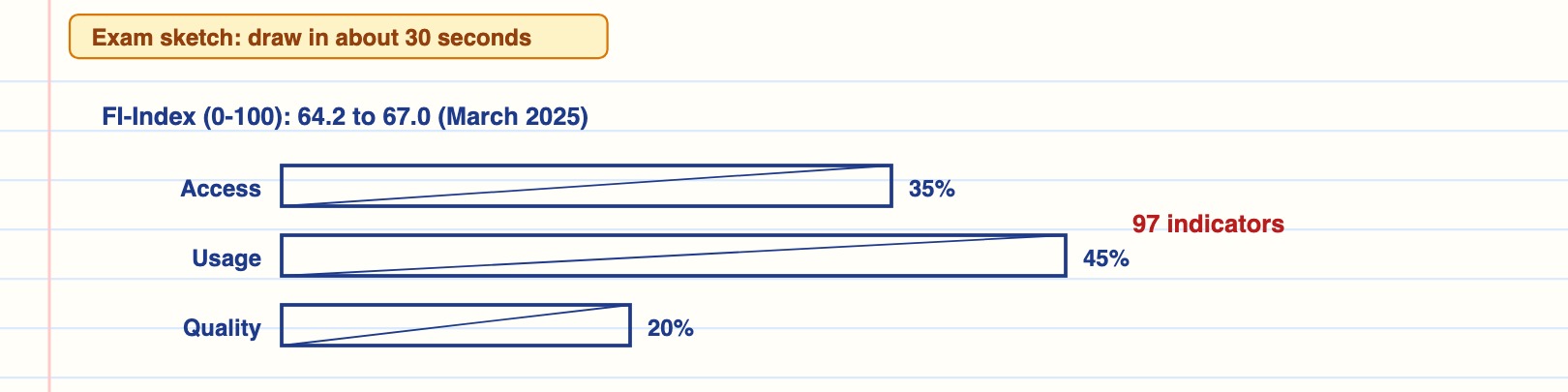
Launched in 2021, it uses 97 indicators on a 0-100 scale across banking, investment, insurance, postal and pension services.
Its sub-indices weight Usage (45%) above Access (35%) and Quality (20%), so it tracks real use, not just reach. It rose from 64.2 to 67.0 by March 2025.
✏️ Draw this here in your answer (about 30 seconds): three bars for the FI-Index weights.
Inclusion is integral, and the index helps target the remaining gaps in usage and quality.
151 words.
Why it scores
Part | What it does |
Definition and SDG link | Sets the frame and gives one authoritative figure |
Economic and social headings | Mirror the question's own words: 'social and economic inclusion' |
A limit | 'Examine' needs a test; account ownership is not usage |
Index details | Year, indicators, scale, weights, latest value: five checkable facts in two lines |
Close | One line answering both demands |
GS III Model Answer 2: Community Participation in Disaster Management
Answer 2: GS III 2026, Question 18 (15 marks, 250 words)
📝 Question: "Community participation is the cornerstone of effective disaster management". Analyse this statement with suitable examples from India. Also discuss the challenges to community participation and measures to strengthen it.
Plan (from article 02): analysis with examples, challenges, measures. Budget 35 / 85 / 50 / 55 / 25.
⏱️ 11-minute plan: 1 min to plan, 8 min to write, 1 min for the sketch, 1 min to check every demand.
The model answer
Disasters strike locally, so the first response is local. The Sendai Framework (2015-2030), with which India aligned its National Disaster Management Plan in June 2016, calls for all-of-society engagement.
Why community is the cornerstone
First responders: trained volunteers under Aapda Mitra and Yuva Aapda Mitra act before outside teams arrive.
Preparedness saves lives: the Union Home Minister has contrasted about 10,000 deaths in the 1999 Odisha super cyclone with one death in Cyclone Fani (2019).
Local plans: Ahmedabad made India's first city heat action plan in 2013, a model of planning at the level where people live.
✏️ Draw this here in your answer (about 30 seconds): the disaster cycle with the community at the centre.
Challenges
Spending is still largely relief-centric, as the Rajya Sabha committee noted in 2026.
Village plans are often not updated or linked to district plans.
Vulnerable groups (women, the elderly, persons with disabilities) are left out.
Urban institutions lag: only one state has set up an Urban Disaster Management Authority under the 2025 amendment.
Measures
Expand and equip Aapda Mitra.
Update Village Disaster Management Plans and integrate them with district and state plans.
Give vulnerable groups targeted provisions.
Set up UDMAs and shift spending towards mitigation.
With states bearing the main responsibility, communities must be partners in planning, not only beneficiaries of relief.
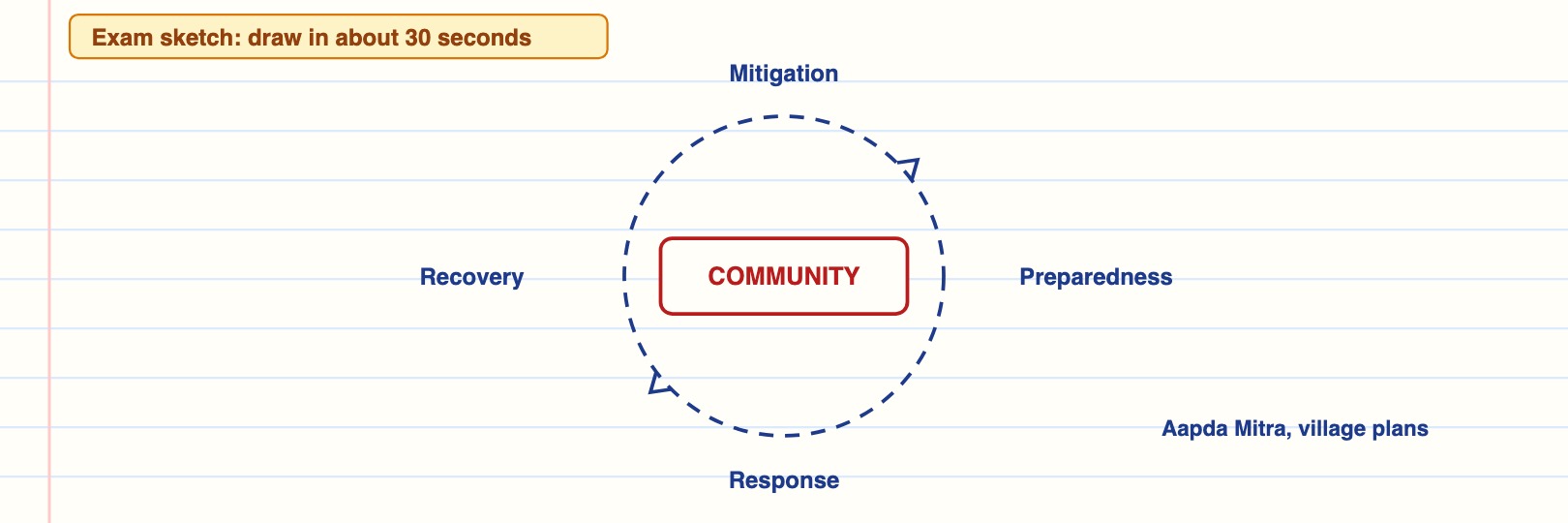
About 210 words, leaving a minute for a 30-second cycle diagram (mitigation → preparedness → response → recovery, with "community" at the centre) which can sit beside the first list.
Why it scores
Part | What it does |
Introduction | A plain truth (the first hour is local) plus the global and national frame (Sendai, NDMP 2016) |
Indian examples | Three, as the question asks for 'suitable examples from India': volunteers, cyclones, heat plans |
Source attribution | The Fani comparison is credited to the Home Minister, not stated as the candidate's own figure |
Challenges from a 2026 committee report | Shows currency and an official source |
Measures mirror challenges | Each challenge has a matching measure |
Conclusion | Links back to the statement: partner, not beneficiary |
What to Reuse, and Your Turn
What to reuse from these two answers
Use the latest official number, with its date. "67.0 by March 2025" is better than "the index has improved".
Credit claims to their source when they come from a speech or a report.
Test the view. Even when you agree, one limit (ownership is not use) shows judgment.
Make challenges and measures a matching pair. The examiner reads them side by side.
Use a committee report for 'challenges'. Parliamentary committees state problems plainly, and they are citable.
Your turn
GS III 2026, Q20: "Discuss counterfeit currency and money laundering as major sources of terror funding in India ... Highlight the role of Financial Action Task Force (FATF) ..." (Internal Security playlist, article 03.)
GS III 2026, Q11: "Explain the key challenges for India's energy security. What measures do you suggest ...?" (Economy and Environment playlists.)
Further Reading
PIB press releases, ministry websites and annual reports, the Gazette of India, MEA and UN documents and the official sources named in each note — the primary sources behind every fact above.
Test Yourself: Practice Questions & PYQs
12 questions on the two model answers, then the real questions.
Practice Questions
Q1. The RBI's FI-Index stood at what value for the year ending March 2025?
(a) 64.2
(b) 67.0
(c) 53.9
(d) 89.0
Show answer
Answer: (b) — Up from 64.2 in March 2024.
Q2. The FI-Index was launched in
(a) 2017
(b) 2014
(c) 2021
(d) 2024
Show answer
Answer: (c) — It has risen 24.3 per cent since then.
Q3. The FI-Index is based on how many indicators?
(a) 97
(b) 52
(c) 17
(d) 26
Show answer
Answer: (a) — Access has 26 and Usage 52 of them.
Q4. Which FI-Index sub-index has the highest weight?
(a) All equal
(b) Quality, 20%
(c) Access, 35%
(d) Usage, 45%
Show answer
Answer: (d) — The index stresses actual use of services.
Q5. Financial inclusion is a key enabler for how many of the 17 SDGs?
(a) 17
(b) 12
(c) 7
(d) 3
Show answer
Answer: (c) — As cited in the 2025 release on the index.
Q6. Account ownership in India, according to the Global Findex 2025, has reached
(a) 54%
(b) 100%
(c) 67%
(d) 89%
Show answer
Answer: (d) — Ownership is not the same as active use.
Q7. Consider the following statements:
1. Jan Dhan has opened over 54 crore accounts.
2. 68% of MUDRA loans have gone to women.
3. PMSBY covers over 100 crore people.
Which of the statements given above are correct?
(a) 1 and 2 only
(b) 2 and 3 only
(c) 1 and 3 only
(d) 1, 2 and 3
Show answer
Answer: (a) — 1 and 2 are correct. PMSBY covers about 49 crore.
Q8. India aligned its National Disaster Management Plan with the Sendai Framework in
(a) June 2016
(b) March 2015
(c) April 2025
(d) June 2019
Show answer
Answer: (a) — One of the first countries to do so.
Q9. Aapda Mitra and Yuva Aapda Mitra are
(a) NDRF battalions
(b) insurance schemes
(c) community volunteer schemes for disaster response
(d) early-warning satellites
Show answer
Answer: (c) — The 2026 committee report wants them expanded.
Q10. India's first city heat action plan was made in
(a) Ahmedabad, 2013
(b) Pune, 2019
(c) Delhi, 2016
(d) Chennai, 2015
Show answer
Answer: (a) — A standard example for heat-wave and urban resilience answers.
Q11. The 2026 Rajya Sabha committee found that disaster-related spending remains
(a) largely relief-centric
(b) unchanged since 2005
(c) entirely central
(d) mainly on mitigation
Show answer
Answer: (a) — It recommends a shift towards mitigation.
Q12. Under the DM (Amendment) Act 2025, Urban Disaster Management Authorities are for
(a) coastal districts only
(b) union territories only
(c) state capitals and cities with municipal corporations
(d) every village
Show answer
Answer: (c) — By 2026 only one state had constituted one.
Mains Practice Questions
Use these to frame full-length answers. You don't have to answer one exactly — they show the angles UPSC tests, so let them guide which points you cover.
Draw the disaster management cycle with community at the centre in 30 seconds.
Write GS III 2026 Q20 on terror funding in 11 minutes and mark it with article 08.
Which figure in Answer 1 would you update first next year, and from which source?
UPSC Mains — Previous Years’ Questions on this topic (last 10 years)
These are the actual GS Mains questions UPSC has asked on this theme — real proof of how, and when, it is tested. Try to write a full answer to each.
2026 (GS-III): Examine the view that financial inclusion is an integral part of social and economic inclusion in a country like India. Also throw light on the usefulness of the R.B.I.'s Financial Inclusion Index.
2026 (GS-III): "Community participation is the cornerstone of effective disaster management". Analyse this statement with suitable examples from India. Also discuss the challenges to community participation and measures to strengthen it.