GS II Model Answers: The Speaker and Anti-defection, and the Governor's Assent Power (2026), with Notes on Why Each Part Scores
GS II Model Answer 1: The Speaker and Anti-defection
🎯 Exam priority: High-yield. GS II questions reward exact Articles and judgments. Notice how each point below carries its legal anchor.
Answer 1: GS II 2026, Question 3 (10 marks, 150 words)
📝 Question: Examine whether the constitutional office of the Lok Sabha Speaker has become vulnerable to partisan politics under the current anti-defection regime. What institutional changes are required to ensure the neutrality of the Lok Sabha Speaker in managing a polarised House?
Plan: two demands: 'examine whether vulnerable' (needs a finding) and 'institutional changes'. Budget about 20 / 75 / 45 / 10.
⏱️ 7-minute plan: 1 min to read and number the demands, 4½ min to write, ½ min for the sketch, 1 min to check that every demand is answered.
The model answer
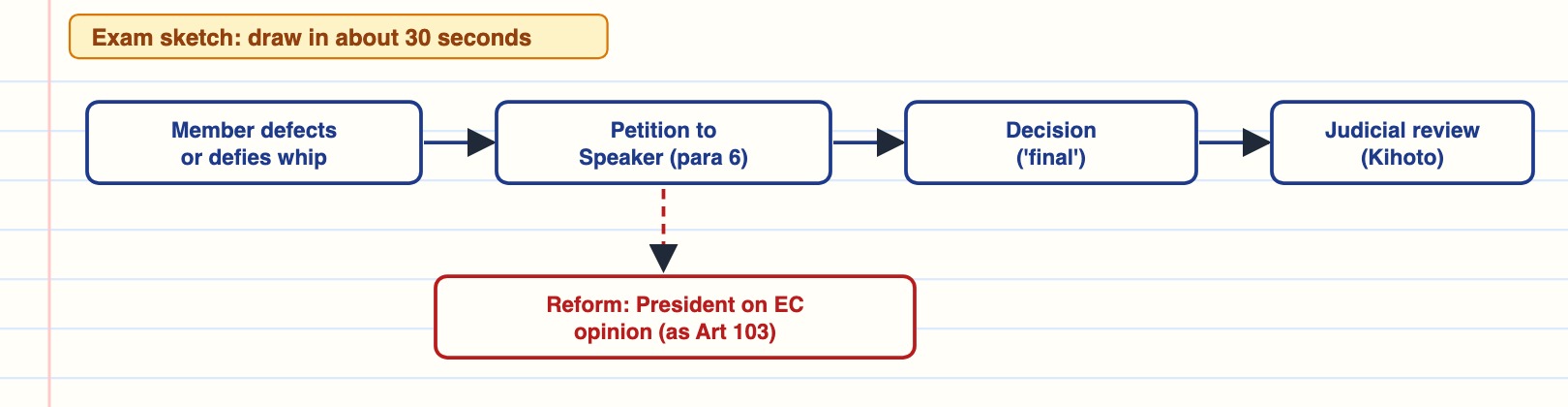
Paragraph 6 of the Tenth Schedule makes the Speaker the final authority on disqualification for defection, which places a party member in a judge's role.
Why the office has become vulnerable
Unlike in Britain, Indian Speakers do not resign from their party, so their rulings can be seen as partisan.
The Speaker acts as a tribunal but may lack legal expertise; Speakers Rabi Ray (1991) and Shivraj Patil (1993) doubted their own suitability.
Judicial review, available after Kihoto Hollohon, covers only mala fides or perversity and comes after the decision.
✏️ Draw this here in your answer (about 30 seconds): the defection case as a flowchart, with the reform in red.
Safeguards exist: removal needs an effective majority, and the salary is charged on the Consolidated Fund.
Institutional changes
Shift defection cases to the President acting on the Election Commission's opinion, as Article 103 does for other disqualifications.
Set a time limit for deciding petitions.
Build the British convention of a non-party Speaker.
A neutral Speaker protects both the House and the law against defection.
154 words: a few words over is acceptable; far over costs time on later questions.
Why it scores
Part | What it does |
Opening | Names the exact provision (Tenth Schedule, paragraph 6) and the core tension in one line |
'Vulnerable' with evidence | Three reasons, each with support: the British comparison, the two Speakers, the limits of judicial review |
Counterpoint | One line on existing safeguards keeps the 'examine' balanced |
Changes tied to problems | Each reform answers a weakness named above; Article 103 gives a constitutional model |
Close | One line linking neutrality to the House's functioning |
GS II Model Answer 2: The Governor and Assent
Answer 2: GS II 2026 (15 marks, 250 words)
📝 Question: Discuss the position of the Governor in the federal polity of India. What is the nature of his power while giving assent to a bill passed by the State Legislature? Is he bound by the aid and advice of his Council of Ministers in all his functions?
Plan: three demands: position (discuss), assent (nature of power), aid and advice (a yes/no answer with reasons). Budget 30 / 70 / 75 / 55 / 20.
⏱️ 11-minute plan: 1 min to plan, 8 min to write, 1 min for the sketch, 1 min to check every demand.
The model answer
The Governor is the constitutional head of a state, appointed by the President (Article 155) and holding office during the President's pleasure (Article 156). The office therefore has a dual role: head of the state and agent of the Centre.
Position in the federal polity
In Hargovind Pant (1979) the Supreme Court held that the office is not employment under the Centre but an independent constitutional office.
The pleasure tenure and the discretion to reserve Bills or recommend President's Rule make it the most debated link in Centre-state relations.
Nature of the assent power (Article 200)
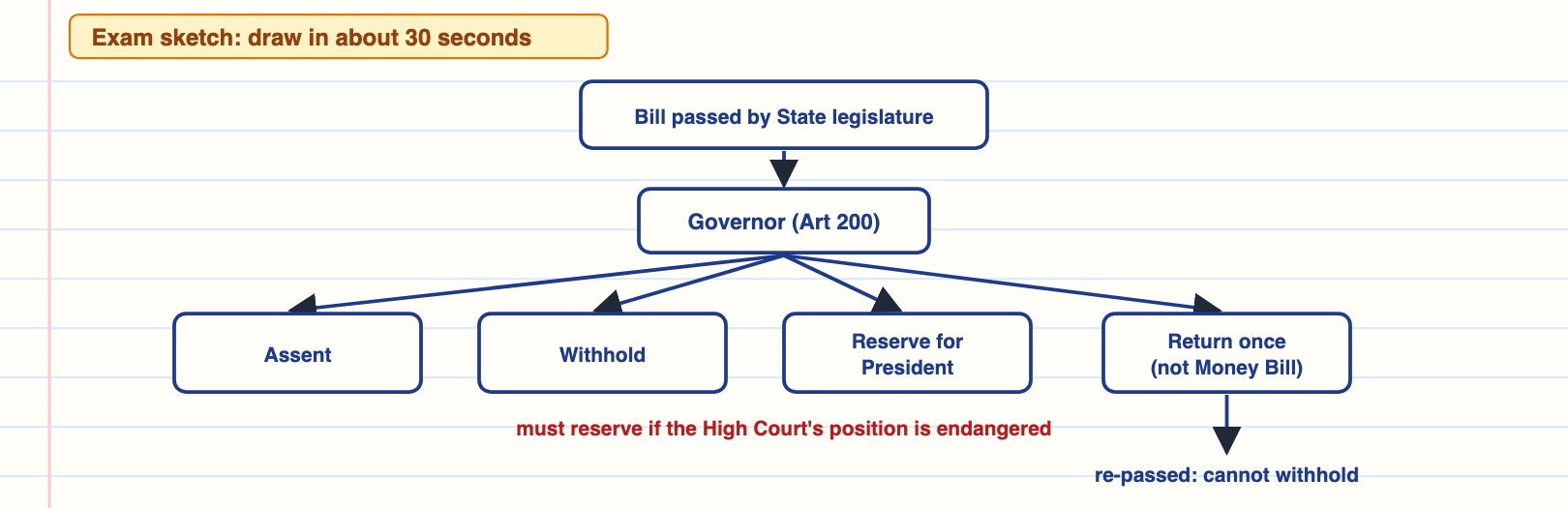
The Governor may assent, withhold assent, reserve the Bill for the President, or return a non-Money Bill once for reconsideration. If the House passes it again, assent cannot be withheld.
A Bill that would endanger the High Court's position must be reserved.
After the 8 April 2025 Tamil Nadu judgment set timelines, the Court's November 2025 opinion on the Presidential Reference held that courts cannot fix timelines and that there is no 'deemed assent'. Courts may intervene only, in a limited way, for inordinate and unexplained delay.
✏️ Draw this here in your answer (about 30 seconds): Article 200's options as a tree saves about 40 words.
Bound by aid and advice in all functions? No.
Article 163(1) excepts functions the Constitution requires him to exercise in his discretion, and under 163(2) his decision on what is discretionary is final.
Constitutional discretion covers reserving Bills and recommending President's Rule. Situational discretion covers, for example, appointing a Chief Minister when no party has a majority.
Outside these areas the Governor acts on ministerial advice. Conventions of restraint in using discretion keep cooperative federalism working.
259 words.
Why it scores
Part | What it does |
Introduction | Two Articles and the 'dual role' frame in three lines |
Three headings | One per demand; the third heading answers the yes/no question in the heading itself |
Article 200 options | All four options and both provisos: precision the examiner can check |
2025 developments | Shows currency: the April 2025 judgment and the November 2025 opinion |
Discretion types | Constitutional versus situational, with one example each |
Conclusion | Links to cooperative federalism without new facts |
A weaker version lists the Governor's powers (executive, legislative, financial, judicial) from the textbook and never says whether he is bound in all functions. Three demands, one answered.
What to Reuse, and Your Turn
What to reuse from these two answers
Anchor every polity point to an Article, a Schedule paragraph or a judgment. "Article 163(1) excepts discretionary functions" beats "the Governor has some discretion".
Put the direct answer in the heading when the question asks yes or no ("Bound ... in all his functions? No.").
Show you are current. One line on the latest judgment or reference opinion lifts a static answer.
Make reforms answer problems. Each change in Answer 1 fixes a weakness listed above it.
Borrow a model from elsewhere in the Constitution (Article 103 for disqualification) or from another democracy (the British Speaker) to make suggestions concrete.
Your turn
GS II 2026: "Is the right to vote a fundamental right? Discuss the position of the Election Commission of India while undertaking the revision of electoral rolls ..." (Polity playlist: elections and the Election Commission.)
GS II 2026: "How far has the Indian federal framework been successful in accommodating regional and cultural diversities? Highlight the role of asymmetric federalism ..." (Polity playlist: federalism and special provisions.)
Further Reading
PIB press releases, ministry websites and annual reports, the Gazette of India, MEA and UN documents and the official sources named in each note — the primary sources behind every fact above.
Test Yourself: Practice Questions & PYQs
12 questions on the two model answers, then the real questions.
Practice Questions
Q1. Who decides whether a member of a House is disqualified for defection under the Tenth Schedule?
(a) The Governor
(b) The Supreme Court
(c) The Speaker or Chairman
(d) The President on the EC's advice
Show answer
Answer: (c) — Paragraph 6; the decision is final, subject to judicial review.
Q2. In Kihoto Hollohon, the Speaker's decision under the Tenth Schedule was held to be
(a) subject to appeal to the President
(b) advisory only
(c) completely immune from courts
(d) subject to judicial review on grounds such as mala fides and perversity
Show answer
Answer: (d) — The Speaker acts as a tribunal.
Q3. Under Article 103, other disqualifications of MPs are decided by
(a) a parliamentary committee
(b) the President, acting on the Election Commission's opinion
(c) the Chief Justice
(d) the Speaker
Show answer
Answer: (b) — A model often suggested for defection cases too.
Q4. The Speaker can be removed by a resolution passed by
(a) a simple majority of members present
(b) two-thirds of both Houses
(c) the President
(d) a majority of all the then members of the Lok Sabha
Show answer
Answer: (d) — An effective majority, after 14 days' notice.
Q5. The Governor holds office
(a) for a fixed five years that cannot be cut short
(b) during the pleasure of the President
(c) until the Chief Minister advises removal
(d) during the pleasure of the state legislature
Show answer
Answer: (b) — Article 156(1).
Q6. Hargovind Pant (1979) held that the Governor's office is
(a) an independent constitutional office, not employment under the Centre
(b) subordinate to the Chief Minister
(c) a central government post
(d) an elected office
Show answer
Answer: (a) — It is a key line for 'position in the federal polity'.
Q7. If a state legislature passes a returned Bill again, the Governor
(a) may withhold assent again
(b) must dissolve the House
(c) cannot withhold assent
(d) must refer it to the Supreme Court
Show answer
Answer: (c) — First proviso to Article 200; he may still reserve it.
Q8. Which Bill must a Governor reserve for the President under Article 200?
(a) Every Bill on List II
(b) One that would endanger the High Court's position
(c) Any Bill opposed by the Opposition
(d) Every Money Bill
Show answer
Answer: (b) — Second proviso to Article 200.
Q9. Consider the following statements:
1. The November 2025 opinion held that courts cannot fix timelines for assent.
2. It accepted the idea of deemed assent.
3. It allowed limited judicial intervention for inordinate and unexplained delay.
Which of the statements given above are correct?
(a) 1 and 2 only
(b) 2 and 3 only
(c) 1 and 3 only
(d) 1, 2 and 3
Show answer
Answer: (c) — 1 and 3 are correct. Deemed assent was rejected.
Q10. Which of these is constitutional (express) discretion of the Governor?
(a) Recommending President's Rule
(b) Appointing a Chief Minister after a hung verdict
(c) Dismissing a ministry that has lost confidence
(d) Dissolving an assembly after a defeat
Show answer
Answer: (a) — The others are situational discretion.
Q11. Under Article 163(2), if a question arises whether a matter is discretionary,
(a) the High Court decides
(b) the Governor's decision is final
(c) the President decides
(d) the Chief Minister decides
Show answer
Answer: (b) — And it cannot be questioned on that ground.
Q12. A yes/no sub-question in a Mains question is best handled by
(a) answering only in the conclusion
(b) stating the answer in the heading and then giving reasons
(c) avoiding a direct answer
(d) repeating the question
Show answer
Answer: (b) — The examiner finds the answer instantly.
Mains Practice Questions
Use these to frame full-length answers. You don't have to answer one exactly — they show the angles UPSC tests, so let them guide which points you cover.
Rewrite Answer 1 with a flowchart of a defection case instead of the first list.
Write the 2026 right-to-vote question in 11 minutes and mark it with article 08.
Which line in Answer 2 shows currency, and what would you replace it with in 2027?
UPSC Mains — Previous Years’ Questions on this topic (last 10 years)
These are the actual GS Mains questions UPSC has asked on this theme — real proof of how, and when, it is tested. Try to write a full answer to each.
2026 (GS-II): Examine whether the constitutional office of the Lok Sabha Speaker has become vulnerable to partisan politics under the current anti-defection regime. What institutional changes are required to ensure the neutrality of the Lok Sabha Speaker in managing a polarised House?
2026 (GS-II): Discuss the position of the Governor in the federal polity of India. What is the nature of his power while giving assent to a bill passed by the State Legislature? Is he bound by the aid and advice of his Council of Ministers in all his functions?