Nutrition for NEET PG PSM: ICMR-NIN 2020 RDA and EAR, Dietary Guidelines 2024, Anaemia Mukt Bharat, SAM Ten Steps, Iodine
Start Here
🎯 Exam priority: High-yield (Tier 1). Nutrition questions test numbers: RDA values (which changed in 2020), IFA doses and tablet colours, Hb cut-offs, SAM criteria and the ten steps, and iodised-salt levels. Everything here is from the ICMR-NIN 2020 requirements and 2024 dietary guidelines and from MoHFW programme guidelines. Older textbooks still carry the 2010 RDAs (e.g. protein 1 g/kg) — learn the 2020 figures.
CBME mapping: CM 5 (nutrition).
EAR and RDA: The 2020 Shift
The Estimated Average Requirement (EAR) is the median of the distribution of requirements; the RDA sits at the upper end of that distribution. EARs are usually about 80% of the RDA.
The 2020 committee recommends using the EAR for population adequacy and for diet/menu planning — using the RDA for everyone shifts intakes too high, pushing some people towards the tolerable upper limit (TUL).
Total energy expenditure = BMR × PAL. Indian PAL for sedentary work was revised down from 1.53 (2010) to 1.40, and adult BMR was reduced by a further 5% — so adult energy needs fell by 3–8 kcal/kg/day.
Group (reference weight) | Energy (kcal/day) | Protein RDA (g/day) |
Man, sedentary (65 kg) | 2110 | 54 (0.83 g/kg) |
Man, moderate (65 kg) | 2710 | 54 |
Man, heavy (65 kg) | 3470 | 54 |
Woman, sedentary (55 kg) | 1660 | 45.7 |
Woman, moderate (55 kg) | 2130 | 45.7 |
Woman, heavy (55 kg) | 2720 | 45.7 |
Pregnancy (2nd / 3rd trimester) | +350 | +9.5 / +22 |
Lactation (0–6 / 6–12 months) | +600 / +520 | +16.9 / +13.2 |
Protein: EAR 0.66 and RDA 0.83 g/kg/day (down from 1 g/kg in 2010); for cereal-based diets with low-quality protein, 1 g/kg. Protein quality is now judged by DIAAS (based on true ileal digestibility) rather than PDCAAS.
The ideal cereal : legume : milk ratio is 3 : 1 : 2.5 (earlier 11 : 1 : 3).
Fats: limit visible fat (cooking oil) to 20–50 g/day — not more than 27 g on a 2000 kcal diet; the essential fatty acids are linoleic (n-6, about 6.6 g/day) and alpha-linolenic (n-3, about 2.2 g/day).
Nutrient (RDA 2020) | Men | Women | Change from 2010 |
Iron (mg) | 19 | 29 | up from 17 / 21 |
Calcium (mg) | 1000 | 1000 | up from 600 |
Vitamin A (µg) | 1000 | 840 | up from 600 |
Folate (µg DFE) | 300 | 220 | up from 200 |
Vitamin B12 (µg) | 2.2 | 2.2 | up from 1 |
Vitamin C (mg) | 80 | 65 | up from 40 |
Vitamin D (IU) | 600 | 600 | up from 400 |
Iodine (µg) | 150 | 150 | unchanged |
Dietary Guidelines for Indians 2024 and My Plate
ICMR-NIN's 2024 dietary guidelines give 17 guidelines. The most-tested points:
Sugar under 5% of total energy for adults; no added sugar under 2 years.
Breastfeeding within one hour of birth; colostrum is the milk of the first 3–4 days; exclusive breastfeeding for 6 months; complementary feeding soon after 6 months, with breastfeeding up to 2 years and beyond.
Pregnancy: a woman should be at least 21 years at her first pregnancy; IFA and calcium after 12 weeks, continued in lactation.
At least 400 g of vegetables a day; combine cereals and pulses 3 : 1 for better protein quality.
Added salt at most 5 g/day, and it should be iodised.
Avoid vanaspati (partially hydrogenated fat — trans fats) and repeated heating of cooking oil.
Activity: 30–45 minutes of brisk walking for adults; 60 minutes a day for children.
My Plate for the Day (about 1.2 kg of raw food, 2000 kcal; protein ≈ 15% and fat ≈ 30% of energy; sugar 25–30 g at most):
Food group (2000 kcal day) | Raw amount | % of energy |
Cereals incl. millets | 250 g | 42 |
Pulses (or egg/fish/meat) | 85 g | 14 |
Milk/curd | 300 ml | 11 |
Vegetables + green leafy vegetables | 400 g | 9 |
Fruits | 100 g | 3 |
Nuts and seeds | 35 g | 9 |
Fats and oils | 27 g | 12 |
Anaemia Mukt Bharat
Launched with a 6 × 6 × 6 strategy: six target beneficiary groups, six interventions and six institutional mechanisms.
The six interventions: (1) prophylactic IFA, (2) deworming, (3) year-round behaviour-change campaign "Solid Body, Smart Mind" — including delayed cord clamping (by 3 minutes), (4) testing and treatment with digital haemoglobinometers, (5) IFA-fortified foods in public programmes, (6) addressing non-nutritional causes (malaria, haemoglobinopathies, fluorosis) in endemic pockets.
Beneficiary | Prophylactic IFA (Anaemia Mukt Bharat) | Deworming (albendazole 400 mg) |
Children 6–59 months | IFA syrup 1 ml (20 mg iron + 100 µg folic acid) twice a week | Biannual; ½ tablet at 12–24 months, 1 tablet at 24–59 months |
Children 5–9 years | 1 pink tablet weekly (45 mg iron + 400 µg FA) | Biannual, 1 tablet |
Adolescents 10–19 years | 1 blue tablet weekly (60 mg iron + 500 µg FA) | Biannual, 1 tablet |
Women of reproductive age (non-pregnant, non-lactating) | 1 red tablet weekly (60 mg iron + 500 µg FA) | Biannual, 1 tablet |
Pregnant and lactating women | 1 red tablet daily from the 4th month — at least 180 days in pregnancy and 180 days post-partum | One dose after the first trimester |
Withhold prophylactic iron during acute illness (fever, diarrhoea, pneumonia) and in thalassaemia major or repeated transfusions.
Hb cut-offs (WHO, used by the programme):
Group | Anaemia if Hb below (g/dl) | Mild | Moderate | Severe |
Children 6–59 months | 11 | 10–10.9 | 7–9.9 | < 7 |
Children 5–11 years | 11.5 | 11–11.4 | 8–10.9 | < 8 |
Children 12–14 years | 12 | 11–11.9 | 8–10.9 | < 8 |
Non-pregnant women (≥ 15 y) | 12 | 11–11.9 | 8–10.9 | < 8 |
Pregnant women | 11 | 10–10.9 | 7–9.9 | < 7 |
Men (≥ 15 y) | 13 | 11–12.9 | 8–10.9 | < 8 |
Severe Acute Malnutrition (SAM)
SAM in children 6–59 months = any one of: weight-for-height below −3 SD of the WHO standards, MUAC < 115 mm, or bilateral pitting oedema.
SAM with a medical complication — anorexia, fever ≥ 39 °C or hypothermia < 35 °C, persistent vomiting, severe dehydration, lethargy or convulsions, hypoglycaemia, severe anaemia, severe pneumonia — needs admission to a Nutrition Rehabilitation Centre (NRC); grade +++ oedema always needs in-patient care.
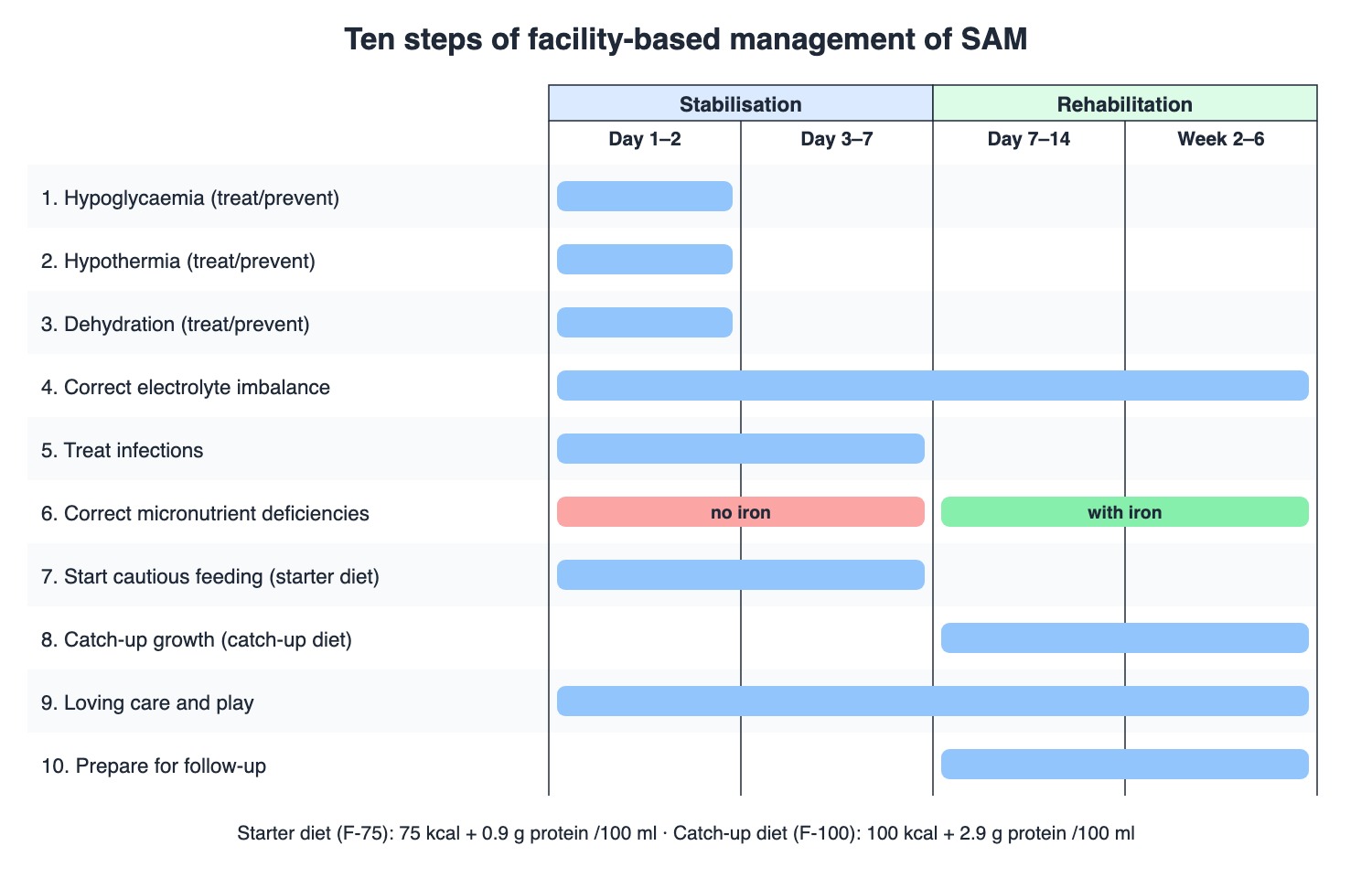
The ten steps: hypoglycaemia, hypothermia and dehydration are tackled in days 1–2; iron is withheld until the rehabilitation phase.
Starter diet (F-75): 75 kcal and 0.9 g protein per 100 ml, 8–12 feeds a day — low protein and sodium, high carbohydrate.
Catch-up diet (F-100): 100 kcal and 2.9 g protein per 100 ml, for rapid weight gain once appetite returns.
Vitamin A on admission: 50,000 IU under 6 months; 1 lakh IU at 6–12 months (or weight < 8 kg); 2 lakh IU over 12 months — repeated on days 2 and 14 if there are eye signs.
Discharge: 15% weight gain, oedema resolved, weight gain > 5 g/kg/day for 3 consecutive days, and no illness.
Iodine Deficiency Disorders
The National Goitre Control Programme (1962) was renamed the NIDDCP in August 1992.
Iodised salt must contain at least 30 ppm iodine at manufacture and 15 ppm at consumer level.
Goals: IDD prevalence below 5% and 100% household use of adequately iodised salt (15 ppm); districts are resurveyed every 5 years; urinary iodine excretion and salt iodine are monitored in laboratories.
The adult RDA for iodine is 150 µg/day.
Traps the Examiner Sets
Protein RDA is now 0.83 g/kg, not 1 g/kg; iron RDA is 19 mg (men) and 29 mg (women); calcium 1000 mg.
EAR = median requirement (≈ 80% of the RDA) and is the figure to use for population adequacy.
IFA tablet colours: pink 5–9 years, blue adolescents, red women (weekly) and pregnancy (daily).
Under-fives get IFA syrup twice a week, not daily.
Anaemia in pregnancy: Hb < 11; severe < 7 (not < 8).
SAM: MUAC < 115 mm (not 125 mm); no iron during stabilisation.
Salt iodine: 30 ppm at production, 15 ppm at the household.
Rapid-Revision Cards
EAR vs RDA
EAR = median requirement (≈ 80% of RDA), used for population adequacy; RDA at the upper end of the distribution.
Protein RDA 2020
0.83 g/kg/day (EAR 0.66); was 1 g/kg in 2010.
Energy, sedentary man / woman
2110 / 1660 kcal/day (65 / 55 kg).
Extra energy, pregnancy / lactation
+350 / +600 (0–6 m), +520 (6–12 m) kcal/day.
Iron RDA 2020
Men 19 mg, women 29 mg.
Calcium RDA 2020
1000 mg (was 600).
Cereal : legume : milk
3 : 1 : 2.5.
Visible fat
20–50 g/day; ≤ 27 g on 2000 kcal.
Salt / sugar limits (DGI 2024)
Salt ≤ 5 g/day; sugar < 5% energy; no added sugar < 2 years.
My Plate (2000 kcal)
Cereals 250 g, pulses 85 g, milk 300 ml, veg 400 g, fruit 100 g, nuts 35 g, oil 27 g.
AMB strategy
6 × 6 × 6: beneficiaries, interventions, institutional mechanisms.
IFA under-fives
1 ml syrup twice weekly (20 mg Fe + 100 µg FA per ml).
IFA tablet colours
Pink 5–9 y (45 mg); blue adolescents (60 mg); red women and pregnancy (60 mg).
IFA in pregnancy
Daily from 4th month, ≥ 180 days + 180 days post-partum.
Severe anaemia
Hb < 7 (under-fives, pregnancy); < 8 (others).
SAM definition
WFH < −3 SD or MUAC < 115 mm or bilateral pitting oedema.
F-75 / F-100
75 kcal + 0.9 g protein / 100 kcal + 2.9 g protein per 100 ml.
SAM discharge
15% weight gain, no oedema, > 5 g/kg/day × 3 days.
Iodised salt
≥ 30 ppm at manufacture; ≥ 15 ppm at consumer.
NGCP → NIDDCP
1962 → August 1992.
Sources
Sources
Facts in this article were checked against these documents.
A Brief Note on Nutrient Requirements for Indians, the RDA and EAR (ICMR-NIN 2020) — ICMR-National Institute of Nutrition, 2020 (link)
Dietary Guidelines for Indians — booklet — ICMR-National Institute of Nutrition, 2024 (link)
My Plate for the Day — ICMR-National Institute of Nutrition, 2018 (link)
Anemia Mukt Bharat: Intensified National Iron Plus Initiative — Operational Guidelines — MoHFW, 2018 (link)
Operational Guidelines on Facility Based Management of Children with Severe Acute Malnutrition — MoHFW, 2011 (link)
National Iodine Deficiency Disorders Control Programme — Dte.GHS, MoHFW, n.d. (link)
IDD & Nutrition Cell — MoHFW, n.d. (link)
Test Yourself: Practice Questions
Twenty questions in NEET PG style.
Practice Questions (NEET PG pattern)
Original questions written in the style of the exam: +4 for a correct answer, −1 for a wrong one. Every answer was checked against the sources listed above. NEET PG papers are not published by NBEMS, so these are not past-paper questions.
Q1. According to ICMR-NIN 2020, the RDA for protein for a healthy Indian adult is
(a) 1.2 g/kg/day
(b) 1.0 g/kg/day
(c) 0.66 g/kg/day
(d) 0.83 g/kg/day
Show answer
Answer: (d) — RDA 0.83 g/kg/day (EAR 0.66); the 2010 value was 1 g/kg/day.
Q2. The Estimated Average Requirement (EAR) of a nutrient is
(a) the average intake of the population
(b) the 97.5th percentile of requirements
(c) the median of the distribution of requirements
(d) the tolerable upper limit
Show answer
Answer: (c) — EAR is the median requirement; EARs are usually about 80% of the RDA.
Q3. For assessing the adequacy of a population's diet, ICMR-NIN 2020 recommends using
(a) RDA
(b) EAR
(c) Adequate intake
(d) TUL
Show answer
Answer: (b) — Using the RDA as the target shifts intakes too high; the EAR is recommended for population adequacy and diet planning.
Q4. The energy requirement of a sedentary Indian man (65 kg) under ICMR-NIN 2020 is
(a) 1660 kcal/day
(b) 2110 kcal/day
(c) 2710 kcal/day
(d) 2320 kcal/day
Show answer
Answer: (b) — 2110 kcal/day (2320 in 2010); 2710 is moderate work; 1660 is a sedentary woman.
Q5. The additional energy recommended during pregnancy is
(a) +600 kcal/day
(b) +350 kcal/day
(c) +150 kcal/day
(d) +520 kcal/day
Show answer
Answer: (b) — Pregnancy +350 kcal/day; lactation +600 (0–6 months) and +520 (6–12 months).
Q6. The RDA of iron for an adult Indian woman (ICMR-NIN 2020) is
(a) 35 mg/day
(b) 29 mg/day
(c) 19 mg/day
(d) 21 mg/day
Show answer
Answer: (b) — Women 29 mg (21 in 2010); men 19 mg (17 in 2010).
Q7. The cereal : legume : milk ratio recommended for good protein quality is
(a) 11 : 1 : 3
(b) 2 : 1 : 1
(c) 3 : 1 : 2.5
(d) 4 : 1 : 1
Show answer
Answer: (c) — 3 : 1 : 2.5 (2020); 11 : 1 : 3 was the 2010 composition.
Q8. On a 2000 kcal diet, ICMR-NIN advises visible fat (cooking oil) of not more than
(a) 27 g/day
(b) 50 g/day
(c) 60 g/day
(d) 10 g/day
Show answer
Answer: (a) — Visible fat 20–50 g/day by energy level; not more than 27 g for a 2000 kcal diet.
Q9. The Dietary Guidelines for Indians (2024) limit added salt to a maximum of
(a) 5 g/day
(b) 10 g/day
(c) 2 g/day
(d) 8 g/day
Show answer
Answer: (a) — Restrict added salt to a maximum of 5 g/day and use iodised salt.
Q10. Under Anaemia Mukt Bharat, children aged 6–59 months receive
(a) one pink tablet weekly
(b) 1 ml IFA syrup daily
(c) one blue tablet weekly
(d) 1 ml IFA syrup twice a week
Show answer
Answer: (d) — Biweekly 1 ml IFA syrup (20 mg elemental iron + 100 µg folic acid per ml).
Q11. The weekly IFA tablet for school-going adolescents (10–19 years) under Anaemia Mukt Bharat is
(a) blue, 60 mg iron + 500 µg folic acid
(b) pink, 45 mg iron + 400 µg folic acid
(c) white, 20 mg iron + 100 µg folic acid
(d) red, 100 mg iron + 500 µg folic acid
Show answer
Answer: (a) — Blue tablet weekly for adolescents; pink (45 mg + 400 µg) for 5–9 years; red for women.
Q12. Prophylactic IFA for a pregnant woman under Anaemia Mukt Bharat is
(a) one tablet weekly throughout pregnancy
(b) one tablet daily from the 4th month, for at least 180 days, continued 180 days post-partum
(c) one tablet daily for 100 days only
(d) two tablets daily from the first trimester
Show answer
Answer: (b) — Daily IFA (60 mg iron + 500 µg FA) from the second trimester, minimum 180 days in pregnancy and 180 days post-partum.
Q13. Severe anaemia in a pregnant woman is defined as haemoglobin below
(a) 8 g/dl
(b) 10 g/dl
(c) 9 g/dl
(d) 7 g/dl
Show answer
Answer: (d) — Pregnant women: mild 10–10.9, moderate 7–9.9, severe < 7 g/dl.
Q14. Which behaviour is promoted under Anaemia Mukt Bharat to improve infants' iron stores?
(a) Routine iron drops from birth
(b) Cow's milk from 6 months
(c) Early cord clamping within 30 seconds
(d) Delayed cord clamping by 3 minutes
Show answer
Answer: (d) — The BCC campaign includes ensuring delayed cord clamping (by 3 minutes) after delivery in facilities.
Q15. A 2-year-old is admitted to an NRC. Which finding alone defines severe acute malnutrition?
(a) MUAC of 120 mm
(b) Height-for-age below −3 SD
(c) Weight-for-age below −2 SD
(d) MUAC of 110 mm
Show answer
Answer: (d) — SAM: WFH < −3 SD, MUAC < 115 mm, or bilateral pitting oedema. Height-for-age reflects stunting, weight-for-age underweight.
Q16. In the ten steps of SAM management, iron is
(a) never given
(b) given only at discharge
(c) started on day 1
(d) withheld during stabilisation and started in rehabilitation
Show answer
Answer: (d) — Micronutrients are corrected throughout, but with no iron in stabilisation and with iron in rehabilitation.
Q17. The starter diet (F-75) for SAM provides per 100 ml
(a) 75 kcal and 0.9 g protein
(b) 100 kcal and 2.9 g protein
(c) 75 kcal and 2.9 g protein
(d) 100 kcal and 0.9 g protein
Show answer
Answer: (a) — F-75: 75 kcal, 0.9 g protein /100 ml; catch-up F-100: 100 kcal, 2.9 g protein /100 ml.
Q18. A child with SAM is discharged from the NRC after achieving
(a) 15% weight gain with oedema resolved
(b) 5% weight gain
(c) two weeks of stay regardless of weight
(d) MUAC of 115 mm
Show answer
Answer: (a) — Discharge: 15% weight gain, no oedema, > 5 g/kg/day gain for 3 consecutive days, and no illness.
Q19. The minimum iodine content of iodised salt at the consumer level is
(a) 5 ppm
(b) 15 ppm
(c) 50 ppm
(d) 30 ppm
Show answer
Answer: (b) — At least 30 ppm at manufacture and 15 ppm at consumption.
Q20. The National Goitre Control Programme, launched in 1962, was renamed NIDDCP in
(a) 1992
(b) 2002
(c) 1985
(d) 1975
Show answer
Answer: (a) — NGCP (1962) became NIDDCP in August 1992.
Active Recall
From memory: define EAR and RDA and give the 2020 protein RDA, energy for a sedentary man and the extra energy in pregnancy; state the iron RDAs; list Anaemia Mukt Bharat IFA doses by age group with tablet colours and the Hb cut-offs for severe anaemia; define SAM, name the ten steps and the starter and catch-up diets with discharge criteria; and give the iodised-salt standards.