Immunization for NEET PG PSM: India's UIP Schedule (2024), Cold Chain, Open Vial Policy, AEFI and the 2026 HPV Campaign
Start Here
🎯 Exam priority: High-yield (Tier 1). Recent papers regularly ask the schedule, new vaccines, and catch-up or cold-chain scenarios. Everything here comes from the Ministry of Health's Routine Immunization Manual for Medical Officers (September 2024) and the HPV campaign guidelines (February 2026) — not from older handbooks, which miss the 2023 third fIPV dose.
CBME mapping: CM 8, CM 10.
The National Immunization Schedule
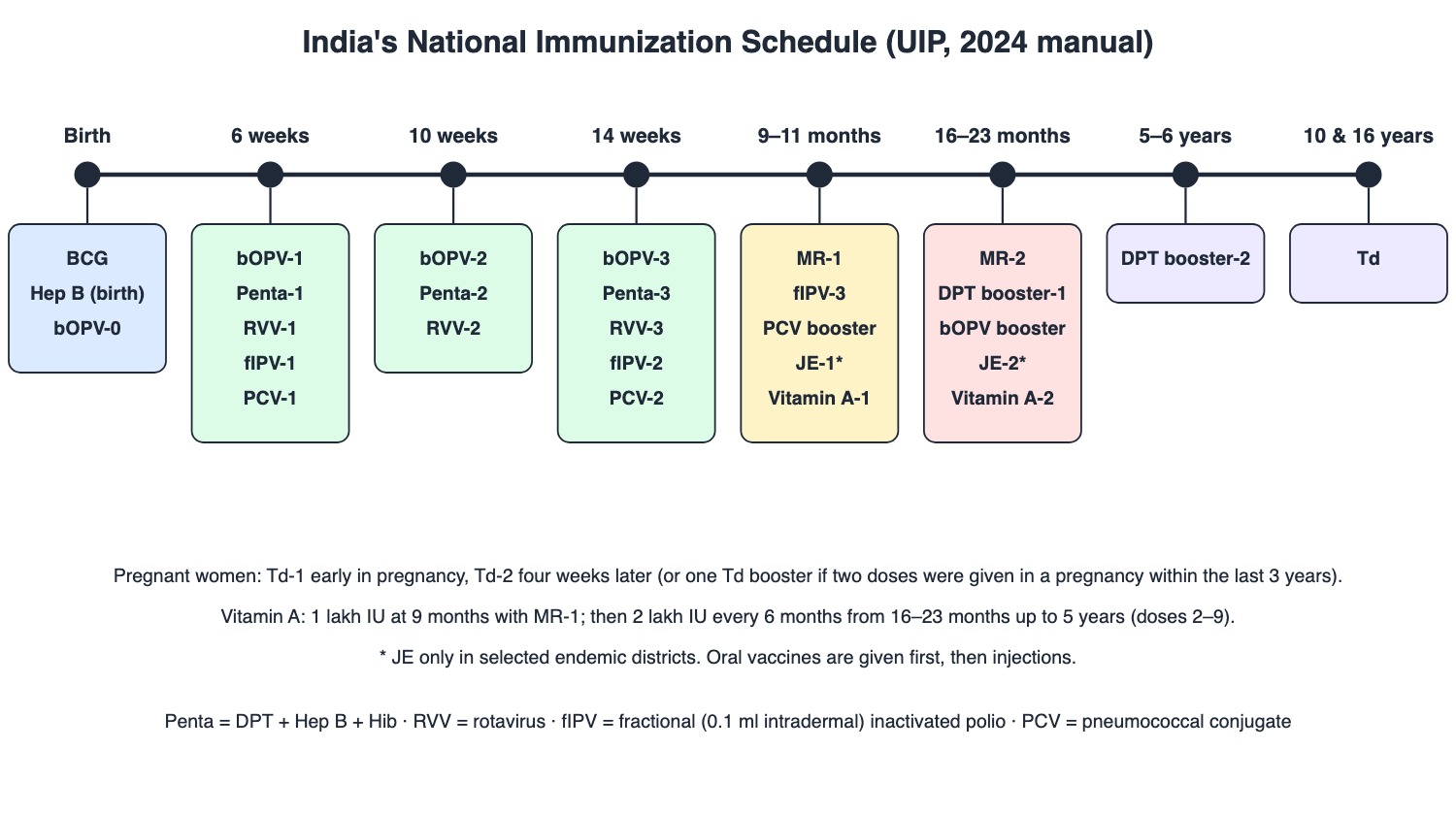
India's National Immunization Schedule as given in the 2024 Routine Immunization Manual (Table 3.1). Ages are in completed weeks, months or years.
Vaccine | Age | Dose · route | Site |
BCG | Birth (up to 1 year) | 0.05 ml up to 1 month, 0.1 ml after · intradermal | Left upper arm (deltoid) |
Hep B birth dose | Within 24 hours of birth | 0.5 ml · IM | Left anterolateral thigh |
bOPV-0; bOPV 1–3 | Birth (within 15 days); 6, 10, 14 weeks | 2 drops · oral | Mouth |
Rotavirus 1–3 | 6, 10, 14 weeks (up to 1 year) | 5 drops or 2 ml (by formulation) · oral | Mouth |
fIPV 1, 2, 3 | 6 weeks, 14 weeks, 9–11 months | 0.1 ml · intradermal | Right upper arm (1, 2); left (3) |
PCV | 6, 14 weeks + booster 9–11 months | 0.5 ml · IM | Right anterolateral thigh |
Pentavalent 1–3 | 6, 10, 14 weeks (up to 1 year) | 0.5 ml · IM | Left anterolateral thigh |
MR-1; MR-2 | 9–11 months; 16–23 months | 0.5 ml · subcutaneous | Right upper arm |
DPT booster-1; booster-2 | 16–23 months; 5–6 years (up to 7 years) | 0.5 ml · IM | Thigh (booster-1); left upper arm (booster-2) |
Td | 10 and 16 years; pregnancy | 0.5 ml · IM | Upper arm |
Vitamin A | 9 months with MR-1 (1 lakh IU); then 2 lakh IU every 6 months to 5 years | Oral | Mouth |
At any visit, give oral vaccines first, then injections.
The Hep B birth dose prevents mother-to-child transmission only if given within the first 24 hours.
BCG and MR need reconstitution, always with the diluent supplied by the same manufacturer.
Pregnant women: Td-1 early in pregnancy and Td-2 four weeks later; a single Td booster if two doses were received in a pregnancy within the last three years.
How the Programme Grew
Year | Milestone |
2011 | Pentavalent vaccine (DPT + Hep B + Hib) introduced in a phased manner |
2014 | India and the South-East Asia Region certified polio-free; Mission Indradhanush launched |
2016 | tOPV → bOPV switch (25 April); fractional IPV nationwide; rotavirus vaccine begins in 4 states |
2017 | MR campaign (9 months–15 years) replacing measles vaccine; PCV in a phased manner |
2019 | Td replaces TT; rotavirus vaccine nationwide |
2021 | PCV nationwide |
2023 | fIPV-3 at 9–11 months; U-WIN digital platform introduced |
2026 | HPV vaccination campaign: single dose for girls aged 14 (see below) |
Cold Chain, VVM and the Open Vial Policy
Equipment | Temperature | Use |
Ice-lined refrigerator (ILR) | +2 °C to +8 °C | Store all UIP vaccines at PHC and district level |
Deep freezer | −15 °C to −25 °C | Prepare and store ice packs (and OPV/freeze-dried vaccine storage at higher levels) |
Walk-in cooler | +2 °C to +8 °C | Bulk storage; no hold-over time without power |
Cold box, vaccine carrier | +2 °C to +8 °C | Transport and session sites |
Inside the ILR, keep freeze-sensitive vaccines in the upper part of the basket, never touching a cooling surface or ice packs. A shake test shows whether a vaccine has been damaged by freezing.
Group (MoHFW 2024) | Vaccines | Heat | Freezing |
Heat-sensitive | OPV; rotavirus (VVM on label) | Sensitive | Not damaged |
Heat- and light-sensitive | MR, BCG | Sensitive | Not damaged |
Freeze-sensitive | IPV, DPT, pentavalent, JE, rotavirus (VVM on cap) | Sensitive | Damaged |
Freeze-sensitive, heat-stable | Hepatitis B, PCV, Td | Relatively stable | Damaged |
The vaccine vial monitor (VVM) is a heat-sensitive label that records cumulative heat exposure; a vial past its discard point must not be used.
Open vial policy: opened multi-dose vials of Hep B, OPV, IPV, PCV, DPT, Td, JE (killed), pentavalent and rotavirus (VVM on label) can be reused in later sessions for up to 28 days, if within expiry with a usable VVM.
It does not apply to BCG, MR, JE (live) or rotavirus with VVM on the cap: these are used for at most 4 hours after reconstitution or opening.
Adverse Events Following Immunization (AEFI)
An AEFI is any untoward medical occurrence after immunization that does not necessarily have a causal relationship with the vaccine.
Serious AEFI: death, hospitalization, persistent or significant disability, congenital anomaly, or events occurring in a cluster. Any hospitalization is reported as serious, whatever its clinical severity.
ANMs carry intramuscular adrenaline at every session for anaphylaxis (part of UIP since 2017).
HPV Vaccination Campaign, 2026
Who: girls aged 14 — those who have had their 14th birthday but not their 15th.
What: the quadrivalent HPV vaccine (Gardasil), a single 0.5 ml intramuscular dose in the left upper arm. India chose a single-dose schedule because evidence shows efficacy and duration of protection comparable to two doses.
Why: WHO's global strategy aims to eliminate cervical cancer as a public-health problem (fewer than 4 cases per 100,000 women-years), with the 90-70-90 targets to be met by 2030.
Traps the Examiner Sets
fIPV now has three doses: 6 weeks, 14 weeks and 9–11 months (since 2023).
PCV is 2 primary doses (6 and 14 weeks) + a booster at 9–11 months — not at 10 weeks.
Td replaced TT in 2019; the 10- and 16-year doses are Td.
BCG dose is 0.05 ml up to 1 month of age, 0.1 ml after.
BCG and MR (reconstituted) — 4-hour rule; Penta, PCV, IPV, Hep B, OPV — open vial policy (28 days).
The HPV campaign is a single dose for 14-year-old girls.
Rapid-Revision Cards
Birth vaccines
BCG, Hep B birth dose (within 24 h), bOPV-0 (within 15 days).
6 weeks
bOPV-1, Penta-1, RVV-1, fIPV-1, PCV-1.
10 weeks
bOPV-2, Penta-2, RVV-2.
14 weeks
bOPV-3, Penta-3, RVV-3, fIPV-2, PCV-2.
9–11 months
MR-1, fIPV-3, PCV booster, JE-1 (endemic), Vitamin A 1 lakh IU.
16–23 months
MR-2, DPT booster-1, bOPV booster, JE-2, Vitamin A 2 lakh IU.
5–6 years / 10 & 16 years
DPT booster-2 / Td.
BCG dose
0.05 ml up to 1 month; 0.1 ml after; intradermal, left arm.
fIPV
0.1 ml intradermal; 6 w, 14 w, 9–11 m (3rd dose since 2023).
Pentavalent contains
DPT + Hep B + Hib.
ILR / deep freezer temperature
+2 to +8 °C / −15 to −25 °C.
Open vial policy
Eligible multi-dose vials reused up to 28 days.
Not under open vial policy
BCG, MR, JE (live), RVV with VVM on cap — 4 hours.
VVM shows
Cumulative heat exposure (shake test checks freezing).
Heat-stable but freeze-damaged vaccines
Hepatitis B, PCV, Td.
Heat/light-sensitive, not freeze-damaged
MR, BCG.
Serious AEFI
Death, hospitalization, disability, congenital anomaly, cluster.
HPV campaign 2026
Girls aged 14; single 0.5 ml IM dose quadrivalent; left arm.
Sources
Sources
Facts in this article were checked against these documents.
Routine Immunization Manual for Medical Officers (Table 3.1 NIS; cold chain; AEFI; FAQs) — Ministry of Health & Family Welfare, Government of India, September 2024 (link)
Operational Guidelines for Roll Out of HPV Vaccination Campaign — Ministry of Health & Family Welfare / National Health Mission, February 2026 (link)
CBME Curriculum 2024, Vol. II — Community Medicine (CM 8, CM 10) — National Medical Commission, 2024
Test Yourself: Practice Questions
Eighteen questions in NEET PG style.
Practice Questions (NEET PG pattern)
Original questions written in the style of the exam: +4 for a correct answer, −1 for a wrong one. Every answer was checked against the sources listed above. NEET PG papers are not published by NBEMS, so these are not past-paper questions.
Q1. Under India's 2024 National Immunization Schedule, the third dose of fractional IPV is given at
(a) 9–11 months
(b) 10 weeks
(c) 5–6 years
(d) 16–23 months
Show answer
Answer: (a) — fIPV is given at 6 weeks, 14 weeks and 9–11 months; the third dose was introduced in 2023.
Q2. The route and dose of fractional IPV are
(a) 0.5 ml subcutaneous
(b) 0.1 ml intradermal
(c) 2 drops oral
(d) 0.5 ml intramuscular
Show answer
Answer: (b) — fIPV is a fractional 0.1 ml intradermal dose (right upper arm for doses 1 and 2, left for dose 3).
Q3. A 3-week-old baby comes for a missed BCG. The correct dose is
(a) 0.5 ml subcutaneous
(b) 0.1 ml intradermal
(c) 0.05 ml intradermal
(d) BCG cannot be given after birth
Show answer
Answer: (c) — BCG is 0.05 ml up to 1 month of age and 0.1 ml from 1 month to 1 year, intradermally in the left upper arm.
Q4. The hepatitis B birth dose prevents perinatal transmission only if it is given
(a) within 24 hours of birth
(b) before 1 year
(c) at 6 weeks
(d) within 15 days
Show answer
Answer: (a) — The MoHFW manual states the birth dose is effective against mother-to-child transmission only within the first 24 hours.
Q5. Pneumococcal conjugate vaccine under UIP is given at
(a) 6 and 14 weeks, with a booster at 9–11 months
(b) birth and 6 weeks
(c) 6, 10 and 14 weeks
(d) 9 months and 16 months
Show answer
Answer: (a) — PCV: 2 primary doses at 6 and 14 weeks + 1 booster at 9–11 months.
Q6. Which vaccine replaced TT in India's immunization programme in 2019?
(a) Td
(b) DPT
(c) TdaP
(d) Pentavalent
Show answer
Answer: (a) — Td (tetanus and adult diphtheria) replaced TT in 2019.
Q7. The second dose of DPT booster is given at
(a) 9 months
(b) 16–23 months
(c) 10 years
(d) 5–6 years
Show answer
Answer: (d) — DPT booster-2 is given at 5–6 years (up to 7 years of age).
Q8. The first dose of vitamin A under the schedule is
(a) 1 lakh IU at 9 months with MR-1
(b) 2 lakh IU at 9 months
(c) 2 lakh IU at birth
(d) 1 lakh IU at 6 weeks
Show answer
Answer: (a) — Vitamin A: 1 lakh IU (1 ml) at 9 months with MR-1; then 2 lakh IU every 6 months from 16–23 months up to 5 years.
Q9. At a session where several vaccines are due, the correct order is
(a) oral vaccines first, then injections
(b) injections first, then oral
(c) live vaccines last
(d) any order
Show answer
Answer: (a) — The manual instructs that oral vaccines are given first, followed by injections.
Q10. The temperature range of an ice-lined refrigerator storing UIP vaccines is
(a) 0 °C to +4 °C
(b) −15 °C to −25 °C
(c) +2 °C to +8 °C
(d) +8 °C to +15 °C
Show answer
Answer: (c) — An ILR maintains +2 °C to +8 °C; deep freezers (−15 °C to −25 °C) are for ice packs.
Q11. A partially used vial of pentavalent vaccine from today's session may be used in later sessions for up to
(a) 4 hours
(b) it must be discarded at the end of the session
(c) 7 days
(d) 28 days, if within expiry and VVM usable
Show answer
Answer: (d) — Under the open vial policy, eligible multi-dose vials can be reused for up to four weeks (28 days) from opening.
Q12. The open vial policy does NOT apply to
(a) PCV
(b) pentavalent vaccine
(c) BCG and measles-rubella vaccine
(d) Td
Show answer
Answer: (c) — OVP excludes BCG, MR, rotavirus with VVM on cap/stem and JE (live); these must be used within 4 hours of opening/reconstitution.
Q13. A reconstituted vial of MR vaccine must be discarded after a maximum of
(a) 28 days
(b) 24 hours
(c) 1 hour
(d) 4 hours
Show answer
Answer: (d) — Vaccines outside the open vial policy are used for a maximum of 4 hours after reconstitution or opening.
Q14. The vaccine vial monitor on a vial indicates
(a) freezing
(b) cumulative heat exposure
(c) expiry date
(d) contamination
Show answer
Answer: (b) — A VVM is a heat-sensitive label that registers cumulative heat exposure; freezing is checked by the shake test.
Q15. Which statement about AEFI is correct?
(a) Clusters are not reported
(b) Only deaths count as serious AEFI
(c) Any hospitalization after immunization is reported as a serious AEFI
(d) An AEFI must be caused by the vaccine
Show answer
Answer: (c) — AEFI need not be causally linked to the vaccine; serious AEFI includes death, hospitalization, disability, congenital anomaly or clusters.
Q16. Which group of vaccines is relatively heat-stable but damaged by freezing?
(a) OPV and rotavirus
(b) BCG and JE (live)
(c) MR and BCG
(d) Hepatitis B, PCV and Td
Show answer
Answer: (d) — The 2024 manual groups Hep B, PCV and Td as relatively heat-stable but damaged by freezing; MR and BCG are heat- and light-sensitive but not damaged by freezing.
Q17. In India's 2026 HPV vaccination campaign, the vaccine schedule is
(a) a single dose for boys and girls aged 9
(b) a single 0.5 ml IM dose of quadrivalent vaccine for girls aged 14
(c) two doses for girls aged 9–14
(d) three doses for women up to 26
Show answer
Answer: (b) — The campaign uses quadrivalent Gardasil as a single 0.5 ml IM dose in the left upper arm for girls aged 14.
Q18. WHO's threshold for eliminating cervical cancer as a public-health problem is fewer than
(a) 4 cases per 100,000 women-years
(b) 40 cases per million
(c) 10 cases per 100,000 women-years
(d) 1 case per 1,000 women
Show answer
Answer: (a) — The global strategy sets elimination at fewer than 4 cases per 100,000 women-years, with 90-70-90 targets by 2030.
Q19. India switched from trivalent to bivalent OPV on
(a) 14 July 2016
(b) 1 January 2023
(c) 25 April 2016
(d) 27 March 2014
Show answer
Answer: (c) — The tOPV to bOPV switch was on 25 April 2016.
Active Recall
Write the National Immunization Schedule from birth to 16 years from memory, with the 2023 fIPV-3 dose; then list which vaccines fall under the open vial policy and which follow the 4-hour rule, give the ILR temperature, define AEFI and serious AEFI, and state the 2026 HPV campaign's target and dose.