Infectious Disease Epidemiology, Outbreak Investigation and Surveillance (IDSP): Epidemic Curves, Chain of Infection (NEET PG PSM)
Start Here
🎯 Exam priority: High-yield (Tier 1). Expect a scenario: an epidemic curve to classify, an outbreak to investigate step by step, a carrier or mode of transmission to name, or an IDSP form to identify. Facts checked against the CDC's Principles of Epidemiology and the National Centre for Disease Control's description of IDSP.
CBME mapping: CM 7, CM 8.
How Much Disease? Sporadic to Pandemic
Term | Meaning |
Sporadic | Occurs infrequently and irregularly |
Endemic | Constant presence or usual prevalence in a population within an area |
Hyperendemic | Persistent, high levels of occurrence |
Epidemic / outbreak | An increase, often sudden, above what is normally expected; 'outbreak' is often used for a more limited area |
Pandemic | An epidemic that has spread over several countries or continents |
An epidemic is defined relative to what is normally expected in that area — a single case of a disease long absent can be an epidemic, while hundreds of cases of an endemic disease may not be.
The Chain of Infection
An agent leaves its reservoir through a portal of exit, travels by a mode of transmission, and enters a susceptible host through a portal of entry. Breaking any link controls the disease.
Link | What it is | Example / how to break it |
Reservoir | Habitat where the agent normally lives and multiplies — humans, animals or the environment | Treat cases and carriers |
Portal of exit | How the agent leaves the reservoir | Cover coughs, safe disposal of faeces |
Mode of transmission | Direct (contact, droplet) or indirect (airborne, vehicle-borne, vector-borne) | Ventilation, safe water and food, vector control |
Portal of entry | How it enters the new host | Bed nets, condoms, gloves |
Susceptible host | A person who can be infected | Immunization, nutrition |
Direct transmission: direct contact (skin, kissing, sexual contact, soil) or droplet spread.
Indirect transmission: airborne (dust or droplet nuclei), vehicle-borne (food, water, needles, fomites) or vector-borne.
A carrier is a person with inapparent infection who can still transmit it: asymptomatic (healthy) carriers never have symptoms; incubatory carriers transmit before symptoms; convalescent carriers after recovery; chronic carriers for months or years (hepatitis B, Salmonella Typhi).
Herd (community) immunity: when enough people are immune, an infected person is unlikely to meet a susceptible one, which protects even the unimmunized.
Epidemic Curves
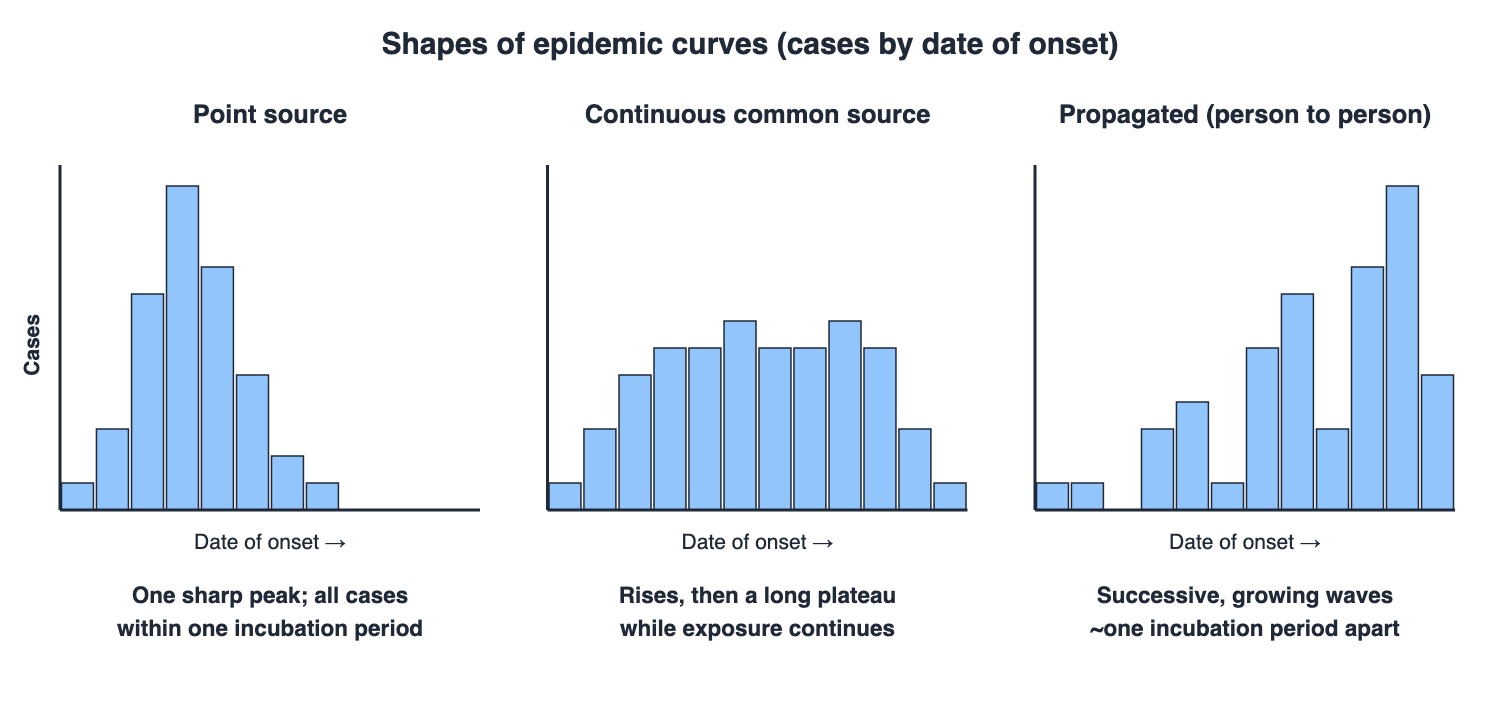
A point-source outbreak gives one sharp peak within one incubation period; a continuing common source gives a plateau; person-to-person spread gives successive waves about one incubation period apart.
Type | Exposure | Epidemic curve |
Point source (common source) | One source, brief exposure | Single sharp peak; all cases within one incubation period |
Continuous common source | One source, exposure continues | Rises and plateaus; flattened, widened peak |
Intermittent common source | One source, exposure on and off | Irregular peaks reflecting the exposure pattern |
Propagated | Person to person (or by vector or needle) | Cases over more than one incubation period; classically successive taller peaks one incubation period apart |
Mixed | Common source followed by person-to-person spread | A point-source peak followed by propagated waves |
Example from the CDC text: in a measles outbreak the peaks occurred about 11 days apart — consistent with measles' incubation period, the signature of propagated spread.
Investigating an Outbreak: 13 Steps
# | Step |
1 | Prepare for field work |
2 | Establish the existence of an outbreak |
3 | Verify the diagnosis |
4 | Construct a working case definition |
5 | Find cases systematically and record information |
6 | Perform descriptive epidemiology (time, place, person) |
7 | Develop hypotheses |
8 | Evaluate hypotheses epidemiologically |
9 | Reconsider, refine and re-evaluate hypotheses as needed |
10 | Compare with laboratory and environmental studies |
11 | Implement control and prevention measures |
12 | Initiate or maintain surveillance |
13 | Communicate findings |
The order is conceptual — in practice several steps run together, and the first three often change places.
A case definition is a set of standard criteria (clinical, and limits of time, place and person) for deciding who counts as a case; cases are often classified as confirmed, probable, possible or suspect.
Surveillance and India's IDSP
Surveillance is the ongoing collection, analysis and use of health data for action. Syndromic surveillance uses computer methods to spot rises above baseline in symptom-based data, such as emergency-department visits.
IDSP (Integrated Disease Surveillance Programme) collects data on epidemic-prone diseases weekly (Monday to Sunday) on three formats:
Form | Cases | Filled by |
S | Suspected (syndromic) | Health workers |
P | Presumptive (probable) | Clinicians |
L | Laboratory-confirmed | Laboratory staff |
A rising trend in any area is investigated by Rapid Response Teams (RRTs).
Traps the Examiner Sets
A point-source outbreak has all cases within one incubation period; cases spread over several incubation periods mean propagated (or continuing) spread.
From a point-source curve with a known exposure time: onset of the earliest case − exposure = minimum incubation period; onset of the median case − exposure = median incubation period.
S = health worker, P = clinician, L = laboratory.
Verify the diagnosis and establish that an outbreak exists before launching control measures — unless the danger is immediate.
Herd immunity protects the unvaccinated only while vaccine coverage stays high.
Rapid-Revision Cards
Endemic vs hyperendemic
Usual constant presence vs persistently high level.
Epidemic vs outbreak
Same definition; outbreak often for a more limited area.
Pandemic
Epidemic across several countries or continents.
Chain of infection
Reservoir → portal of exit → mode of transmission → portal of entry → susceptible host.
Direct transmission
Direct contact or droplet spread.
Indirect transmission
Airborne, vehicle-borne, vector-borne.
Carrier
Inapparent infection, still able to transmit.
Types of carriers
Asymptomatic (healthy), incubatory, convalescent, chronic (HBV, S. Typhi).
Estimating incubation period from a point-source curve
Earliest case − exposure = minimum; median case − exposure = median.
Herd immunity
Enough immune people make infected–susceptible contact unlikely.
Point-source curve
Single sharp peak; all cases within one incubation period.
Propagated curve
Successive taller peaks ~one incubation period apart.
Continuous common-source curve
Rise then plateau (flattened, widened).
Outbreak investigation — first steps
Prepare → establish outbreak → verify diagnosis → case definition.
Outbreak investigation — last step
Communicate findings (13th).
IDSP forms
S = health worker (suspected), P = clinician (presumptive), L = laboratory (confirmed).
IDSP reporting period
Weekly, Monday–Sunday; RRTs investigate rising trends.
Sources
Sources
Facts in this article were checked against these documents.
Principles of Epidemiology in Public Health Practice, 3rd ed., Lessons 1, 5 and 6 — U.S. Centers for Disease Control and Prevention (public domain), 2006, updated 2012 (link)
Integrated Disease Surveillance Programme (IDSP) — National Centre for Disease Control, MoHFW (archived web page), accessed 2026-10-24 (link)
CBME Curriculum 2024, Vol. II — Community Medicine (CM 7, CM 8) — National Medical Commission, 2024
Test Yourself: Practice Questions
Sixteen questions in NEET PG style.
Practice Questions (NEET PG pattern)
Original questions written in the style of the exam: +4 for a correct answer, −1 for a wrong one. Every answer was checked against the sources listed above. NEET PG papers are not published by NBEMS, so these are not past-paper questions.
Q1. Malaria constantly present at a usual level in a district is described as
(a) epidemic
(b) endemic
(c) sporadic
(d) pandemic
Show answer
Answer: (b) — Endemic = the constant presence or usual prevalence of a disease in a population within an area.
Q2. A disease occurring infrequently and irregularly is called
(a) sporadic
(b) holoendemic only
(c) hyperendemic
(d) endemic
Show answer
Answer: (a) — Sporadic refers to a disease that occurs infrequently and irregularly.
Q3. An epidemic that spreads over several countries or continents is a
(a) outbreak
(b) pandemic
(c) hyperendemic
(d) cluster
Show answer
Answer: (b) — A pandemic is an epidemic spread over several countries or continents, usually affecting many people.
Q4. The habitat in which an infectious agent normally lives, grows and multiplies is its
(a) portal of entry
(b) vector
(c) vehicle
(d) reservoir
Show answer
Answer: (d) — The reservoir is the agent's natural habitat — humans, animals or the environment.
Q5. Spread of hepatitis B by sharing contaminated needles is an example of
(a) vehicle-borne (indirect) transmission
(b) droplet spread
(c) vector-borne transmission
(d) airborne transmission
Show answer
Answer: (a) — Inanimate objects that carry the agent are vehicles; sharing needles is vehicle-borne spread.
Q6. A person who harbours and can transmit an infection without showing signs of disease is a
(a) reservoir host only
(b) carrier
(c) case
(d) contact
Show answer
Answer: (b) — A carrier is a person with inapparent infection who is capable of transmitting the pathogen to others.
Q7. Protection of unvaccinated children because most others in the community are immune is called
(a) herd immunity
(b) passive immunity
(c) innate immunity
(d) cross immunity
Show answer
Answer: (a) — Herd immunity depends on enough immune persons to make contact between an infected and a susceptible person unlikely.
Q8. After a wedding feast, 60 guests develop vomiting within 2–6 hours, with a single sharp peak. The epidemic is most likely
(a) propagated
(b) mixed
(c) point source
(d) continuous common source
Show answer
Answer: (c) — When everyone is exposed over a brief period and all fall ill within one incubation period, the common-source outbreak is a point-source outbreak.
Q9. An epidemic curve showing successive, progressively taller peaks about one incubation period apart suggests
(a) intermittent common source
(b) point-source exposure
(c) a laboratory error
(d) propagated (person-to-person) spread
Show answer
Answer: (d) — Propagated outbreaks classically show progressively taller peaks one incubation period apart.
Q10. Cases of a waterborne disease keep occurring for weeks from one contaminated supply, producing a broad plateau. This is a
(a) point-source outbreak
(b) sporadic occurrence
(c) propagated outbreak
(d) continuous common-source outbreak
Show answer
Answer: (d) — In a continuous common-source outbreak, the range of exposures and incubation periods flattens and widens the curve.
Q11. In a measles outbreak, peaks on the epidemic curve about 11 days apart indicate
(a) a vector-borne source
(b) person-to-person spread, matching the incubation period
(c) seasonal variation only
(d) a point source
Show answer
Answer: (b) — The CDC text cites peaks about 11 days apart as consistent with the incubation period of measles — propagated spread.
Q12. In the conceptual sequence of outbreak investigation, the step that comes immediately after verifying the diagnosis is
(a) develop hypotheses
(b) construct a working case definition
(c) communicate findings
(d) implement control measures
Show answer
Answer: (b) — CDC's sequence: prepare, establish the outbreak, verify the diagnosis, construct a working case definition, find cases…
Q13. The last step in CDC's 13 steps of outbreak investigation is
(a) develop hypotheses
(b) verify the diagnosis
(c) implement control measures
(d) communicate findings
Show answer
Answer: (d) — Step 13 is to communicate findings; steps 11 and 12 are control measures and surveillance.
Q14. Under IDSP, the 'P' form is filled by
(a) laboratory staff (confirmed cases)
(b) clinicians (presumptive cases)
(c) health workers (suspected cases)
(d) ASHA workers only
Show answer
Answer: (b) — S, P and L forms are filled by health workers, clinicians and laboratory staff respectively.
Q15. IDSP reports epidemic-prone diseases
(a) daily
(b) monthly
(c) weekly, Monday to Sunday
(d) quarterly
Show answer
Answer: (c) — IDSP collects data on epidemic-prone diseases on a weekly basis (Monday–Sunday).
Q16. A typhoid patient recovers but continues to excrete Salmonella Typhi in stools for a year. This person is a
(a) secondary case
(b) incubatory carrier
(c) contact
(d) chronic carrier
Show answer
Answer: (d) — Chronic carriers harbour a pathogen such as hepatitis B virus or Salmonella Typhi for months or years after infection.
Q17. In a point-source outbreak with a known time of exposure, the median incubation period is estimated as the time from exposure to the
(a) onset of the last case
(b) peak of the second wave
(c) onset of the median case
(d) onset of the first case
Show answer
Answer: (c) — Subtracting the exposure time from the onset of the median case gives the median incubation period; the earliest case gives the minimum.
Q18. A rising trend of illness detected by IDSP is investigated by
(a) Rapid Response Teams
(b) District Collector's office
(c) the Medical Council
(d) the Registrar General
Show answer
Answer: (a) — Rising trends are investigated by Rapid Response Teams (RRTs) to diagnose and control the outbreak.
Active Recall
From memory: define sporadic, endemic, epidemic and pandemic; draw the chain of infection; sketch the three epidemic curves; list the 13 steps of outbreak investigation in order; and name who fills the S, P and L forms of IDSP.