Family Planning for NEET PG PSM: IUCD, Antara, Mala N, Chhaya, Sterilisation — Timing, Eligibility, Incentives
Start Here
🎯 Exam priority: High-yield (Tier 1). Family planning questions test durations (IUCD 10 vs 5 years, MPA 3 months), timing after delivery, COC contraindications, sterilisation eligibility and the programme's brand names. Everything here is from MoHFW reference manuals and the 2022 NHSRC family planning booklet for Community Health Officers.
CBME mapping: CM 10.
Healthy Timing and Spacing of Pregnancy
High-risk pregnancies: mother < 18 or > 35 years; births less than 2 years apart; pregnancy within 6 months of a miscarriage/abortion; 5th or later pregnancy.
Advice: first pregnancy not before 18; wait at least 24 months after a birth before conceiving (birth-to-birth interval at least 36 months); wait 6 months after miscarriage or abortion.
Eligible couples are of reproductive age, 15–49 years. All methods are free through public facilities and ASHAs.
The Basket of Methods
Method | Key facts (national programme) |
IUCD 380A / IUCD 375 | Copper IUCDs: 380A protects 10 years, 375 protects 5 years; also emergency contraception if inserted within 5 days |
Injectable MPA ('Antara') | 150 mg IM every 3 months; window 2 weeks early to 4 weeks late; first dose only after an MBBS doctor screens; fertility returns 7–10 months after the last dose |
Mala N (COC) | 28 pills: 21 hormonal (levonorgestrel 0.15 mg + ethinyl estradiol 30 µg) + 7 iron pills; taken daily without a break |
Centchroman ('Chhaya') | Non-hormonal, non-steroidal; twice a week for 3 months, then once a week |
Condoms ('Nirodh') | The only method giving dual protection (pregnancy + STI/HIV) |
Female sterilisation | Minilap (modified Pomeroy) or laparoscopic (Falope rings) |
Male sterilisation | Conventional or no-scalpel vasectomy |
MPA: tell clients not to massage the injection site or apply heat, and to carry the MPA card. A late client beyond the window restarts as a new client.
Chhaya missed pill: take it as soon as possible; if late by more than 7 days, restart as a new user.
IUCD: insert only if no MEC category 4 condition; follow-up at 6 weeks or after the first period, whichever is earlier.
When to Start After Delivery or Abortion
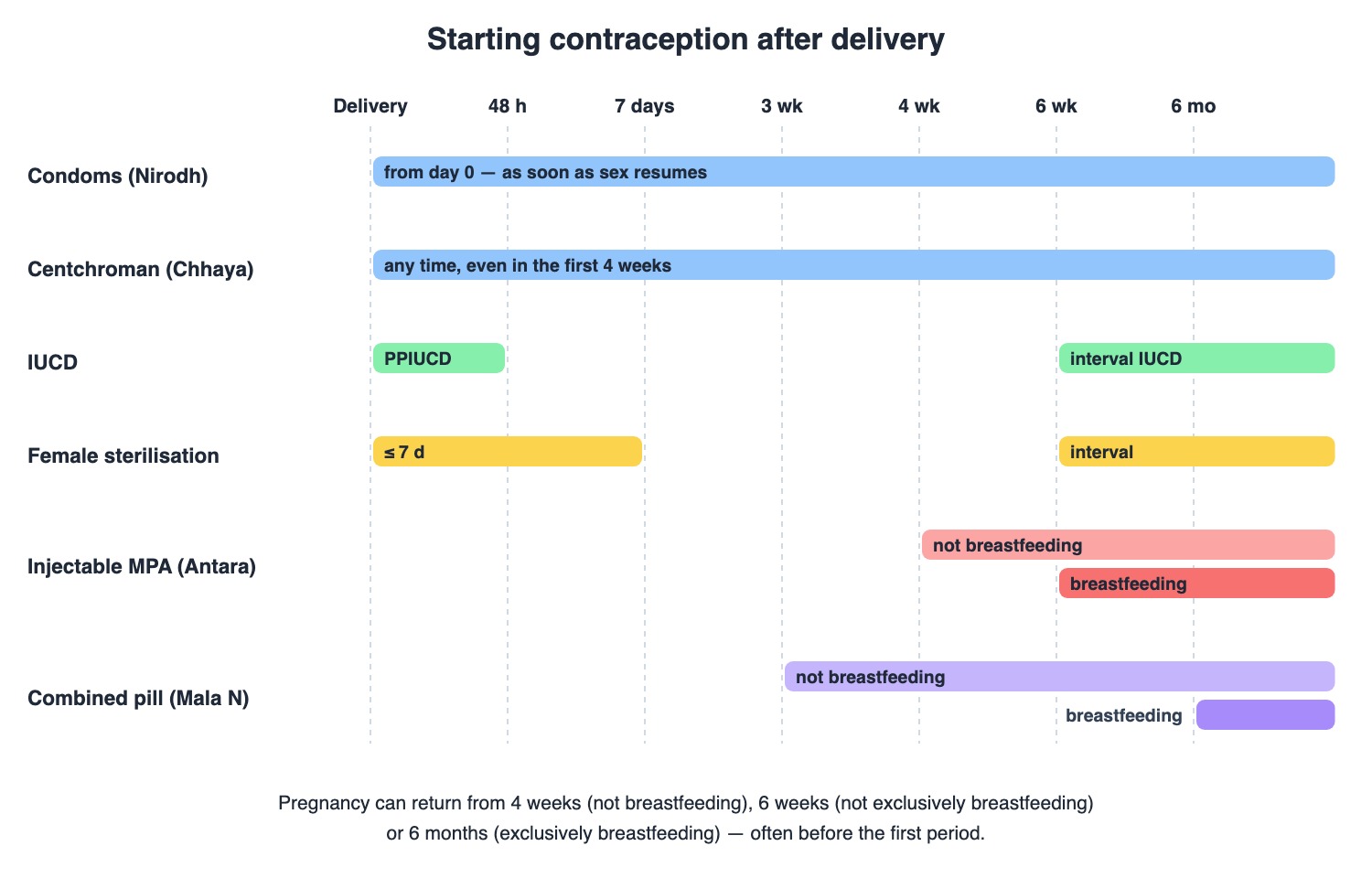
When each method can start after delivery (time axis not to scale). Exclusive breastfeeding protects only until 6 months.
Method | After vaginal delivery | After abortion |
IUCD | PPIUCD within 48 h (or during caesarean); interval IUCD from 6 weeks | Within 12 days of a completed surgical abortion |
Injectable MPA | From 6 weeks if breastfeeding; from 4 weeks if not | Within 7 days of completed abortion |
Centchroman | Any time, even before 4 weeks | Within 7 days of completed abortion |
Combined pill | Not before 6 months if breastfeeding; not before 3 weeks if not | — |
Female sterilisation | Within 7 days (postpartum minilap only) or from 6 weeks (interval) | With surgical MTP or within 7 days |
Combined Pills: Who Should Not Use Them and Missed Pills
Not for: breastfeeding women under 6 months postpartum, non-breastfeeding under 3 weeks; smokers of more than 15 cigarettes a day aged 35+; deep vein thrombosis, heart disease, liver disease, breast cancer, migraine with focal neurological symptoms, unexplained vaginal bleeding, anticonvulsant use. Hypertension and long-standing diabetes with complications need a clinician's advice.
Missed 1–2 pills: take one now and the next at the usual time. Missed 3+ in week 1–2: take one now, continue, back-up for 7 days. Missed 3+ in week 3: finish the hormonal pills, skip the iron pills and start a new pack next day, back-up for 7 days. Missed iron pills: just discard them.
Sterilisation
Eligibility: ever-married; women 22–49 years, men 22–60; at least one child over one year old (unless medically indicated); neither partner already sterilised; written informed consent.
Female: follow-up on day 7 and at 6 weeks/first period; certificate after one month. Postpartum only by minilap within 7 days; otherwise interval sterilisation from 6 weeks.
Male (NSV): walks home 30 minutes later; use back-up contraception until azoospermia — semen examination at 3 months; certificate then.
Sterilisation does not protect against RTIs/STIs/HIV. Complications, failure or death are covered by the Family Planning Indemnity Scheme.
Schemes and Incentives
Home delivery of contraceptives by ASHA: Nirodh, Chhaya, Mala N and the emergency pill (Ezy Pill).
Ensuring spacing at birth (ASHA incentive): ₹500 for delaying the first child 2 years after marriage; ₹500 for a 3-year gap between 1st and 2nd child; ₹1000 if the couple adopts a permanent method after 1 or 2 children.
PPIUCD/PAIUCD: ₹300 to the acceptor, ₹150 to the provider, ₹150 to the ASHA.
Nishchay pregnancy test kits are given out by ASHAs for early detection of pregnancy.
Traps the Examiner Sets
IUCD 380A = 10 years, 375 = 5 years.
PPIUCD: within 48 hours; post-abortion IUCD within 12 days.
Chhaya is non-hormonal, twice weekly × 3 months then weekly — and safe while breastfeeding.
MPA delays return of fertility (7–10 months) — not permanent infertility.
Mala N has 7 iron pills, not placebo.
Female sterilisation age 22–49; male 22–60; youngest child must be over 1 year.
Vasectomy is not effective until azoospermia (~3 months).
Rapid-Revision Cards
IUCD durations
380A: 10 years · 375: 5 years.
PPIUCD / PAIUCD timing
PPIUCD ≤ 48 h (or at caesarean); PAIUCD ≤ 12 days after surgical abortion.
Antara (MPA)
150 mg IM every 3 months; window −2 to +4 weeks; first dose after MBBS screening.
MPA after delivery
Breastfeeding: 6 weeks · not breastfeeding: 4 weeks.
MPA fertility return
7–10 months after last dose.
Chhaya (centchroman)
Non-hormonal; twice weekly × 3 months, then weekly; ok in breastfeeding.
Mala N
21 LNG 0.15 mg + EE 30 µg; 7 iron pills.
COC after delivery
Breastfeeding: not before 6 months · not breastfeeding: not before 3 weeks.
COC: no-go list
Smoker > 15/day aged ≥ 35, DVT, heart/liver disease, breast cancer, migraine with aura, anticonvulsants.
HTSP
First pregnancy ≥ 18; wait 24 months after birth (36-month birth interval); 6 months after abortion.
Sterilisation eligibility
Ever-married; F 22–49, M 22–60; ≥ 1 child aged > 1 year.
Postpartum tubectomy
Minilap within 7 days; interval from 6 weeks.
Vasectomy follow-up
Back-up until azoospermia; semen test at 3 months.
ASHA spacing incentives
₹500 delay 1st child 2 y · ₹500 3-y spacing · ₹1000 permanent method after 1–2 children.
PPIUCD incentive
₹300 acceptor · ₹150 provider · ₹150 ASHA.
Dual protection
Condoms only.
Sources
Sources
Facts in this article were checked against these documents.
Family Planning Program: Guidance Booklet for Community Health Officer — NHSRC / MoHFW, 2022 (link)
Reference Manual for Injectable Contraceptive (DMPA) — Family Planning Division, MoHFW, 2016 (link)
Reference Manual for IUCD Services — Family Planning Division, MoHFW, 2018 (link)
Reference Manual for Female Sterilization — Family Planning Division, MoHFW, 2014 (link)
Standards & Quality Assurance in Sterilization Services — Family Planning Division, MoHFW, 2014 (link)
Test Yourself: Practice Questions
Eighteen questions in NEET PG style.
Practice Questions (NEET PG pattern)
Original questions written in the style of the exam: +4 for a correct answer, −1 for a wrong one. Every answer was checked against the sources listed above. NEET PG papers are not published by NBEMS, so these are not past-paper questions.
Q1. The Copper IUCD 380A supplied under the national programme protects for
(a) 10 years
(b) 12 years
(c) 3 years
(d) 5 years
Show answer
Answer: (a) — IUCD 380A protects for 10 years; IUCD 375 for 5 years.
Q2. A postpartum IUCD after vaginal delivery should be inserted within
(a) 7 days
(b) 6 weeks
(c) 12 days
(d) 48 hours
Show answer
Answer: (d) — PPIUCD within 48 hours of vaginal delivery or during caesarean section; otherwise wait for interval insertion at 6 weeks.
Q3. After a completed surgical abortion, an IUCD can be inserted within
(a) 48 hours
(b) 30 days
(c) 6 weeks
(d) 12 days
Show answer
Answer: (d) — Post-abortion IUCD within 12 days of completion of abortion.
Q4. Centchroman (Chhaya) is best described as
(a) a non-hormonal, non-steroidal weekly pill taken twice a week for the first 3 months
(b) an emergency contraceptive
(c) a progestogen-only daily pill
(d) a combined pill with iron
Show answer
Answer: (a) — Twice weekly for 3 months, then once a week; non-hormonal.
Q5. Each injection of medroxyprogesterone acetate (Antara) gives protection for
(a) 2 months
(b) 1 month
(c) 3 months
(d) 6 months
Show answer
Answer: (c) — A single 150 mg IM dose protects for 3 months; window: 2 weeks early to 4 weeks late.
Q6. A breastfeeding mother wants injectable MPA. It can be started
(a) immediately after delivery
(b) 6 months after delivery
(c) 6 weeks after delivery
(d) 4 weeks after delivery
Show answer
Answer: (c) — Breastfeeding: at 6 weeks; non-breastfeeding: at 4 weeks.
Q7. After stopping injectable MPA, return of fertility typically takes
(a) 2–3 years
(b) 1 month
(c) 7–10 months from the last dose
(d) immediately
Show answer
Answer: (c) — Fertility returns 7–10 months after the last injection — a delay, not infertility.
Q8. The 7 non-hormonal tablets in a Mala N strip contain
(a) vitamin B12
(b) placebo sugar
(c) folic acid only
(d) iron
Show answer
Answer: (d) — 21 hormonal pills (LNG 0.15 mg + EE 30 µg) and 7 iron pills.
Q9. Combined oral contraceptives should NOT be given to
(a) a woman with a past ectopic pregnancy
(b) a 25-year-old non-smoker
(c) a woman with dysmenorrhoea
(d) a breastfeeding woman 3 months postpartum
Show answer
Answer: (d) — COCs are not used in breastfeeding women under 6 months postpartum (or non-breastfeeding under 3 weeks).
Q10. A woman on Mala N missed three hormonal pills in the third week. She should
(a) only discard the missed pills
(b) take two pills and continue
(c) finish the hormonal pills, skip the iron pills, start a new pack next day and use back-up for 7 days
(d) stop the pack and wait for her period
Show answer
Answer: (c) — Missed 3+ in week 3: finish hormonal pills, start a new pack next day, back-up for 7 days.
Q11. The age limits for female sterilisation under the national programme are
(a) 25–50 years
(b) 22–49 years
(c) 21–49 years
(d) 18–45 years
Show answer
Answer: (b) — Women 22–49, men 22–60; ever-married; at least one child over 1 year.
Q12. Postpartum female sterilisation (minilap) should be done within
(a) 48 hours of delivery
(b) 6 weeks of delivery
(c) 7 days of delivery
(d) 3 months of delivery
Show answer
Answer: (c) — Within 7 days after birth (postpartum minilap); otherwise interval sterilisation from 6 weeks.
Q13. After vasectomy the man should use back-up contraception until
(a) the wound heals
(b) the next day
(c) 1 week
(d) azoospermia is confirmed, usually about 3 months
Show answer
Answer: (d) — Semen examination at 3 months confirms azoospermia; the certificate is issued then.
Q14. The only contraceptive that gives dual protection against pregnancy and STI/HIV is
(a) the condom
(b) MPA
(c) centchroman
(d) the IUCD
Show answer
Answer: (a) — Condoms (Nirodh) provide dual protection.
Q15. The recommended minimum interval between two births under HTSP is
(a) 24 months
(b) 12 months
(c) 18 months
(d) 36 months
Show answer
Answer: (d) — Wait at least 24 months after a birth before conceiving, i.e. a birth-to-birth interval of at least 36 months.
Q16. Under the PPIUCD incentive scheme, the acceptor receives
(a) ₹500
(b) ₹300
(c) ₹150
(d) ₹1000
Show answer
Answer: (b) — ₹300 to the acceptor; ₹150 each to the provider and the ASHA.
Q17. An IUCD can act as emergency contraception if inserted within
(a) 72 hours only
(b) 5 days of unprotected intercourse
(c) 10 days
(d) 24 hours
Show answer
Answer: (b) — Within five days of (the first) unprotected intercourse.
Q18. The most common technique for minilap tubectomy is
(a) fimbriectomy
(b) the modified Pomeroy technique
(c) Irving technique
(d) Falope ring application
Show answer
Answer: (b) — Modified Pomeroy for minilap; Falope rings for laparoscopic sterilisation.
Active Recall
From memory: list India's basket of contraceptive methods with their brand names and durations; say when each can be started after delivery and after abortion; give the COC contraindications and missed-pill rules; and state sterilisation eligibility, timing, follow-up and the main family planning incentives.