Snakebite and Envenomation for NEET PG Medicine: MoHFW First Aid, 20WBCT, ASV Dosing, Atropine–Neostigmine, Scorpion Sting
Start Here
🎯 Exam priority: High (India-specific). Expect: the four common venomous snakes, krait features, neuroparalytic vs vasculotoxic signs, first-aid errors (tourniquet, incision), 20WBCT method and repeat, ASV indications and doses, no test dose, adrenaline, AN injection doses and stopping rule, no AN in krait, FFP when coagulopathy persists, scorpion sting and prazosin.
CBME mapping: GM 21.1–21.9. Snake identification and medicolegal aspects are in Forensic Medicine; ASV production in Pharmacology; epidemiology in Community Medicine.
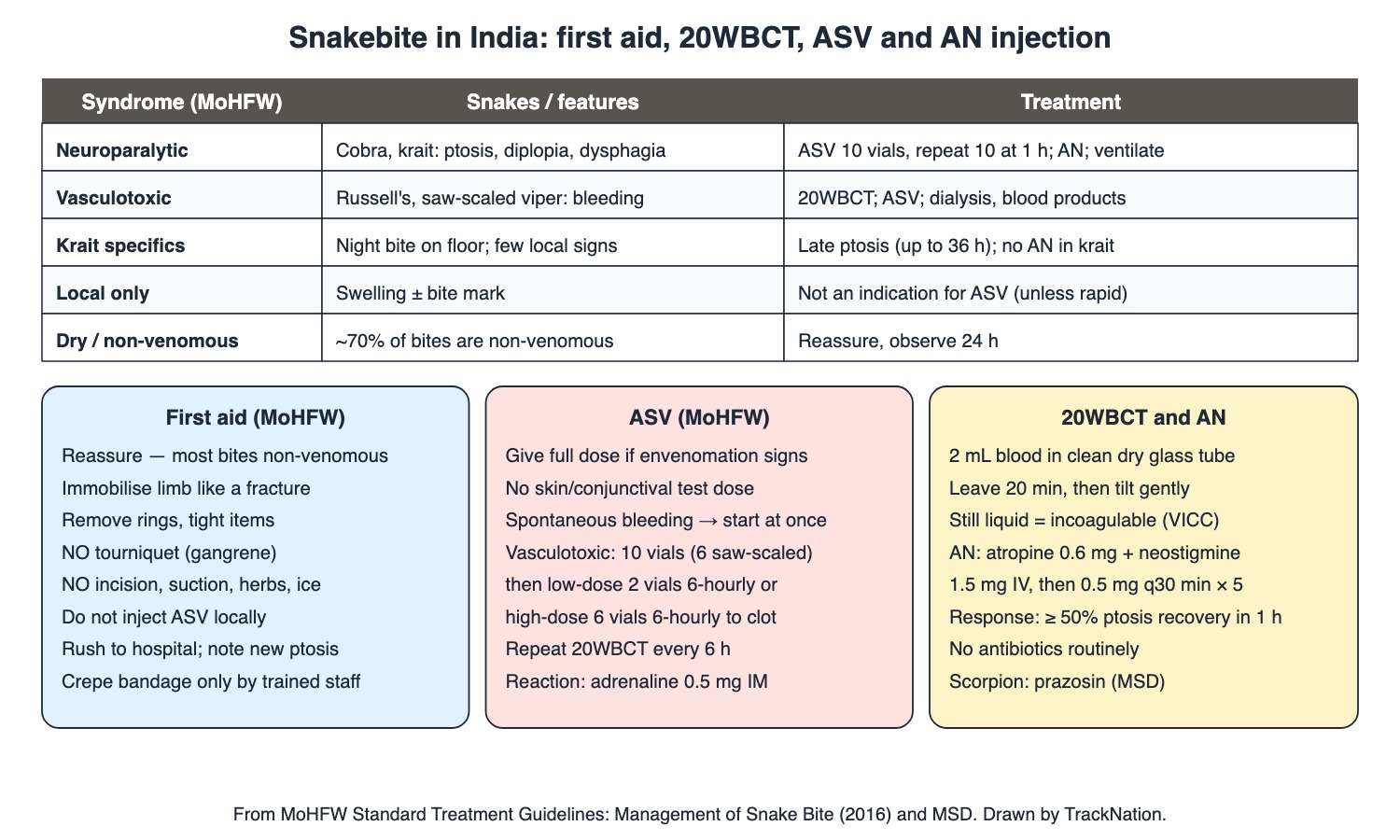
Snakebite syndromes, first aid, ASV, 20WBCT and AN injection. Drawn by TrackNation.
Snakes, Syndromes and First Aid
Medically important Indian snakes: Indian cobra (Naja naja), common krait (Bungarus caeruleus), Russell's viper (Daboia russelii), saw-scaled viper (Echis carinatus). About 70% of bites are non-venomous.
Neuroparalytic (cobra, krait): ptosis, diplopia, dysarthria, dysphagia, dyspnoea, paralysis. Krait bites at night on people sleeping on the floor, with no local signs, abdominal pain; symptoms can appear after 6–12 h and ptosis as late as 36 h. Locked-in syndrome: quadriplegia and anarthria with preserved consciousness; vertical eye movements are retained.
Vasculotoxic (Russell's and saw-scaled viper): local swelling, blistering, necrosis, bleeding, incoagulable 20WBCT, shock, AKI (not with saw-scaled viper); compartment syndrome.
First aid: reassure; immobilise the limb like a fracture; remove rings, watches, tight clothing; don't let the victim run or drive. Do not tie a tourniquet (gangrene), incise, suck, rub, apply herbs, ice or chemicals, or inject ASV locally. A crepe bandage only by trained staff. Admit every suspected bite and observe for 24 h.
20WBCT, ASV and AN Injection
20WBCT: 2 mL fresh venous blood in a clean, dry glass tube, undisturbed for 20 minutes, then tilt; still liquid = incoagulable (venom-induced consumption coagulopathy). Repeat 6 hours after the loading dose (and at 6 h in neurotoxic bites).
AN injection (neuroparalytic): atropine 0.6 mg then neostigmine 1.5 mg IV; repeat neostigmine 0.5 mg with atropine every 30 min for 5 doses, then taper. Response = ≥ 50% recovery of ptosis in 1 h; stop if no response after the 3rd dose. No AN in confirmed krait bite. Ventilate if needed.
Persistent coagulopathy after adequate ASV: FFP or cryoprecipitate (fresh whole blood if neither). Prophylactic antibiotics are unnecessary. No specific Indian ASV for sea snake or pit viper bites.
Scorpion sting (MSD): prazosin may prevent pulmonary oedema from extreme hypertension in serious stings.
ASV (MoHFW STG 2016) | Rule |
When | Signs of envenomation (with or without lab tests) — full dose at once; spontaneous bleeding > 20 min after bite → start without waiting for 20WBCT |
Not for | Purely local swelling (even with fang marks) or old swelling — rapid swelling does indicate envenoming |
Test dose | None — skin/conjunctival tests do not predict reactions; no absolute contraindication; never an incomplete dose |
Neuroparalytic | 10 vials over 30 min; second 10 vials after 1 h if no improvement |
Vasculotoxic | Low dose: 10 vials (6 for saw-scaled) then 2 vials 6-hourly; or high dose: 10 then 6 vials 6-hourly till clotting normal |
Total | Usually 10–30 vials (each neutralises 6 mg of Russell's viper venom) |
Premedication / reaction | Prophylactic adrenaline (not in hypertension); for reaction adrenaline 0.5 mg IM |
Traps the Examiner Sets
No ASV test dose — ever.
Local swelling alone is not an indication for ASV.
Krait: night, floor, no fang-mark swelling, late ptosis; no AN.
Saw-scaled viper does not cause AKI; starting ASV dose is 6 vials.
No tourniquets — they cause gangrene.
Memory Hooks & Shortcuts
Shortcuts to lock in this article's numbers and lists. Each one only re-packages facts proven above.
🧠 Krait 'Kills in the dark, Keeps no marks' — krait
🧠 20WBCT '2-20-tilt': 2 mL, 20 minutes, tilt — 20WBCT
🧠 ASV: 'No test, No local, No incomplete' — ASV rules
🧠 Neuro ASV '10 + 10' — neuroparalytic dose
🧠 AN: 'A before N, half the droop in an hour' — AN injection
🧠 Saw-scaled: 'Six vials, Spares the kidney' — saw-scaled viper
Rapid-Revision Cards
Big four
Cobra, krait, Russell's viper, saw-scaled viper.
Non-venomous
~70% of bites.
Krait
Night, floor, no local signs; late ptosis (36 h).
Neuroparalytic
Ptosis, diplopia, dysphagia, paralysis.
Vasculotoxic
Bleeding, 20WBCT incoagulable, shock, AKI.
Saw-scaled viper
No AKI; ASV start 6 vials.
First aid
Reassure, immobilise, remove rings.
Never
Tourniquet, incision, suction, herbs, local ASV.
Observe
Admit all; 24 h.
20WBCT
2 mL, glass tube, 20 min, tilt.
Repeat 20WBCT
6-hourly.
ASV now
Spontaneous bleeding > 20 min after bite.
Not ASV
Purely local or old swelling.
Test dose
None.
Neuro ASV
10 vials, repeat 10 at 1 h.
Vasculo ASV
10 (6 SSV) then 2 q6h (low) or 6 q6h (high).
Total ASV
10–30 vials.
Adrenaline
Premed (not in HTN); reaction 0.5 mg IM.
AN injection
Atropine 0.6 + neostigmine 1.5 mg IV; 0.5 mg q30 min × 5.
AN response
≥ 50% ptosis recovery in 1 h; stop after 3 failed doses.
No AN
Krait.
Persistent coagulopathy
FFP or cryoprecipitate.
Antibiotics
Not prophylactic.
Scorpion
Prazosin.
Sources
Facts in this article were checked against these documents.
Standard Treatment Guidelines: Management of Snake Bite — Quick Reference Guide — Ministry of Health & Family Welfare, Government of India, July 2016 (link)
MSD Manual Professional: Scorpion Stings — Merck & Co. (MSD Manuals), reviewed 2025–26 (link)
Competency Based Undergraduate Curriculum, General Medicine (GM 21) — National Medical Commission, 2024
Test Yourself: Practice Questions
Thirty questions in NEET PG style, most of them clinical vignettes.
Practice Questions (NEET PG pattern)
Original questions written in the style of the exam: +4 for a correct answer, −1 for a wrong one. Every answer was checked against the sources listed above. NEET PG papers are not published by NBEMS, so these are not past-paper questions.
Q1. The medically most important venomous snakes of India include all EXCEPT
(a) common krait
(b) the python
(c) Indian cobra
(d) Russell's viper
Show answer
Answer: (b) — Plus saw-scaled viper.
Q2. A villager sleeping on the floor wakes with severe abdominal pain and later develops ptosis; no fang marks or swelling are seen. The likely snake is
(a) python
(b) Russell's viper
(c) common krait
(d) saw-scaled viper
Show answer
Answer: (c) — Night bite, no local signs.
Q3. Approximately what proportion of snakebites are by non-venomous species (MoHFW)?
(a) 30%
(b) 95%
(c) 70%
(d) 10%
Show answer
Answer: (c) — Reassure the patient.
Q4. Correct first aid for a snakebite on the leg is
(a) incise and suck the wound
(b) reassure and immobilise the limb like a fracture, remove rings and tight items
(c) apply ice and herbs
(d) tie a tight tourniquet
Show answer
Answer: (b) — Tourniquets cause gangrene.
Q5. A relative has tied a tight cord above a snakebite. The MoHFW guideline warns that tourniquets
(a) prevent all envenoming
(b) should be tightened every hour
(c) may cause gangrenous limbs
(d) are recommended for 6 hours
Show answer
Answer: (c) — Crepe bandage only by trained staff.
Q6. A snakebite victim with no symptoms reaches hospital. Per MoHFW he should be
(a) given antibiotics only
(b) sent home immediately
(c) admitted and observed for 24 hours
(d) given ASV prophylactically
Show answer
Answer: (c) — Watch for envenomation.
Q7. The bedside test of venom-induced coagulopathy is
(a) D-dimer
(b) 20-minute whole blood clotting test: 2 mL blood in a clean dry glass tube, tilted after 20 minutes
(c) bleeding time
(d) platelet count only
Show answer
Answer: (b) — Liquid blood = incoagulable.
Q8. After the loading dose of ASV in a vasculotoxic bite, the 20WBCT is repeated
(a) every 30 minutes
(b) every 6 hours until clotting returns
(c) never
(d) after 3 days
Show answer
Answer: (b) — Guides repeat ASV.
Q9. A man bitten by a viper has spontaneous gum bleeding 30 minutes after the bite. The next step is
(a) observe for 24 h
(b) wait for 20WBCT
(c) give vitamin K only
(d) start ASV without waiting for the 20WBCT
Show answer
Answer: (d) — Spontaneous bleeding beyond 20 min is enough.
Q10. A patient has only mild swelling around fang marks 8 hours after a bite, with normal 20WBCT and no systemic signs. ASV is
(a) not indicated — purely local swelling is not a ground for ASV
(b) indicated, 2 vials
(c) indicated, 10 vials
(d) indicated as test dose
Show answer
Answer: (a) — Rapidly spreading swelling would be different.
Q11. Before giving ASV, a skin or conjunctival test dose is
(a) mandatory
(b) required only in children
(c) done with 1 vial
(d) not recommended — it does not predict reactions
Show answer
Answer: (d) — No ASV test dose must be given.
Q12. The MoHFW dose of ASV for neuroparalytic envenomation is
(a) 1 vial every 6 hours
(b) 50 vials at once
(c) 2 vials only
(d) 10 vials over 30 minutes, repeated once after 1 hour if no improvement
Show answer
Answer: (d) — Plus AN injection and ventilation.
Q13. In the low-dose regimen for a saw-scaled viper bite with coagulopathy, the initial ASV dose is
(a) 10 vials then 10 hourly
(b) 6 vials, then 2 vials 6-hourly
(c) 1 vial
(d) 20 vials
Show answer
Answer: (b) — Russell's viper: 10 vials.
Q14. The usual total ASV requirement in Russell's viper envenomation is
(a) not quantifiable
(b) 1–2 vials
(c) 100 vials
(d) 10–30 vials (each neutralises 6 mg venom)
Show answer
Answer: (d) — Higher initial dose up to 30 vials in severe bleeding.
Q15. Before ASV, routine prophylactic adrenaline is recommended EXCEPT in
(a) women
(b) known hypertensives (or BP > 140/90)
(c) patients with bleeding
(d) children
Show answer
Answer: (b) — Given subcutaneously.
Q16. A patient develops an anaphylactic reaction during ASV infusion. The dose of adrenaline for an adult is
(a) 1 mg subcutaneously daily
(b) 0.05 mg orally
(c) 5 mg IV push
(d) 0.5 mg IM
Show answer
Answer: (d) — Children 0.01 mg/kg.
Q17. ASV has
(a) absolute contraindication in children
(b) absolute contraindication in asthma
(c) absolute contraindication in pregnancy
(d) no absolute contraindications
Show answer
Answer: (d) — Never withhold from a deserving case; never give an incomplete dose.
Q18. The AN injection for a neuroparalytic bite in an adult starts with
(a) pralidoxime 1 g
(b) adrenaline 1 mg
(c) atropine 0.6 mg then neostigmine 1.5 mg IV
(d) physostigmine 2 mg
Show answer
Answer: (c) — Then neostigmine 0.5 mg with atropine every 30 min × 5.
Q19. A positive response to the AN injection is
(a) pupil dilation
(b) rise in BP
(c) ≥ 50% recovery of ptosis within 1 hour
(d) complete recovery in 5 minutes
Show answer
Answer: (c) — Stop if no response after the 3rd dose.
Q20. In confirmed krait bite, the AN injection is
(a) given every 30 minutes
(b) given as a single large dose
(c) replaced by pralidoxime
(d) not given
Show answer
Answer: (d) — As stated in the MoHFW guideline.
Q21. After a krait bite, ptosis has been recorded as late as
(a) never after 1 hour
(b) 5 minutes only
(c) 1 week
(d) 36 hours after hospitalisation
Show answer
Answer: (d) — Symptoms may appear after 6–12 h.
Q22. A paralysed snakebite patient cannot move limbs or speak but has preserved consciousness and vertical eye movements. This is
(a) hysteria
(b) brain death
(c) coma
(d) locked-in syndrome — not brain death
Show answer
Answer: (d) — Quadriplegia and anarthria with preserved consciousness.
Q23. Acute kidney injury is a feature of vasculotoxic envenoming EXCEPT after bites by
(a) both vipers
(b) Russell's viper
(c) saw-scaled viper
(d) none
Show answer
Answer: (c) — Russell's viper commonly causes AKI.
Q24. Despite adequate ASV, a Russell's viper victim still has incoagulable blood and bleeding. The next step is
(a) fresh frozen plasma or cryoprecipitate
(b) give heparin
(c) give aspirin
(d) stop ASV forever
Show answer
Answer: (a) — Fresh whole blood if neither is available.
Q25. Prophylactic antibiotics after snakebite are
(a) required before ASV
(b) required for all krait bites
(c) always required
(d) unnecessary
Show answer
Answer: (d) — Treat infection if it occurs.
Q26. ASV should NOT be
(a) given intravenously
(b) given in full dose
(c) injected locally at the bite site
(d) given to children
Show answer
Answer: (c) — IV infusion only.
Q27. Rapid development of swelling after a bite indicates
(a) dry bite
(b) envenoming (consider ASV)
(c) allergy only
(d) non-venomous snake
Show answer
Answer: (b) — Old or purely local swelling does not.
Q28. ASV available in India does not specifically cover bites by
(a) sea snakes and pit vipers
(b) Russell's viper
(c) saw-scaled viper
(d) cobra
Show answer
Answer: (a) — Polyvalent ASV covers the big four.
Q29. Which wound practice is recommended after snakebite?
(a) apply chilli paste
(b) leave the wound alone — no incision, suction, rubbing, herbs, ice or cautery
(c) incise and drain
(d) cauterise
Show answer
Answer: (b) — These introduce infection and delay care.
Q30. In a serious scorpion sting with extreme hypertension, a drug that may prevent pulmonary oedema is
(a) prazosin
(b) adrenaline
(c) atropine
(d) propranolol
Show answer
Answer: (a) — Supportive care otherwise.
Active Recall
From memory: name the big four snakes, describe neuroparalytic and vasculotoxic syndromes and krait clues, list first-aid do's and don'ts, explain the 20WBCT, give ASV indications, non-indications and regimens, the adrenaline rules, the AN injection schedule and response, and management of persistent coagulopathy and scorpion sting.