Paediatric Haematology and Oncology for NEET PG: Thalassaemia, Sickle Cell (ICMR), G6PD, ITP vs Haemophilia, ALL, Wilms, Neuroblastoma, Retinoblastoma
Start Here
🎯 Exam priority: High. Expect: age of onset of thalassaemia major, sickle cell genetics and crisis triggers, penicillin prophylaxis doses, G6PD triggers, ITP vs haemophilia lab pattern, commonest childhood cancer and its peak age, neuroblastoma clues, Wilms and WAGR, leukocoria and RB1.
CBME mapping: PE29. Fact-checked against the ICMR Standard Treatment Workflow for Sickle Cell Disease (2020) and the MSD Manual. Iron-deficiency anaemia is covered in article 08.
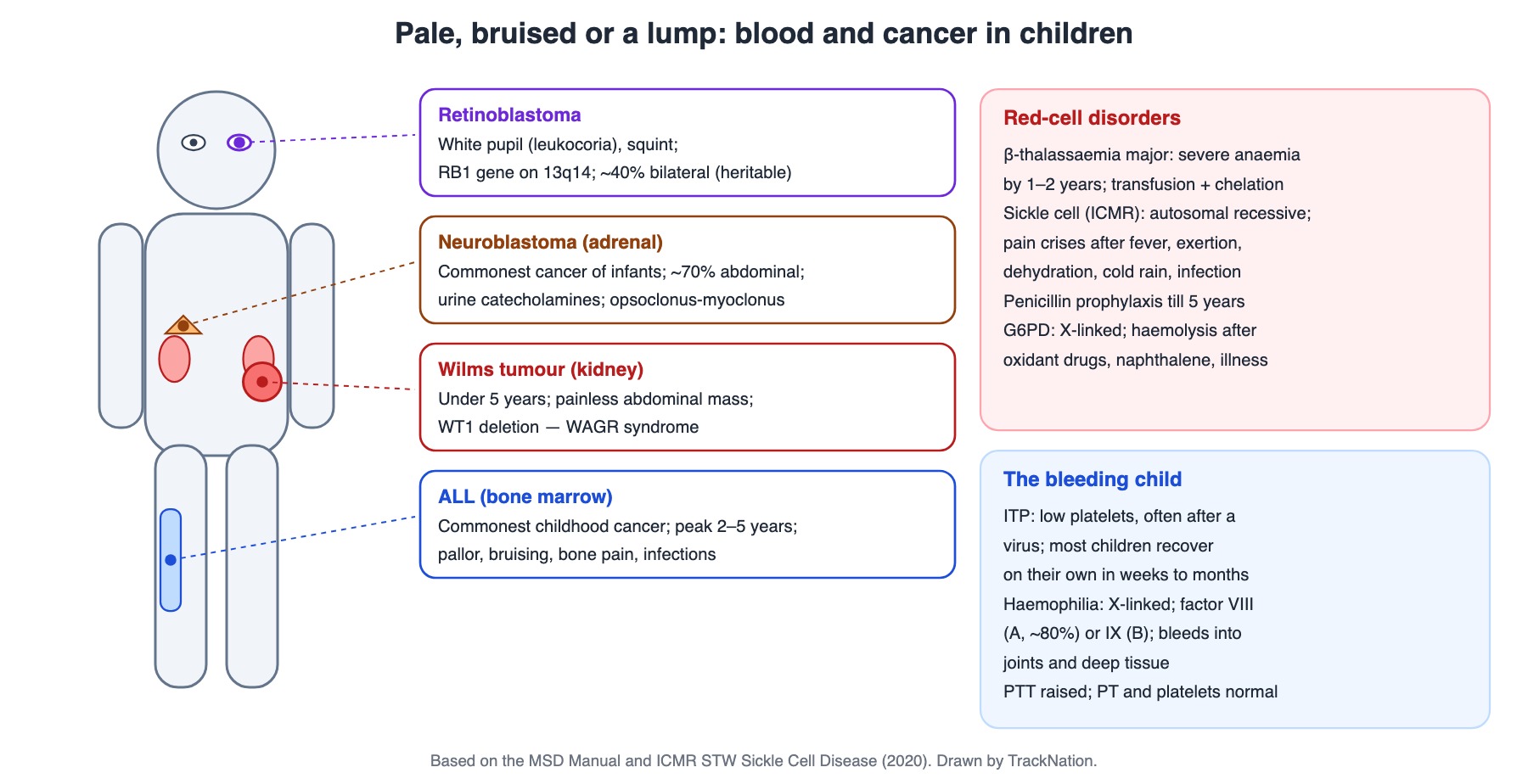
Childhood cancers by site, red-cell disorders and the bleeding child. Drawn by TrackNation.
Haemolytic Anaemias
Thalassaemias: inherited microcytic haemolytic anaemias from defective haemoglobin synthesis. Traits are usually silent with mild microcytosis. β-thalassaemia major appears by 1–2 years with severe anaemia and iron overload; now classed as transfusion-dependent or not. Treatment: transfusion, chelation, splenectomy, stem-cell transplant.
Sickle cell disease (ICMR): autosomal recessive β-globin mutation; ~88% of Asia's homozygous patients are Indian. HbAS carriers are usually well; HbSS is disease. Vaso-occlusive crises (hands, feet, limbs, abdomen, ribs) follow fever, exertion, dehydration, drenching in rain, surgery or infection; also splenic sequestration, acute chest syndrome, priapism.
Sickle screening: CBC for all women in the first trimester; if the mother is a carrier, test the father; newborn point-of-care testing to start penicillin prophylaxis till 5 years (65 mg BD under 12 months, 125 mg BD to 2 years, 250 mg BD to 5). Treat fever early. Hydroxyurea cuts crises and acute chest syndrome (MSD).
Hereditary spherocytosis: RBC membrane defect, usually mild haemolysis. G6PD deficiency: X-linked, so boys are mainly affected, with haemolysis after illness or oxidants (primaquine, sulfonamides, nitrofurans, naphthalene).
The Bleeding Child: ITP vs Haemophilia
Childhood ITP: often after a virus; spleen normal; acute and self-limited — most children recover on their own, so care is usually supportive; IVIG or anti-D for life-threatening bleeding.
Haemophilia: X-linked; A = factor VIII (~80%), B = factor IX; bleeding into joints and deep tissues after trauma. Labs: raised PTT, normal PT and platelets; confirm by factor assay.
Childhood Cancers
ALL: the commonest childhood cancer, peak 2–5 years: fatigue, pallor, infections, bone pain, bruising and bleeding; treatment includes CNS prophylaxis (intrathecal chemotherapy).
Neuroblastoma: commonest cancer of infants and commonest extracranial solid tumour; usually adrenal; produces catecholamines (urine metabolites). Clues: periorbital bruising and proptosis from orbital metastasis, Horner syndrome, opsoclonus-myoclonus; MYCN amplification is a prognostic marker.
Wilms tumour: under 5 years; painless abdominal mass; 4–5% of childhood cancers; WAGR = Wilms (WT1 deletion), aniridia, genitourinary anomalies, intellectual disability.
Retinoblastoma: leukocoria (white pupil) and squint; RB1 on 13q14; about 40% bilateral — always heritable.
Traps the Examiner Sets
β-thal major presents by 1–2 years, not at birth.
Penicillin prophylaxis in sickle cell runs to 5 years.
ITP: low platelets, normal PTT; haemophilia: normal platelets, raised PTT.
Commonest childhood cancer = ALL; commonest cancer of infancy = neuroblastoma.
Bilateral retinoblastoma is always heritable.
Memory Hooks & Shortcuts
Shortcuts to lock in this article's numbers and lists. Each one only re-packages facts proven above.
🧠 Thal major 'one-two, pale and blue' — shows at 1–2 years — thalassaemia
🧠 Sickle crisis triggers 'Fever, Fatigue, Fluids-low, Freezing rain' — sickle cell
🧠 Penicillin '65-125-250 till five' — prophylaxis
🧠 Platelets low = ITP (skin); PTT high = haemophilia (joints) — bleeding
🧠 'All Little Lads' get ALL most; 'New Babies' get Neuroblastoma — cancers
Rapid-Revision Cards
Thalassaemia
Microcytic haemolytic; major by 1–2 y.
Thal treatment
Transfusion + chelation; SCT.
Sickle genetics
AR; HbAS carrier, HbSS disease.
India & sickle
~88% of Asia's HbSS are Indian (ICMR).
VOC triggers
Fever, exertion, dehydration, rain, surgery, infection.
Commonest crisis
Vaso-occlusive.
Sequestration
Young children, spleen not fibrosed.
Penicillin
Till 5 y: 65/125/250 mg BD.
Antenatal sickle
Mother carrier → test father.
Hydroxyurea
Fewer crises and acute chest.
G6PD
X-linked; oxidants, naphthalene.
HS
Membrane defect; mild haemolysis.
Childhood ITP
Post-viral; self-limited; supportive.
Haemophilia
X-linked; VIII (80%) / IX.
Haemophilia labs
PTT ↑; PT, platelets normal.
ALL
Commonest childhood cancer; peak 2–5 y.
Neuroblastoma
Commonest infant cancer; adrenal; catecholamines.
NB clues
Periorbital bruising, Horner, opsoclonus-myoclonus.
Wilms
< 5 y; painless mass; WAGR (WT1).
Retinoblastoma
Leukocoria; RB1 13q14.
Bilateral RB
~40%; always heritable.
Sources
Facts in this article were checked against these documents.
Standard Treatment Workflow: Sickle Cell Disease — ICMR / Department of Health Research, MoHFW, 2020
MSD Manual Professional: Thalassemias; Sickle Cell Disease; Hereditary Spherocytosis; G6PD Deficiency; ITP; Hemophilia; ALL; Wilms Tumor; Neuroblastoma; Retinoblastoma — Merck & Co., 2025–2026 (link)
Test Yourself: Practice Questions
Thirty questions in NEET PG style, many of them OPD and ward scenarios.
Practice Questions (NEET PG pattern)
Original questions written in the style of the exam: +4 for a correct answer, −1 for a wrong one. Every answer was checked against the sources listed above. NEET PG papers are not published by NBEMS, so these are not past-paper questions.
Q1. β-thalassaemia major typically presents at
(a) birth
(b) 1–2 years
(c) 10 years
(d) adolescence
Show answer
Answer: (b) — Severe anaemia and iron overload.
Q2. Thalassaemias are
(a) aplastic anaemias
(b) inherited microcytic haemolytic anaemias
(c) megaloblastic anaemias
(d) acquired macrocytic anaemias
Show answer
Answer: (b) — MSD.
Q3. Which is NOT a standard treatment option for severe thalassaemia?
(a) chelation
(b) transfusion
(c) long-term high-dose iron
(d) stem cell transplantation
Show answer
Answer: (c) — Iron overload is the problem.
Q4. Sickle cell disease is inherited as
(a) mitochondrial
(b) autosomal recessive
(c) X-linked
(d) autosomal dominant
Show answer
Answer: (b) — β-globin mutation.
Q5. Per ICMR, the share of Asia's homozygous sickle cases that are Indian is about
(a) 20%
(b) 50%
(c) 5%
(d) 88%
Show answer
Answer: (d) — ICMR.
Q6. Which is a listed trigger for a vaso-occlusive crisis?
(a) sleeping
(b) a full meal
(c) getting drenched in rain
(d) mild cold weather indoors
Show answer
Answer: (c) — Also fever, exertion, dehydration.
Q7. The commonest type of sickle crisis is
(a) vaso-occlusive (pain) crisis
(b) sequestration crisis
(c) aplastic crisis
(d) haemolytic crisis
Show answer
Answer: (a) — MSD.
Q8. Splenic sequestration crisis occurs mainly in
(a) young children whose spleen is not yet fibrosed
(b) carriers
(c) adults
(d) after splenectomy
Show answer
Answer: (a) — MSD.
Q9. Penicillin prophylaxis in sickle cell disease (ICMR) is given till
(a) adolescence only
(b) 10 years
(c) 1 year
(d) 5 years
Show answer
Answer: (d) — Lifelong if splenectomised.
Q10. ICMR penicillin dose for a sickle baby under 12 months is
(a) 500 mg once
(b) 125 mg once weekly
(c) 65 mg twice daily
(d) 250 mg twice daily
Show answer
Answer: (c) — 125 mg BD to 2 y; 250 mg BD to 5 y.
Q11. If an antenatal woman is a sickle carrier, ICMR says next
(a) start hydroxyurea
(b) no action
(c) test the father
(d) terminate pregnancy
Show answer
Answer: (c) — Then counselling and prenatal testing.
Q12. A drug that reduces sickle crises and acute chest syndrome is
(a) hydroxyurea
(b) folic acid alone
(c) iron
(d) aspirin
Show answer
Answer: (a) — MSD.
Q13. G6PD deficiency is inherited as
(a) mitochondrial
(b) autosomal dominant
(c) autosomal recessive
(d) X-linked
Show answer
Answer: (d) — Boys affected.
Q14. Which can trigger haemolysis in G6PD deficiency?
(a) vitamin D
(b) paracetamol at normal dose
(c) amoxicillin
(d) naphthalene balls
Show answer
Answer: (d) — Also primaquine, sulfonamides.
Q15. Hereditary spherocytosis is a defect of the red cell
(a) enzyme G6PD
(b) haemoglobin
(c) nucleus
(d) membrane
Show answer
Answer: (d) — MSD.
Q16. ITP in children is usually
(a) acute and self-limited
(b) inherited
(c) chronic
(d) malignant
Show answer
Answer: (a) — MSD.
Q17. A well 4-year-old with petechiae 2 weeks after a cold, normal spleen and low platelets most likely has
(a) ALL
(b) ITP
(c) aplastic anaemia
(d) haemophilia
Show answer
Answer: (b) — Post-viral.
Q18. Management of most children with ITP is
(a) supportive — most recover spontaneously
(b) chemotherapy
(c) lifelong steroids
(d) splenectomy
Show answer
Answer: (a) — IVIG/anti-D for severe bleeding.
Q19. Haemophilia A is deficiency of
(a) von Willebrand factor
(b) factor XI
(c) factor VIII
(d) factor IX
Show answer
Answer: (c) — ~80% of haemophilia.
Q20. Haemophilia is inherited as
(a) sporadic only
(b) X-linked
(c) autosomal recessive
(d) autosomal dominant
Show answer
Answer: (b) — MSD.
Q21. The lab pattern of haemophilia is
(a) raised PTT, normal PT and platelets
(b) raised bleeding time only
(c) low platelets
(d) raised PT only
Show answer
Answer: (a) — Confirm by factor assay.
Q22. A boy with recurrent swollen painful knees after minor falls most likely has
(a) Henoch–Schönlein purpura
(b) ALL
(c) ITP
(d) haemophilia
Show answer
Answer: (d) — Joint bleeds.
Q23. The commonest childhood cancer is
(a) acute lymphoblastic leukaemia
(b) Wilms tumour
(c) neuroblastoma
(d) retinoblastoma
Show answer
Answer: (a) — MSD.
Q24. Peak age of ALL in children is
(a) 10–14 years
(b) 16–18 years
(c) 2–5 years
(d) under 6 months
Show answer
Answer: (c) — MSD.
Q25. The commonest cancer in infants is
(a) neuroblastoma
(b) medulloblastoma
(c) ALL
(d) Wilms tumour
Show answer
Answer: (a) — MSD.
Q26. A toddler with an abdominal mass, bruising around both eyes and jerky eye movements most likely has
(a) hepatoblastoma
(b) Wilms tumour
(c) neuroblastoma
(d) lymphoma
Show answer
Answer: (c) — Orbital metastasis; opsoclonus-myoclonus.
Q27. Neuroblastoma is detected by urinary metabolites of
(a) cortisol
(b) serotonin
(c) catecholamines
(d) histamine
Show answer
Answer: (c) — MSD.
Q28. The commonest presentation of Wilms tumour is
(a) a painless abdominal mass
(b) seizures
(c) jaundice
(d) haematemesis
Show answer
Answer: (a) — Under 5 years.
Q29. WAGR syndrome includes Wilms tumour with
(a) ataxia and telangiectasia
(b) aniridia, genitourinary anomalies and intellectual disability
(c) anosmia
(d) albinism
Show answer
Answer: (b) — WT1 deletion.
Q30. A 1-year-old's photo shows a white pupil. The gene implicated is
(a) WT1
(b) MYCN
(c) RB1 on 13q14
(d) TP53 on 17p
Show answer
Answer: (c) — 40% bilateral, heritable.
Active Recall
From memory: describe thalassaemia major and its treatment, sickle cell genetics, crisis triggers, ICMR screening and penicillin prophylaxis, G6PD triggers, childhood ITP vs haemophilia, and the key features of ALL, neuroblastoma, Wilms tumour and retinoblastoma.