Paediatric Neurology for NEET PG: Febrile Seizures, ICMR Acute Encephalitis Syndrome, Meningitis, Infantile Spasms, Cerebral Palsy, DMD and GBS
Start Here
🎯 Exam priority: Very high. Expect: febrile seizure age and simple vs complex, AES definition and empirical triad, when not to do an LP, mannitol and head position, seizure drug doses, infantile spasms EEG and treatment, CP commonest type, DMD gene and course, GBS CSF.
CBME mapping: PE30. Fact-checked against the ICMR Standard Treatment Workflow for Acute Encephalitis Syndrome in Children (2019) and the MSD Manual.
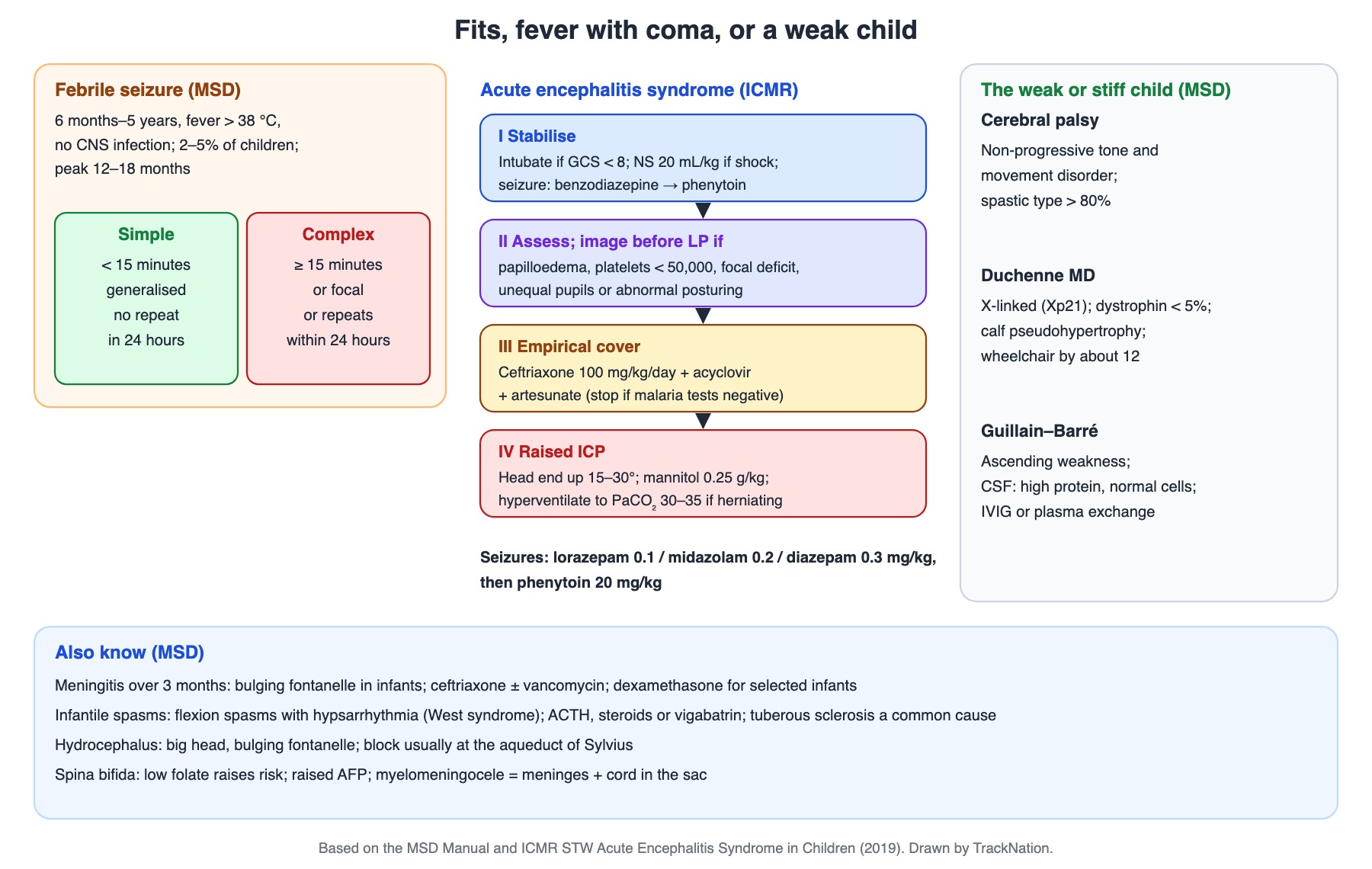
Febrile seizure types, the ICMR AES ladder and the weak child. Drawn by TrackNation.
Febrile Seizures (MSD)
Seizure in a child of 6 months–5 years with fever > 38 °C, not due to CNS infection, with no previous afebrile seizure; 2–5% of children, most at 12–18 months.
Simple (most): < 15 minutes, no focal features, no recurrence within 24 h. Complex: ≥ 15 minutes, focal, or recurs within 24 hours.
Epilepsy risk is only slightly raised — more with developmental delay.
Acute Encephalitis Syndrome (ICMR)
AES: acute fever (≤ 5–7 days) with altered sensorium and/or new seizures (simple febrile seizures excluded). Admit all.
Refer to PICU: GCS < 8, abnormal breathing, fluid-refractory shock, abnormal posturing, seizures despite benzodiazepine and phenytoin.
Image before LP if papilloedema, platelets < 50,000, focal deficit, unequal/unreactive pupils, or decerebrate/decorticate posturing. Investigations include CSF (with HSV PCR), JE serology, malaria smear/RDT, dengue tests.
Steps: I stabilise (intubate if GCS < 8; NS 20 mL/kg for shock; treat seizures) → II assess → III empirical ceftriaxone 100 mg/kg/day + acyclovir + artesunate (stop artesunate if smear and RDT negative) → IV supportive: head end up 15–30°, mannitol 0.25 g/kg, hyperventilate to PaCO₂ 30–35 if herniating; pulse methylprednisolone for suspected ADEM → V rehabilitation.
Seizures: IV lorazepam 0.1, midazolam 0.2 or diazepam 0.3 mg/kg (IM midazolam 0.2 if no line), then phenytoin 20 mg/kg.
Meningitis, Spasms, Hydrocephalus, Spina Bifida (MSD)
Meningitis beyond 3 months: causes depend on Hib and pneumococcal vaccination; infants show a bulging fontanelle rather than neck stiffness; ceftriaxone (± vancomycin for resistant pneumococci); dexamethasone for selected infants.
Infantile spasms: flexion of arms and trunk with leg extension; EEG hypsarrhythmia (West syndrome); tuberous sclerosis a common cause; treat with ACTH, oral steroids or vigabatrin.
Hydrocephalus: big head, bulging fontanelle, vomiting, irritability; obstruction usually at the aqueduct of Sylvius; after fontanelle closure, pressure rises without head growth.
Spina bifida: low maternal folate raises risk; raised AFP in maternal serum and amniotic fluid; meningocele (meninges) vs myelomeningocele (meninges + cord).
The Weak or Stiff Child (MSD)
Cerebral palsy: non-progressive disorder of tone, movement and posture; spastic type > 80%; prematurity a major risk; hemiplegic and diplegic children often have normal intelligence.
Duchenne MD: X-linked recessive, dystrophin gene at Xp21, dystrophin < 5%; proximal weakness, calf pseudohypertrophy; wheelchair by about 12. Carrier females may have raised CK.
Guillain–Barré: ascending weakness with areflexia; CSF albuminocytologic dissociation (high protein, normal cells); IVIG or plasma exchange; Miller Fisher variant = ophthalmoparesis, ataxia, areflexia.
Traps the Examiner Sets
A febrile seizure lasting 15 minutes or recurring within 24 h is complex.
AES excludes simple febrile seizures.
Platelets < 50,000 or papilloedema — image before any LP.
Hypsarrhythmia = infantile spasms; think tuberous sclerosis.
CP does not progress; DMD does.
Memory Hooks & Shortcuts
Shortcuts to lock in this article's numbers and lists. Each one only re-packages facts proven above.
🧠 Febrile seizure '6 to 5, under 15, once a day' — febrile seizures
🧠 AES triple cover 'C-A-A': Ceftriaxone, Acyclovir, Artesunate — AES
🧠 Benzo doses '0.1-0.2-0.3': lorazepam, midazolam, diazepam — seizure drugs
🧠 Infantile spasms 'Hyps and Tubers' — hypsarrhythmia, tuberous sclerosis — spasms
🧠 DMD 'X-p-21, Calves Big, Chair by 12' — DMD
Rapid-Revision Cards
Febrile seizure
6 mo–5 y; > 38 °C; no CNS infection; 2–5%.
Peak age
12–18 months.
Simple
< 15 min, generalised, no repeat in 24 h.
Complex
≥ 15 min, focal, or repeats in 24 h.
AES
Fever + altered sensorium/new seizure; excl. simple FS.
PICU
GCS < 8, shock, posturing, refractory fits.
Image before LP
Papilloedema, platelets < 50k, focal, pupils, posturing.
AES empirical
Ceftriaxone + acyclovir + artesunate.
Raised ICP
Head 15–30°; mannitol 0.25 g/kg; PaCO₂ 30–35.
Seizure drugs
Lorazepam 0.1 / midazolam 0.2 / diazepam 0.3 → phenytoin 20.
ADEM
Pulse methylprednisolone.
Infant meningitis
Bulging fontanelle; ceftriaxone ± vancomycin.
Infantile spasms
Hypsarrhythmia; ACTH/steroids/vigabatrin.
Spasms cause
Tuberous sclerosis.
Hydrocephalus
Aqueduct of Sylvius.
Spina bifida
Folate; AFP; myelomeningocele.
CP
Non-progressive; spastic > 80%.
DMD
X-linked; Xp21; dystrophin < 5%.
DMD signs
Calf pseudohypertrophy; wheelchair ~12.
GBS
Ascending, areflexia; CSF protein ↑ cells normal.
GBS Rx
IVIG or plasma exchange.
Sources
Facts in this article were checked against these documents.
Standard Treatment Workflow: Acute Encephalitis Syndrome in Children — ICMR / Department of Health Research, MoHFW, 2019
MSD Manual Professional: Febrile Seizures; Bacterial Meningitis in Infants > 3 Months; Infantile Spasms; Cerebral Palsy; Congenital Hydrocephalus; Spina Bifida; Duchenne MD; Guillain-Barré Syndrome — Merck & Co., 2025–2026 (link)
Test Yourself: Practice Questions
Thirty questions in NEET PG style, many of them emergency scenarios.
Practice Questions (NEET PG pattern)
Original questions written in the style of the exam: +4 for a correct answer, −1 for a wrong one. Every answer was checked against the sources listed above. NEET PG papers are not published by NBEMS, so these are not past-paper questions.
Q1. Febrile seizures occur in children aged
(a) 5–10 years
(b) birth to 1 month
(c) 6 months to 5 years
(d) any age
Show answer
Answer: (c) — MSD.
Q2. Most febrile seizures occur at
(a) 3 months
(b) 12–18 months
(c) 6 years
(d) 4 years
Show answer
Answer: (b) — MSD.
Q3. A 2-year-old has a 5-minute generalised seizure with fever and recovers fully. This is
(a) complex febrile seizure
(b) epilepsy
(c) simple febrile seizure
(d) meningitis
Show answer
Answer: (c) — < 15 min, no focal, no recurrence.
Q4. Which makes a febrile seizure complex?
(a) duration 3 minutes
(b) age 2 years
(c) temperature 39 °C
(d) a second seizure within 24 hours
Show answer
Answer: (d) — Also ≥ 15 min or focal.
Q5. The risk of later epilepsy after febrile seizures is
(a) zero
(b) very high
(c) 100%
(d) only slightly increased
Show answer
Answer: (d) — Higher with developmental delay.
Q6. ICMR defines AES as acute fever with
(a) rash only
(b) cough
(c) diarrhoea
(d) altered sensorium and/or new-onset seizures, excluding simple febrile seizures
Show answer
Answer: (d) — Fever ≤ 5–7 days.
Q7. In AES, LP should be preceded by neuroimaging if platelets are below
(a) 1,50,000
(b) 50,000
(c) 10,000
(d) 2,00,000
Show answer
Answer: (b) — ICMR.
Q8. Which is NOT a reason to image before LP in AES?
(a) decerebrate posturing
(b) fever of 3 days
(c) unequal pupils
(d) papilloedema
Show answer
Answer: (b) — ICMR.
Q9. Empirical therapy in AES (ICMR) includes
(a) fluconazole
(b) ceftriaxone, acyclovir and artesunate
(c) amoxicillin only
(d) steroids only
Show answer
Answer: (b) — Stop artesunate if malaria tests negative.
Q10. Acyclovir in AES is used for
(a) all suspected sporadic viral encephalitis
(b) only confirmed HSV
(c) never
(d) only JE
Show answer
Answer: (a) — ICMR.
Q11. A child with AES and GCS 7 should be
(a) intubated and referred to a PICU
(b) observed in OPD
(c) given oral fluids
(d) sent home
Show answer
Answer: (a) — ICMR.
Q12. Raised ICP in AES: head end elevation of
(a) flat
(b) 60°
(c) 15–30°
(d) 90°
Show answer
Answer: (c) — ICMR.
Q13. Initial mannitol bolus in AES (ICMR) is
(a) 0.25 g/kg
(b) 5 mL/kg
(c) 2 g/kg
(d) 1 g/kg every hour
Show answer
Answer: (a) — Repeat 6-hourly up to 48 h.
Q14. With signs of impending herniation, ventilate to a PaCO₂ of
(a) 60 mmHg
(b) 30–35 mmHg
(c) 45–50 mmHg
(d) 20 mmHg
Show answer
Answer: (b) — ICMR.
Q15. First-line drug for an ongoing seizure in AES (IV) is
(a) valproate
(b) phenobarbitone 40 mg/kg
(c) phenytoin 20 mg/kg
(d) lorazepam 0.1 mg/kg
Show answer
Answer: (d) — Or midazolam 0.2 / diazepam 0.3.
Q16. If there is no IV access, ICMR's first seizure drug is
(a) IM midazolam 0.2 mg/kg
(b) oral phenytoin
(c) rectal paracetamol
(d) IM phenobarbitone
Show answer
Answer: (a) — ICMR.
Q17. Second-line drug after a benzodiazepine in AES is
(a) acyclovir
(b) phenytoin 20 mg/kg
(c) mannitol
(d) levetiracetam 5 mg/kg
Show answer
Answer: (b) — ICMR.
Q18. Pulse methylprednisolone in AES is for suspected
(a) JE
(b) cerebral malaria
(c) ADEM or autoimmune encephalitis
(d) bacterial meningitis
Show answer
Answer: (c) — ICMR.
Q19. In infants with meningitis, a common sign instead of neck stiffness is
(a) Kernig sign
(b) bulging anterior fontanelle
(c) papilloedema
(d) photophobia
Show answer
Answer: (b) — MSD.
Q20. Vancomycin is added in meningitis beyond 3 months because of
(a) fungi
(b) Hib
(c) cephalosporin-resistant pneumococci
(d) Listeria
Show answer
Answer: (c) — MSD.
Q21. The EEG of infantile spasms shows
(a) hypsarrhythmia
(b) 3-Hz spike and wave
(c) normal
(d) centrotemporal spikes
Show answer
Answer: (a) — West syndrome.
Q22. A common cause of infantile spasms is
(a) DMD
(b) spina bifida
(c) febrile seizures
(d) tuberous sclerosis complex
Show answer
Answer: (d) — MSD.
Q23. Treatment of infantile spasms includes
(a) carbamazepine
(b) phenytoin
(c) surgery first
(d) ACTH, oral steroids or vigabatrin
Show answer
Answer: (d) — MSD.
Q24. Cerebral palsy is
(a) a non-progressive disorder of tone, movement and posture
(b) always with intellectual disability
(c) a progressive muscle disease
(d) a genetic neuropathy
Show answer
Answer: (a) — MSD.
Q25. The commonest type of cerebral palsy is
(a) spastic
(b) hypotonic
(c) dyskinetic
(d) ataxic
Show answer
Answer: (a) — > 80%.
Q26. Congenital hydrocephalus is most often due to obstruction at the
(a) arachnoid villi
(b) aqueduct of Sylvius
(c) foramen of Monro
(d) central canal
Show answer
Answer: (b) — MSD.
Q27. Open spina bifida raises which marker in maternal serum?
(a) alpha-fetoprotein
(b) PAPP-A
(c) oestriol
(d) hCG
Show answer
Answer: (a) — MSD.
Q28. Duchenne muscular dystrophy maps to
(a) chromosome 13
(b) Xp21 (dystrophin)
(c) chromosome 7
(d) Xq28
Show answer
Answer: (b) — Dystrophin < 5%.
Q29. A boy with proximal weakness and big firm calves most likely has
(a) Duchenne muscular dystrophy
(b) spina bifida
(c) cerebral palsy
(d) GBS
Show answer
Answer: (a) — Pseudohypertrophy.
Q30. CSF in Guillain–Barré syndrome typically shows
(a) blood
(b) normal protein
(c) high cells and low sugar
(d) high protein with normal cell count
Show answer
Answer: (d) — Albuminocytologic dissociation.
Active Recall
From memory: define febrile seizures and contrast simple and complex, define AES and give ICMR red flags, LP contraindications, empirical drugs, ICP measures and seizure drugs, and summarise meningitis in infants, infantile spasms, hydrocephalus, spina bifida, CP, DMD and GBS.