Paediatric Nephrology for NEET PG: Nephrotic vs Nephritic, Minimal Change Disease, Post-Streptococcal GN, UTI, Reflux, HUS and Undescended Testis
Start Here
🎯 Exam priority: High. Expect: nephrotic definition and commonest cause in children, steroid response and relapse, nephrotic vs nephritic features, PSGN latency and C3 recovery, HUS triad and organism, UTI colony counts and imaging, VUR investigation, orchiopexy age, enuresis treatment.
CBME mapping: PE21. Fact-checked against the MSD Manual and the Indian Society of Pediatric Nephrology's revised guideline on steroid-sensitive nephrotic syndrome (2021, abstract).
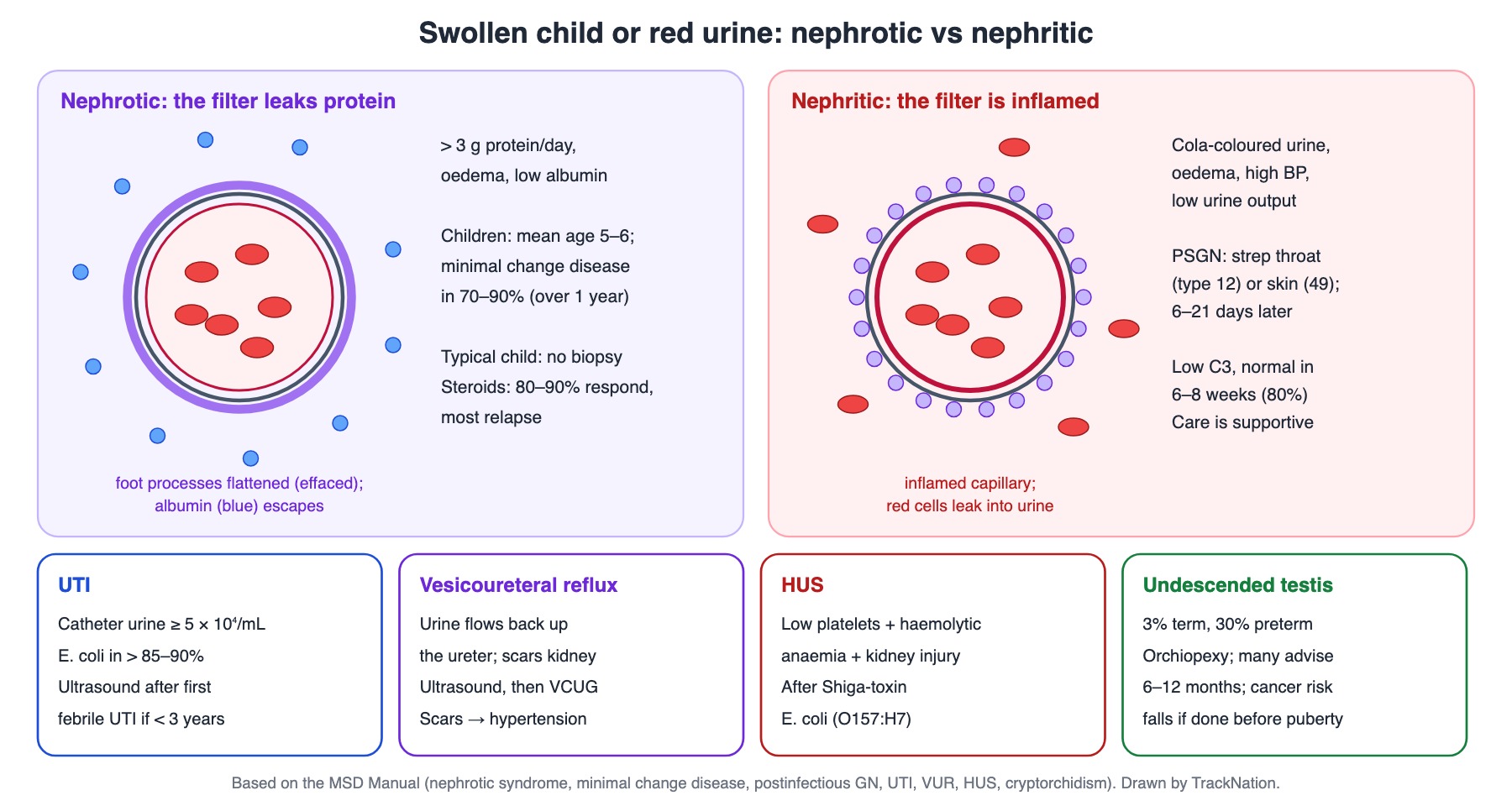
Nephrotic vs nephritic glomerulus, with UTI, reflux, HUS and undescended testis. Drawn by TrackNation.
Nephrotic Syndrome and Minimal Change Disease
Nephrotic syndrome = heavy proteinuria (> 3 g/day in adult terms) + oedema + hypoalbuminaemia. Commoner in children, mean age 5–6 years; congenital forms appear in the first year.
Minimal change disease causes 70–90% of childhood nephrotic syndrome over 1 year; usually no hypertension or azotaemia; electron microscopy shows effaced podocyte foot processes. A typical child is treated as MCD without biopsy.
Steroids: 80–90% respond, but most relapse; non-responders may need cyclophosphamide or cyclosporine. India's ISPN 2021 guideline covers frequent relapses and steroid dependence (levamisole, mycophenolate, calcineurin inhibitors, rituximab) and complications — oedema, hypovolaemia and serious infections.
Other clues: abdominal pain from ascites or mesenteric oedema; thromboembolism is a recognised complication.
Nephritic: Post-Streptococcal GN and HUS
Post-streptococcal GN: nephritogenic group A strep — type 12 (throat) or type 49 (skin/impetigo); latency 6–21 days (up to 6 weeks). Cola-coloured urine, oedema, hypertension, oliguria.
Alternate complement pathway → low C3 and CH50 (C4 near normal); low complement is essentially confirmatory and returns to normal within 6–8 weeks in 80%. Care is supportive; kidney failure in about 1% of children.
HUS: thrombocytopenia + microangiopathic haemolytic anaemia + acute kidney injury, usually after Shiga-toxin E. coli (O157:H7) infection in children.
UTI and Vesicoureteral Reflux
UTI: ≥ 5 × 10⁴ colonies/mL in a catheter sample (any growth ≥ 10³ on suprapubic aspiration). E. coli > 85–90%. 4–10% of febrile infants without a focus have a UTI. Collect by catheter in infants.
Imaging: kidney and bladder ultrasound after the first febrile UTI in children under 3.
VUR: urine flows back up the ureter; infection reaches the kidney → scarring → later hypertension or kidney dysfunction. Investigate with ultrasound then voiding cystourethrogram (VCUG).
Undescended Testis and Bed-wetting
Cryptorchidism: 3% of term and 30% of preterm boys; half descend in the first month. Treatment is orchiopexy, ideally at 6–12 months (corrected); untreated → subfertility and testicular cancer (risk falls if fixed before puberty).
Nocturnal enuresis without an organic cause: the bed-wetting alarm is the most effective long-term strategy.
Traps the Examiner Sets
MCD: no hypertension, no azotaemia, no biopsy in a typical child — and it relapses.
PSGN: low C3 with near-normal C4; C3 normalises within 6–8 weeks in 80%.
Throat PSGN (type 12) vs skin PSGN (type 49).
HUS triad: low platelets, MAHA, AKI — typically after Shiga-toxin E. coli O157:H7.
Undescended testis: orchiopexy ideally at 6–12 months; cancer risk falls if done before puberty.
Memory Hooks & Shortcuts
Shortcuts to lock in this article's numbers and lists. Each one only re-packages facts proven above.
🧠 Nephrotic = 'Puffy and Protein'; Nephritic = 'Pee red and Pressure up' — nephrotic vs nephritic
🧠 MCD 'Minimal change, maximal response — and many relapses' — MCD
🧠 PSGN 'Throat 12, Skin 49'; C3 back in 6–8 weeks — PSGN
🧠 HUS 'TMA-K': Thrombocytopenia, MAHA, AKI after E. coli O157 — HUS
🧠 Undescended testis: 'fix it by the first birthday' — orchiopexy
Rapid-Revision Cards
Nephrotic
Proteinuria + oedema + low albumin.
Childhood NS
Mean age 5–6; MCD 70–90%.
MCD EM
Foot-process effacement.
MCD
No HTN/azotaemia; no biopsy if typical.
Steroids
80–90% respond; most relapse.
Non-responders
Cyclophosphamide / cyclosporine.
ISPN 2021
Levamisole, MMF, CNIs, rituximab for FR/SD.
Congenital NS
First year of life.
PSGN strains
Type 12 throat; type 49 skin.
PSGN latency
6–21 days.
PSGN signs
Cola urine, oedema, HTN, oliguria.
PSGN complement
Low C3/CH50; C4 normal; normal by 6–8 wk.
PSGN Rx
Supportive; kidney failure ~1%.
HUS
Low platelets + MAHA + AKI; O157:H7.
UTI catheter
≥ 5 × 10⁴/mL.
UTI SPA
≥ 10³/mL.
UTI organism
E. coli > 85–90%.
First febrile UTI < 3 y
Ultrasound.
VUR
Ultrasound then VCUG; scars → HTN.
Undescended testis
3% term, 30% preterm; orchiopexy 6–12 mo.
Enuresis
Bed-wetting alarm.
Sources
Facts in this article were checked against these documents.
MSD Manual Professional: Nephrotic Syndrome; Minimal Change Disease; Postinfectious GN; HUS; UTI in Children; Vesicoureteral Reflux; Cryptorchidism; Urinary Incontinence in Children — Merck & Co., 2025–2026 (link)
Steroid Sensitive Nephrotic Syndrome: Revised Guidelines (Indian Society of Pediatric Nephrology) — Indian Pediatrics, 2021
Test Yourself: Practice Questions
Thirty questions in NEET PG style, many of them OPD scenarios.
Practice Questions (NEET PG pattern)
Original questions written in the style of the exam: +4 for a correct answer, −1 for a wrong one. Every answer was checked against the sources listed above. NEET PG papers are not published by NBEMS, so these are not past-paper questions.
Q1. Nephrotic syndrome is heavy proteinuria with
(a) oedema and hypoalbuminaemia
(b) polyuria
(c) fever and rash
(d) haematuria and hypertension
Show answer
Answer: (a) — MSD.
Q2. The commonest cause of nephrotic syndrome in a 4-year-old is
(a) FSGS
(b) IgA nephropathy
(c) membranous nephropathy
(d) minimal change disease
Show answer
Answer: (d) — 70–90%.
Q3. Mean age at diagnosis of childhood nephrotic syndrome is about
(a) 5–6 years
(b) 12 years
(c) 16 years
(d) 6 months
Show answer
Answer: (a) — MSD.
Q4. Electron microscopy in minimal change disease shows
(a) mesangial IgA
(b) effacement of podocyte foot processes
(c) crescents
(d) subepithelial deposits
Show answer
Answer: (b) — MSD.
Q5. Minimal change disease usually has
(a) low C3
(b) severe hypertension
(c) red cell casts
(d) no hypertension or azotaemia
Show answer
Answer: (d) — MSD.
Q6. In a typical 4-year-old with nephrotic syndrome, kidney biopsy is
(a) contraindicated forever
(b) usually not needed before steroids
(c) always first
(d) needed for diagnosis
Show answer
Answer: (b) — Presumed MCD.
Q7. How many children with MCD respond to steroids?
(a) 30%
(b) 100%
(c) 80–90%
(d) 10%
Show answer
Answer: (c) — Most relapse.
Q8. After responding to steroids, most children with MCD
(a) relapse
(b) need transplant
(c) progress to ESRD
(d) never relapse
Show answer
Answer: (a) — MSD.
Q9. Nephrotic syndrome appearing in the first year of life suggests
(a) congenital nephrotic syndrome
(b) HUS
(c) PSGN
(d) MCD
Show answer
Answer: (a) — MSD.
Q10. Which drug is named in India's ISPN guideline for frequently relapsing nephrotic syndrome?
(a) levamisole
(b) warfarin
(c) digoxin
(d) amphotericin
Show answer
Answer: (a) — Also MMF, CNIs, rituximab.
Q11. Post-streptococcal GN after a throat infection is classically caused by M type
(a) 1
(b) 3
(c) 12
(d) 49
Show answer
Answer: (c) — Type 49 = impetigo.
Q12. Skin (impetigo)-associated PSGN is linked to type
(a) 18
(b) 12
(c) 49
(d) 6
Show answer
Answer: (c) — MSD.
Q13. The typical latency between strep infection and PSGN is
(a) 1–2 days
(b) 6 months
(c) same day
(d) 6–21 days
Show answer
Answer: (d) — Up to 6 weeks.
Q14. A 7-year-old with cola-coloured urine, puffy eyes and high BP 2 weeks after sore throat most likely has
(a) UTI
(b) HUS
(c) post-streptococcal GN
(d) minimal change disease
Show answer
Answer: (c) — Nephritic.
Q15. Complement pattern in PSGN is
(a) high C3
(b) low C3 and CH50 with near-normal C4
(c) normal complement
(d) low C4 only
Show answer
Answer: (b) — Alternate pathway.
Q16. In PSGN, C3 returns to normal in most children within
(a) 2 years
(b) 6–8 weeks
(c) 6 months
(d) 3 days
Show answer
Answer: (b) — 80%.
Q17. Treatment of PSGN is
(a) plasmapheresis for all
(b) cyclophosphamide
(c) supportive
(d) high-dose steroids
Show answer
Answer: (c) — MSD.
Q18. The HUS triad is
(a) haematuria, oedema, hypertension
(b) anaemia, neutropenia, fever
(c) thrombocytopenia, microangiopathic haemolytic anaemia and acute kidney injury
(d) fever, rash, conjunctivitis
Show answer
Answer: (c) — MSD.
Q19. Childhood HUS most often follows infection with
(a) rotavirus
(b) Salmonella Typhi
(c) Streptococcus pyogenes
(d) Shiga-toxin-producing E. coli O157:H7
Show answer
Answer: (d) — MSD.
Q20. UTI in a child on a catheter sample is defined as at least
(a) 10⁷ colonies/mL
(b) any growth
(c) 5 × 10⁴ colonies/mL
(d) 10² colonies/mL
Show answer
Answer: (c) — MSD.
Q21. On suprapubic aspiration, UTI is defined by a count of
(a) 10⁶ colonies/mL
(b) 10⁵ colonies/mL
(c) 10⁷ colonies/mL
(d) 10³ colonies/mL
Show answer
Answer: (d) — MSD.
Q22. The commonest organism in childhood UTI is
(a) E. coli
(b) Proteus
(c) Staph aureus
(d) Klebsiella
Show answer
Answer: (a) — > 85–90%.
Q23. Among febrile infants with no focus, the share with UTI is about
(a) 50%
(b) 4–10%
(c) < 0.1%
(d) 80%
Show answer
Answer: (b) — MSD.
Q24. After a first febrile UTI in a 1-year-old, the usual imaging is
(a) none ever
(b) MRI
(c) kidney and bladder ultrasound
(d) CT abdomen
Show answer
Answer: (c) — Under 3 years.
Q25. Vesicoureteral reflux is best shown by
(a) urine culture
(b) voiding cystourethrogram (VCUG)
(c) plain X-ray
(d) IVU only
Show answer
Answer: (b) — After ultrasound.
Q26. Long-term danger of VUR with recurrent infection is
(a) renal scarring and hypertension
(b) nephrotic syndrome
(c) kidney stones only
(d) bladder cancer
Show answer
Answer: (a) — MSD.
Q27. Undescended testis occurs in about what share of preterm boys?
(a) 30%
(b) 0.3%
(c) 80%
(d) 3%
Show answer
Answer: (a) — 3% at term.
Q28. Orchiopexy for undescended testis is ideally done at
(a) puberty
(b) 5 years
(c) birth
(d) 6–12 months (corrected age)
Show answer
Answer: (d) — MSD.
Q29. Uncorrected undescended testis is associated with
(a) hypospadias always
(b) nephrotic syndrome
(c) subfertility and testicular cancer
(d) Wilms tumour
Show answer
Answer: (c) — MSD.
Q30. The most effective long-term treatment of monosymptomatic bed-wetting is
(a) a bed-wetting alarm
(b) fluid loading at night
(c) antibiotics
(d) punishment
Show answer
Answer: (a) — MSD.
Active Recall
From memory: define nephrotic syndrome and describe minimal change disease and its steroid response, contrast it with post-streptococcal GN including complement, give the HUS triad, UTI colony counts and imaging, VUR investigation, undescended testis management and enuresis treatment.