Electroconvulsive Therapy (Modified ECT) for NEET PG: Indications, Procedure, Electrode Placement, Adverse Effects, Myths and rTMS
Start Here
🎯 Exam priority: High. Expect: modified vs unmodified ECT, first-line indications (suicidal, psychotic depression, catatonia, poor intake), MHCA rules for minors, succinylcholine, electrode placements and their cognitive profile, seizure threshold dosing, the Hamilton cuff, course length, memory effects, ECT in pregnancy, and rTMS, esketamine and light therapy.
CBME mapping: PS 13.1 — describe the process of modified ECT and identify misconceptions associated with ECT. Main Indian source: the Indian Psychiatric Society clinical practice guideline (2023).
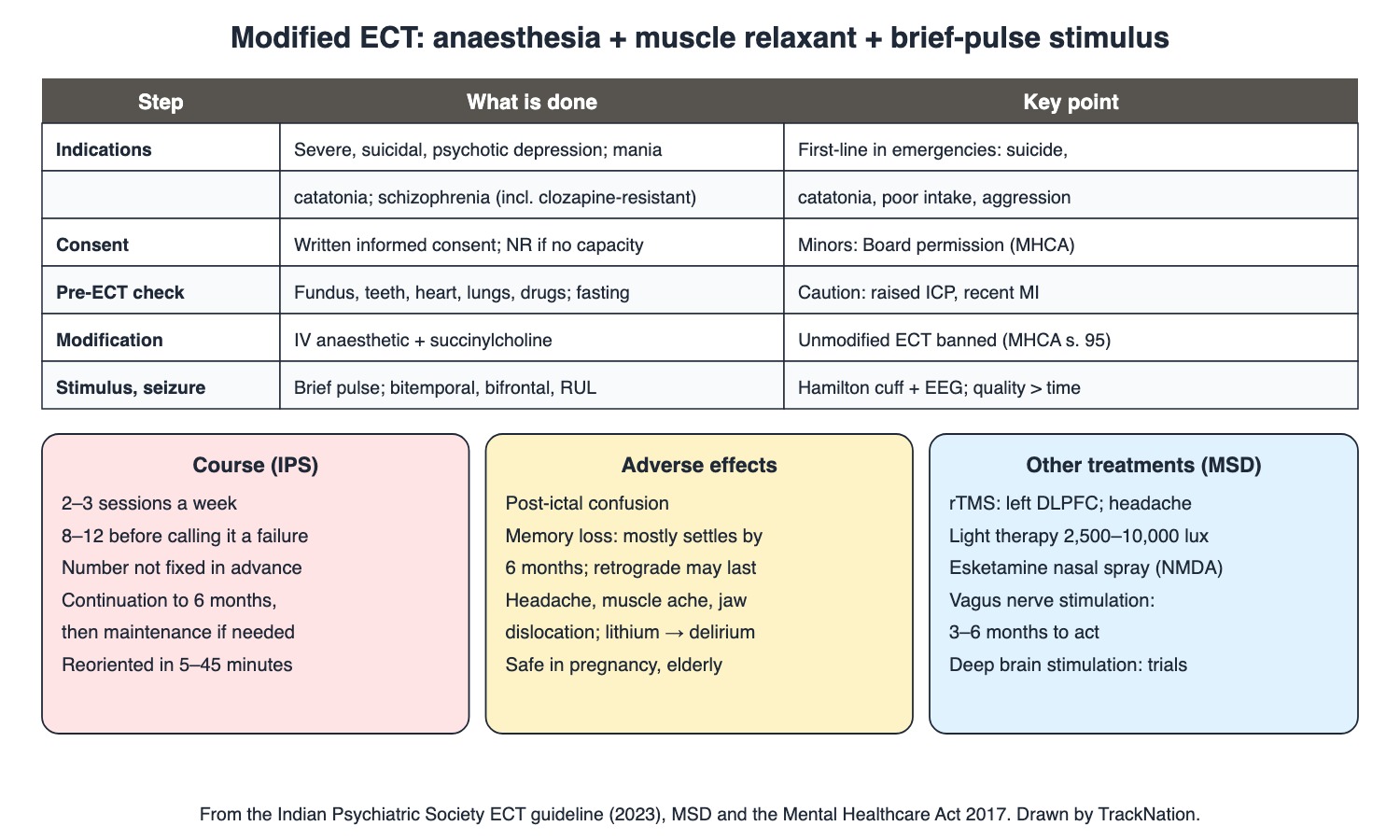
Modified ECT steps, course, adverse effects and other brain treatments. Drawn by TrackNation.
What Modified ECT Is and When to Use It
ECT induces a controlled seizure with a brief electric current; the seizure itself is integral to the effect. Modified ECT = stimulus given under general anaesthesia and muscle relaxation. Unmodified ECT is prohibited under MHCA 2017 (s. 95).
Indications (IPS): depression (poor oral intake, high suicide risk, psychotic or melancholic features, peripartum, treatment resistance), mania (agitation, resistance, delirious mania), schizophrenia (acute exacerbation, treatment-resistant, clozapine augmentation, postpartum psychosis), catatonia (benzodiazepine-resistant, malignant), and NMS. Uncommon: autism with self-injury, dementia aggression, OCD, Parkinson's, intractable epilepsy.
First-line in emergencies across diagnoses: high suicidality, catatonia, excitement, aggression, poor oral intake. It should not be withheld until several drug trials fail in severe depression. Best responders: older age, psychotic features, short episode, past response.
Before ECT: Consent and Checks
Written informed consent after explaining benefits, risks, electrode placement and anaesthesia; if the patient lacks capacity, check the advance directive and take consent from the nominated representative. Minors: guardian's consent, two independent opinions and prior permission of the Mental Health Review Board (MHCA s. 95). Re-consent before continuation ECT.
Examination: fundoscopy (mandatory), teeth, heart, lungs, nervous system; baseline cognition (Indian tool: B4ECT-RECODE). Drugs: anticonvulsants raise the seizure threshold, clozapine and chlorpromazine lower it, lithium raises post-ictal delirium, TCAs add cardiac risk.
IPS lists these as conditions needing caution: raised intracranial pressure or brain mass, unstable aneurysm, recent stroke, phaeochromocytoma, raised intraocular pressure or retinal detachment, recent MI (wait 4–6 weeks), unstable arrhythmia, high anaesthetic risk, fractures or spinal injury. Fast: clear fluids 2 h, light meal 6 h, fatty food 8 h. Stop theophylline 24 h before.
The Procedure
Anaesthesia: short-acting IV agent — propofol (shortens seizures, raises threshold, stable haemodynamics), thiopentone, etomidate or ketamine (prolong or enhance seizures; useful with a high threshold), methohexital (considered the gold standard but scarce). Muscle relaxant: succinylcholine 0.3–1 mg/kg; use a non-depolarising agent in pseudocholinesterase deficiency or recent organophosphate poisoning (suspect it after a recent suicide attempt).
Stimulus: brief (0.5–2 ms) or ultrabrief (0.2–0.4 ms) pulse from a constant-current device; sine-wave machines are obsolete. Charge = current × pulse width × frequency × train duration.
Electrodes: bitemporal (classical), bifrontal (as effective, fewer cognitive effects), right unilateral (fewest cognitive effects; evidence only in depression). Dose: find the seizure threshold by titration in session 1, then 1.5× threshold for bilateral and 4–6× for right unilateral.
Seizure monitoring: the Hamilton cuff isolates one limb from the relaxant to show the motor seizure; EEG shows recruitment, polyspikes and post-ictal suppression. Quality matters more than the old 15 s motor / 25 s EEG rule. No seizure 20 s after the stimulus → restimulate at a higher dose. Seizure beyond 120 s → terminate (prolonged = over 180 s). Recover in left lateral position; no feeding until fully awake.
Course, Aftercare and Adverse Effects
Usually 2–3 sessions a week; the number is not fixed in advance; give 8–12 before calling it a failure (schizophrenia needs more than mood disorders). MSD: response in the first 6–12 is often rapid; relapse is common, so continue medicines. Continuation ECT up to 6 months, then maintenance every 1–12 weeks.
Post-ictal confusion (reorientation in 5–45 minutes); memory impairment — mostly resolves by 6 months, but retrograde amnesia for the months before ECT can persist; risk higher with bilateral ECT, old age, baseline deficits and lithium. Reduce by spacing sessions, unilateral placement, briefer pulses, lower dose.
Others: headache, muscle ache (worst after the first session), temporomandibular dislocation, nausea, tardive seizure, treatment-emergent mania.
Special groups: safe and preferred in pregnancy (left lateral tilt, fetal monitoring); safe and effective in the elderly; in children avoid etomidate and ketamine because prolonged seizures are commoner.
Misconceptions vs Facts
Misconception | Fact (source) |
ECT is given awake and is painful | Modified ECT is under general anaesthesia and muscle relaxation (IPS) |
ECT is a last resort | First-line in emergencies; not to be withheld until many drug trials fail (IPS) |
ECT causes permanent memory loss in everyone | Most memory effects resolve by 6 months; retrograde gaps can persist (MSD) |
ECT is dangerous in pregnancy and old age | Safe and effective; preferred option in pregnancy (IPS) |
One course cures for good | Relapse is common; medicines or continuation ECT follow (MSD, IPS) |
Any doctor can give ECT in an emergency | MHCA s. 94 bars ECT as emergency treatment |
Other Physical Treatments (MSD)
rTMS: high-frequency over the left (or low-frequency over the right) dorsolateral prefrontal cortex; good trial support in major depression; adverse effects headache and scalp discomfort; also used in bipolar depression.
Phototherapy: 2,500–10,000 lux at 30–60 cm for 30–60 minutes a day; seasonal and non-seasonal depression.
Ketamine/esketamine (NMDA antagonists) for treatment-resistant depression; esketamine is a nasal spray — observe 2 hours, no driving until the next day.
Vagus nerve stimulation (implanted generator; 3–6 months to work) and deep brain stimulation (still under trial) for refractory depression.
Traps the Examiner Sets
Unmodified ECT and ECT as MHCA emergency treatment are both barred.
Right unilateral = fewest cognitive effects; bitemporal = classical.
Lithium with ECT raises delirium risk.
Hamilton cuff shows the motor seizure despite the relaxant.
Memory Hooks & Shortcuts
Shortcuts to lock in this article's numbers and lists. Each one only re-packages facts proven above.
🧠 Modified ECT = 'Sleep + Still + Spark': anaesthesia, relaxant, brief pulse — procedure
🧠 First-line '4 S's': Suicidal, Stuporous (catatonia), Starving, Storming (aggression) — indications
🧠 'Right unilateral = right for memory' — placement
🧠 'Lithium + ECT = Lost and confused' — drug caution
🧠 'Cuff the limb, catch the fit' — Hamilton cuff
Rapid-Revision Cards
Modified ECT
GA + muscle relaxant.
Unmodified ECT
Banned (MHCA s. 95).
First-line ECT
Suicide, catatonia, poor intake, aggression.
Severe depression
Don't withhold ECT.
Clozapine-resistant
ECT augmentation.
Good response
Older, psychotic, short episode.
Minors
Guardian + Board permission.
Mandatory exam
Fundoscopy.
Lithium + ECT
Delirium, memory risk.
Recent MI
Wait 4–6 weeks.
Relaxant
Succinylcholine.
Recent OP poisoning
Non-depolarising agent.
Stimulus
Brief pulse, constant current.
Fewest cognitive effects
Right unilateral.
Bilateral dose
1.5× threshold.
Hamilton cuff
Shows motor seizure.
Seizure > 120 s
Terminate.
Course
2–3/week; 8–12 before failure.
Memory
Mostly back by 6 months.
Pregnancy
Safe, preferred.
rTMS side effect
Headache.
Sources
Facts in this article were checked against these documents.
Clinical Practice Guidelines for the Use of Electroconvulsive Therapy (Thirthalli J, Sinha P, Sreeraj VS) — Indian Journal of Psychiatry 65(2):258–269 (Indian Psychiatric Society; CC BY-NC-SA), 2023 (link)
MSD Manual Professional: Depressive Disorders; Bipolar Disorders; Medications for Treatment of Depression — Merck & Co. (MSD Manuals), 2025–26 (link)
The Mental Healthcare Act, 2017, sections 94 and 95 — Gazette of India, 2017 (link)
Competency Based Undergraduate Curriculum, Psychiatry (PS 13) — National Medical Commission, 2024
Test Yourself: Practice Questions
Thirty questions in NEET PG style, most of them clinical vignettes.
Practice Questions (NEET PG pattern)
Original questions written in the style of the exam: +4 for a correct answer, −1 for a wrong one. Every answer was checked against the sources listed above. NEET PG papers are not published by NBEMS, so these are not past-paper questions.
Q1. Modified ECT differs from the older unmodified form because the stimulus is given
(a) under general anaesthesia and muscle relaxation
(b) without anaesthesia
(c) only on the right side
(d) with sine-wave current
Show answer
Answer: (a) — Definition.
Q2. Under MHCA 2017, which of these is prohibited?
(a) ECT in pregnancy
(b) ECT without muscle relaxants and anaesthesia
(c) ECT in the elderly
(d) ECT for mania
Show answer
Answer: (b) — Section 95.
Q3. A severely depressed man has stopped eating and drinking and voices a firm plan to end his life. The best next step is
(a) urgent ECT as first-line treatment
(b) wait 6 weeks for an SSRI
(c) start psychotherapy only
(d) give vitamins
Show answer
Answer: (a) — Emergency indication.
Q4. IPS advises that in severe depression ECT
(a) needs 5 failed drugs
(b) is never used
(c) is only a last resort
(d) should not be withheld until several drug or psychotherapy trials fail
Show answer
Answer: (d) — Not a last resort.
Q5. A patient with catatonia has not responded to a lorazepam trial. The treatment of choice is
(a) observation
(b) ECT
(c) haloperidol
(d) SSRI
Show answer
Answer: (b) — Benzodiazepine-resistant catatonia.
Q6. In schizophrenia that has not responded to clozapine, an evidence-based option is
(a) stopping all drugs
(b) psychoanalysis
(c) ECT as clozapine augmentation
(d) adding an SSRI only
Show answer
Answer: (c) — IPS table 1.
Q7. A predictor of good response to ECT is
(a) young age with mild symptoms
(b) older age with psychotic symptoms
(c) long episode duration
(d) personality disorder
Show answer
Answer: (b) — Also past response.
Q8. For a 16-year-old who needs ECT, MHCA requires
(a) a court order
(b) guardian's consent and prior permission of the Mental Health Review Board
(c) only the patient's consent
(d) no special step
Show answer
Answer: (b) — Section 95(2).
Q9. Which examination does IPS make mandatory before ECT?
(a) colonoscopy
(b) bone densitometry
(c) spirometry
(d) fundoscopy
Show answer
Answer: (d) — Plus dental, cardiac, pulmonary.
Q10. A patient on lithium is scheduled for ECT. The specific concern is
(a) post-ictal delirium and memory impairment
(b) hypertension
(c) hypoglycaemia
(d) missed seizures from lithium
Show answer
Answer: (a) — Reduce if level > 0.6.
Q11. A patient on high-dose valproate has repeatedly missed seizures with ECT. The likely reason is that
(a) valproate lowers the threshold
(b) anticonvulsants raise the seizure threshold
(c) ECT dose is too high
(d) succinylcholine blocks seizures
Show answer
Answer: (b) — Review drugs.
Q12. A patient had an MI 2 weeks ago and now has severe depression. IPS suggests
(a) waiting 4–6 weeks after the MI if possible
(b) no cardiac review
(c) ECT is absolutely contraindicated forever
(d) ECT today
Show answer
Answer: (a) — Recent MI needs caution.
Q13. Before morning ECT a patient may take clear liquids up to
(a) 8 hours before
(b) 2 hours before
(c) immediately before
(d) 12 hours before
Show answer
Answer: (b) — Light meals 6 h, fatty 8 h.
Q14. The preferred muscle relaxant for modified ECT is
(a) baclofen
(b) succinylcholine
(c) pancuronium
(d) dantrolene
Show answer
Answer: (b) — 0.3–1 mg/kg.
Q15. A patient referred for ECT attempted suicide 3 weeks ago by an unknown poison. The concern with succinylcholine is
(a) malignant hyperthermia always
(b) no concern
(c) prolonged apnoea from organophosphate-related cholinesterase deficiency
(d) seizure failure
Show answer
Answer: (c) — Consider a non-depolarising agent.
Q16. An anaesthetic that shortens seizure duration and raises the seizure threshold but gives stable haemodynamics is
(a) ketamine
(b) propofol
(c) methohexital
(d) etomidate
Show answer
Answer: (b) — Etomidate prolongs seizures.
Q17. Modern ECT machines should deliver
(a) direct current
(b) sine-wave current
(c) constant voltage
(d) brief or ultrabrief pulses with constant current
Show answer
Answer: (d) — Sine wave obsolete.
Q18. The electrode placement with the fewest cognitive adverse effects is
(a) left anterior right temporal
(b) right unilateral
(c) bitemporal
(d) bilateral parietal
Show answer
Answer: (b) — Evidence only in depression.
Q19. Compared with bitemporal placement, bifrontal ECT is
(a) more confusing
(b) less effective
(c) as effective or more, with fewer cognitive effects
(d) only for children
Show answer
Answer: (c) — Mania, depression, schizophrenia.
Q20. For bilateral brief-pulse ECT, IPS recommends a charge of about
(a) 6 times the threshold
(b) the maximum device dose always
(c) 1.5 times the seizure threshold
(d) half the threshold
Show answer
Answer: (c) — 4–6× for right unilateral.
Q21. The Hamilton cuff technique is used during ECT to
(a) see the motor seizure in a limb isolated from the muscle relaxant
(b) measure blood pressure
(c) prevent aspiration
(d) deliver the stimulus
Show answer
Answer: (a) — Shows generalisation.
Q22. Regarding the old rule of 25 seconds of EEG seizure, IPS now says
(a) longer is always better
(b) 25 s is mandatory
(c) duration alone predicts response
(d) seizure quality matters more than any fixed duration
Show answer
Answer: (d) — Old rule of little value.
Q23. No motor or EEG seizure appears 20 seconds after the stimulus. You should
(a) stop ECT permanently
(b) wait 1 hour
(c) give a second anaesthetic only
(d) restimulate at a higher dose
Show answer
Answer: (d) — Watch for delayed onset.
Q24. An ECT seizure is still continuing at 130 seconds. The correct action is to
(a) give succinylcholine again
(b) restimulate
(c) wait until 10 minutes
(d) terminate it (e.g. with a benzodiazepine or the induction agent)
Show answer
Answer: (d) — Prolonged > 180 s.
Q25. A depressed patient has had 5 ECT sessions with little improvement. IPS advises
(a) switch to unmodified ECT
(b) stop now
(c) continue to at least 8–12 sessions before calling it a failure
(d) double the frequency to daily
Show answer
Answer: (c) — Number not fixed.
Q26. The usual frequency of an acute ECT course is
(a) 2–3 sessions a week
(b) daily
(c) once a month
(d) twice a day
Show answer
Answer: (a) — Then taper.
Q27. After a course of ECT a patient reports gaps in memory for events of the preceding months. The accurate counselling is that
(a) this never happens
(b) this means brain damage
(c) memory always returns in a day
(d) most memory effects resolve by 6 months but retrograde gaps may persist
Show answer
Answer: (d) — Honest consent.
Q28. A woman 24 weeks pregnant has severe psychotic depression. Regarding ECT
(a) only after delivery
(b) it is safe, effective and a preferred option, with left lateral tilt and fetal monitoring
(c) only unmodified ECT is allowed
(d) it is absolutely contraindicated
Show answer
Answer: (b) — Lower teratogenic risk than many drugs.
Q29. A patient with treatment-resistant depression receives esketamine. After each dose he should be
(a) observed for 2 hours and not drive until the next day
(b) started on an MAOI
(c) sent home at once
(d) given ECT the same day
Show answer
Answer: (a) — NMDA antagonist.
Q30. The commonest adverse effects of rTMS for depression are
(a) weight gain
(b) memory loss
(c) headache and scalp discomfort
(d) seizures in most patients
Show answer
Answer: (c) — More with high frequency.
Active Recall
From memory: define modified ECT and list its indications and first-line uses, describe consent rules and pre-ECT checks, outline the anaesthesia, stimulus, electrode placement and seizure monitoring, give the usual course and adverse effects, and correct three common misconceptions; name two other brain treatments.