Poverty and Development for UPSC: Latest Poverty Estimates, the Agrarian Structure, Land Reforms, the Green Revolution and Footloose Labour
How Poor Is India Now?
🎯 Exam priority: Important (Mains). The syllabus names "poverty and developmental issues", and the 2025 paper asked whether environmental protection conflicts with the needs of the poor. The NCERT chapter on rural change explains why poverty persists; the Economic Survey gives the latest numbers.
How poor is India now?
Measure | Latest estimate |
World Bank international poverty line | Raised in June 2025 from USD 2.15 to USD 3.00 a day (2021 purchasing power) |
Extreme poverty, 2022-23 | 5.3% |
Lower-middle-income poverty, 2022-23 | 23.9% |
World Bank multidimensional poverty measure, 2022-23 | 15.5% |
NITI Aayog Multidimensional Poverty Index | Measures deprivation in health, education and living standards; gaps between States have narrowed, with the poorest States improving fastest |
Why it has fallen: the Survey credits targeted welfare schemes, economic reforms and wider access to essential services, alongside steady gains in life expectancy, infant mortality and school enrolment. It also cautions that the new estimates are not directly comparable with earlier poverty lines. Poverty also follows social lines: in 2011-12, 45.3% of rural Scheduled Tribes and 31.5% of rural Scheduled Castes were below the poverty line, against 15.5% of forward castes and 25.4% overall.
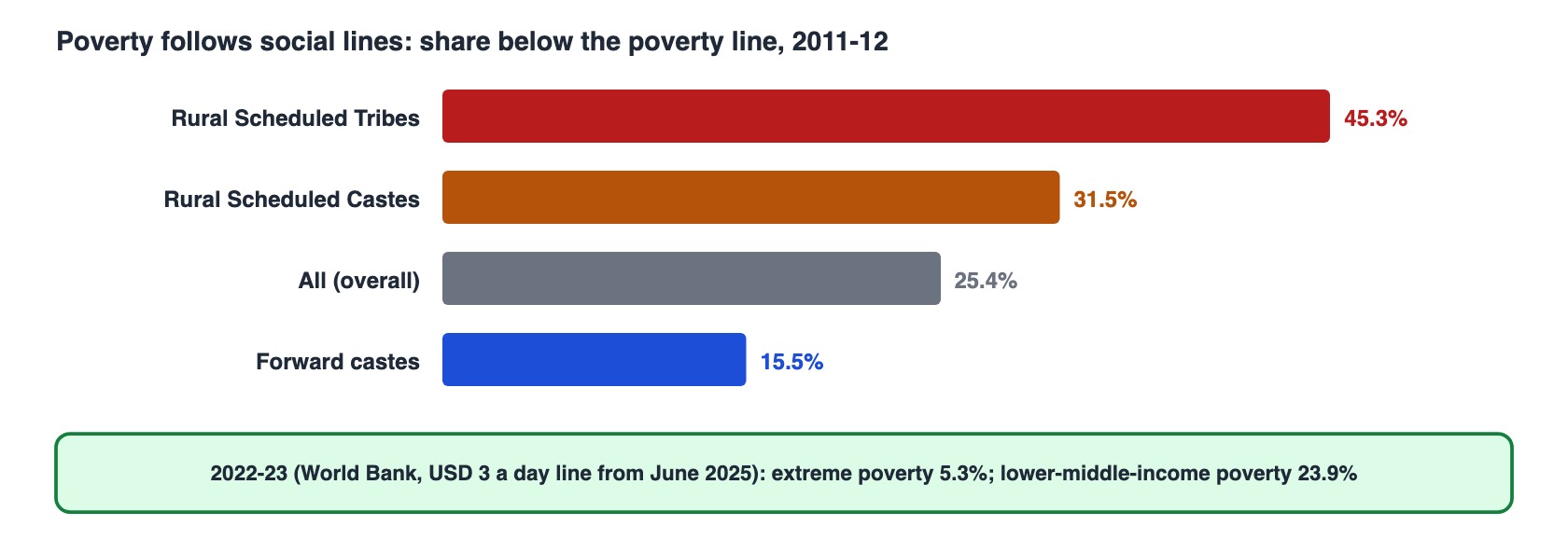
Poverty by social group in 2011-12, and the newest World Bank estimates.
A sociological lens: poverty is unequal access to resources. Bourdieu's three forms of capital (economic, cultural and social) explain why it is inherited: a poor family lacks not only income but also education and networks, and each kind of capital helps buy the others.
Land, Caste and the Agrarian Structure
Most of India's poor have always been rural, so rural social structure is where poverty begins.
Land, caste and the agrarian structure
Land is the key resource in rural society, and its distribution is highly unequal; land ownership and caste overlap. Practices such as begar (unpaid labour owed by low castes to the landlord) survived in parts of north India until recently.
Colonial roots: under the zamindari system, intermediaries squeezed cultivators and production stagnated; under raiyatwari ("raiyat" means cultivator in Telugu) cultivators paid tax directly, had more incentive to invest, and those areas became more prosperous.
Land reform | What happened |
Abolition of zamindari | Removed intermediaries; the most effective reform, weakening the zamindars' economic and political power |
Tenancy abolition and regulation | Poorly implemented in most States; radical change only in West Bengal and Kerala, where tenants got land rights |
Land ceilings | Limits on family holdings; largely evaded through 'benami' transfers to relatives |
From patronage to exploitation
Where farming commercialised after independence, especially in Green Revolution areas, rural social relations changed in four ways: more hired labour as cultivation intensified; wages paid in cash instead of grain; hereditary (often bonded) ties between landowners and workers loosened; and a class of "free" wage labourers emerged. Jan Breman called the change in the relation between dominant-caste landlords and low-caste workers a shift "from patronage to exploitation". Some scholars read it as a transition to capitalist agriculture, which separates workers from the land and uses free wage labour.
Market links are old: in the 19th century Maharashtra's cotton farmers were already tied to the world market; after 1947 the state sped this up with irrigation, roads, electricity, inputs and credit through banks and cooperatives.
New rural elites: in coastal Andhra Pradesh, western UP and central Gujarat, well-to-do dominant-caste farmers invested farm profits in business, moved into towns and became regional elites, economically and politically dominant.
The NCERT verdict: the agrarian structure remains highly unequal, and land reform is needed not only for growth but to end rural poverty and secure social justice. Outcomes diverge: in eastern UP and Bihar, weak reforms and little redistribution changed little; Kerala's political mobilisation, redistribution and Gulf remittances transformed its villages into a mixed economy.
The Green Revolution and After
Development itself created new inequalities.
The Green Revolution and after
What it was: a 1960s-70s programme of high-yielding seeds, fertilisers and pesticides, only where irrigation was assured and mainly for wheat and rice (Punjab, western UP, coastal Andhra Pradesh and similar regions).
Who gained: farmers who produced a surplus for the market, not peasants in subsistence farming. Expensive inputs favoured medium and large farmers, and tenant-cultivators were often displaced. Regional inequality worsened, between the Green Revolution belt and the east.
Circulation of labour: workers from drought-prone, less productive regions migrate for part of the year to farms in Punjab and Haryana, brick kilns in UP and construction sites in Delhi or Bangalore, often leaving women and children behind with grandparents. Jan Breman called them "footloose labour", but the term does not mean freedom: they are usually paid below the minimum wage.
Feminisation of agricultural labour: as men migrate, women do more of the farm work, at lower wages, and are still largely excluded from owning land.
Globalisation: contract farming (the company specifies the crop and inputs and buys at a fixed price) gives a market but shifts risk and dependence; agrarian distress, high-cost inputs and the shift to cash crops lie behind the wave of farmers' suicides since 1997-98 (8,900 in Andhra Pradesh, Karnataka, Kerala and Maharashtra between 2001 and 2006, by official figures the NCERT text cites). The state's withdrawal from farm extension, replaced by multinational seed and fertiliser firms, added to the risk.
Writing the answer (2025): growth, environment and the poor
Agree that the conflict is real in the short run: the poor depend most directly on forests, land, water and fish, and conservation that fences these off, or "clean" industry that displaces them, falls hardest on them. But the poor also suffer most from degradation (polluted water, failed rains, heat). The way out is inclusive sustainability: secure rights to commons (forest rights, article 4), green jobs and skills, compensation and transition support, and growth that reaches the regions and groups the Green Revolution left behind. Close with the sociological point of this article: poverty is reproduced through land, caste and missing capital, so environmental policy that ignores these structures will widen inequality, while policy that builds the assets of the poor can make conservation and poverty reduction work together.
Further Reading
PIB press releases, ministry websites and annual reports, the Gazette of India, MEA and UN documents and the official sources named in each note — the primary sources behind every fact above.
Test Yourself: Practice Questions & PYQs
12 practice questions, then the GS Paper 1 question on poverty and development.
Practice Questions
Q1. In June 2025 the World Bank raised its international poverty line to
(a) USD 3.00 a day (2021 PPP)
(b) USD 1.90 a day
(c) USD 2.15 a day
(d) USD 4.20 a day
Show answer
Answer: (a) — On this line, India's extreme poverty in 2022-23 was 5.3%.
Q2. According to the Economic Survey 2025-26, India's extreme poverty rate in 2022-23 on the revised World Bank line was
(a) 12.4%
(b) 15.5%
(c) 5.3%
(d) 23.9%
Show answer
Answer: (c) — 23.9% is lower-middle-income poverty; 15.5% is the World Bank multidimensional measure.
Q3. Under the raiyatwari system,
(a) zamindars collected revenue
(b) land was owned by the village community
(c) cultivators paid land tax directly to the government
(d) temples owned all land
Show answer
Answer: (c) — 'Raiyat' means cultivator in Telugu; these areas became relatively more prosperous.
Q4. According to the NCERT text, the most effective land reform after independence was
(a) land ceilings
(b) tenancy regulation
(c) abolition of zamindari
(d) the Bhoodan movement
Show answer
Answer: (c) — It removed the intermediaries between cultivators and the state.
Q5. Land ceiling laws were widely evaded through
(a) benami transfers
(b) raiyatwari
(c) contract farming
(d) begar
Show answer
Answer: (a) — Land was transferred to relatives and others to stay under the ceiling.
Q6. In which States did tenancy reform bring a radical restructuring of the agrarian structure?
(a) West Bengal and Kerala
(b) Punjab and Haryana
(c) Gujarat and Maharashtra
(d) Bihar and UP
Show answer
Answer: (a) — Elsewhere tenancy laws were poorly implemented.
Q7. The NCERT text distinguishes 'peasants' from 'farmers'. Farmers are those who
(a) work only for wages
(b) produce a surplus for the market
(c) own no land
(d) grow only food crops
Show answer
Answer: (b) — Farmers gained most from the Green Revolution.
Q8. The term 'footloose labour' for seasonal migrant workers was used by
(a) M.N. Srinivas
(b) Jan Breman
(c) Andre Beteille
(d) Amartya Sen
Show answer
Answer: (b) — It does not mean freedom: such workers are usually paid below the minimum wage.
Q9. 'Feminisation of the agricultural labour force' refers to
(a) women owning more land
(b) women leaving agriculture
(c) women doing an increasing share of farm work as men migrate
(d) more women entering factories
Show answer
Answer: (c) — Women still earn lower wages and are largely excluded from land ownership.
Q10. Consider the following statements:
1. The Green Revolution was introduced mainly in areas with assured irrigation.
2. It worsened regional inequalities.
3. Small and marginal farmers gained the most from it.
Which of the statements given above are correct?
(a) 1 and 2 only
(b) 2 and 3 only
(c) 1 and 3 only
(d) 1, 2 and 3
Show answer
Answer: (a) — 1 and 2 are correct. Expensive inputs favoured medium and large farmers.
Q11. In contract farming, the company usually
(a) pays only minimum support price
(b) specifies the crop, supplies inputs and buys at a fixed price
(c) sells seeds but never buys produce
(d) leases the farmer's land
Show answer
Answer: (b) — It assures a market but increases the farmer's dependence.
Q12. Kerala's rural transformation is attributed in the NCERT text to
(a) the Green Revolution
(b) zamindari
(c) political mobilisation, redistribution and Gulf remittances
(d) contract farming
Show answer
Answer: (c) — Its villages became a mixed economy of farming, retail and services.
Mains Practice Questions
Use these to frame full-length answers. You don't have to answer one exactly — they show the angles UPSC tests, so let them guide which points you cover.
Achieving sustainable growth with environmental protection could conflict with poor people's needs. Comment.
Why have land reforms had only a limited impact on rural poverty?
How did the Green Revolution change rural inequality?
UPSC Mains — Previous Years’ Questions on this topic (last 10 years)
These are the actual GS Mains questions UPSC has asked on this theme — real proof of how, and when, it is tested. Try to write a full answer to each.
2025 (GS-I): Achieving sustainable growth with emphasis on environmental protection could come into conflict with poor people's needs in a country like India. Comment.