Read This First: CSAT (UPSC Prelims Paper II), the 33% Rule, What the 2016-2026 Papers Contain and a Plan to Clear It
Start Here: The CSAT Rules
🎯 Start here. CSAT (General Studies Paper II) does not add a single mark to your Prelims score, but if you score below 33% in it, your Paper I score is not even counted. This page sets out the rules, what the paper really contains, and a plan that makes it safe.
The rules, from the UPSC notification
Item | CSAT (Paper II) |
Questions and marks | 80 questions, 200 marks, so 2.5 marks each (all items carry equal marks) |
Time | Two hours, the same as Paper I |
Negative marking | One-third of the question's marks for a wrong answer: 0.83; two answers marked count as wrong; a blank costs nothing |
Qualifying line | 33%, which is 66 marks out of 200 |
What happens if you miss it | UPSC draws up the list for Mains from candidates who clear 33% in Paper II and the cut-off in Paper I; Paper II marks themselves do not count for ranking |
Both papers compulsory | A candidate who skips either paper is disqualified |
The syllabus, as notified: comprehension; interpersonal skills including communication skills; logical reasoning and analytical ability; decision making and problem solving; general mental ability; basic numeracy (numbers and their relations, orders of magnitude, Class X level); and data interpretation (charts, graphs, tables, data sufficiency, Class X level).
What the Papers Actually Contain
The syllabus is broad, but the papers are not.
What the papers actually contain
We counted the question types in every official Paper II from 2016 to 2026 (series A, from upsc.gov.in). Comprehension items are those introduced by the passage directions; data-sufficiency items are those set as a "Question" with "Statement I" and "Statement II".
Year | Comprehension items (of 80) | Data-sufficiency items | Note |
2016 | 27 | 0 | |
2017 | 33 | 0 | The most passage-heavy paper |
2018 | 26 | 0 | |
2019 | About 30 | 0 | |
2020 | 25 | 0 | |
2021 | 27 | 3 | Data sufficiency appears |
2022 | 27 | 6 | |
2023 | 27 | 5 | |
2024 | 27 | 10 | |
2025 | 29 | 5 | Eight passage sets |
2026 | 23 | 5 | Eleven short passages, mostly two items each |
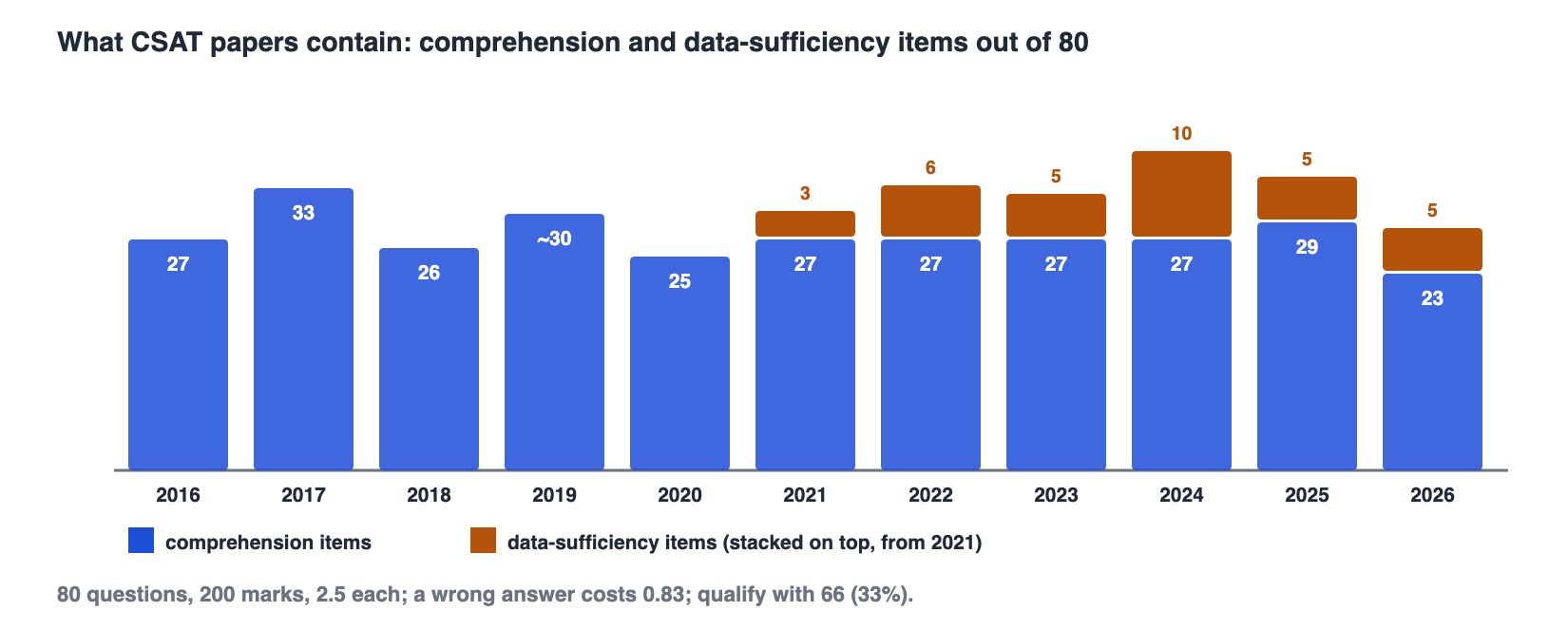
What the CSAT papers of 2016-2026 actually contained.
Comprehension is about a third of the paper (23 to 33 items a year). It is the cheapest marks for most candidates.
The rest is maths and reasoning: number properties, percentages, ratios, time and work, speed, counting, clocks and calendars, codes, directions, arrangements, and statement-conclusion items. These decide whether you clear 66 comfortably.
Data sufficiency has been a fixed block since 2021 (3 to 10 items). Charts and tables, by contrast, are now rare.
No situational "what would you do" questions appear in any paper from 2016 to 2026, though "decision making" is still in the syllabus. The "decision making and problem solving" article in this playlist covers the puzzle-type problem solving that is actually set.
A Plan That Makes CSAT Safe
Treat CSAT as a pass-or-fail test you must not fail.
A plan that makes it safe
Aim well above 66. Because of the negative marks, a target of about 100 to 110 leaves room for a hard paper. That is roughly 40 to 44 correct answers with few wrong ones.
Take a diagnostic first. Sit one past paper under exam conditions. If you score above 120, a past paper every fortnight is enough. If you score below 90, give CSAT 45 minutes a day until Prelims, starting now.
Order of attack in the exam: comprehension sets first (about 60 minutes for the passages), then the maths and reasoning items you can solve in under two minutes, then a second pass. Leave lengthy calculations for the end.
Guessing: with four options and a one-third penalty, a blind guess gains nothing on average. If you can rule out two options, a guess is worth taking.
Use this playlist in order: comprehension, numeracy, reasoning, data interpretation and sufficiency, problem solving. Each article teaches the method through real UPSC questions with the official answer, then gives practice. This playlist's weekly test draws on all of them.
# | Article | What you get |
1 | Reading comprehension | The five question types, the method, traps, real passages |
2 | Basic numeracy | Number properties, percentages, ratio, averages, work, speed, counting |
3 | Logical reasoning | Clocks, calendars, directions, codes, sequences, statements and conclusions |
4 | Data interpretation and data sufficiency | Reading tables and charts; the five-option logic of data sufficiency |
5 | Decision making and problem solving | Puzzles, maximum-minimum, cases and elimination |
Further Reading
PIB press releases, ministry websites and annual reports, the Gazette of India, MEA and UN documents and the official sources named in each note — the primary sources behind every fact above.
Test Yourself: Quick Revision
8 quick questions on the rules and the pattern.
Practice Questions
Q1. How many marks does each CSAT question carry?
(a) 2
(b) 2.5
(c) 3
(d) 2.25
Show answer
Answer: (b) — 200 marks over 80 questions.
Q2. What is deducted for a wrong answer in CSAT?
(a) Nothing
(b) 0.83 marks
(c) 1 mark
(d) 0.66 marks
Show answer
Answer: (b) — One-third of 2.5.
Q3. The qualifying mark in CSAT is
(a) 50 out of 200 (25%)
(b) 66 out of 200 (33%)
(c) 80 out of 200 (40%)
(d) There is no minimum
Show answer
Answer: (b) — Fixed at 33% in the notification.
Q4. If you leave a CSAT question blank, you
(a) lose 2.5 marks
(b) lose nothing
(c) lose 0.83 marks
(d) lose 0.66 marks
Show answer
Answer: (b) — No penalty for a blank.
Q5. Which part has made up about a third of every CSAT paper from 2016 to 2026?
(a) Reading comprehension
(b) English grammar
(c) Decision making
(d) Data interpretation
Show answer
Answer: (a) — 23 to 33 items a year.
Q6. Data-sufficiency questions have appeared in CSAT every year since
(a) 2026
(b) 2021
(c) They have never appeared
(d) 2016
Show answer
Answer: (b) — 3 to 10 items a year from 2021.
Q7. CSAT marks are used to
(a) break ties in the final merit list
(b) add to the Prelims score for ranking
(c) decide whether Paper I is counted; they do not add to the score
(d) decide the interview marks
Show answer
Answer: (c) — It is a qualifying paper.
Q8. If a candidate marks two options for one question, it is treated as
(a) a wrong answer with the penalty
(b) correct if one option is right
(c) half correct
(d) a blank
Show answer
Answer: (a) — The notification treats it as wrong.
Mains Practice Questions
Use these to frame full-length answers. You don't have to answer one exactly — they show the angles UPSC tests, so let them guide which points you cover.
Work out how many correct answers you need to reach 100 marks if you also make 8 wrong attempts.
Which part of CSAT is your weakest, judged by one timed past paper?
Why is comprehension the cheapest source of marks in CSAT for most candidates?