Read This First: Internal Security and Disaster Management for UPSC, the Playlist Map, 46 Mains PYQs by Year and How to Study
Start Here: What This Playlist Covers
🎯 Start here. Internal security and disaster management make up a fixed block of GS Paper 3 in Mains, and defence and agency facts appear in Prelims. This page maps the playlist, shows how often UPSC asks each theme, and how to prepare.
Every article is built from official sources (Home and Defence Ministry releases, MHA replies in Parliament, the Acts, PIB backgrounders up to November 2026, and the UN Sendai Framework), with the real Mains questions printed at the end.
What is in this playlist
# | Article | Headline items |
1 | Left-Wing Extremism | Naxalbari to Naxal-free (March 2026), 2015 Action Plan, schemes, surrender policy |
2 | North-East and Jammu & Kashmir | Peace accords, AFSPA rollback, Article 370, Operation Sindoor |
3 | Terror financing and organised crime | UAPA 2019, PMLA and ED, BNS, FATF, narco-terror |
4 | Cyber security | CERT-In, NCIIPC, I4C and 1930, IT Rules 2021, DPDP Rules 2025 |
5 | Forces and agencies | CAPFs and their borders, NIA, MAC, NATGRID, NCTC, PRAHAAR 2026 |
6 | Border management | Seven land borders, Myanmar fencing, drones, Vibrant Villages |
7 | Defence | CDS, procurement and indigenisation, exports, Agniveers, exercises |
8 | Disaster management | DM Act and the 2025 amendment, NDRF, funds, Sendai Framework |
The constitutional frame
Who is responsible: public order (entry 1) and police (entry 2) are in the State List. The Union List (entry 2A) covers deploying the Union's armed forces in aid of the civil power. So States lead on policing, and the Centre supplies forces, intelligence, money and specialised agencies.
Article 355: the Union has a duty to protect every State against external aggression and internal disturbance, and to ensure that each State is governed according to the Constitution. Central deployments rest on this duty.
Article 352: a national emergency can be declared for war, external aggression or armed rebellion. The 44th Amendment (1978) replaced the earlier ground "internal disturbance" with "armed rebellion".
This split is why so many Mains questions turn on Centre-State coordination: the NCTC debate, NIA jurisdiction, AFSPA and the deployment of central forces.
The threat map in 2026
Threat | Where it stands | Article |
Left-Wing Extremism | No district classed as LWE-affected since March-April 2026; 'Legacy and Thrust' districts watched to prevent relapse | 1 |
North-East insurgency | Peace accords; AFSPA withdrawn from Tripura and Meghalaya and cut back elsewhere, but still in parts of Manipur, Nagaland and Arunachal; Manipur and the Myanmar border remain sensitive | 2 |
Jammu and Kashmir, cross-border terror | Terrorist-initiated incidents fell from 228 (2018) to 12 (2025); the Pahalgam attack and Operation Sindoor (2025) show the external link | 2, 7 |
Terror finance and organised crime | Hawala, crypto and crowdfunding; over 57 individuals designated as terrorists; FATF 'regular follow-up' | 3 |
Cyber crime and cyber attacks | Fast-growing digital fraud; critical infrastructure protection | 4 |
Borders, drones, narcotics | 791 drone intrusions in 2025, mostly on the Punjab and Rajasthan border, many carrying narcotics; the Myanmar border fence; illegal migration | 6 |
Disasters | Climate change and urban growth raise the risk; the 2025 DM amendment | 8 |
The Home Minister told the Intelligence Bureau's 2026 conference that the three old "hotspots" (Naxalism, the North-East and J&K) had been dealt with, and asked agencies to plan for the next 15-20 years: radicalisation, cyber misinformation, drones, the blue economy, information warfare and bio-security. Expect Mains questions to follow that shift from insurgency to technology-driven threats.
Related: NIA and NDMA structure (Polity 37), defence technology (S&T 12), forest rights and PM-JANMAN (Government Schemes playlist).
How Often UPSC Asks It
This section is far more a Mains theme than a Prelims one.
How often UPSC asks it
Mains GS3 questions quoted in this playlist, by year (46 in all):
Year | Questions | Themes |
2016 | 4 | Border management, social media misuse, urban floods, cloudbursts |
2017 | 3 | North-East insurgency, cyber attacks, terror funding |
2018 | 3 | LWE, drug trafficking, Sendai vs Hyogo |
2019 | 6 | OGWs, CyberDome, UAPA and NIA amendments, Myanmar border, vulnerability, landslides |
2020 | 5 | Cyber crime, border local support, LWE, proactive DM, transborder crime |
2021 | 6 | Money laundering, cross-border cyber attacks, earthquakes, landslides, state and non-state threats, terrorism |
2022 | 4 | Organised crime, cyber security strategy, Naxalism, cloudbursts |
2023 | 2 | Hearts and minds in J&K, drones |
2024 | 5 | Narco-terrorism, China and Pakistan borders, social media, resilience and Sendai, urban floods |
2025 | 2 | Terrorism in India, LWE |
2026 | 6 | Ladakh and BADP, J&K and Article 370, FATF, IT Rules and fake news, infrastructure vs DRR, community participation |
Prelims asks fewer but sharper questions: cyber attack names (2018), the CDS's duties and Exercise Mitra Shakti (2024), and Mission Sudarshan Chakra (2026). These are worked through in the cyber and defence articles.
How to Study This Playlist
A method for this paper:
How to study this playlist
Structure every answer the same way: the threat and its causes, the framework (law, agency, scheme), what has worked (with one or two numbers), gaps, and a way forward. Each article is organised to give you these blocks.
Keep numbers current: LWE districts (126 to zero), J&K indicators, cyber fraud savings, drone intrusions, defence exports. The Current Affairs playlist adds each month's changes, and these articles are updated to match.
Know the institutions cold: which force guards which border, CERT-In vs NCIIPC vs I4C, NIA vs ED, NDMA vs NDRF. Prelims tests exactly this.
Use the precise terms (each is explained in its article): whole-of-government (the 2015 LWE plan), Legacy and Thrust districts (after LWE), disturbed area (the AFSPA trigger), Free Movement Regime (the Myanmar border), predicate offence and hawala (money laundering), grey list (FATF), and Build Back Better (Sendai). An examiner reads them as signs that you know the framework.
Practise with the real questions: each article ends with practice MCQs and the Mains questions UPSC has set on that theme; write at least one answer per article.
Further Reading
PIB press releases, ministry websites and annual reports, the Gazette of India, MEA and UN documents and the official sources named in each note — the primary sources behind every fact above.
For Your Mains Answer
For your Mains answer
✍️ Sketch to draw (30 seconds): the six-box frame for any internal-security answer: threat and scale, drivers, constitutional frame, response, gaps, way forward.
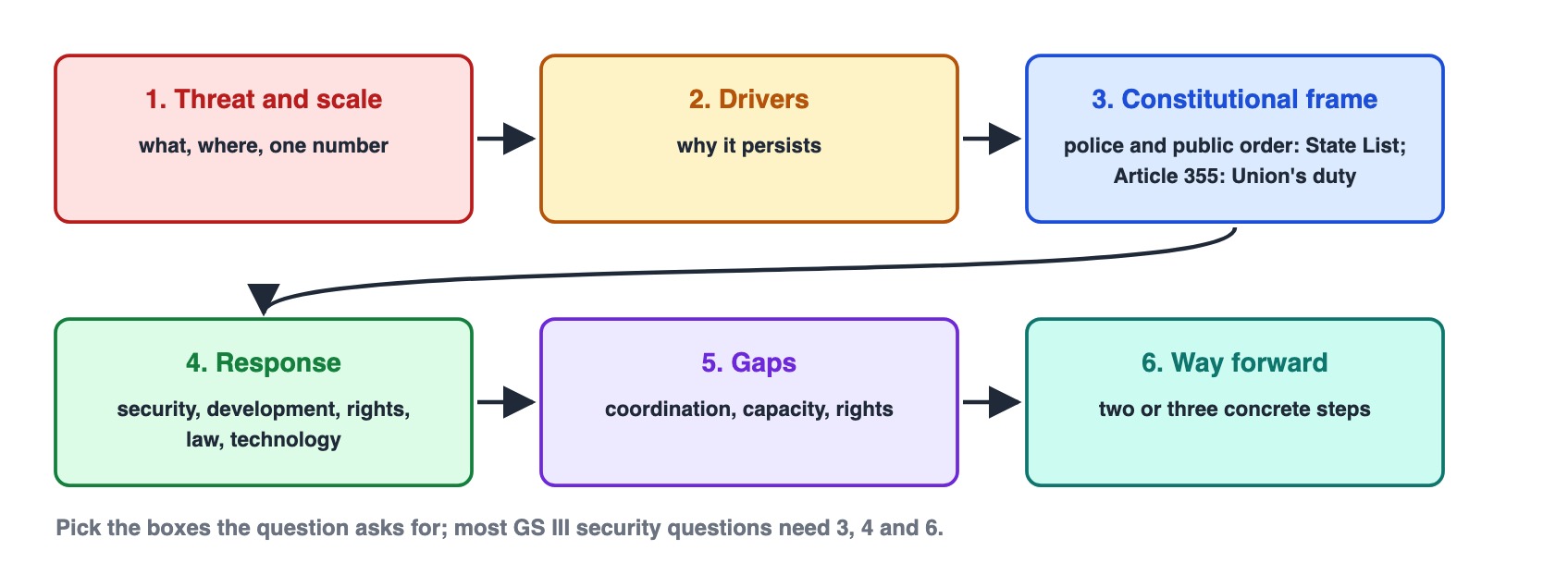
A six-box frame for any internal-security answer. Most GS III questions need the constitutional frame, the response and the way forward.
Use in your answer
Kind | Item to quote |
Constitution | Public order (entry 1) and police (entry 2) are in the State List; the Union List (entry 2A) covers deploying the Union's armed forces in aid of the civil power |
Constitution | Article 355: the Union's duty to protect every State against external aggression and internal disturbance |
Constitution | Article 352: 'armed rebellion' replaced 'internal disturbance' as a ground for national emergency (44th Amendment, 1978) |
Theme to link | Centre-State coordination: the NCTC debate, NIA jurisdiction, AFSPA and central deployments |
An opening for any GS III security question
Police and public order are State subjects, but Article 355 makes the Union responsible for protecting every State against internal disturbance; India's internal security therefore rests on Centre-State coordination.
A way-forward line
Strengthen coordination (intelligence sharing, joint operations, police modernisation) while keeping development and rights in the same plan as security.
Structure any security answer with the six-box frame in the orientation article; the Mains Answer Writing playlist shows full model answers.
Test Yourself: Quick Revision
14 quick questions across the playlist.
Practice Questions
Q1. Which force guards the India-China border?
(a) SSB
(b) Assam Rifles
(c) BSF
(d) ITBP
Show answer
Answer: (d) — See the agencies and borders articles.
Q2. The national nodal agency for protecting critical information infrastructure is
(a) NTRO
(b) NCIIPC
(c) CERT-In
(d) I4C
Show answer
Answer: (b) — Designated under Section 70A of the IT Act.
Q3. Money laundering cases are investigated by the
(a) NIA
(b) CBI
(c) Enforcement Directorate
(d) NCB
Show answer
Answer: (c) — Under the PMLA, 2002.
Q4. The NDRF was constituted under the
(a) NIA Act, 2008
(b) Environment Protection Act, 1986
(c) Disaster Management Act, 2005
(d) Police Act, 1861
Show answer
Answer: (c) — Section 44.
Q5. India's first National Counter Terrorism Policy and Strategy, unveiled in February 2026, is called
(a) SAMADHAN
(b) SUDARSHAN
(c) SURAKSHA CHAKRA
(d) PRAHAAR
Show answer
Answer: (d) — See the agencies article.
Q6. The Free Movement Regime that India decided to scrap in 2024 applied to its border with
(a) Nepal
(b) Myanmar
(c) Bangladesh
(d) Bhutan
Show answer
Answer: (b) — See the borders article.
Q7. The Chief of Defence Staff heads the
(a) Department of Military Affairs
(b) National Security Council Secretariat
(c) Defence Research and Development Organisation
(d) Department of Defence Production
Show answer
Answer: (a) — See the defence article.
Q8. LWE-affected districts fell to zero by
(a) March 2027
(b) March-April 2026
(c) December 2024
(d) August 2025
Show answer
Answer: (b) — See the LWE article.
Q9. The cyber fraud helpline number is
(a) 14567
(b) 181
(c) 1930
(d) 1098
Show answer
Answer: (c) — See the cyber article.
Q10. The Sendai Framework for Disaster Risk Reduction runs from
(a) 2010 to 2030
(b) 2015 to 2030
(c) 2020 to 2035
(d) 2005 to 2015
Show answer
Answer: (b) — See the disaster article.
Q11. India was placed in which FATF category in 2024?
(a) Enhanced follow-up
(b) Black list
(c) Grey list
(d) Regular follow-up
Show answer
Answer: (d) — See the terror-financing article.
Q12. The Vibrant Villages Programme-I covers villages along the
(a) northern border
(b) western border
(c) coastline
(d) Myanmar border only
Show answer
Answer: (a) — See the borders article.
Q13. The Union's duty to protect every State against external aggression and internal disturbance is laid down in
(a) Article 352
(b) Article 355
(c) Article 263
(d) Article 356
Show answer
Answer: (b) — Article 356 is President's Rule; Article 352 is a national emergency.
Q14. The 44th Amendment (1978) changed one ground for a national emergency under Article 352 from 'internal disturbance' to
(a) breakdown of law and order
(b) insurgency
(c) civil unrest
(d) armed rebellion
Show answer
Answer: (d) — Public order and police remain State subjects.
Mains Practice Questions
Use these to frame full-length answers. You don't have to answer one exactly — they show the angles UPSC tests, so let them guide which points you cover.
Pick one theme from this playlist and draft a 250-word answer using the threat, framework, results, gaps and way-forward structure.
Which internal security threat has declined most in the last decade, and which has grown? Argue with numbers.
Why do internal security questions keep returning to Centre-State coordination?