The Emergency 1975-77 for UPSC GS1: JP Movement, Allahabad Judgment, Article 352, Censorship, the 1977 Janata Victory and Lessons
Background and Trigger
🎯 Exam priority: Important (Mains GS1). The Emergency (June 1975-March 1977) was the gravest crisis of India's democracy. It is asked across GS1 (post-independence history), GS2 (emergency provisions and the safeguards added afterwards) and Essay. Know the background, the events, the excesses and the lessons.
Background (1971-1975)
Economic distress: after 1971, rising prices, food scarcity, unemployment and corruption fuelled protest.
Gujarat and Bihar movements (1974): students in Gujarat began an agitation in January 1974; in Bihar students invited Jayaprakash Narayan (JP), who had left active politics, to lead them. He agreed on condition that the movement stay non-violent, and called for "Total Revolution".
Railway strike (1974): George Fernandes led a nationwide strike of railway employees over bonus and service conditions; the government opposed it.
Conflict with the judiciary: in Kesavananda Bharati (1973) the Supreme Court held that Parliament cannot amend the Constitution's basic features. The government then set aside the seniority of three judges who had ruled against it and made A.N. Ray Chief Justice; people close to the Prime Minister spoke of a "committed" judiciary and bureaucracy.
The trigger
On 12 June 1975, Justice Jagmohan Lal Sinha of the Allahabad High Court declared Indira Gandhi's 1971 election invalid on a petition by the socialist Raj Narain, for using government servants in her campaign. JP held a massive rally at Delhi's Ramlila grounds on 25 June 1975, calling for her resignation and asking the army, police and officials not to obey "illegal and immoral orders".
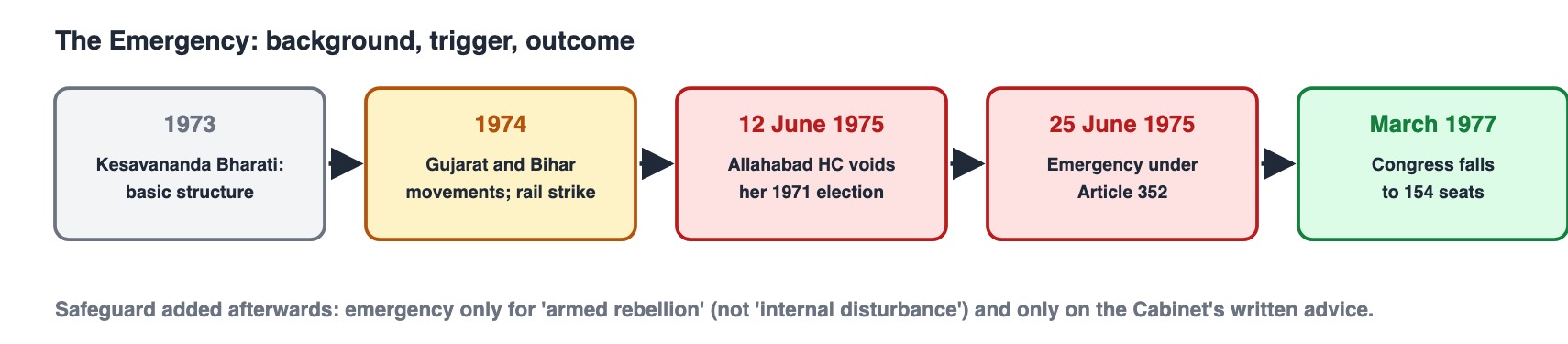
The Emergency: background, trigger and the 1977 verdict.
The Emergency and the 1977 Elections
The Emergency (25 June 1975 - March 1977)
Declaration: the government invoked Article 352, citing a threat of internal disturbance (the article then allowed emergency on grounds of external threat or internal disturbance).
Censorship: newspapers needed prior approval for all material; some left blank spaces in protest, which was then also banned.
Bans and arrests: the RSS and Jamait-e-Islami were banned; protests and strikes were forbidden; preventive detention was used extensively against opposition leaders and activists, and the right to move courts for fundamental rights was suspended.
Excesses: forced relocations and forced sterilisations, mostly in the northern States.
Institutions: the Shah Commission, appointed after the Emergency, found that the administration and police had become vulnerable to political pressure.
The 1977 elections
In January 1977, after eighteen months, elections were announced and leaders released; they were held in March 1977.
Opposition parties merged into the Janata Party under JP's leadership; Jagjivan Ram's Congress for Democracy joined. The campaign slogan: "save democracy"; the election became a referendum on the Emergency.
Result: the Janata Party and allies won 330 of 542 seats (Janata alone 295); the Congress fell to 154 seats and under 35% of votes, losing every seat in Bihar, UP, Delhi, Haryana and Punjab. Indira Gandhi lost Rae Bareli. Morarji Desai became the first non-Congress Prime Minister.
Lessons and Debates
Lessons of the Emergency
Democracy is resilient: normal functioning resumed quickly; NCERT's lesson is that it is extremely difficult to do away with democracy in India.
Safeguards were added: after the Emergency, an emergency can be proclaimed only on grounds of "armed rebellion" (not "internal disturbance"), and only on the written advice of the Union Cabinet.
Civil liberties gained value: the Emergency made everyone more aware of their worth, and courts became more active in protecting individual liberties.
Unresolved issues: the line between legitimate protest and disorder, the misuse of preventive detention, and the politicisation of police and bureaucracy (the Shah Commission's finding) remain live questions.
Debates
Government's justification | Critics' view |
Mass agitations and calls to disobey orders threatened stability | The trigger was a court verdict against the Prime Minister personally |
Opposition used extra-parliamentary methods | Constitutional emergency powers were used to suspend democracy |
Order and discipline improved | Censorship, mass detention and forced sterilisations violated rights |
Use Ambedkar's warning about hero-worship and constitutional morality (Ethics playlist, articles 07-08) to frame Essay or GS answers on the Emergency.
Further Reading
PIB press releases, ministry websites and annual reports, the Gazette of India, MEA and UN documents and the official sources named in each note — the primary sources behind every fact above.
Test Yourself: Practice Questions & PYQs
12 practice questions on the Emergency.
Practice Questions
Q1. Students in Bihar invited which leader to head their movement in 1974?
(a) Morarji Desai
(b) George Fernandes
(c) Jayaprakash Narayan
(d) Raj Narain
Show answer
Answer: (c) — He agreed on condition that it stay non-violent.
Q2. The 1974 railway strike was led by
(a) Charan Singh
(b) Jagjivan Ram
(c) George Fernandes
(d) Jayaprakash Narayan
Show answer
Answer: (c) — Over bonus and service conditions.
Q3. In which case did the Supreme Court hold in 1973 that Parliament cannot amend the basic features of the Constitution?
(a) Maneka Gandhi
(b) Golaknath
(c) Kesavananda Bharati
(d) Minerva Mills
Show answer
Answer: (c) — The government then superseded three judges to appoint A.N. Ray as CJI.
Q4. Indira Gandhi's election was declared invalid on 12 June 1975 by
(a) Justice Jagmohan Lal Sinha of the Allahabad High Court
(b) the Election Commission
(c) the Shah Commission
(d) the Supreme Court
Show answer
Answer: (a) — On a petition by Raj Narain.
Q5. The Emergency of 1975 was declared under Article 352 on the ground of
(a) armed rebellion
(b) external aggression
(c) financial crisis
(d) internal disturbance
Show answer
Answer: (d) — Later amendments replaced 'internal disturbance' with 'armed rebellion'.
Q6. Which organisations were banned during the Emergency?
(a) The CPI and CPI(M)
(b) The Congress (O) and Swatantra
(c) The Akali Dal and DMK
(d) The RSS and Jamait-e-Islami
Show answer
Answer: (d) — Protests and strikes were also disallowed.
Q7. Which commission inquired into Emergency excesses?
(a) The Sarkaria Commission
(b) The Mandal Commission
(c) The Kothari Commission
(d) The Shah Commission
Show answer
Answer: (d) — It found the administration and police vulnerable to political pressure.
Q8. Elections ending the Emergency were held in
(a) March 1977
(b) December 1976
(c) June 1975
(d) January 1980
Show answer
Answer: (a) — They became a referendum on the Emergency.
Q9. In 1977 the Janata Party alone won how many Lok Sabha seats?
(a) 295
(b) 352
(c) 330
(d) 154
Show answer
Answer: (a) — With allies it won 330 of 542.
Q10. Consider the following statements:
1. After the Emergency, national emergency can be proclaimed only on grounds of armed rebellion (besides war and external aggression).
2. The President must receive the Union Cabinet's advice in writing.
3. Internal disturbance remains a ground for national emergency.
Which of the statements given above are correct?
(a) 1 and 2 only
(b) 2 and 3 only
(c) 1 and 3 only
(d) 1, 2 and 3
Show answer
Answer: (a) — 1 and 2 are correct. 'Internal disturbance' was replaced.
Q11. The first Prime Minister from a non-Congress party was
(a) Charan Singh
(b) V.P. Singh
(c) Morarji Desai
(d) Jagjivan Ram
Show answer
Answer: (c) — He served from 1977 to 1979.
Q12. Jagjivan Ram's party that later merged with the Janata Party was
(a) Lok Dal
(b) Congress for Democracy
(c) Bharatiya Lok Dal
(d) Congress (O)
Show answer
Answer: (b) — It was formed by Congress leaders opposed to the Emergency.
Mains Practice Questions
Use these to frame full-length answers. You don't have to answer one exactly — they show the angles UPSC tests, so let them guide which points you cover.
What led to the declaration of Emergency in 1975?
What were the lessons of the Emergency for Indian democracy?
Why were the 1977 elections called a referendum on the Emergency?
UPSC Mains — Previous Years’ Questions on this topic (last 10 years)
These are the actual GS Mains questions UPSC has asked on this theme — real proof of how, and when, it is tested. Try to write a full answer to each.
No GS1 question of 2019 or 2021-2026 asked directly about the Emergency; it is a frequent theme in GS2 (emergency provisions) and Essay.