The Cold War for UPSC GS1: Iron Curtain to 1991, Containment, NATO and the Warsaw Pact, Nuclear Crises, Detente and the Soviet Collapse
Origins of the Cold War
🎯 Exam priority: Foundational (Mains GS1). The Cold War closes the GS1 world-history syllabus and links to GS2 international relations. Know its phases, crises and end; India's response (non-alignment) is in article 11.
What the Cold War was
After 1945 the world split into a US-led capitalist Western Bloc and a Soviet-led communist Eastern Bloc: a contest for ideological, economic and military supremacy fought without direct war between the two superpowers, but through alliances, arms races, propaganda and proxy wars. In March 1946 Winston Churchill warned at Fulton, Missouri, that an "iron curtain" had cut Europe in two.
Origins and early phase (1945-1955)
Year | Event |
1946 | Churchill's 'iron curtain' speech; George Kennan's Long Telegram proposes containment of Soviet influence |
1947 | Truman Doctrine: US aid to resist communism, first tested in Greece |
1948 | Marshall Plan: an eventual $12 billion to rebuild Western Europe; Soviet blockade of Berlin met by the Berlin Airlift for nearly a year |
1949 | NATO formed: an attack on one member is an attack on all; the USSR tests its first atomic bomb, ending the US monopoly |
1950 | Korean War begins when North Korea's army attacks on 25 June 1950 |
1955 | After West Germany joins NATO, the USSR forms the Warsaw Pact |
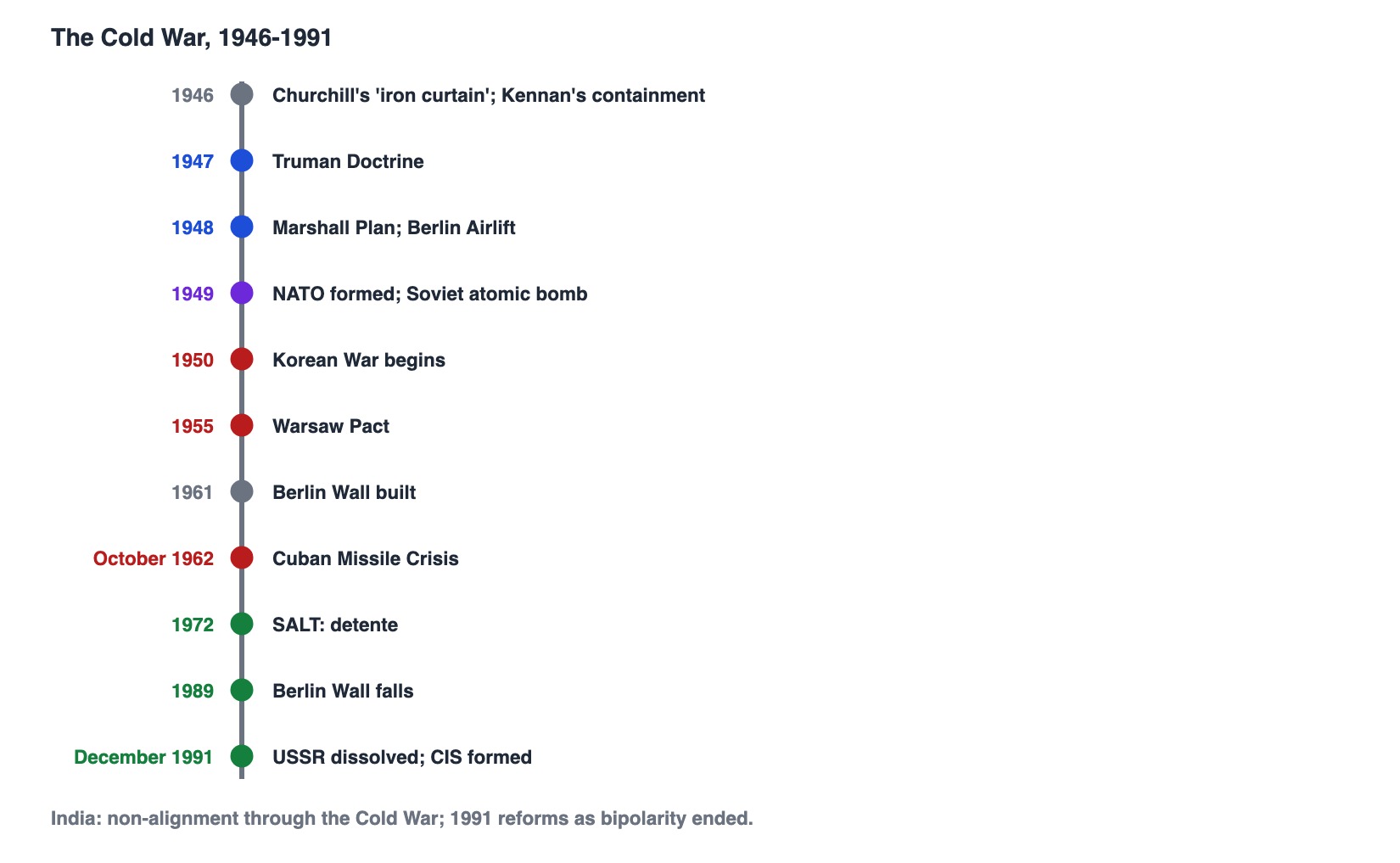
The Cold War from the iron curtain to the end of the USSR.
Nuclear Age, Crises and the End
The nuclear age and crises
Deterrence: both sides built huge nuclear arsenals; neither would strike first for fear of its own annihilation, a doctrine called mutually assured destruction (MAD).
Berlin Wall (1961-1989): it separated East and West Berlin and became the greatest symbol of the Cold War.
Cuban Missile Crisis (October 1962): Soviet missiles in Cuba brought Kennedy and Khrushchev to the brink of nuclear war; both refused to retreat until a settlement removed the missiles.
Proxy wars: Korea, Vietnam (Soviet aid to Vietnamese communists against a US-backed South) and the Soviet invasion of Afghanistan (December 1979), where the US armed the Soviets' Islamist opponents.
Detente: the SALT treaty at the 1972 Moscow Summit limited anti-ballistic missiles and opened a period of relaxed tension, trade and arms talks.
The end of the Cold War (1985-1991)
Mikhail Gorbachev (in power from 1985) faced shortages and discontent. He launched perestroika (restructuring of state and economy, some private enterprise, cuts in military spending) and glasnost (openness), and negotiated arms limits with the US.
1989: the Berlin Wall was toppled by the people; East European countries replaced their communist governments one after another; Germany was reunified.
December 1991: Russia, Belarus and Ukraine dissolved the USSR and formed the Commonwealth of Independent States (CIS); Russia took the Soviet seat at the UN.
Why it collapsed (NCERT and OpenStax): a stagnant economy and falling productivity and technology, a costly arms race and the Afghan war, an unaccountable party, nationalism in the republics, and reforms that unleashed forces Gorbachev could not control.
After Bipolarity and India
After bipolarity
Shock therapy: former communist states, guided by the World Bank and IMF, moved abruptly to markets and private property, with severe economic and social costs.
A unipolar moment: the US as the sole superpower, its dominance soon limited by alternative centres of power: the European Union, ASEAN and a rising China (NCERT).
Legacy and India
The Cold War shaped the borders of Europe and Asia, the arms control regime, and the ideological contest of capitalism and communism (article 06). India refused to join either bloc and helped found the Non-Aligned Movement (article 11). The end of bipolarity coincided with India's 1991 economic reforms and new partnerships with the US.
Further Reading
PIB press releases, ministry websites and annual reports, the Gazette of India, MEA and UN documents and the official sources named in each note — the primary sources behind every fact above.
Test Yourself: Practice Questions & PYQs
12 practice questions on the Cold War.
Practice Questions
Q1. Churchill's 'iron curtain' speech was delivered in 1946 at
(a) London
(b) Potsdam
(c) Yalta
(d) Fulton, Missouri
Show answer
Answer: (d) — It described Europe divided by Soviet domination.
Q2. The US strategy of confining Soviet influence to Eastern Europe was called
(a) appeasement
(b) detente
(c) containment
(d) rollback
Show answer
Answer: (c) — It was first proposed by George Kennan.
Q3. The Truman Doctrine was first tested in 1947 in
(a) Vietnam
(b) Korea
(c) Greece
(d) Cuba
Show answer
Answer: (c) — It promised US aid against communism.
Q4. The Marshall Plan provided Western Europe with an eventual total of about
(a) $1 billion
(b) $100 billion
(c) $12 billion
(d) $33 billion
Show answer
Answer: (c) — Congress approved it through the Economic Cooperation Act of 1948.
Q5. NATO was formed in
(a) 1949
(b) 1955
(c) 1945
(d) 1961
Show answer
Answer: (a) — An attack on one member is treated as an attack on all.
Q6. The Warsaw Pact was formed in 1955 after
(a) the Cuban Missile Crisis
(b) West Germany joined NATO
(c) the Korean War ended
(d) Stalin died
Show answer
Answer: (b) — Its members were the USSR and the communist states of Eastern Europe.
Q7. 'Mutually assured destruction' refers to
(a) the Marshall Plan
(b) the space race
(c) nuclear deterrence between the superpowers
(d) proxy wars
Show answer
Answer: (c) — Neither side would strike first for fear of annihilation.
Q8. The Cuban Missile Crisis took place in
(a) October 1962
(b) June 1950
(c) November 1989
(d) December 1979
Show answer
Answer: (a) — Kennedy and Khrushchev stood on the brink for ten days.
Q9. The SALT treaty, signed at the 1972 Moscow Summit, began
(a) glasnost
(b) detente
(c) the Cold War
(d) the Korean War
Show answer
Answer: (b) — It limited anti-ballistic missiles.
Q10. Consider the following statements:
1. Gorbachev's perestroika meant restructuring the Soviet state and economy.
2. Glasnost meant openness.
3. Gorbachev increased military spending sharply.
Which of the statements given above are correct?
(a) 1 and 2 only
(b) 2 and 3 only
(c) 1 and 3 only
(d) 1, 2 and 3
Show answer
Answer: (a) — 1 and 2 are correct. He cut military spending.
Q11. The USSR was dissolved in December 1991 by the leaders of
(a) Russia, Belarus and Ukraine
(b) Russia, Kazakhstan and Georgia
(c) the Baltic states
(d) the Warsaw Pact
Show answer
Answer: (a) — They formed the Commonwealth of Independent States.
Q12. The abrupt post-communist shift to markets in the former Soviet bloc is called
(a) detente
(b) perestroika
(c) shock therapy
(d) containment
Show answer
Answer: (c) — It was guided by the World Bank and the IMF.
Mains Practice Questions
Use these to frame full-length answers. You don't have to answer one exactly — they show the angles UPSC tests, so let them guide which points you cover.
What were the main phases of the Cold War?
Why did the Soviet Union collapse?
How did the Cold War shape India's foreign policy?
UPSC Mains — Previous Years’ Questions on this topic (last 10 years)
These are the actual GS Mains questions UPSC has asked on this theme — real proof of how, and when, it is tested. Try to write a full answer to each.
No GS1 question of 2019 or 2021-2026 asked directly about the Cold War; it is background for GS2 international relations and for the decolonisation article that follows.