The Second World War for UPSC GS1: Causes, Blitzkrieg to Hiroshima, the Holocaust, India's War, and the New World Order
Causes and the Trigger
🎯 Exam priority: Important (Mains GS1). "World wars" are in the syllabus; the Second World War is the hinge between the interwar crisis (article 08) and the Cold War and decolonisation (articles 10-11). No GS1 question of 2019-2026 asked about it directly, but it underpins questions on democracy, decolonisation and the world order.
Causes
Versailles and revisionism: a punished Germany; Italy and Japan dissatisfied with their gains.
The Depression and fascism (article 08): aggressive, expansionist regimes in Germany, Italy and Japan.
Failure of collective security and appeasement: Manchuria, Ethiopia, the Rhineland, Austria and the Sudetenland went unpunished.
The Nazi-Soviet Pact (23 August 1939): Germany and the USSR agreed not to attack each other, with secret protocols dividing eastern Europe, freeing Hitler to strike Poland.
The trigger
Germany invaded Poland on 1 September 1939 using blitzkrieg ("lightning war": massive air strikes followed by fast armoured advances). Britain and France declared war; about two weeks later the Soviets invaded Poland from the east.
Course of the War and the Holocaust
Course of the war
Date | Event |
1940 | Norway surrenders (June); France signs an armistice (June) and the Vichy regime under Petain follows; the Battle of Britain in the air (late summer-autumn) stops a German invasion |
22 June 1941 | Operation Barbarossa: Germany invades the USSR, which joins the Allies |
7 December 1941 | Japan attacks Pearl Harbor; the United States enters the war |
January 1942 | Wannsee Conference plans the 'Final Solution': the extermination of Europe's Jews |
June 1942 | Battle of Midway: turning point in the Pacific |
1942-1943 | Battle of Stalingrad: turning point in the east |
6 June 1944 | D-Day: Allied invasion of France |
February 1945 | Yalta Conference of the 'Big Three' plans the peace |
May 1945 | Germany surrenders |
6 and 9 August 1945 | Atomic bombs on Hiroshima and Nagasaki; the USSR attacks Japanese-held Manchuria and Korea |
2 September 1945 | Japan's formal surrender in Tokyo Bay |
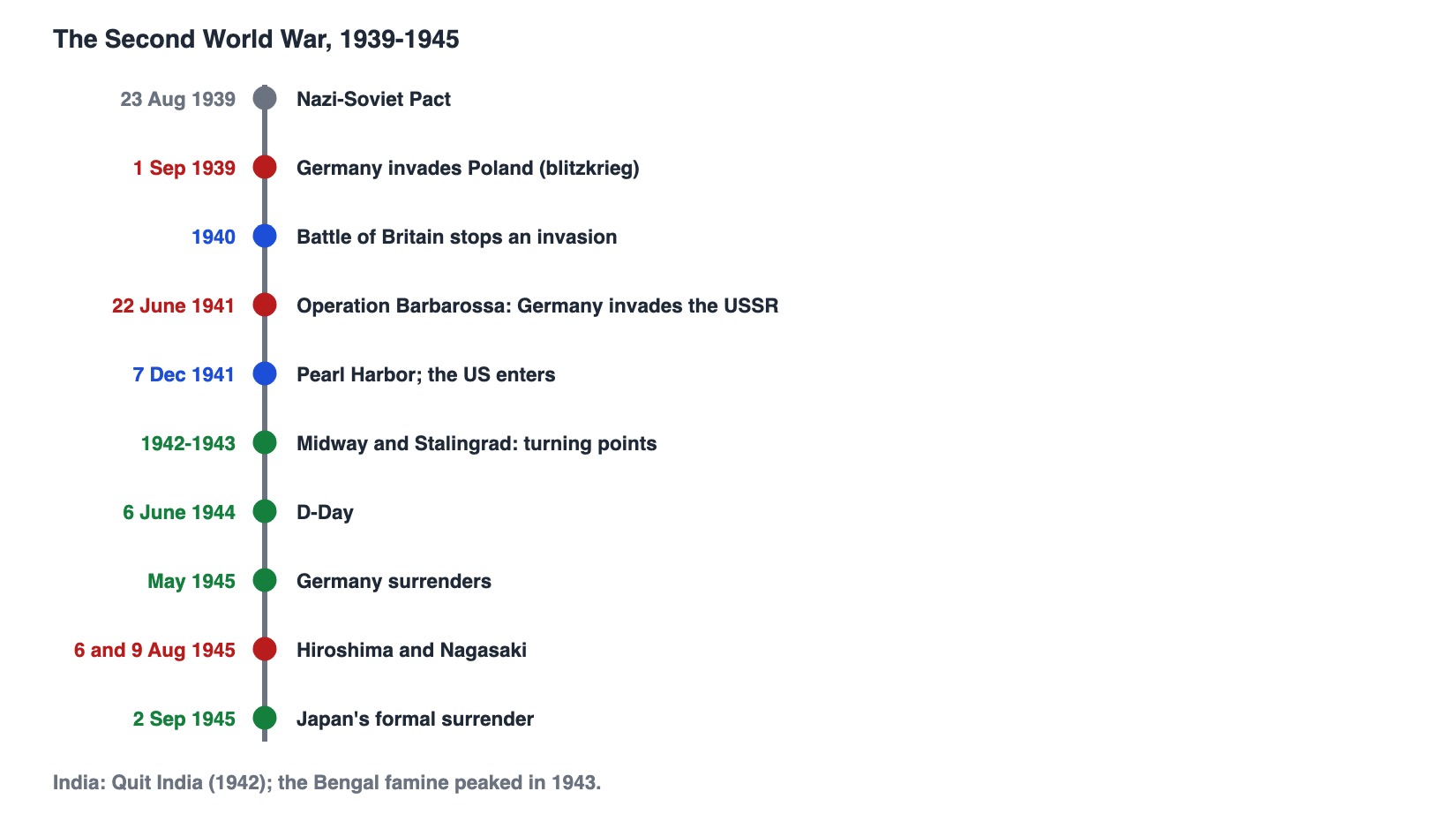
The Second World War in ten dates.
The Holocaust
Nazi racial policy culminated in genocide: more than six million Jewish people and at least three million members of other groups (Roma, gay people, communists, socialists, Jehovah's Witnesses) were murdered, with the collaboration of tens of thousands across Europe. It is the reason the postwar order made human rights and the crime of genocide matters of international law.
India and the New World Order
India and the war
The Congress, under Gandhi, launched the nonviolent Quit India movement (1942); the British arrested Gandhi and other Congress leaders and detained them through most of the war.
The Bengal famine peaked in 1943, caused by the dispatch of Indian food to the war effort, natural disasters at the end of 1942, refugees from Burma, and colonial mismanagement.
The war exhausted Britain and hastened Indian independence in 1947.
Consequences: a new world order
The Atlantic Charter (1941) of Roosevelt and Churchill recast the Fourteen Points: unconditional surrender of the Axis (Germany, Italy, Japan), no territorial expansion, self-determination, free trade, social welfare.
The United Nations (1945), pledged "to save succeeding generations from the scourge of war" and to reaffirm human rights.
Bretton Woods (1944): the IMF (to manage members' external deficits and surpluses) and the World Bank (to finance reconstruction).
Two superpowers, the US and the USSR, and the start of the Cold War (article 10); a weakened Europe and the beginning of decolonisation (article 11); and the nuclear age.
Further Reading
PIB press releases, ministry websites and annual reports, the Gazette of India, MEA and UN documents and the official sources named in each note — the primary sources behind every fact above.
Test Yourself: Practice Questions & PYQs
12 practice questions on the Second World War.
Practice Questions
Q1. The German-Soviet Nonaggression Pact was signed on
(a) 22 June 1941
(b) 1 September 1939
(c) 7 December 1941
(d) 23 August 1939
Show answer
Answer: (d) — It included secret protocols dividing eastern Europe.
Q2. 'Blitzkrieg' means
(a) lightning war
(b) total war
(c) scorched earth
(d) war of attrition
Show answer
Answer: (a) — Massive air strikes followed by fast advances; first used against Poland.
Q3. Operation Barbarossa was Germany's invasion of
(a) Poland
(b) the Soviet Union
(c) Britain
(d) France
Show answer
Answer: (b) — It began on 22 June 1941.
Q4. The United States entered the Second World War after
(a) Japan's attack on Pearl Harbor
(b) the sinking of the Lusitania
(c) the invasion of Poland
(d) the Battle of Britain
Show answer
Answer: (a) — The attack came on 7 December 1941.
Q5. The turning point of the Pacific war was the Battle of
(a) the Bulge
(b) Midway (June 1942)
(c) El Alamein
(d) Stalingrad
Show answer
Answer: (b) — Japan lost four aircraft carriers.
Q6. D-Day, the Allied invasion of France, took place on
(a) 6 June 1944
(b) 8 May 1945
(c) 1 September 1939
(d) 6 August 1945
Show answer
Answer: (a) — It opened the western front in Europe.
Q7. The Wannsee Conference of January 1942 planned
(a) the D-Day landings
(b) the United Nations
(c) the division of Germany
(d) the 'Final Solution' to exterminate Europe's Jews
Show answer
Answer: (d) — More than six million Jews were murdered.
Q8. The Yalta Conference (February 1945) was held in
(a) the Soviet Crimea
(b) Washington
(c) London
(d) Potsdam
Show answer
Answer: (a) — The Big Three planned the postwar order.
Q9. Atomic bombs were dropped on Hiroshima and Nagasaki in
(a) June 1944
(b) August 1945
(c) December 1941
(d) May 1945
Show answer
Answer: (b) — Japan formally surrendered on 2 September 1945.
Q10. Consider the following statements:
1. The Atlantic Charter affirmed self-determination.
2. It called for the unconditional surrender of the Axis.
3. It was signed by Stalin and Hitler.
Which of the statements given above are correct?
(a) 1 and 2 only
(b) 2 and 3 only
(c) 1 and 3 only
(d) 1, 2 and 3
Show answer
Answer: (a) — 1 and 2 are correct. It was produced by Roosevelt and Churchill.
Q11. The Bengal famine peaked in
(a) 1929
(b) 1947
(c) 1918
(d) 1943
Show answer
Answer: (d) — Food was sent to the war effort, among other causes.
Q12. The Bretton Woods conference of 1944 created
(a) NATO
(b) the IMF and the World Bank
(c) the United Nations
(d) the League of Nations
Show answer
Answer: (b) — They are called the Bretton Woods twins.
Mains Practice Questions
Use these to frame full-length answers. You don't have to answer one exactly — they show the angles UPSC tests, so let them guide which points you cover.
Was the Second World War a continuation of the First? Discuss.
How did the Second World War transform the world order?
How did the war affect India's freedom struggle?
UPSC Mains — Previous Years’ Questions on this topic (last 10 years)
These are the actual GS Mains questions UPSC has asked on this theme — real proof of how, and when, it is tested. Try to write a full answer to each.
No GS1 question of 2019 or 2021-2026 asked directly about the Second World War; it underlies the 2021 question on democracy between the wars (article 08) and questions on decolonisation.