STIs and HIV in the Skin for NEET PG Dermatology: Genital Ulcer Clues, NACP Colour Kits, Syphilis Serology and BPG, HIV Skin Markers
Start Here
🎯 Exam priority: High (Dermatology and PSM). Expect: painless vs painful ulcer and the nodes, organisms of chancroid, LGV and donovanosis, Donovan bodies, NACP kit colours and contents, syphilis stages, treponemal vs non-treponemal tests, prozone, fourfold titre fall, BPG dosing, drugs avoided in pregnancy, herpes at labour, partner rules, and the skin signs that point to HIV.
CBME mapping: DR 10.1–10.11, DR 11.1–11.2. Programme content overlaps PSM; organisms overlap Microbiology.
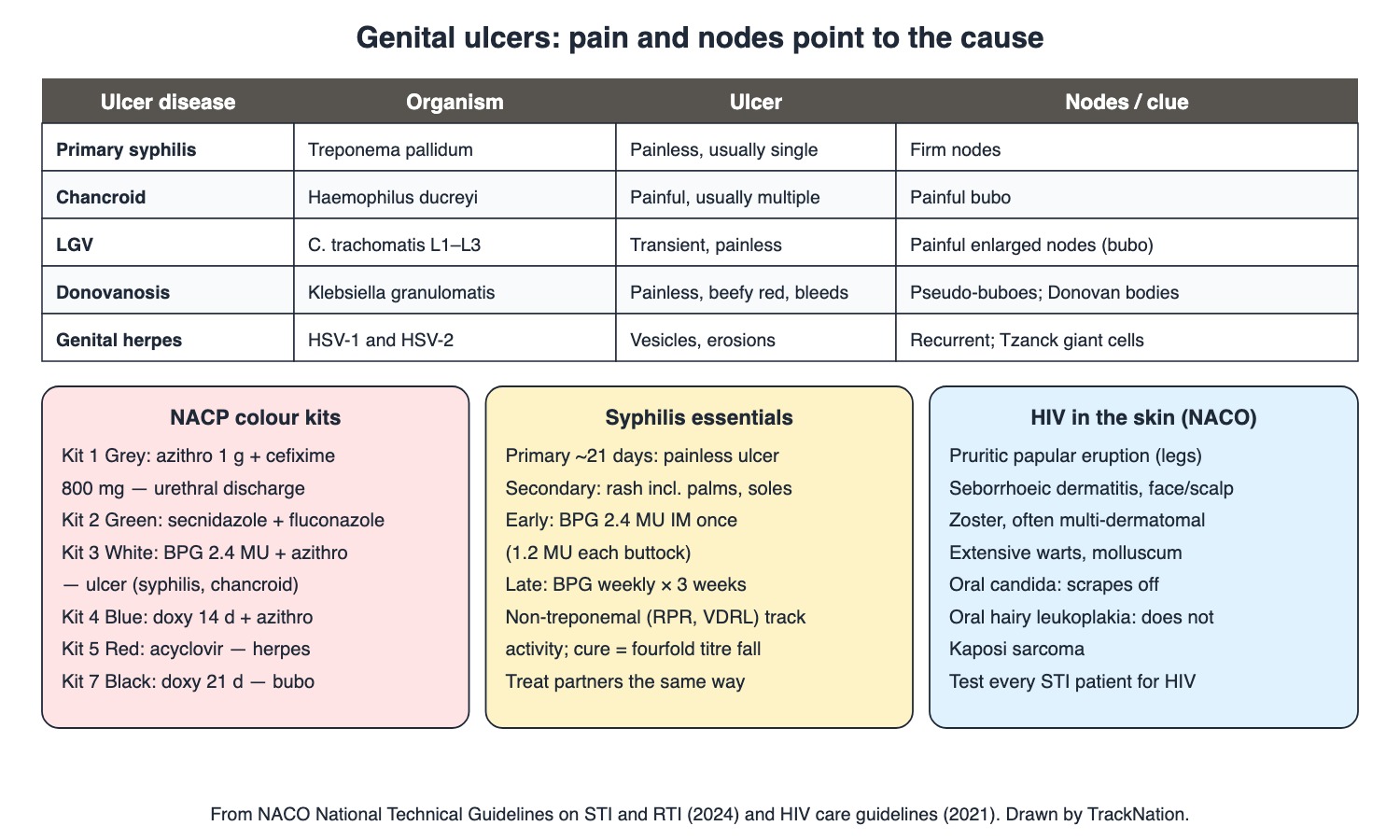
Genital ulcer diseases compared; NACP colour-coded kits; syphilis essentials; HIV skin markers. Drawn by TrackNation.
Syndromic Management and Genital Ulcers
Syndromic case management treats the likely organisms of a syndrome (urethral discharge, vaginal discharge, genital ulcer, lower abdominal pain, scrotal swelling, bubo, anorectal discharge) using symptoms and signs. Many STIs are asymptomatic, so absence of symptoms does not rule one out. Every STI patient is referred for HIV and syphilis testing.
Bedside clues (NACO): painless, usually single ulcer with firm nodes → syphilis; painful, usually multiple ulcers with a painful bubo → chancroid (H. ducreyi); transient painless ulcer then painful enlarged nodes → LGV (C. trachomatis L1–L3); painless, beefy red, bleeding ulcers without true node involvement (pseudo-buboes) → donovanosis (Klebsiella granulomatis; Donovan bodies on Giemsa-stained crush smear); vesicles or erosions, recurrent → herpes (Tzanck giant cells, NAAT). HIV can blur these pictures.
Treatment: chancroid — azithromycin 1 g once; LGV — doxycycline 100 mg twice daily for 21 days; herpes — acyclovir 400 mg three times daily for 7 days. Women with herpetic lesions at the onset of labour need caesarean section; oral acyclovir is allowed in pregnancy.
Discharge: gonorrhoea — ceftriaxone 500 mg IM or cefixime 800 mg once; chlamydia — doxycycline 100 mg twice daily 7 days or azithromycin 1 g. Doxycycline and quinolones are contraindicated in pregnancy. Anogenital warts (condylomata acuminata) are HPV growths that recur.
NACP kit (colour) | Contents | Syndrome |
Kit 1 (Grey) | Azithromycin 1 g + cefixime 800 mg single dose | Urethral discharge; cervicitis; painful scrotal swelling |
Kit 2 (Green) | Secnidazole 2 g + fluconazole 150 mg single dose | Vaginal discharge (vaginitis) |
Kit 3 (White) | Benzathine penicillin G 2.4 MU + azithromycin 1 g | Genital ulcer (syphilis, chancroid) |
Kit 4 (Blue) | Doxycycline 100 mg twice daily 14 days + azithromycin 1 g | Genital ulcer if BPG unavailable or penicillin allergy |
Kit 5 (Red) | Acyclovir 400 mg three times daily 7 days | Genital ulcer — herpes |
Kit 6 (Yellow) | Cefixime 800 mg + metronidazole + doxycycline 14 days | Lower abdominal pain (PID) |
Kit 7 (Black) | Doxycycline 100 mg twice daily 21 days | Inguinal bubo; LGV proctitis |
Syphilis
Treponema pallidum. Primary: about 21 days (10–90) after exposure, a painless ulcer lasting 2–6 weeks. Secondary: skin rash including the palms and soles with fever and myalgia, for 2–6 weeks; then latent and late stages.
Serology: non-treponemal tests (VDRL, RPR, Wassermann) give titres for monitoring; treponemal tests (TPHA, TPPA, TP-ELISA, FTA-Abs, most rapid tests) can stay positive for life. False negatives from the prozone phenomenon occur in primary and secondary syphilis, HIV and pregnancy. A fourfold fall in titre (two dilutions, e.g. 1:16 → 1:4) indicates successful treatment — do not repeat titres before 8 weeks.
Treatment: early (primary, secondary, early latent) — benzathine penicillin G 2.4 MU IM once (1.2 MU in each buttock); alternatives doxycycline 14 days. Late latent or tertiary — BPG 2.4 MU weekly for 3 weeks. Penicillin desensitisation is used when no alternative exists, including pregnancy. Treat partners with the same regimen.
Partners and HIV in the Skin
Partners: those in contact within 60 days of a discharge syndrome are evaluated and treated; partners of syphilis and chancroid get the same regimen; herpes partners are not treated without an active episode.
HIV skin markers (NACO): diffuse dry skin, pruritic papular eruption (mainly legs), seborrhoeic dermatitis on face and scalp, herpes simplex, herpes zoster or its scars (especially multi-dermatomal), extensive warts and molluscum, fungal nail infection, oral candidiasis (white plaques scrape off) vs oral hairy leukoplakia (does not), and Kaposi sarcoma.
Traps the Examiner Sets
Painful ulcer + painful bubo = chancroid; painless + firm nodes = syphilis.
Beefy red bleeding ulcer = donovanosis (Donovan bodies).
No doxycycline or quinolones in pregnancy.
Multi-dermatomal zoster or extensive molluscum → test for HIV.
Memory Hooks & Shortcuts
Shortcuts to lock in this article's numbers and lists. Each one only re-packages facts proven above.
🧠 'Syphilis is painless, chancroid makes you cry' — ulcer pain
🧠 Donovanosis = 'Donovan bodies, beefy red, bleeds' — donovanosis
🧠 Kits by colour: 'Grey Goes for discharge, Green for vaginitis, White for ulcers, Red for herpes, Black for buboes' — NACP kits
🧠 Syphilis cure = 'Four-fold fall, not before eight weeks' — serology
🧠 'Candida Comes off, hairy leukoplakia Holds on' — oral HIV lesions
Rapid-Revision Cards
Syphilis ulcer
Painless, single; firm nodes.
Chancroid
Painful, multiple; painful bubo; H. ducreyi.
LGV
Transient painless ulcer → painful bubo; L1–L3.
Donovanosis
Painless beefy red; Donovan bodies; K. granulomatis.
Herpes
Vesicles, recurrent; Tzanck giant cells.
Kit 1 Grey
Azithro 1 g + cefixime 800 mg.
Kit 2 Green
Secnidazole + fluconazole.
Kit 3 White
BPG 2.4 MU + azithro.
Kit 4 Blue
Doxy 14 d + azithro (no BPG).
Kit 5 Red
Acyclovir 7 days.
Kit 6 Yellow
PID: cefixime + metronidazole + doxy.
Kit 7 Black
Doxy 21 days: bubo, LGV.
Primary syphilis
~21 days; ulcer 2–6 weeks.
Secondary
Rash incl. palms, soles.
Early syphilis Rx
BPG 2.4 MU once (1.2 each buttock).
Late syphilis Rx
BPG weekly × 3.
Monitor
Non-treponemal fourfold fall.
Prozone
False negative, high antibody.
Pregnancy
No doxycycline or quinolones.
Herpes at labour
Caesarean section.
HIV skin
PPE, seb derm, zoster, molluscum, OHL.
Sources
Facts in this article were checked against these documents.
National Technical Guidelines on STI and RTI — National AIDS Control Organisation, MoHFW, 2024 (link)
National Guidelines for HIV Care and Treatment — National AIDS Control Organisation, MoHFW, 2021 (link)
Competency Based Undergraduate Curriculum, Dermatology (DR 10, DR 11) — National Medical Commission, 2024
Test Yourself: Practice Questions
Thirty questions in NEET PG style, most of them clinical vignettes.
Practice Questions (NEET PG pattern)
Original questions written in the style of the exam: +4 for a correct answer, −1 for a wrong one. Every answer was checked against the sources listed above. NEET PG papers are not published by NBEMS, so these are not past-paper questions.
Q1. A man has a single painless genital ulcer with firm, non-tender inguinal nodes. The most likely diagnosis is
(a) genital herpes
(b) LGV
(c) chancroid
(d) primary syphilis
Show answer
Answer: (d) — NACO bedside clue.
Q2. Multiple painful genital ulcers with a painful inguinal bubo suggest
(a) primary syphilis
(b) LGV
(c) donovanosis
(d) chancroid
Show answer
Answer: (d) — Haemophilus ducreyi.
Q3. The organism of chancroid is
(a) Treponema pallidum
(b) Klebsiella granulomatis
(c) Haemophilus ducreyi
(d) Chlamydia trachomatis L2
Show answer
Answer: (c) — Painful ulcer.
Q4. A transient painless penile ulcer followed weeks later by painful enlarged inguinal nodes is typical of
(a) herpes
(b) lymphogranuloma venereum
(c) syphilis
(d) chancroid
Show answer
Answer: (b) — C. trachomatis L1–L3.
Q5. LGV is caused by
(a) Chlamydia trachomatis D–K
(b) Chlamydia trachomatis serovars L1–L3
(c) HSV-2
(d) H. ducreyi
Show answer
Answer: (b) — D–K cause urethritis.
Q6. Painless, beefy red, easily bleeding genital ulcers without true lymph node involvement suggest
(a) syphilis
(b) LGV
(c) chancroid
(d) donovanosis (granuloma inguinale)
Show answer
Answer: (d) — May form pseudo-buboes.
Q7. Donovanosis is diagnosed by finding
(a) a positive VDRL
(b) Donovan bodies on a Giemsa-stained tissue crush preparation
(c) Tzanck giant cells
(d) gram-negative diplococci
Show answer
Answer: (b) — Organism is hard to culture.
Q8. Grouped vesicles and erosions on the genitals with a history of similar episodes suggest
(a) donovanosis
(b) genital herpes
(c) syphilis
(d) chancroid
Show answer
Answer: (b) — Tzanck shows giant cells.
Q9. The NACP Kit 1 (Grey) for urethral discharge contains
(a) azithromycin 1 g and cefixime 800 mg single dose
(b) acyclovir
(c) secnidazole and fluconazole
(d) BPG and azithromycin
Show answer
Answer: (a) — Also cervicitis, scrotal swelling.
Q10. The NACP kit for genital ulcer disease due to syphilis and chancroid (White) contains
(a) acyclovir 400 mg
(b) cefixime and metronidazole
(c) benzathine penicillin G 2.4 MU and azithromycin 1 g
(d) doxycycline for 21 days
Show answer
Answer: (c) — Kit 3.
Q11. The Red NACP kit (Kit 5) is used for
(a) vaginal discharge
(b) herpetic genital ulcers — acyclovir
(c) bubo
(d) PID
Show answer
Answer: (b) — Acyclovir 400 mg three times daily 7 days.
Q12. Kit 7 (Black), doxycycline 100 mg twice daily for 21 days, treats
(a) vaginitis
(b) inguinal bubo and LGV proctitis
(c) urethral discharge
(d) herpes
Show answer
Answer: (b) — LGV.
Q13. Kit 2 (Green) for vaginitis contains
(a) metronidazole only
(b) doxycycline
(c) azithromycin and cefixime
(d) secnidazole 2 g and fluconazole 150 mg
Show answer
Answer: (d) — Trichomonas, BV, candida.
Q14. Primary syphilis usually appears after an incubation of about
(a) 21 days (range 10–90)
(b) 6 months
(c) 1 year
(d) 2 days
Show answer
Answer: (a) — Painless ulcer lasting 2–6 weeks.
Q15. A rash involving the palms and soles with fever, after a healed painless genital ulcer, suggests
(a) scabies
(b) chancroid
(c) primary syphilis
(d) secondary syphilis
Show answer
Answer: (d) — Lasts 2–6 weeks.
Q16. Early syphilis (primary, secondary, early latent) is treated with
(a) ceftriaxone once
(b) BPG weekly for 3 weeks
(c) benzathine penicillin G 2.4 MU IM once (1.2 MU in each buttock)
(d) oral amoxicillin 7 days
Show answer
Answer: (c) — Late syphilis: weekly × 3.
Q17. Late latent or tertiary syphilis is treated with BPG 2.4 MU
(a) daily for 14 days
(b) monthly for a year
(c) once only
(d) once weekly for 3 weeks
Show answer
Answer: (d) — Alternatives: doxycycline 28 days.
Q18. Which is a non-treponemal test for syphilis?
(a) TPHA
(b) FTA-Abs
(c) RPR
(d) TP-ELISA
Show answer
Answer: (c) — Also VDRL, Wassermann.
Q19. A treated patient remains TPHA-positive years later. This is because
(a) treatment failed
(b) reinfection
(c) treponemal tests can stay positive for life even when the disease is inactive
(d) the test is false positive
Show answer
Answer: (c) — Use non-treponemal titres to monitor.
Q20. A patient with secondary syphilis has a falsely negative VDRL because of overwhelming antibody levels. This is the
(a) serofast state
(b) biological false positive
(c) prozone phenomenon
(d) window period
Show answer
Answer: (c) — Excess antibody.
Q21. After syphilis treatment, cure is indicated by
(a) a fourfold fall in non-treponemal titre (e.g. 1:16 to 1:4)
(b) a negative TPHA
(c) any fall in titre after 1 week
(d) disappearance of rash only
Show answer
Answer: (a) — Do not repeat before 8 weeks.
Q22. A pregnant woman with syphilis gives a history of penicillin allergy. NACO advises
(a) ciprofloxacin
(b) penicillin desensitisation when no suitable alternative exists
(c) no treatment until delivery
(d) doxycycline
Show answer
Answer: (b) — Penicillin protects the fetus.
Q23. Which drugs are contraindicated for chlamydia in pregnancy?
(a) azithromycin
(b) amoxicillin
(c) doxycycline and quinolones
(d) erythromycin
Show answer
Answer: (c) — Use azithromycin.
Q24. Uncomplicated gonococcal urethritis is treated with
(a) penicillin G
(b) doxycycline alone
(c) metronidazole
(d) ceftriaxone 500 mg IM or cefixime 800 mg orally, single dose
Show answer
Answer: (d) — Plus chlamydia cover.
Q25. A woman has active genital herpes lesions at the onset of labour. The plan is
(a) no change
(b) delay labour
(c) caesarean section to prevent neonatal herpes
(d) vaginal delivery with acyclovir cream
Show answer
Answer: (c) — Oral acyclovir is allowed in pregnancy.
Q26. Sexual partners of a patient with urethral discharge are evaluated and treated if contact was within
(a) 1 year
(b) 7 days
(c) only if symptomatic
(d) 60 days
Show answer
Answer: (d) — Many STIs are asymptomatic.
Q27. Partners of a patient with chancroid should be
(a) given acyclovir
(b) treated only if symptomatic
(c) ignored
(d) treated with the same regimen
Show answer
Answer: (d) — Same for syphilis.
Q28. Which skin lesion is a clue to HIV infection?
(a) vitiligo
(b) acne vulgaris
(c) pruritic papular eruption on the legs
(d) psoriasis vulgaris
Show answer
Answer: (c) — Also seborrhoeic dermatitis, multi-dermatomal zoster.
Q29. White oral plaques in a person with HIV that do NOT scrape off suggest
(a) aphthous ulcer
(b) oral candidiasis
(c) oral hairy leukoplakia
(d) lichen planus
Show answer
Answer: (c) — Candida plaques scrape off.
Q30. The NACO approach to an STI patient includes
(a) only symptomatic treatment
(b) testing only if symptomatic
(c) no partner contact
(d) referral for HIV and syphilis counselling and testing
Show answer
Answer: (d) — Syndromic management + screening.
Active Recall
From memory: list the bedside clues for each genital ulcer disease, the NACP kit colours and contents, syphilis stages, serology and BPG regimens, the pregnancy rules, partner management and the skin signs of HIV.