Hospital Infections, AMR and Antimicrobial Stewardship for NEET PG Microbiology: MRSA, ESBL, CRE, VRE, Drug Targets and India's Data
Start Here
🎯 Exam priority: High. Expect: drug class to target matching, the mechanism behind MRSA, ESBL, CRE and VRE, efflux and porins, plasmid spread, India's resistance figures, HAP timing and organisms, CAUTI definition, timing of surgical prophylaxis, hand hygiene, the stewardship definition and steps, and the AWaRe groups.
CBME mapping: MI10.1–10.5, MI11.1–11.3. Fact-checked against OpenStax Microbiology, the ICMR Treatment Guidelines for Antimicrobial Use (2019), the WHO AWaRe antibiotic book (2022) and the MSD Manual.
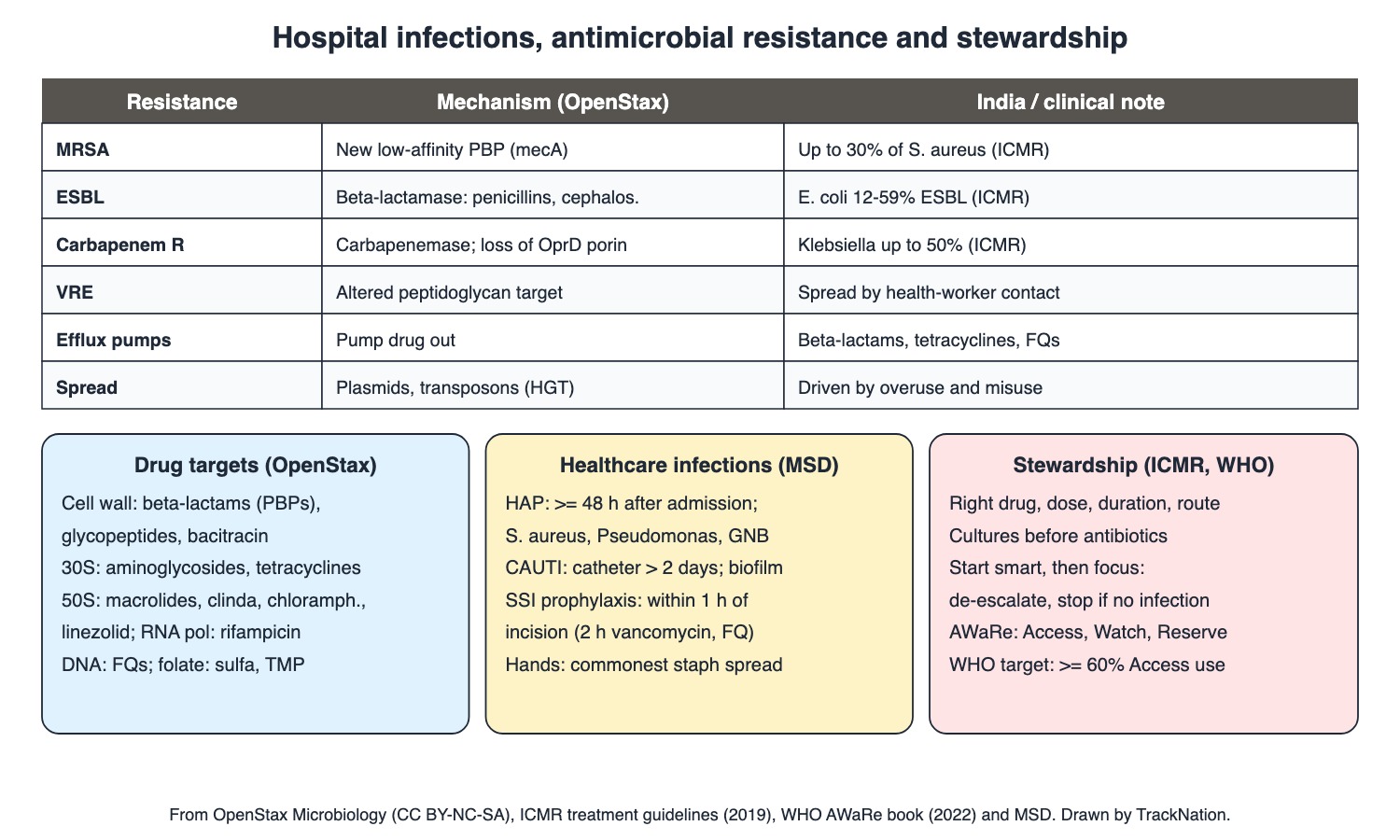
Resistance, hospital infections and stewardship. Drawn by TrackNation.
Where Antibiotics Act (OpenStax 14.3)
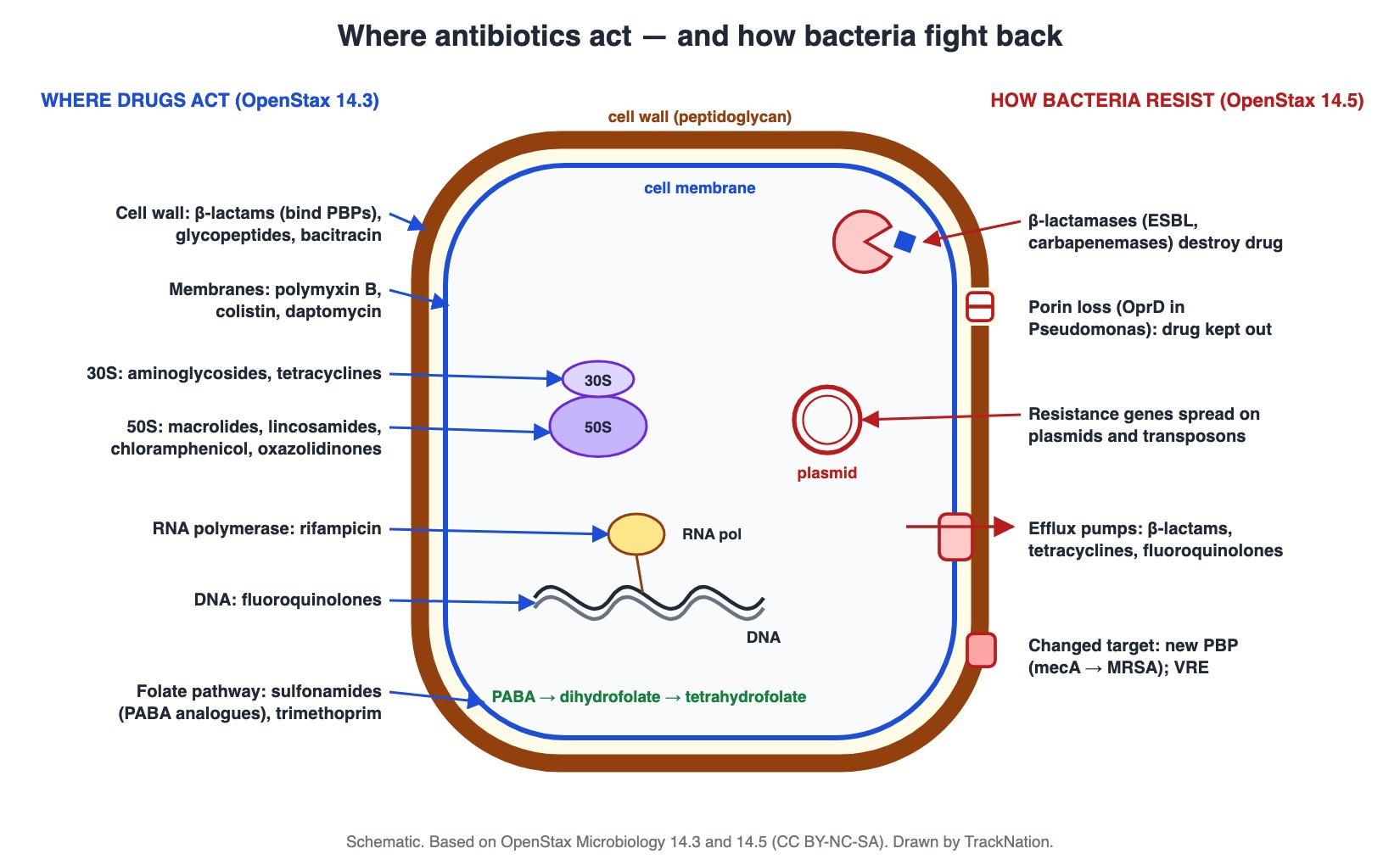
Where each antibiotic class acts on the bacterial cell, and the five ways bacteria resist. Drawn by TrackNation.
Cell wall: β-lactams (penicillins, cephalosporins, monobactams, carbapenems) bind penicillin-binding proteins; glycopeptides bind peptidoglycan subunits; bacitracin blocks subunit transport. A fifth-generation cephalosporin acts on MRSA.
Protein synthesis: 30S — aminoglycosides, tetracyclines; 50S — macrolides, lincosamides, chloramphenicol, oxazolidinones.
Membranes: polymyxin B, colistin, daptomycin. Nucleic acids: rifamycins (RNA polymerase), fluoroquinolones (DNA). Folate: sulfonamides (PABA analogues) and trimethoprim.
How Bacteria Resist (OpenStax 14.5, ICMR)
Three strategies: destroy or modify the drug, alter the target, or stop it entering or accumulating.
ESBLs inactivate all penicillins, cephalosporins and monobactams; carbapenemases are β-lactamases that break carbapenems; P. aeruginosa also resists carbapenems by losing its OprD porin. Efflux pumps push out β-lactams, tetracyclines and fluoroquinolones.
MRSA gains a new low-affinity PBP (gene mecA) → resistance to virtually all β-lactams. VRE: altered peptidoglycan target; spreads between patients on health workers' hands.
Resistance genes ride on plasmids and transposons (horizontal transfer) or arise by mutation and are selected by overuse, misuse, underdosing and poor adherence. Multidrug-resistant organisms are "superbugs"; CRE are a growing hospital threat.
India (ICMR 2019): 12–59% of E. coli produce ESBL and up to 30% carbapenemase; Klebsiella up to 50% carbapenem-resistant with rising polymyxin resistance; MRSA in up to 30% of S. aureus.
Healthcare-Associated Infections (MSD)
Hospital-acquired pneumonia: develops ≥48 hours after admission; commonest organisms S. aureus, Pseudomonas and other gram-negative bacilli; the commonest HAI in the US.
CAUTI: catheter in place >2 consecutive days; a biofilm protects bacteria; culture after replacing the catheter.
Surgical-site prophylaxis: antibiotic within 1 hour before incision (2 hours for vancomycin and fluoroquinolones); redose cephalosporins if surgery lasts >4 hours.
Prevention: hand hygiene — health workers' hands are the commonest route of staphylococcal spread; alcohol hand rubs fail on visibly dirty hands; device care; BMW segregation (article 03). A single skin-flora blood culture is usually contamination.
Antimicrobial Stewardship (ICMR, WHO)
Definition (ICMR): coordinated interventions to measure and improve antibiotic use by choosing the optimal drug, dose, duration and route.
Steps: make a clinical diagnosis; send cultures before starting empirical antibiotics; start empirical therapy only where early treatment helps; "start smart, then focus" — de-escalate to a single, narrower agent and stop when a non-infectious cause is found.
WHO AWaRe: Access (narrow spectrum, safe), Watch (broader, for sicker patients or likely resistance) and Reserve; WHO wants ≥60% of national consumption from the Access group.
Traps the Examiner Sets
MRSA's resistance comes from a new low-affinity PBP (mecA), covering virtually all β-lactams.
HAP is defined as pneumonia developing ≥48 hours after admission.
Prophylaxis given after incision is too late.
Alcohol hand rubs do not work well on visibly dirty hands.
WHO wants at least 60% of antibiotic use to come from the Access group.
Memory Hooks & Shortcuts
Shortcuts to lock in this article's numbers and lists. Each one only re-packages facts proven above.
🧠 'Buy AT 30, CELLs at 50': aminoglycosides, tetracyclines on 30S; chloramphenicol, erythromycin (macrolides), linezolid, lincosamides on 50S — drug targets
🧠 Resistance 'DTE': Destroy the drug, Twist the target, Exclude entry — mechanisms
🧠 'MRSA Makes a new PBP; ESBL Eats Penicillins and cephalosporins' — resistance
🧠 'Two days in — it's hospital pneumonia' — HAP
🧠 'Start Smart, then Focus' — culture first, then de-escalate — stewardship
Rapid-Revision Cards
Cell-wall drugs
β-lactams (PBPs), glycopeptides, bacitracin.
30S / 50S
Aminoglycosides, tetracyclines / macrolides, clinda, chloramph., linezolid.
Nucleic acid drugs
Rifampicin (RNA pol), FQs (DNA).
Folate drugs
Sulfonamides (PABA analogue), trimethoprim.
Resistance strategies
Destroy drug, change target, block entry.
MRSA
New PBP (mecA).
ESBL
All penicillins, cephalosporins, monobactams.
Carbapenem R
Carbapenemase; OprD loss (Pseudomonas).
VRE
Altered target; spread by hands.
Efflux
β-lactams, tetracyclines, FQs.
Spread
Plasmids, transposons.
Drivers
Overuse, misuse, underdosing, non-adherence.
India ESBL/CP
E. coli ESBL 12–59%, CP up to 30%.
India Klebsiella
Carbapenem R up to 50%.
India MRSA
Up to 30%.
HAP
≥48 h; S. aureus, Pseudomonas.
CAUTI
Catheter >2 days; biofilm.
SSI prophylaxis
Within 1 h of incision; redose >4 h.
Hand rub
Fails on visibly dirty hands.
Stewardship
Right drug, dose, duration, route.
AWaRe
Access ≥60% of use.
Sources
Facts in this article were checked against these documents.
Microbiology (sections 13.3, 14.3, 14.5) — Parker N, Schneegurt M, Thi Tu A-H, Lister P, Forster BM (OpenStax), 2016 (link)
Treatment Guidelines for Antimicrobial Use in Common Syndromes (2nd ed.) — Indian Council of Medical Research, 2019
The WHO AWaRe (Access, Watch, Reserve) antibiotic book — World Health Organization, 2022
MSD Manual Professional: Hospital-Acquired Pneumonia; CAUTI; Prevention of Surgical Site Infection; Staphylococcal Infections; Susceptibility Testing; Culture — Merck & Co. (MSD Manuals), 2024–26 (link)
Competency Based Undergraduate Curriculum, Vol I: Microbiology (MI10.1–10.5, MI11.1–11.3) — National Medical Commission, 2024
Test Yourself: Practice Questions
Thirty questions in NEET PG style, many of them ward scenarios.
Practice Questions (NEET PG pattern)
Original questions written in the style of the exam: +4 for a correct answer, −1 for a wrong one. Every answer was checked against the sources listed above. NEET PG papers are not published by NBEMS, so these are not past-paper questions.
Q1. β-lactam antibiotics act by binding
(a) the 30S ribosome
(b) the 50S ribosome
(c) penicillin-binding proteins
(d) DNA gyrase
Show answer
Answer: (c) — Cell wall synthesis.
Q2. Aminoglycosides and tetracyclines act on the
(a) RNA polymerase
(b) cell membrane
(c) 50S ribosomal subunit
(d) 30S ribosomal subunit
Show answer
Answer: (d) — OpenStax.
Q3. Macrolides, lincosamides, chloramphenicol and oxazolidinones act on the
(a) cell wall
(b) 30S subunit
(c) folate pathway
(d) 50S ribosomal subunit
Show answer
Answer: (d) — OpenStax.
Q4. Rifampicin acts by inhibiting
(a) cell wall synthesis
(b) folate synthesis
(c) bacterial RNA polymerase
(d) DNA gyrase
Show answer
Answer: (c) — OpenStax.
Q5. Sulfonamides are structural analogues of
(a) NAG
(b) D-alanine
(c) folic acid itself
(d) para-aminobenzoic acid (PABA)
Show answer
Answer: (d) — Folate pathway.
Q6. Polymyxins (colistin) act on the
(a) cell wall transpeptidase
(b) ribosome
(c) DNA
(d) bacterial membranes
Show answer
Answer: (d) — OpenStax.
Q7. The three broad mechanisms of antimicrobial resistance are
(a) mutation, transduction, conjugation
(b) drug modification, target modification and reduced entry/accumulation
(c) toxins, adhesins, enzymes
(d) capsule, spores, flagella
Show answer
Answer: (b) — OpenStax.
Q8. MRSA resists methicillin by acquiring
(a) a β-lactamase
(b) a new low-affinity penicillin-binding protein (mecA)
(c) a thicker capsule
(d) an efflux pump only
Show answer
Answer: (b) — Resists virtually all β-lactams.
Q9. ESBL-producing gram-negative bacteria are resistant to
(a) vancomycin
(b) carbapenems only
(c) all penicillins, cephalosporins and monobactams
(d) aminoglycosides only
Show answer
Answer: (c) — OpenStax.
Q10. Pseudomonas aeruginosa commonly resists carbapenems by
(a) a new PBP
(b) making ESBL only
(c) reducing its OprD porin
(d) thickening peptidoglycan
Show answer
Answer: (c) — Reduced entry.
Q11. Vancomycin resistance in enterococci is due to
(a) β-lactamase
(b) efflux
(c) modification of the peptidoglycan target
(d) porin loss
Show answer
Answer: (c) — VRE.
Q12. Efflux pumps commonly cause resistance to
(a) polymyxins only
(b) antifungals only
(c) vancomycin only
(d) β-lactams, tetracyclines and fluoroquinolones
Show answer
Answer: (d) — OpenStax.
Q13. Resistance genes spread rapidly between bacteria mainly on
(a) capsules
(b) flagella
(c) spores
(d) plasmids and transposons
Show answer
Answer: (d) — Horizontal gene transfer.
Q14. Drivers of antimicrobial resistance include
(a) vaccination
(b) culture-guided therapy
(c) overuse, misuse, subtherapeutic dosing and poor adherence
(d) hand hygiene
Show answer
Answer: (c) — OpenStax.
Q15. According to ICMR (2019), ESBL production in Indian E. coli is up to
(a) 90–100%
(b) 5–10%
(c) 1–2%
(d) 12–59%
Show answer
Answer: (d) — Carbapenemase up to 30%.
Q16. ICMR reports carbapenem resistance in Klebsiella pneumoniae in India of up to
(a) 50%
(b) 15%
(c) 95%
(d) 5%
Show answer
Answer: (a) — Polymyxin resistance rising.
Q17. MRSA in India (ICMR 2019) is seen in up to
(a) 30% of S. aureus isolates
(b) 2%
(c) 100%
(d) 80%
Show answer
Answer: (a) — ICMR.
Q18. Hospital-acquired pneumonia is defined as pneumonia developing
(a) after discharge only
(b) only on a ventilator
(c) within 24 hours of admission
(d) at least 48 hours after admission
Show answer
Answer: (d) — MSD.
Q19. The commonest organisms in hospital-acquired pneumonia are
(a) S. aureus, Pseudomonas and other gram-negative bacilli
(b) Mycoplasma
(c) viruses
(d) pneumococcus and Haemophilus
Show answer
Answer: (a) — MSD.
Q20. A UTI is called catheter-associated when the catheter has been in place for
(a) any duration
(b) more than 2 consecutive days
(c) more than 2 hours
(d) more than 2 weeks
Show answer
Answer: (b) — MSD.
Q21. Surgical antibiotic prophylaxis should be given
(a) the day before surgery
(b) within 1 hour before incision
(c) only if infection appears
(d) after closure
Show answer
Answer: (b) — 2 h for vancomycin, FQ.
Q22. Cephalosporin prophylaxis should be redosed if surgery lasts more than
(a) 4 hours
(b) 12 hours
(c) 24 hours
(d) 30 minutes
Show answer
Answer: (a) — MSD.
Q23. The commonest route of spread of staphylococci in hospitals is
(a) food
(b) health workers' hands
(c) water
(d) air conditioning
Show answer
Answer: (b) — Hand hygiene.
Q24. Alcohol hand rubs work by
(a) denaturing proteins and disrupting membranes, but fail on visibly dirty hands
(b) forming a barrier film
(c) killing spores
(d) oxidising DNA
Show answer
Answer: (a) — OpenStax.
Q25. ICMR defines antimicrobial stewardship as interventions that optimise the antibiotic's
(a) packaging
(b) brand
(c) price
(d) choice, dose, duration and route
Show answer
Answer: (d) — ICMR 2019.
Q26. Before starting empirical antibiotics in a septic patient, ICMR advises
(a) starting colistin
(b) avoiding cultures
(c) sending cultures (e.g. two blood culture sets)
(d) waiting 48 hours
Show answer
Answer: (c) — ICMR.
Q27. 'Start smart, then focus' means
(a) start appropriate empirical therapy, then de-escalate based on cultures
(b) avoid antibiotics
(c) use two drugs always
(d) start with the broadest drugs forever
Show answer
Answer: (a) — ICMR.
Q28. In WHO AWaRe, narrow-spectrum antibiotics with good safety are the
(a) Restricted group
(b) Access group
(c) Watch group
(d) Reserve group
Show answer
Answer: (b) — WHO 2022.
Q29. WHO's target is that Access antibiotics make up at least
(a) 60% of national consumption
(b) 10%
(c) 100%
(d) 30%
Show answer
Answer: (a) — WHO.
Q30. Carbapenemases are
(a) β-lactamases that break down carbapenems
(b) efflux pumps
(c) PBPs
(d) porins
Show answer
Answer: (a) — WHO glossary.
Active Recall
From memory: match antibiotic classes to targets, explain how MRSA, ESBL, carbapenem-resistant organisms and VRE resist, how resistance spreads, India's resistance figures, the definitions and prevention of HAP, CAUTI and surgical-site infection, and the principles of stewardship and AWaRe.