Child Health Programmes for NEET PG PSM: HBNC Visit Schedule and RBSK 2.0 (2026) — 4Ds, Mobile Health Teams, DEIC
Start Here
🎯 Exam priority: Medium–high. Child-health questions ask the HBNC visit days, the RBSK 4Ds and its platforms, who sits on the Mobile Health Team and what a DEIC does. RBSK was revised as RBSK 2.0 in 2026 — this article uses the new guidelines and flags what changed.
CBME mapping: CM 10.
The Big Picture
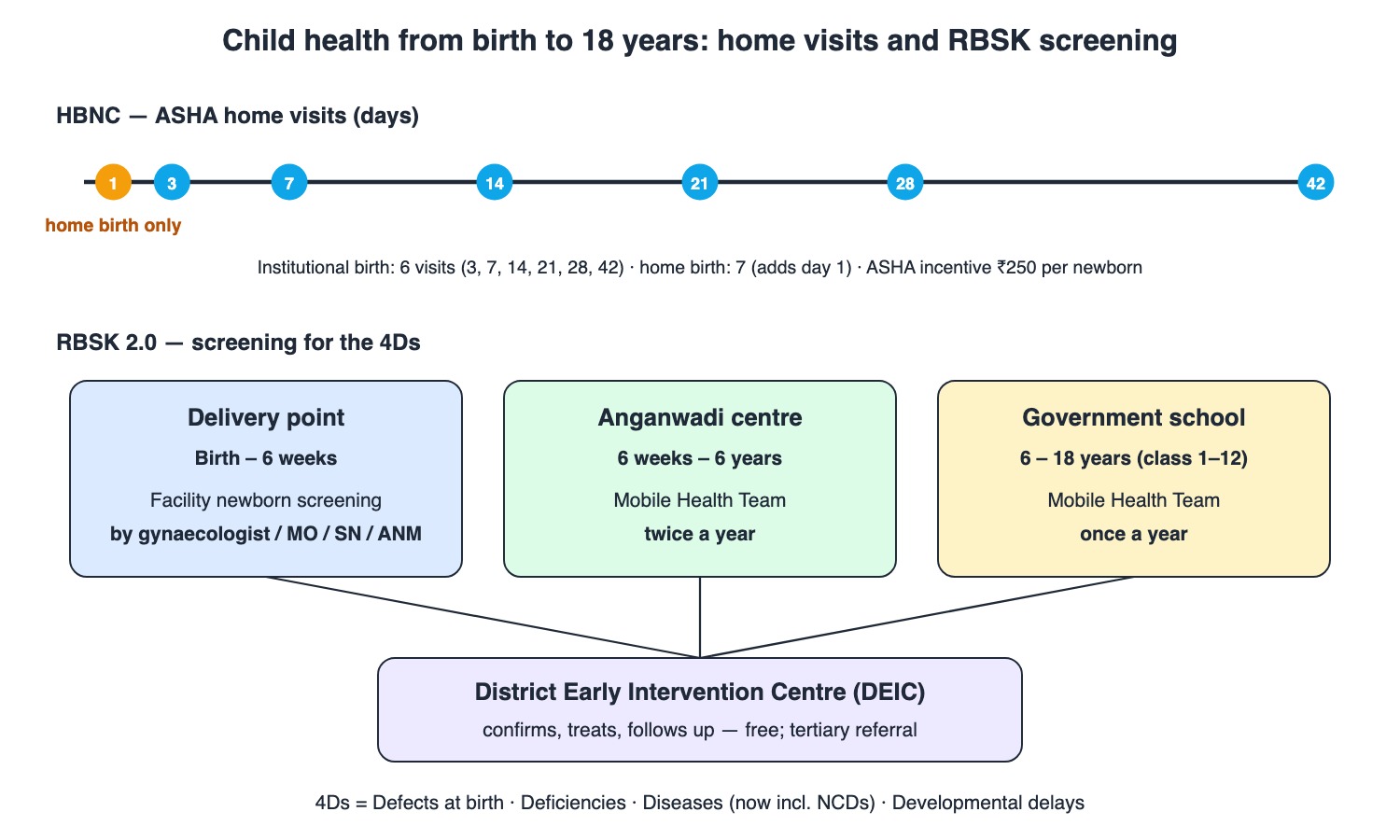
From birth to 18 years: HBNC home visits in the first six weeks, then RBSK screening at the delivery point, the Anganwadi centre and school, with the DEIC as the referral hub.
Under-five mortality fell 41% and neonatal mortality 37% in India in 2014–2024 (global: 18% and 15%), as cited in the RBSK 2.0 guidelines. Nearly 40% of newborn deaths happen in the first 24 hours — the reason home visits start so early.
Home Based Newborn Care (HBNC)
Institutional birth: 6 ASHA visits on days 3, 7, 14, 21, 28 and 42. Home birth: 7 visits — add day 1. After a caesarean (mother home on day 5–6), the five visits from day 7 to 42 earn the full incentive.
At each visit the ASHA promotes exclusive breastfeeding, cord care and warmth, weighs the baby, looks for pneumonia and sepsis, counsels the mother on post-partum care and complications, and refers when needed.
Extra visits for preterm and low-birth-weight babies; follow-up of sick newborns after discharge.
Incentive: ₹250 per newborn (₹500 for twins, ₹750 for triplets), paid after the visits — conditions include recording the newborn's weight in the MCP card, the birth vaccines and birth registration.
RBSK 2.0: Who, Where, How Often
Covers children 0–18 years for the 4Ds: Defects at birth, Deficiencies, Diseases, Developmental delays.
Delivery points (birth–6 weeks): facility newborn screening by gynaecologists, MOs, staff nurses and ANMs; ASHAs screen babies during HBNC visits up to 6 weeks.
Anganwadi centres (6 weeks–6 years): Mobile Health Team, twice a year.
Government and government-aided schools (6–18 years, classes 1–12): Mobile Health Team, once a year.
Mobile Health Team: 2 medical officers (MBBS/BDS/AYUSH), 1 ANM/MPW/staff nurse, 1 pharmacist (data management).
DEIC (district): a multidisciplinary team — paediatrician, MO, psychologist, speech therapist, audiologist, optometrist, physiotherapist, occupational therapist, dentist, social worker — confirms, treats and follows up, free of cost.
The Conditions List (RBSK 2.0)
Group | Conditions |
Defects at birth (1–10) | Neural tube defects, Down syndrome, cleft lip/palate, club foot, developmental dysplasia of the hip, congenital cataract, congenital deafness, congenital heart disease, retinopathy of prematurity, CAKUT (kidney and urinary tract anomalies) |
Deficiencies (11–15) | Vitamin A deficiency, vitamin D deficiency (rickets), severe acute malnutrition, goitre, anaemia |
Diseases incl. NCDs (16–26) | Skin conditions, rheumatic heart disease, reactive airway disease, dental caries, convulsive disorders, diabetes (type 1 and 2), hypertension, kidney disease, otitis media, tuberculosis, leprosy |
Developmental delays (27–35) | Vision and hearing impairment, neuro-motor, motor, cognitive and language delay, behavioural disorders (anxiety, ADHD, sleep), autism spectrum disorder, specific learning disorders, global developmental delay |
Also | Congenital hypothyroidism (optional), adolescent health concerns, red flags for referral |
Diabetes screen: the Mobile Health Team asks about the 4Ts — Toilet, Thirsty, Tired, Thinner, checks random blood sugar on a glucometer when suspicious, and refers to the district NCD clinic (NP-NCD) to classify type 1 or type 2.
What Changed from RBSK to RBSK 2.0
RBSK (2013) | RBSK 2.0 (2026) | |
Scope | 4Ds | Expanded 4Ds + NCDs, mental health, behaviour, lifestyle risks, kidney disorders, digital exposure |
Mobile Health Team | Fixed, mainly AYUSH, 4 persons | 2 MOs (MBBS/BDS/AYUSH) + 1 ANM/MPW/SN + 1 pharmacist, with flexible support staff |
Records | Basic RBSK portal reporting | Longitudinal Health Card; linked with JANANI (RCH 2.0), U-WIN and POSHAN |
Cochlear implant support | 0–2 years | Expanded to 0–6 years |
Convergence | ICDS and schools | Inter-ministerial: MoHFW, MoWCD, MoE, MoSJE |
Traps the Examiner Sets
HBNC: 6 visits for institutional births, 7 for home births (day 1 added); the last visit is day 42.
RBSK: Anganwadi twice a year, schools once a year.
The 4Ds are Defects, Deficiencies, Diseases, Developmental delays — "disabilities" is a common wrong option.
Club foot = talipes (a defect at birth); goitre and anaemia are deficiencies; RHD and dental caries are diseases.
RBSK 2.0 adds diabetes, hypertension and kidney disorders; congenital hypothyroidism is optional.
Memory Hooks & Shortcuts
Shortcuts to lock in this article's numbers and lists. Each one only re-packages facts proven above.
🧠 3-7-14-21-28-42 — HBNC days — roughly week by week to 6 weeks; home births add day 1
🧠 Twice at the Anganwadi, once at school — RBSK screening frequency
🧠 The 4Ds: Defect, Deficient, Diseased, Delayed — the RBSK screening frame
🧠 2 + 1 + 1 — Mobile Health Team: 2 MOs, 1 nurse/ANM, 1 pharmacist
🧠 4Ts: Toilet, Thirsty, Tired, Thinner — the RBSK 2.0 diabetes screen
🧠 Cochlear 2 → 6 — implant support widened from 0–2 to 0–6 years in RBSK 2.0
Rapid-Revision Cards
HBNC visits — institutional birth
Days 3, 7, 14, 21, 28, 42 (six visits).
HBNC visits — home birth
Seven: add day 1.
HBNC incentive
₹250 per newborn (twins ₹500, triplets ₹750).
Extra HBNC visits
Preterm and low-birth-weight babies; sick newborns after discharge.
Deaths on day 1
Nearly 40% of newborn deaths are in the first 24 hours.
RBSK 4Ds
Defects at birth, Deficiencies, Diseases, Developmental delays.
RBSK age range
0–18 years.
RBSK platforms
Delivery point (0–6 wk) · Anganwadi (6 wk–6 y, twice a year) · schools (6–18 y, once a year).
Mobile Health Team
2 MOs (MBBS/BDS/AYUSH) + 1 ANM/MPW/SN + 1 pharmacist.
DEIC
District hub: confirm, treat, follow up — free; multidisciplinary team.
RBSK defects examples
NTD, Down syndrome, cleft, club foot, DDH, congenital cataract/deafness, CHD, ROP, CAKUT.
RBSK deficiencies
Vitamin A, vitamin D (rickets), SAM, goitre, anaemia.
RBSK 2.0 new NCDs
Diabetes (T1/T2), hypertension, kidney disorders.
4Ts
Toilet, Thirsty, Tired, Thinner → RBS → NP-NCD clinic.
Cochlear implant support
0–2 years → 0–6 years under RBSK 2.0.
RBSK 2.0 digital
Health Card; linked to JANANI (RCH 2.0), U-WIN, POSHAN.
Sources
Sources
Facts in this article were checked against these documents.
Test Yourself: Practice Questions
Sixteen questions in NEET PG style.
Practice Questions (NEET PG pattern)
Original questions written in the style of the exam: +4 for a correct answer, −1 for a wrong one. Every answer was checked against the sources listed above. NEET PG papers are not published by NBEMS, so these are not past-paper questions.
Q1. After an institutional delivery, HBNC home visits by the ASHA are made on days
(a) 3, 7, 14, 21, 28 and 42
(b) 1, 3, 7, 14, 21, 28 and 42
(c) 2, 7, 14 and 28
(d) 1, 7, 28 and 42
Show answer
Answer: (a) — Six visits for institutional births; home births add day 1 (seven visits).
Q2. The extra HBNC visit for a home delivery is on
(a) day 10
(b) day 2
(c) day 1
(d) day 5
Show answer
Answer: (c) — Home delivery: day 1, 3, 7, 14, 21, 28 and 42.
Q3. An ASHA completing HBNC visits for twins receives
(a) ₹750
(b) ₹500
(c) ₹250
(d) ₹1000
Show answer
Answer: (b) — ₹250 per newborn: twins ₹500, triplets ₹750.
Q4. According to the HBNC guidelines, what share of newborn deaths occur within the first 24 hours of life?
(a) About 75%
(b) Nearly 40%
(c) About 10%
(d) About 25%
Show answer
Answer: (b) — Nearly 40% on the first day; about three-quarters in the first week.
Q5. The 4Ds of RBSK are
(a) Defects at birth, Deficiencies, Diseases, Developmental delays
(b) Defects, Disabilities, Deficiencies, Deaths
(c) Diarrhoea, Dehydration, Deficiency, Disability
(d) Diagnosis, Drugs, Diet, Development
Show answer
Answer: (a) — Defects at birth, Deficiencies, Diseases and Developmental delays.
Q6. Under RBSK 2.0, Mobile Health Teams screen children at Anganwadi centres
(a) once every 2 years
(b) twice a year
(c) every month
(d) once a year
Show answer
Answer: (b) — Biannually at each AWC; annually in government and government-aided schools.
Q7. Children aged 6–18 years are screened under RBSK at
(a) Anganwadi centres, twice a year
(b) PHCs, every quarter
(c) government and government-aided schools, once a year
(d) private schools only
Show answer
Answer: (c) — Classes 1–12 in government and government-aided schools, annually.
Q8. The core RBSK 2.0 Mobile Health Team consists of
(a) 1 MO, 1 ASHA and 1 Anganwadi worker
(b) 2 medical officers, 1 ANM/MPW/staff nurse and 1 pharmacist
(c) 4 AYUSH doctors
(d) 1 paediatrician and 2 nurses
Show answer
Answer: (b) — 2 MOs (MBBS/BDS/AYUSH) + 1 ANM/MPW/SN + 1 pharmacist with data skills.
Q9. Under RBSK, club foot (talipes) is classified as a
(a) deficiency
(b) disease
(c) developmental delay
(d) defect at birth
Show answer
Answer: (d) — Talipes is item 4 under defects at birth.
Q10. Which of the following is listed under 'Deficiencies' in RBSK 2.0?
(a) Down syndrome
(b) Goitre
(c) Autism spectrum disorder
(d) Rheumatic heart disease
Show answer
Answer: (b) — Deficiencies: vitamin A, vitamin D (rickets), SAM, goitre, anaemia.
Q11. A new NCD added to the RBSK 2.0 screening list is
(a) hypertension
(b) dental caries
(c) tuberculosis
(d) rheumatic heart disease
Show answer
Answer: (a) — RBSK 2.0 adds NCDs such as diabetes (type 1 and 2), hypertension and kidney disorders.
Q12. The '4Ts' used by RBSK Mobile Health Teams to screen for diabetes are
(a) Toilet, Thirsty, Tired, Thinner
(b) Tremor, Tachycardia, Tired, Thin
(c) Tall, Thin, Tired, Thirsty
(d) Temperature, Tone, Thirst, Toilet
Show answer
Answer: (a) — Symptom screen: Toilet, Thirsty, Tired, Thinner; then random blood sugar if suspected.
Q13. The facility at district level that confirms and treats children referred by RBSK teams is the
(a) Adolescent Friendly Health Clinic
(b) District Early Intervention Centre
(c) Special Newborn Care Unit
(d) Nutrition Rehabilitation Centre
Show answer
Answer: (b) — DEIC — a multidisciplinary team providing free confirmation, treatment and follow-up.
Q14. Under RBSK 2.0, state-supported cochlear implant coverage was expanded to children aged
(a) 0–6 years
(b) 0–2 years
(c) 6–12 years
(d) 0–18 years
Show answer
Answer: (a) — From 0–2 years under RBSK to 0–6 years under RBSK 2.0.
Q15. Who screens newborns at delivery points under RBSK?
(a) The Mobile Health Team
(b) Anganwadi workers
(c) Gynaecologists, medical officers, staff nurses and ANMs
(d) DEIC therapists only
Show answer
Answer: (c) — Facility-based newborn screening is by the delivery-point staff; MHTs work at AWCs and schools.
Q16. RBSK 2.0 links each child's longitudinal Health Card with
(a) the PM-JAY card
(b) JANANI (RCH 2.0), U-WIN and POSHAN
(c) the Ni-kshay portal
(d) the CoWIN portal only
Show answer
Answer: (b) — The RBSK 2.0 digital platform is integrated with JANANI (RCH 2.0), U-WIN and POSHAN.
Active Recall
From memory: give the HBNC visit days for institutional and home births, what each visit covers and the incentive; then explain RBSK 2.0 — the 4Ds with examples, who is screened where and how often, the Mobile Health Team, the DEIC, the 4Ts diabetes screen and what changed from the original RBSK.