Probity in Governance for UPSC GS4: Concept of Public Service, Probity, Good Governance, Transparency and the RTI Act with the 2019 and 2023 Changes
Public Service and Probity
🎯 Exam priority: High-yield (Mains GS4). Probity is a full syllabus head. It was asked directly in 2023 ("probity is essential for effective governance and socio-economic development"), as a 2022 short note ("probity in public life"), and through good governance and e-governance (2022). RTI runs through case studies on transparency.
Concept of public service
Public service means holding power and public resources in trust for the people: the office belongs to the public, not to the officer. Kautilya's ideal, quoted by the 2nd ARC in its report on citizen-centric administration, is still the best summary: "in the happiness of his subjects lies his happiness, in their welfare his welfare; whatever pleases himself he does not consider good, but whatever pleases his subjects". Gandhi's idea of Su-raj (good self-government) carries the same spirit.
Philosophical basis of governance and probity
Social contract and trusteeship: citizens entrust power to the state for their welfare; officials are trustees (Gandhi), not owners, of that power.
Kantian respect for persons: citizens are ends, never mere means to an official's convenience or profit.
Rawls's fairness: institutions are judged by how they treat the least advantaged.
Indian traditions: rajadharma, the ruler's duty to protect and serve; Kautilya's welfare ideal.
What probity is
Probity is uprightness and integrity in the conduct of public affairs, going beyond mere legality. The 2nd ARC sets the standard: probity in public life should be judged not only by conviction in a criminal court but by propriety determined by independent institutions. It recalls the Mudgal case, in which Parliament expelled an MP on 24 September 1951 even though he offered to resign, as a high early standard, and sums up: "The standard should be one of not only the conduct of Caesar's wife but of Caesar himself."
Why probity matters for governance and development (2023)
Area | With probity | Without probity |
Public money | Funds reach intended uses; costs fall | Leakage, inflated contracts, poor-quality assets |
Investment and growth | Predictable rules attract investment | Bribes act as a tax and deter enterprise |
Welfare | Benefits reach the poor | The poor pay bribes for their own entitlements |
Trust and legitimacy | Citizens cooperate and comply | Cynicism, protest, falling faith in democracy |
Good Governance and Transparency
Good governance (2022)
The 2nd ARC says good governance aims to let every citizen, irrespective of class, caste and gender, develop to full potential, and to deliver public services effectively, efficiently and equitably. It rests on four pillars:
Pillar | Meaning |
Ethos | Service to the citizen |
Ethics | Honesty, integrity and transparency |
Equity | Treating all citizens alike, with empathy for the weaker sections |
Efficiency | Speedy, effective service without harassment, using ICT increasingly |
E-governance and good governance: online services, direct benefit transfers, digital land records and online grievance portals reduce contact with intermediaries, cut delay and leakage, and leave an audit trail. Limits: the digital divide (connectivity, literacy, disability), authentication failures that exclude genuine beneficiaries, and data privacy. Ethical e-governance keeps an offline route and a human to appeal to.
Transparency and information sharing
The ARC quotes the maxim "there is no better disinfectant than sunlight": transparency should be the mantra of all official acts, and the RTI regime has set administration on the right course. Its 12th Report calls the right to information a basic necessity of good governance.
The Right to Information Act and Recent Changes
The Right to Information Act, 2005: key provisions
Provision | What it says |
Who can ask | Any citizen; no reason needs to be given for the request |
Time limit | 30 days; 48 hours where the information concerns the life or liberty of a person |
Fees | Reasonable; no fee for persons below the poverty line |
Proactive disclosure (section 4) | Public authorities must publish key information on their own |
Exemptions (section 8) | Sovereignty and security, cabinet papers until decisions are complete, and others listed |
Public interest override | Notwithstanding the Official Secrets Act, 1923 or the exemptions, access may be allowed if public interest in disclosure outweighs the harm |
Legislature test | Information that cannot be denied to Parliament or a State Legislature cannot be denied to any person |
Penalty | Rs 250 a day on an information officer who refuses or delays without cause, up to Rs 25,000 |
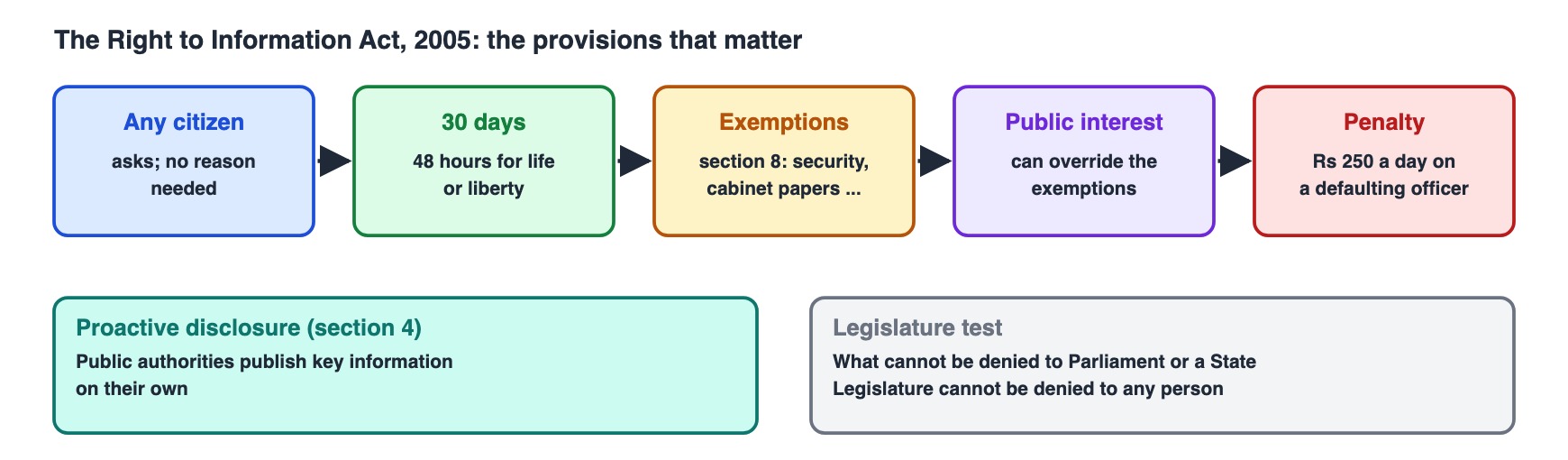
The RTI Act's key provisions as a chain, from the request to the penalty.
Recent changes and debates
2019 amendment: the fixed five-year term of the Chief Information Commissioner and Information Commissioners was replaced by a term "as may be prescribed by the Central Government", along with salaries. Critics argue this weakens the commissions' independence; the government argues it rationalises service conditions.
Personal information (DPDP Act, 2023): the original section 8(1)(j) exempted personal information only where it had no relationship to public activity or interest or would cause an unwarranted invasion of privacy, with an information officer able to disclose it in the larger public interest. Section 44(3) of the Digital Personal Data Protection Act, 2023 substitutes the clause with "information which relates to personal information". Transparency advocates fear this blanket exemption could shield officials' conduct; supporters argue it protects privacy, itself a fundamental right.
Ethical balance: transparency and privacy are both values. The test should be the public interest: information about how public power and public money are used should be open; truly private matters of individuals should be protected.
Other tools of transparency
Proactive disclosure on websites, social audits (article 09), citizens' charters (article 13), open data, publication of reasons for decisions, e-procurement and asset declarations by officials.
Further Reading
PIB press releases, ministry websites and annual reports, the Gazette of India, MEA and UN documents and the official sources named in each note — the primary sources behind every fact above.
Test Yourself: Practice Questions & PYQs
12 practice questions, then the GS4 questions on probity and transparency.
Practice Questions
Q1. The 2nd ARC says the standard for probity in public life should be
(a) the opinion of the ruling party
(b) criminal conviction alone
(c) propriety as judged by independent institutions, not only criminal conviction
(d) public popularity
Show answer
Answer: (c) — It cites the conduct of 'Caesar himself', not just Caesar's wife.
Q2. The Mudgal case, cited by the ARC as a high standard, involved
(a) the first Lokpal appointment
(b) Parliament expelling an MP in 1951 though he offered to resign
(c) a civil servant's dismissal for bribery
(d) a Supreme Court ruling on RTI
Show answer
Answer: (b) — Nehru upheld the principle.
Q3. Which are the four pillars of good governance in the 2nd ARC's 12th Report?
(a) Speed, secrecy, strength and size
(b) Law, order, justice and police
(c) Ethos, ethics, equity and efficiency
(d) Liberty, equality, fraternity and justice
Show answer
Answer: (c) — Ethos is service to the citizen; equity includes empathy for the weaker sections.
Q4. Under the RTI Act, information concerning the life or liberty of a person must be supplied within
(a) 15 days
(b) 7 days
(c) 30 days
(d) 48 hours
Show answer
Answer: (d) — The normal limit is 30 days.
Q5. Under the RTI Act, an applicant
(a) must state the purpose
(b) must pay a fee even if below the poverty line
(c) must be a resident of the State
(d) need not give any reason for requesting information
Show answer
Answer: (d) — No fee is charged from persons below the poverty line.
Q6. The RTI Act allows access even to exempt information if
(a) the applicant is a journalist
(b) a minister approves
(c) public interest in disclosure outweighs the harm
(d) the information is more than five years old in every case
Show answer
Answer: (c) — This applies notwithstanding the Official Secrets Act, 1923.
Q7. The maximum penalty on an information officer under section 20 of the RTI Act is
(a) Rs 25,000
(b) Rs 1 lakh
(c) Rs 10,000
(d) Rs 2,500
Show answer
Answer: (a) — At Rs 250 per day of delay.
Q8. Consider the following statements:
1. The 2019 amendment replaced the fixed five-year term of Information Commissioners.
2. Terms are now as prescribed by the Central Government.
3. The 2019 amendment abolished the Central Information Commission.
Which of the statements given above are correct?
(a) 1 and 2 only
(b) 2 and 3 only
(c) 1 and 3 only
(d) 1, 2 and 3
Show answer
Answer: (a) — 1 and 2 are correct. The commission continues.
Q9. Section 44(3) of the DPDP Act, 2023 amended which RTI provision?
(a) Section 6 on requests
(b) Section 8(1)(j) on personal information
(c) Section 20 on penalties
(d) Section 4 on proactive disclosure
Show answer
Answer: (b) — It now exempts 'information which relates to personal information'.
Q10. 'Information that cannot be denied to Parliament shall not be denied to any person' is a provision of the
(a) Official Secrets Act, 1923
(b) DPDP Act, 2023
(c) RTI Act, 2005
(d) Lokpal Act, 2013
Show answer
Answer: (c) — It is the legislature test for disclosure.
Q11. Gandhi's concept of good self-government cited by the ARC is
(a) Su-raj
(b) Satyagraha
(c) Swadeshi
(d) Sarvodaya
Show answer
Answer: (a) — The ARC links it to good governance.
Q12. The maxim the ARC uses for transparency is
(a) there is no better disinfectant than sunlight
(b) the end justifies the means
(c) might is right
(d) silence is golden
Show answer
Answer: (a) — Transparency, it says, should be the mantra of all official acts.
Mains Practice Questions
Use these to frame full-length answers. You don't have to answer one exactly — they show the angles UPSC tests, so let them guide which points you cover.
Probity is essential for an effective system of governance and socio-economic development. Discuss.
How has the RTI Act changed administrative culture? What are the threats to it?
What is good governance, and how far has e-governance advanced it?
UPSC Mains — Previous Years’ Questions on this topic (last 10 years)
These are the actual GS Mains questions UPSC has asked on this theme — real proof of how, and when, it is tested. Try to write a full answer to each.
2022 (GS-IV): What do you understand by the term 'good governance'? How far recent initiatives in terms of e-Governance steps taken by the State have helped the beneficiaries? Discuss with suitable examples.
2022 (short note, 30 words): Probity in public life.
2023 (GS-IV): 'Probity is essential for an effective system of governance and socio-economic development.' Discuss.