Growth and Anthropometry for NEET PG Paediatrics: Weight, Length and Head Milestones, Teeth, Growth Charts, Faltering and India's NFHS Data
Start Here
🎯 Exam priority: Very high. Expect: when birth weight doubles, triples and quadruples, length and head circumference milestones, number of teeth by age, growth velocity, body proportion ratios, SGA/LGA cut-offs, the adolescent growth spurt, precocious puberty, the definition of growth faltering, and India's NFHS stunting and wasting figures.
CBME mapping: PE1, PE2. Fact-checked against the MSD Manual and India's National Family Health Surveys (NFHS-5, NFHS-6).
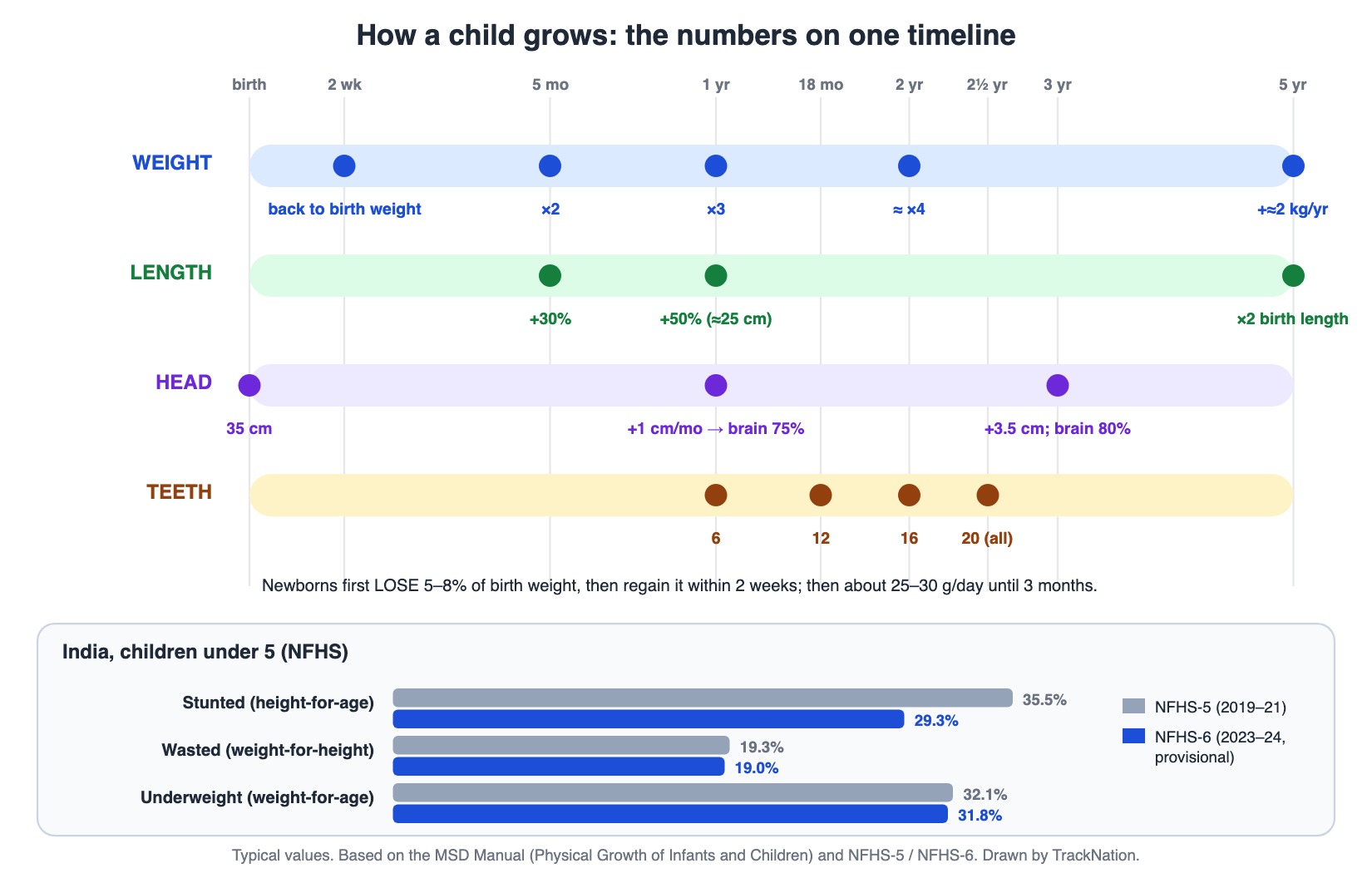
Weight, length, head and teeth from birth to 5 years on one timeline, with India's NFHS nutrition figures. Drawn by TrackNation.
Two Phases and How to Measure (MSD)
Growth has two phases: rapid but slowing growth from birth to about 1–2 years, then steady yearly increments until puberty, when a second spurt comes. All organs grow except lymphatic tissue, which shrinks.
Chart every parameter on the WHO growth charts from birth to 2 years. Measure length lying down (supine stadiometer) in infants and standing height from about 3 years; take three readings and average them.
Growth velocity is a more sensitive measure than a single height: about 2.5 cm/month to 6 months, 1.3 cm/month from 7–12 months and about 7.6 cm/year from 1 to 10 years. After 12 months height is mostly genetic.
Body proportions: the crown–pubis : pubis–heel ratio is 1.7 at birth, 1.5 at 1 year, 1.2 at 5 years and 1.0 after 7 years. Body water is 70% of weight at birth and 61% at 12 months — infants dehydrate easily.
Weight, Length, Head and Teeth (MSD)
Weight: newborns lose 5–8% in the first days and regain birth weight by 2 weeks; then gain 25–30 g/day to 3 months; double by 5 months, triple by 12 months, almost quadruple by 2 years; then about 2 kg/year until puberty.
Length: +30% by 5 months, +50% by 12 months (about 25 cm in year 1), and double the birth length by 5 years. Boys reach half adult height at about 2 years, girls at about 19 months.
Head circumference (measured to 36 months): 35 cm at birth, +1 cm/month in year 1, then +3.5 cm over the next 2 years. The brain is 25% of adult size at birth, 75% at 1 year, 80% at 3 years and 90% at 7 years.
Teeth: about 6 by 12 months, 12 by 18 months, 16 by 2 years and all 20 by 2½ years; permanent teeth replace them from 5 to 13 years and appear earlier in girls.
Newborn Size, Puberty and Growth Faltering (MSD)
Birth size (weight for gestational age): SGA <10th percentile, AGA 10th–90th, LGA >90th. Correct for gestation in preterm babies until 2 years.
Adolescent spurt: girls about 9½–13½ years (peak 11–12½, up to 9 cm/year); boys about 12–16 (peak 13–14, >10 cm/year). Precocious puberty: breasts before 8 in girls, testicular/penile growth before 9 in boys — untreated, the growth plates close early and the adult is short. Most slow growers have constitutional delay and catch up.
Growth and weight faltering (formerly failure to thrive): weight, length or BMI below expected, or crossing 2 percentile lines after normal growth. Causes are organic, nonorganic or (most often) mixed. Weight is the most sensitive indicator; a BMI z-score below −2 signals undernutrition. With poor intake, weight falls before length; falling length means severe, prolonged undernutrition.
India's Numbers (NFHS)
NFHS-5 (2019–21): of children under 5, 36% stunted (short for age), 19% wasted (thin for height), 32% underweight and 3% overweight.
NFHS-6 (2023–24, provisional), India total: stunting 29.3% (35.5% in NFHS-5), wasting 19.0%, severe wasting 5.2% (7.7%), underweight 31.8%.
Remember the pairs: stunting = height-for-age, wasting = weight-for-height, underweight = weight-for-age.
Traps the Examiner Sets
Weight doubles by 5 months and triples by 12 months; length doubles only by 5 years.
Newborns lose 5–8% of birth weight and regain it by 2 weeks — this is normal.
Lymphatic tissue is the one tissue that shrinks as the child grows.
With poor calorie intake, weight falls first; length and head follow later.
Stunting is low height-for-age; wasting is low weight-for-height.
Memory Hooks & Shortcuts
Shortcuts to lock in this article's numbers and lists. Each one only re-packages facts proven above.
🧠 'Five, Twelve, Twenty-four: Double, Triple, Quadruple' — birth weight by months — weight
🧠 'Length takes Five years to double' — weight takes only five months — length
🧠 '35 at birth, a centimetre a month' — head circumference in year 1 — head
🧠 Teeth '6-12-16-20 at 12-18-24-30 months' — add four teeth every six months — teeth
🧠 'Stunted = Short (height), Wasted = Wafer-thin (weight-for-height)' — NFHS
Rapid-Revision Cards
Weight ×2 / ×3 / ×4
5 mo / 12 mo / ~2 yr.
Newborn weight loss
5–8%; regained by 2 weeks.
Gain to 3 months
25–30 g/day.
2 yr → puberty
~2 kg/yr.
Length
+30% at 5 mo; +50% (25 cm) at 1 yr; ×2 at 5 yr.
Half adult height
Boys ~2 yr; girls ~19 mo.
Head at birth
35 cm.
Head growth
+1 cm/mo in year 1; +3.5 cm next 2 yr.
Brain size
25% birth; 75% 1 yr; 80% 3 yr; 90% 7 yr.
Teeth
6 at 1 yr; 12 at 18 mo; 16 at 2 yr; 20 at 2½ yr.
Permanent teeth
5–13 yr; earlier in girls.
Shrinking tissue
Lymphatic.
WHO charts
Birth to 2 years.
Velocity
2.5 cm/mo to 6 mo; 7.6 cm/yr 1–10 yr.
Body ratio
1.7 → 1.5 → 1.2 → 1.0 (7 yr).
Body water
70% at birth; 61% at 1 yr.
SGA / LGA
< 10th / > 90th percentile.
Precocious puberty
Girls < 8; boys < 9.
Faltering
Crosses 2 percentile lines; weight falls first.
NFHS-6 stunting
29.3% (NFHS-5 35.5%).
Wasting / stunting
Wt-for-ht / ht-for-age.
Sources
Facts in this article were checked against these documents.
MSD Manual Professional: Physical Growth of Infants and Children; Growth Parameters in Neonates; Physical Growth and Sexual Maturation of Adolescents; Growth and Weight Faltering in Children — Merck & Co., 2025 (link)
National Family Health Survey (NFHS-5) 2019–21: India Report — International Institute for Population Sciences / MoHFW, 2022
National Family Health Survey (NFHS-6) 2023–24: India and State/UT Fact Sheets (provisional) — International Institute for Population Sciences / MoHFW, 2026
Test Yourself: Practice Questions
Thirty questions in NEET PG style, many of them clinic scenarios.
Practice Questions (NEET PG pattern)
Original questions written in the style of the exam: +4 for a correct answer, −1 for a wrong one. Every answer was checked against the sources listed above. NEET PG papers are not published by NBEMS, so these are not past-paper questions.
Q1. A healthy term baby doubles the birth weight by about
(a) 2 months
(b) 2 years
(c) 5 months
(d) 12 months
Show answer
Answer: (c) — Triples by 12 months.
Q2. Birth weight triples by about
(a) 3 years
(b) 2 years
(c) 12 months
(d) 5 months
Show answer
Answer: (c) — Almost quadruples by 2 years.
Q3. A 4-day-old term baby has lost 6% of birth weight and is feeding well. The best step is
(a) start formula top-ups
(b) reassure — newborns lose 5–8% and regain by 2 weeks
(c) check thyroid function
(d) admit for sepsis work-up
Show answer
Answer: (b) — Physiological.
Q4. In the first 3 months a term infant gains about
(a) 60–80 g/day
(b) 100 g/day
(c) 25–30 g/day
(d) 5–10 g/day
Show answer
Answer: (c) — MSD.
Q5. Between 2 years and puberty, weight increases by about
(a) 2 kg/year
(b) 10 kg/year
(c) 0.5 kg/year
(d) 5 kg/year
Show answer
Answer: (a) — MSD.
Q6. Length at 12 months compared with birth length is about
(a) triple
(b) 50% more
(c) the same
(d) double
Show answer
Answer: (b) — About 25 cm gained.
Q7. Birth length doubles by about
(a) 10 years
(b) 1 year
(c) 2 years
(d) 5 years
Show answer
Answer: (d) — MSD.
Q8. Average head circumference of a term newborn is
(a) 40 cm
(b) 35 cm
(c) 30 cm
(d) 45 cm
Show answer
Answer: (b) — +1 cm/month in year 1.
Q9. In the first year, head circumference increases by about
(a) 5 cm per month
(b) 3 cm per month
(c) 1 cm per month
(d) 0.2 cm per month
Show answer
Answer: (c) — MSD.
Q10. By 12 months the brain is about what percentage of adult size?
(a) 75%
(b) 50%
(c) 25%
(d) 90%
Show answer
Answer: (a) — 25% at birth, 90% at 7 years.
Q11. Up to what age is head circumference routinely measured?
(a) 10 years
(b) 36 months
(c) 12 months
(d) 5 years
Show answer
Answer: (b) — Reflects brain growth.
Q12. A 12-month-old typically has how many teeth?
(a) 6
(b) 12
(c) 2
(d) 20
Show answer
Answer: (a) — 12 by 18 months, 16 by 2 years.
Q13. All 20 deciduous teeth have usually erupted by
(a) 1 year
(b) 6 years
(c) 2½ years
(d) 5 years
Show answer
Answer: (c) — MSD.
Q14. Which tissue decreases in size as a child grows?
(a) Liver
(b) Muscle
(c) Brain
(d) Lymphatic tissue
Show answer
Answer: (d) — MSD.
Q15. Up to what age are WHO growth charts recommended for all growth parameters?
(a) 6 months
(b) 5 years
(c) 2 years
(d) 10 years
Show answer
Answer: (c) — MSD.
Q16. Growth velocity between 1 and 10 years averages about
(a) 7.6 cm per year
(b) 25 cm per year
(c) 2.5 cm per year
(d) 15 cm per year
Show answer
Answer: (a) — 2.5 cm/month to 6 months.
Q17. The crown–pubis to pubis–heel ratio at birth is
(a) 1.2
(b) 1.7
(c) 2.5
(d) 1.0
Show answer
Answer: (b) — 1.0 after 7 years.
Q18. Body water as a percentage of body weight at birth is about
(a) 40%
(b) 70%
(c) 90%
(d) 50%
Show answer
Answer: (b) — 61% at 12 months.
Q19. A newborn weighing below the 10th percentile for gestational age is
(a) small for gestational age
(b) preterm
(c) appropriate for gestational age
(d) large for gestational age
Show answer
Answer: (a) — LGA > 90th.
Q20. The peak adolescent growth spurt in boys is typically at
(a) 11–12 years
(b) 13–14 years
(c) 9–10 years
(d) 16–17 years
Show answer
Answer: (b) — > 10 cm in the peak year.
Q21. The peak growth spurt in girls is typically at
(a) 11–12½ years
(b) 8–9 years
(c) 16 years
(d) 14–15 years
Show answer
Answer: (a) — Up to 9 cm in the peak year.
Q22. Precocious puberty in girls is traditionally defined as breast development before
(a) 8 years
(b) 10 years
(c) 12 years
(d) 6 years
Show answer
Answer: (a) — Boys: before 9.
Q23. Untreated precocious puberty leads to
(a) short adult stature from early growth-plate closure
(b) no effect on height
(c) tall adult stature
(d) obesity only
Show answer
Answer: (a) — MSD.
Q24. Most children who grow slowly have
(a) Turner syndrome
(b) growth hormone deficiency
(c) hypothyroidism
(d) constitutional delay and catch up
Show answer
Answer: (d) — MSD.
Q25. Growth and weight faltering includes a child whose weight
(a) crosses 2 percentile lines downward after normal growth
(b) is above the 90th percentile
(c) stays on the 25th percentile
(d) rises across percentiles
Show answer
Answer: (a) — Formerly failure to thrive.
Q26. The most sensitive indicator of a child's nutritional status is
(a) mid-arm circumference
(b) height
(c) head circumference
(d) weight
Show answer
Answer: (d) — MSD.
Q27. In faltering from poor calorie intake, the first parameter to fall is
(a) weight
(b) head circumference
(c) all three together
(d) length
Show answer
Answer: (a) — Length later.
Q28. Most cases of growth and weight faltering are
(a) genetic
(b) endocrine
(c) purely organic
(d) mixed organic and nonorganic
Show answer
Answer: (d) — MSD.
Q29. In NFHS-6 (2023–24, provisional), stunting in Indian children under 5 was
(a) 35.5%
(b) 5.2%
(c) 19.0%
(d) 29.3%
Show answer
Answer: (d) — 35.5% in NFHS-5.
Q30. Wasting is defined by low
(a) weight-for-age
(b) weight-for-height
(c) height-for-age
(d) head-for-age
Show answer
Answer: (b) — Stunting = height-for-age.
Active Recall
From memory: give the weight, length, head circumference, brain size and teeth milestones from birth to 5 years, growth velocity and body proportions, SGA and LGA cut-offs, the adolescent spurt and precocious puberty ages, how growth faltering is defined, and India's NFHS figures.