Drug Absorption, Bioavailability and Distribution for NEET PG Pharmacology: pKa, First-Pass, AUC, Volume of Distribution
Start Here
🎯 Exam priority: High. Pharmacokinetics questions are short and mostly logic: an ionisation scenario, a volume of distribution sum, or which drug is displaced. Learn the rule and the calculation.
CBME mapping: PH 1.4, PH 1.5, PH 1.6. Pharmacokinetics is what the body does to a drug; pharmacodynamics is what the drug does to the body.
Crossing Membranes
A drug must be in solution to be absorbed, and unless given IV it must cross cell membranes to reach the circulation.
Mechanism | Energy | Against gradient? | Point to remember |
Passive diffusion | No | No | Most drugs; favours lipid-soluble, small, un-ionised molecules |
Facilitated diffusion | No | No | Carrier-mediated; for example glucose |
Active transport | Yes | Yes | Selective; for drugs resembling ions, vitamins, sugars, amino acids |
Pinocytosis | Yes | — | Vesicle engulfs fluid or particles; more relevant for protein drugs |
Passive diffusion goes faster with a steeper concentration gradient, higher lipid solubility, smaller size, lower ionisation and larger surface area.
Ionisation: pH and pKa
Most drugs are weak acids or bases. The un-ionised form crosses membranes; the ionised form does not. pKa is the pH at which the two forms are equal.
Setting | Weak acid (e.g. aspirin) | Weak base (e.g. quinidine) |
pH below pKa | Mostly un-ionised | Mostly ionised |
pH above pKa | Mostly ionised | Mostly un-ionised |
pKa 4.4 at stomach pH 1.4 | Un-ionised : ionised = 1000 : 1 | Mostly ionised |
pKa 4.4 at plasma pH 7.4 | Un-ionised : ionised = 1 : 1000 | — |
The rule: acids stay un-ionised in acid, bases stay un-ionised in base. Each step of 1 pH unit away from pKa changes the ratio tenfold, which is why 3 units gives 1000 to 1.
The catch: even though aspirin is un-ionised in the stomach, most absorption of any oral drug happens in the small intestine, because its surface area is larger and its membranes are more permeable.
Oral and Other Routes
Gastric emptying is often the rate-limiting step. Food, especially fat, slows it. Drugs that delay emptying, such as parasympatholytics, slow the absorption of other drugs.
Food effects: raises the extent of absorption of griseofulvin; lowers it for penicillin G, which is degraded in the stomach.
Dissolution can be the rate-limiting step for solid forms.
Peptides such as insulin are destroyed in the gut and are not given orally.
Buccal and sublingual: thin, vascular mucosa; holding the drug in place improves absorption.
IV enters the circulation directly. IM and subcutaneous doses must still cross membranes.
Controlled-release forms reduce dosing frequency and smooth out plasma levels. Crushing them can be dangerous. Transdermal forms release drug over long periods.
Bioavailability
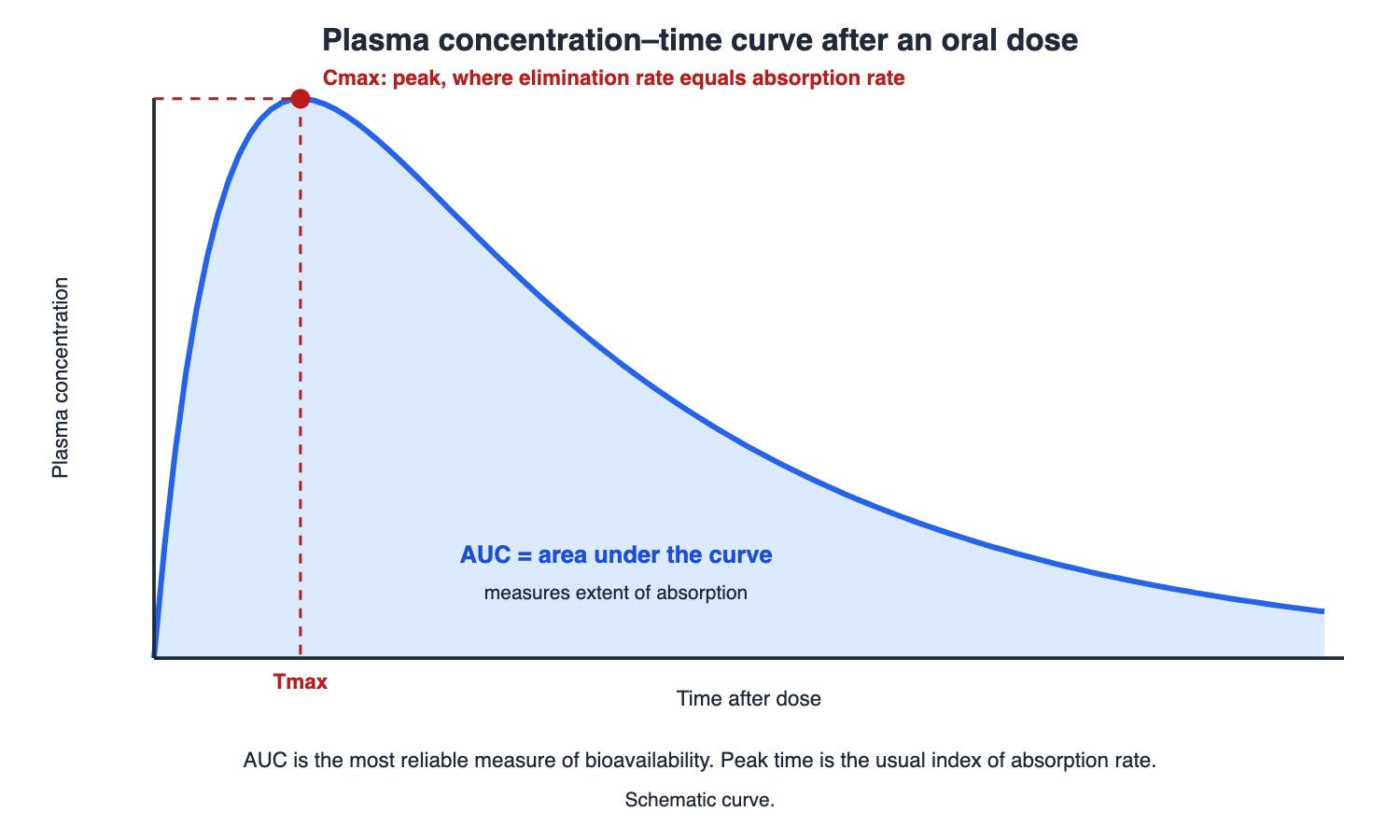
AUC tells you how much drug got in. Peak time tells you how fast.
Bioavailability is the extent and rate at which the active drug reaches the systemic circulation: amount absorbed ÷ dose.
Measured by AUC, the most reliable measure. The peak level can mislead because elimination starts at once. Peak time is the usual index of absorption rate.
First-pass metabolism happens in the gut wall and liver before the drug reaches the systemic circulation, and is a common cause of low oral bioavailability.
Other causes: poor water solubility, slow absorption, too little time in the gut, and chemical reactions such as tetracycline binding metal ions or digoxin adsorbing to cholestyramine.
Term | Means |
Chemical equivalence | Same active drug, same amount; inactive ingredients may differ |
Bioequivalence | Same dose regimen gives equivalent drug levels in plasma and tissues |
Therapeutic equivalence | Same dose regimen gives the same therapeutic and adverse effects |
Therapeutic index is the ratio of minimum toxic concentration to median effective concentration. Small bioavailability differences matter most for narrow therapeutic index drugs; penicillin's wide index tolerates them.
Distribution
Apparent volume of distribution (Vd) = amount of drug in the body ÷ plasma concentration. It is a theoretical volume, not a real fluid compartment.
Worked example: 1,000 mg gives a plasma level of 10 mg/L. Vd = 1,000 ÷ 10 = 100 L. That is more than total body water, so the drug must be concentrated in tissues.
High Vd: heavily tissue-bound, little left in plasma.
Low Vd: stays in the circulation.
Drug type | Binds mainly to | Volume of distribution | Examples |
Acidic | Albumin | Small | Warfarin, aspirin |
Basic | Alpha-1 acid glycoprotein, lipoproteins | Large | Amphetamine, meperidine |
Only unbound drug reaches tissues and acts. Saturation of binding sites is the basis of displacement interactions.
Redistribution: thiopental enters the brain fast and works fast, then its effect ends within minutes as it moves to poorly perfused fat. Repeated doses accumulate there.
Tissue storage: chloroquine reaches levels thousands of times plasma in white cells and liver.
Blood-brain barrier: tight capillary endothelium plus an astrocytic sheath. Lipid-soluble drugs enter; polar compounds do not.
Traps the Examiner Sets
Weak acids are un-ionised in the stomach, but the main absorption site is still the small intestine.
High Vd means low plasma level, not more drug in the blood.
Acidic drugs bind albumin; basic drugs bind alpha-1 acid glycoprotein.
Thiopental's short action comes from redistribution, not metabolism.
AUC measures extent; peak time reflects rate.
Facilitated diffusion uses a carrier but no energy.
Memory Hooks & Shortcuts
Shortcuts to lock in this article's numbers and lists. Each one only re-packages facts proven above.
🧠 Like stays un-ionised with like — acid in acid, base in base
🧠 Three pH units, a thousand to one — each unit away from pKa changes the ratio tenfold
🧠 Absorption lives in the small intestine — whatever the drug's charge
🧠 AUC = how much, peak time = how fast — extent and rate of absorption
🧠 Vd = Dose over Concentration — the only sum you need
🧠 Acids to Albumin — the A-A binding pair
🧠 Thiopental leaves for fat — redistribution ends its effect
Rapid-Revision Cards
Pharmacokinetics vs pharmacodynamics
What the body does to the drug; what the drug does to the body.
Which form crosses membranes
Un-ionised, lipid-soluble.
pKa
pH at which ionised and un-ionised forms are equal.
Weak acid in acid
Mostly un-ionised.
Weak base in acid
Mostly ionised.
Main absorption site
Small intestine, for acids and bases.
Rate-limiting step for oral absorption
Often gastric emptying.
Active transport
Needs energy, selective, can go against a gradient.
Facilitated diffusion
Carrier, no energy, not against a gradient.
Pinocytosis matters for
Protein drugs.
Bioavailability
Extent and rate of reaching systemic circulation; amount absorbed ÷ dose.
Best measure of bioavailability
AUC.
Peak concentration occurs when
Elimination rate equals absorption rate.
First-pass metabolism
In gut wall and liver, before systemic circulation.
Tetracycline and antacids
Metal ion complex reduces absorption.
Bioequivalence
Equivalent plasma and tissue levels.
Therapeutic index
Minimum toxic ÷ median effective concentration.
Vd formula
Amount in body ÷ plasma concentration.
High Vd means
Tissue-bound, low plasma level.
Acidic drug binding
Albumin.
Basic drug binding
Alpha-1 acid glycoprotein and lipoproteins.
Active fraction
Unbound drug.
Thiopental short action
Redistribution to fat.
Blood-brain barrier
Capillary endothelium + astrocytic sheath.
Sources
Facts in this article were checked against these documents.
Overview of Pharmacokinetics; Drug Absorption; Drug Bioavailability; Drug Distribution to Tissues — MSD Manual Professional Edition, reviewed 2026 (link)
Competency Based Undergraduate Curriculum, Pharmacology (PH) — National Medical Commission, 2024
Test Yourself: Practice Questions
Twenty-six questions in NEET PG style, including clinical vignettes.
Practice Questions (NEET PG pattern)
Original questions written in the style of the exam: +4 for a correct answer, −1 for a wrong one. Every answer was checked against the sources listed above. NEET PG papers are not published by NBEMS, so these are not past-paper questions.
Q1. Which form of a drug crosses cell membranes most easily by passive diffusion?
(a) Protein-bound
(b) Large and polar
(c) Ionised, water-soluble
(d) Un-ionised, lipid-soluble
Show answer
Answer: (d) — The un-ionised form is usually lipid soluble and diffuses readily.
Q2. A weak acid with a pKa of 4.4 is in gastric fluid at pH 1.4. The ratio of un-ionised to ionised drug is
(a) 1 : 1
(b) 1 : 1000
(c) 1000 : 1
(d) 10 : 1
Show answer
Answer: (c) — pH is 3 units below pKa, so the acid is mostly un-ionised: 1000 to 1.
Q3. pKa is the pH at which a drug is
(a) 50% ionised
(b) bound to albumin
(c) fully un-ionised
(d) fully ionised
Show answer
Answer: (a) — At pKa, ionised and un-ionised forms are equal.
Q4. Aspirin is a weak acid. The main site of its absorption is the
(a) stomach
(b) small intestine
(c) colon
(d) mouth
Show answer
Answer: (b) — Whether acid or base, most absorption occurs in the small intestine, with its larger surface area.
Q5. Transport that needs energy and can move a drug against a concentration gradient is
(a) active transport
(b) passive diffusion
(c) facilitated diffusion
(d) filtration
Show answer
Answer: (a) — Active transport is selective and energy-dependent.
Q6. Glucose crosses membranes faster than its lipid solubility predicts, without using energy. This is
(a) simple diffusion
(b) active transport
(c) facilitated diffusion
(d) pinocytosis
Show answer
Answer: (c) — A carrier speeds passage without energy expenditure or transport against a gradient.
Q7. Insulin is not given orally because
(a) it is excreted in bile
(b) it is degraded in the gut
(c) it causes vomiting
(d) it is too lipid soluble
Show answer
Answer: (b) — Peptide drugs are susceptible to degradation.
Q8. Taking griseofulvin with a fatty meal
(a) increases its absorption
(b) stops its absorption
(c) has no effect
(d) destroys the drug
Show answer
Answer: (a) — Food may enhance the extent of absorption of poorly soluble drugs such as griseofulvin.
Q9. The rate-limiting step for absorption of many oral drugs is
(a) plasma protein binding
(b) gastric emptying
(c) renal clearance
(d) biliary excretion
Show answer
Answer: (b) — Most absorption occurs in the small intestine, so gastric emptying often limits the rate.
Q10. A patient crushes a controlled-release tablet because he cannot swallow it. The main concern is
(a) the dose may be released too quickly
(b) no concern at all
(c) the drug becomes inactive
(d) the drug cannot be absorbed
Show answer
Answer: (a) — Crushing or disturbing a controlled-release form can be dangerous.
Q11. The most reliable measure of the extent of bioavailability is
(a) peak time
(b) peak concentration
(c) area under the plasma concentration–time curve
(d) half-life
Show answer
Answer: (c) — AUC is directly proportional to the unchanged drug reaching the circulation.
Q12. Peak plasma concentration after an oral dose occurs when
(a) half the dose is excreted
(b) absorption has stopped completely
(c) the drug reaches the liver
(d) elimination rate equals absorption rate
Show answer
Answer: (d) — The peak is reached when the rate of elimination equals the rate of absorption.
Q13. Metabolism of a drug in the gut wall and liver before it reaches the systemic circulation is
(a) redistribution
(b) phase II conjugation
(c) first-pass metabolism
(d) enterohepatic circulation
Show answer
Answer: (c) — First-pass metabolism occurs before a drug reaches the systemic circulation.
Q14. A patient on tetracycline takes antacids and has a poor response. The mechanism is
(a) enzyme induction
(b) complex formation with metal ions
(c) increased renal excretion
(d) protein displacement
Show answer
Answer: (b) — Tetracycline forms a complex with polyvalent metal ions, reducing absorption.
Q15. Two brands give equivalent plasma and tissue levels when used in the same regimen. They are
(a) bioequivalent
(b) therapeutically inferior
(c) chemically different
(d) prodrugs
Show answer
Answer: (a) — Bioequivalence means equivalent drug concentrations in plasma and tissues.
Q16. A patient gets 500 mg of a drug and the plasma level is 25 mg/L. The apparent volume of distribution is
(a) 20 L
(b) 12.5 L
(c) 0.05 L
(d) 125 L
Show answer
Answer: (a) — Vd = amount in body ÷ plasma concentration = 500 ÷ 25 = 20 L.
Q17. A drug is given in a dose of 2,000 mg and gives a plasma level of 2 mg/L. It is most likely
(a) confined to the ECF
(b) not absorbed
(c) confined to plasma
(d) heavily bound in tissues
Show answer
Answer: (d) — Vd is 1,000 L, far above body volume: the drug is tissue-bound with a low plasma level.
Q18. Acidic drugs bind mainly to
(a) globulin only
(b) alpha-1 acid glycoprotein
(c) albumin
(d) haemoglobin
Show answer
Answer: (c) — Acidic drugs bind albumin; basic drugs bind alpha-1 acid glycoprotein and lipoproteins.
Q19. Which part of a drug in plasma is pharmacologically active?
(a) The total concentration
(b) The fraction in red cells
(c) The unbound fraction
(d) The albumin-bound fraction
Show answer
Answer: (c) — Only unbound drug is available for passive diffusion to tissues.
Q20. A single IV dose of thiopental wears off within minutes because of
(a) rapid hepatic metabolism
(b) rapid renal excretion
(c) binding to receptors
(d) redistribution to fat
Show answer
Answer: (d) — The effect ends as the drug redistributes to slowly perfused fatty tissues.
Q21. The blood-brain barrier is formed by
(a) the dura mater
(b) the choroid plexus alone
(c) the arachnoid only
(d) brain capillary endothelium and the astrocytic sheath
Show answer
Answer: (d) — Tight capillary endothelium plus astrocytes.
Q22. An 80-year-old on long-term phenytoin is admitted malnourished with serum albumin 2.1 g/dL. Her total phenytoin level is in range but she is ataxic. The best explanation is
(a) reduced oral absorption
(b) more unbound (free) phenytoin because albumin is low
(c) phenytoin enzyme induction
(d) a falsely high total level
Show answer
Answer: (b) — Rapid falls in albumin raise the unbound (active) fraction; phenytoin and warfarin are the classic examples.
Q23. A man takes digoxin and cholestyramine together each morning, and his digoxin level is low. The mechanism is
(a) enzyme induction
(b) displacement from albumin
(c) increased renal clearance
(d) adsorption of digoxin to cholestyramine in the gut
Show answer
Answer: (d) — Bioavailability falls when a drug adsorbs to another drug, such as digoxin to cholestyramine; separate the doses.
Q24. Oral penicillin G is best taken
(a) with a fatty meal to increase absorption
(b) with antacids
(c) on an empty stomach, because food reduces absorption of drugs degraded in the stomach
(d) with milk
Show answer
Answer: (c) — Food reduces absorption of drugs degraded in the stomach (penicillin G) but can increase it for poorly soluble drugs (griseofulvin).
Q25. A 78-year-old on a proton pump inhibitor needs calcium supplementation. The better choice is
(a) calcium citrate, which absorbs well in a less acidic stomach
(b) calcium carbonate on an empty stomach
(c) no calcium at all
(d) calcium carbonate, which needs acid
Show answer
Answer: (a) — Raised gastric pH (age or PPIs) reduces calcium carbonate absorption; calcium citrate absorbs better.
Q26. An elderly man with atrophic gastritis develops dyspepsia on enteric-coated aspirin. A likely reason is
(a) slower gastric emptying
(b) increased protein binding
(c) higher gastric pH causing early release of the enteric-coated tablet
(d) reduced first-pass metabolism
Show answer
Answer: (c) — Raised gastric pH can release enteric-coated forms early, increasing GI adverse effects.
Active Recall
From memory: list the four ways drugs cross membranes; explain how pH and pKa decide ionisation with an example; say where oral drugs are absorbed and what slows it; define bioavailability, AUC and first-pass metabolism; calculate a volume of distribution; and explain protein binding, redistribution and the blood-brain barrier.