Drug Development, Clinical Trials and Regulation for NEET PG Pharmacology: Phases I–IV, NDCT Rules 2019, Ethics Committees, NLEM 2022
Start Here
🎯 Exam priority: Medium. Expect one question on trial phases (which phase gives most safety data, which is first-in-human) and sometimes one on Indian regulation: orphan drug, Ethics Committee composition, CTRI, or the essential medicines list.
CBME mapping: PH 10 (applied pharmacology: drug development, regulation, essential medicines).
The Four Phases
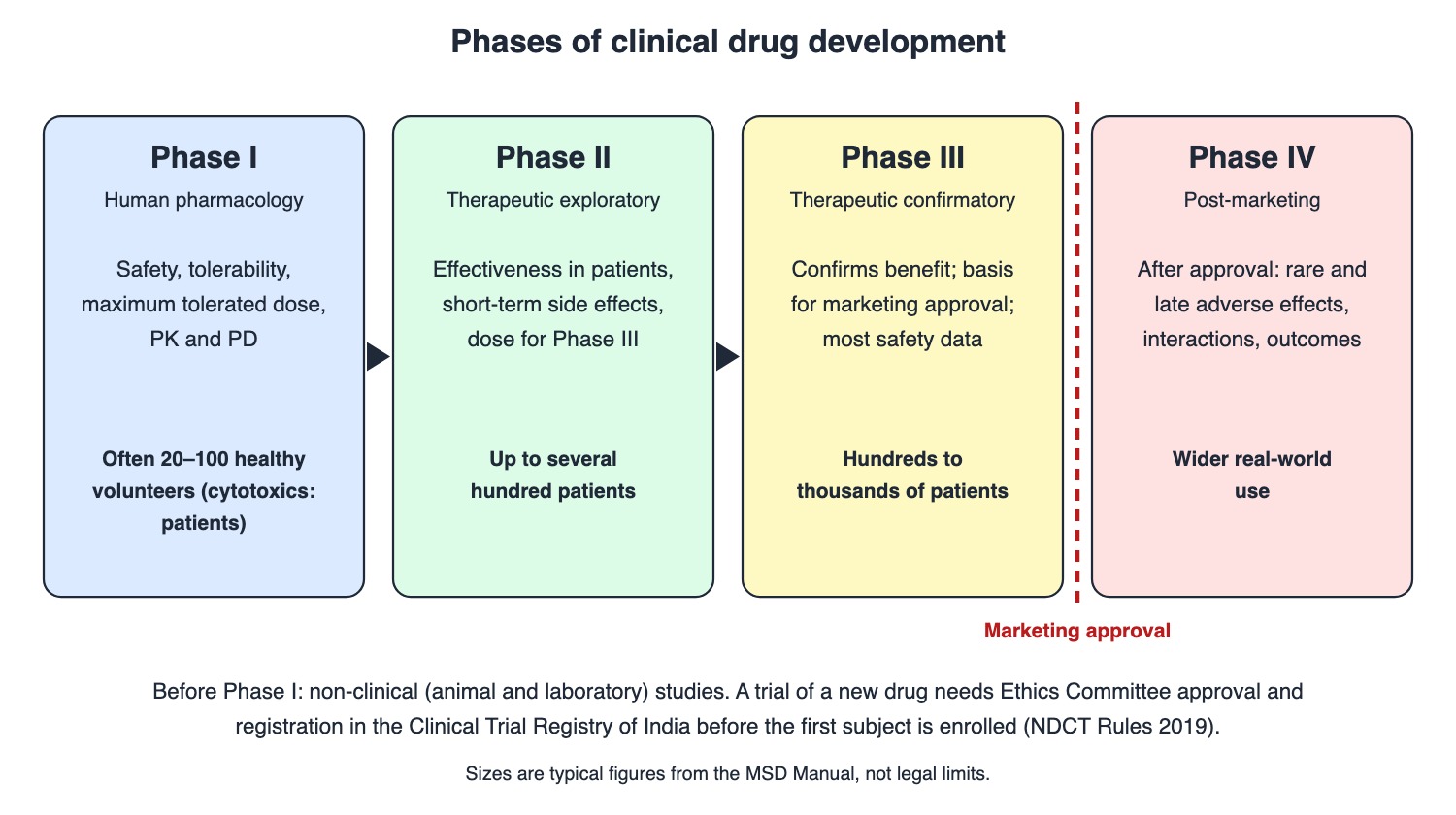
The four phases of clinical drug development. Objectives from the New Drugs and Clinical Trials Rules 2019; typical sizes from the MSD Manual. Drawn by TrackNation.
Phase | Also called | Main objective (NDCT Rules 2019) | Typical size (MSD Manual) |
I | Human pharmacology | Safety and tolerability on first use in humans; maximum tolerated dose, PK, PD | Often 20–100, usually healthy volunteers |
II | Therapeutic exploratory | Effectiveness in patients with the condition; short-term side effects; dose for Phase III | Up to several hundred |
III | Therapeutic confirmatory | Confirms therapeutic benefit; basis for marketing approval | Hundreds to thousands; most safety data |
IV | Post-marketing | After approval, for the approved indication: interactions, safety, mortality and morbidity studies | Large, real-world |
Phase I is usually in healthy volunteers, but drugs with significant toxicity, such as cytotoxics, are studied in patients.
Phase II doses are usually below the highest Phase I doses; a key aim is choosing the dose for Phase III.
Phase III gives most of the safety data before approval; Phase IV picks up uncommon or slowly developing adverse effects missed by smaller, shorter trials. Older adults should be included in Phase III in meaningful numbers when the disease is one of ageing.
Efficacy, Effectiveness and Outcomes
Efficacy: the ability to achieve the desired effect in a controlled clinical setting (a trial).
Effectiveness: the ability to achieve it in the real world after approval. A drug can lower blood pressure well in a trial yet be ineffective in practice if side effects make patients stop it.
Surrogate outcomes are intermediate measures (a lab value, an image, a physiological reading) used in place of the clinical outcome that matters.
What the Law Calls a New Drug
India's New Drugs and Clinical Trials Rules, 2019 (under the Drugs and Cosmetics Act) govern trials and approval of new drugs. The regulator is the Central Licencing Authority.
Counts as a "new drug" under the NDCT Rules | How long it stays "new" |
A drug not used in India to any significant extent and not yet approved as safe and efficacious | 4 years from permission |
An approved drug with a new claim: indication, route, dose or dosage form | 4 years from permission |
A fixed-dose combination of separately approved drugs, combined for the first time or in a new ratio | 4 years from permission |
A modified or sustained release form, or a novel delivery system | Always deemed new |
A vaccine, rDNA product, monoclonal antibody, stem-cell or gene-therapy product, xenograft | Always deemed new |
Investigational new drug: a new chemical or biological entity not approved for marketing in any country.
Orphan drug: treats a condition affecting not more than 5 lakh people in India.
Academic clinical trial: an investigator- or institution-led trial of an already approved drug for a new indication, route, dose or dosage form, with results meant only for academic or research use.
Ethics Committees and Trial Rules
Composition: at least 7 members, including at least one lay person, one woman, one legal expert and one independent member (for example a social scientist or ethicist). At least half must be unaffiliated with the institution, and the chairperson must be unaffiliated.
Registration: every trial of a new drug must be registered with the Clinical Trial Registry of India (CTRI), maintained by ICMR, before the first subject is enrolled.
Timelines: an application for a drug discovered in India, or researched and developed in India for manufacture and marketing here, is decided within 30 working days; if the regulator does not reply, permission is deemed granted. Other trial applications are decided within 90 working days.
Serious adverse events: the investigator reports within 24 hours; the analysed report goes to the regulator, Ethics Committee chair and institution within 14 days. A trial subject who is injured gets complete medical management and compensation.
Informed consent of vulnerable subjects in trials of a new chemical or molecular entity is audio-video recorded. Ethics Committees keep trial records for 5 years after completion. No fee is charged for trials by government-funded or government-owned institutions.
National List of Essential Medicines 2022
384 medicines in 27 sections (the last is COVID-19 management). Each medicine is tagged with the level of healthcare where it should be available: P (primary), S (secondary), T (tertiary).
Added (34), including bedaquiline, nicotine replacement therapy and ormeloxifene (centchroman).
Deleted (26) from the 2015 list, including ranitidine, atenolol and sucralfate.
Traps the Examiner Sets
First-in-human = Phase I; most pre-approval safety data = Phase III; rare and late ADRs = Phase IV.
Phase I is not always in healthy volunteers: cytotoxic drugs go straight to patients.
Efficacy is in a trial; effectiveness is in real life.
Orphan drug in India: a condition affecting ≤ 5 lakh people.
A new fixed-dose combination of old drugs is still a "new drug".
Ethics Committee: minimum 7; chair must be from outside the institution.
NLEM 2022 dropped ranitidine and atenolol.
Memory Hooks & Shortcuts
Shortcuts to lock in this article's numbers and lists. Each one only re-packages facts proven above.
🧠 Safe → Works → Proves → Watches — Phase I safety, II works in patients, III proves benefit, IV watches after approval
🧠 Explore at Two, Confirm at Three — Phase II therapeutic exploratory; Phase III therapeutic confirmatory
🧠 Seven on the panel, chair from outside — Ethics Committee: at least 7; unaffiliated chairperson
🧠 Orphan = 5 lakh — orphan drug: condition affecting ≤ 5 lakh people in India
🧠 Made in India, 30 days — trial applications for drugs discovered in India: 30 working days
🧠 384 in 2022 — NLEM 2022 lists 384 medicines
Rapid-Revision Cards
Phase I
First in human; safety, tolerability, MTD, PK/PD; healthy volunteers (cytotoxics: patients).
Phase II
Therapeutic exploratory; effectiveness in patients; dose for Phase III.
Phase III
Therapeutic confirmatory; basis for approval; most safety data.
Phase IV
Post-marketing; rare and late ADRs.
Typical sizes (MSD)
I: 20–100 · II: up to several hundred · III: hundreds–thousands.
Efficacy
Desired effect in a controlled setting.
Effectiveness
Desired effect in the real world after approval.
Surrogate outcome
Intermediate measure used instead of the clinical outcome.
NDCT Rules
New Drugs and Clinical Trials Rules, 2019.
New drug: how long
4 years; vaccines, biologicals, modified-release always new.
New FDC
First-time fixed ratio of approved drugs = new drug.
Orphan drug (India)
≤ 5 lakh persons affected.
Investigational new drug
Not approved for marketing in any country.
Academic clinical trial
Approved drug, new use; research only.
Ethics Committee
≥ 7: lay person, woman, legal expert, independent member.
EC independence
≥ 50% unaffiliated; unaffiliated chair.
CTRI
Register before first subject; maintained by ICMR.
Indian-discovered drug
Trial decision in 30 working days, else deemed approved.
Other trial applications
Decision in 90 working days.
SAE reporting
Investigator: 24 hours; analysed report: 14 days.
Audio-video consent
Vulnerable subjects in NCE/NME trials.
NLEM 2022
384 medicines, 27 sections; P/S/T levels.
NLEM 2022 changes
+34 (bedaquiline, NRT, centchroman); −26 (ranitidine, atenolol, sucralfate).
Sources
Facts in this article were checked against these documents.
New Drugs and Clinical Trials Rules, 2019 (G.S.R. 227(E)) — Ministry of Health and Family Welfare, Gazette of India (CDSCO copy), 2019
MSD Manual Professional Edition: Evaluating Drug Efficacy and Safety — Merck & Co. (MSD Manuals), 2025 (link)
National List of Essential Medicines 2022 — Ministry of Health and Family Welfare, 2022
Competency Based Undergraduate Curriculum, Pharmacology (PH 10) — National Medical Commission, 2024
Test Yourself: Practice Questions
Twenty-four questions in NEET PG style, including clinical vignettes.
Practice Questions (NEET PG pattern)
Original questions written in the style of the exam: +4 for a correct answer, −1 for a wrong one. Every answer was checked against the sources listed above. NEET PG papers are not published by NBEMS, so these are not past-paper questions.
Q1. The first administration of an investigational new drug to humans, to estimate safety and tolerability, is
(a) Phase I
(b) Phase III
(c) Phase IV
(d) Phase II
Show answer
Answer: (a) — Phase I estimates safety and tolerability with the initial administration of an investigational new drug into humans.
Q2. Phase I trials of a cytotoxic anticancer drug are usually done in
(a) animals only
(b) healthy volunteers
(c) children only
(d) patients
Show answer
Answer: (d) — Drugs with significant potential toxicity, such as cytotoxics, are usually studied in patients.
Q3. Phase II trials are also called
(a) therapeutic confirmatory trials
(b) therapeutic exploratory trials
(c) post-marketing surveillance
(d) human pharmacology trials
Show answer
Answer: (b) — Phase II = therapeutic exploratory; Phase III = therapeutic confirmatory.
Q4. An important goal of Phase II is to
(a) detect very rare adverse effects
(b) find the maximum tolerated dose in healthy volunteers
(c) obtain marketing approval
(d) determine the dose and regimen for Phase III
Show answer
Answer: (d) — Phase II evaluates effectiveness in patients and sets the dose and regimen for Phase III.
Q5. Which phase provides most of the safety data before a drug is approved?
(a) Phase III
(b) Phase IV
(c) Phase I
(d) Phase II
Show answer
Answer: (a) — Phase III studies hundreds to thousands of patients and provides most of the safety data.
Q6. Rare or slowly developing adverse effects are most likely to be detected in
(a) Phase III
(b) Phase I
(c) Phase IV
(d) Phase II
Show answer
Answer: (c) — Phase IV (post-marketing) can detect uncommon or slowly developing adverse effects missed by smaller, shorter trials.
Q7. Under the NDCT Rules 2019, 'effectiveness' means a drug's ability to achieve the desired effect
(a) in healthy volunteers
(b) in a controlled clinical setting
(c) in animal studies
(d) in a real-world clinical situation after approval
Show answer
Answer: (d) — Efficacy = controlled setting; effectiveness = real world after approval.
Q8. In India, an orphan drug treats a condition affecting not more than
(a) 10 lakh persons
(b) 50,000 persons
(c) 5 lakh persons
(d) 1 lakh persons
Show answer
Answer: (c) — NDCT Rules 2019: a condition affecting not more than five lakh persons in India.
Q9. Which of these is always deemed a 'new drug' under the NDCT Rules 2019?
(a) A drug used widely in India for decades
(b) A generic of a drug approved ten years ago
(c) A monoclonal antibody
(d) An over-the-counter antacid
Show answer
Answer: (c) — Vaccines, rDNA products, monoclonal antibodies, stem-cell and gene-therapy products (and modified-release forms) are always deemed new drugs.
Q10. Two separately approved drugs are combined for the first time in a fixed ratio. Under the NDCT Rules this product
(a) is an investigational new drug in every country
(b) is an orphan drug
(c) is a new drug
(d) needs no approval
Show answer
Answer: (c) — A first-time fixed-dose combination of separately approved drugs is a 'new drug'.
Q11. Most drugs approved as 'new drugs' stay in that category for
(a) 1 year
(b) until the patent expires
(c) 4 years from permission
(d) 10 years
Show answer
Answer: (c) — Drugs other than modified-release forms and biologicals such as vaccines remain new drugs for four years.
Q12. The minimum number of members of an Ethics Committee for clinical trials under the NDCT Rules is
(a) 7
(b) 3
(c) 11
(d) 5
Show answer
Answer: (a) — At least seven members, including a lay person, a woman, a legal expert and an independent member.
Q13. The chairperson of a clinical-trial Ethics Committee must be
(a) a member not affiliated with the institution
(b) the principal investigator
(c) the head of the institution
(d) a government official
Show answer
Answer: (a) — At least half the members, and the chairperson, must be unaffiliated with the institution.
Q14. Before enrolling the first subject, a clinical trial in India must be registered with
(a) the WHO
(b) the Indian Pharmacopoeia Commission
(c) the state drug controller only
(d) the Clinical Trial Registry of India (ICMR)
Show answer
Answer: (d) — CTRI, maintained by ICMR, before the first subject is enrolled.
Q15. An application to trial a drug discovered in India must be decided within
(a) 30 working days, failing which permission is deemed granted
(b) 6 months
(c) 90 working days
(d) 7 days
Show answer
Answer: (a) — Drugs discovered or developed in India: 30 working days; deemed approval if no communication. Others: 90 working days.
Q16. An investigator must report a serious adverse event in a trial within
(a) 24 hours of its occurrence
(b) 7 days
(c) 30 days
(d) the end of the trial
Show answer
Answer: (a) — Within twenty-four hours to the regulator, sponsor and Ethics Committee; the analysed report within 14 days.
Q17. Audio-video recording of informed consent is required for
(a) every trial participant
(b) bioequivalence studies only
(c) Phase IV studies only
(d) vulnerable subjects in trials of a new chemical or molecular entity
Show answer
Answer: (d) — NDCT Rules: audio-video recording of the consent process for vulnerable subjects in NCE/NME trials.
Q18. A trial of an already approved drug for a new indication, run by a university with results only for research, is
(a) a bioequivalence study
(b) a Phase I trial
(c) a global clinical trial
(d) an academic clinical trial
Show answer
Answer: (d) — Academic clinical trial: approved drug, new indication/route/dose/form, investigator-initiated, academic use only.
Q19. How many medicines does the National List of Essential Medicines 2022 contain?
(a) 348
(b) 384
(c) 376
(d) 410
Show answer
Answer: (b) — NLEM 2022 lists 384 medicines in 27 sections.
Q20. In NLEM 2022, the letters P, S and T against a medicine indicate
(a) its price band
(b) the level of healthcare where it should be available
(c) its schedule under drug law
(d) its pregnancy safety category
Show answer
Answer: (b) — Primary, secondary and tertiary level of healthcare.
Q21. Which drug was deleted from the national essential medicines list in 2022?
(a) Bedaquiline
(b) Ranitidine
(c) Ormeloxifene
(d) Nicotine replacement therapy
Show answer
Answer: (b) — Ranitidine, atenolol and sucralfate were among 26 deletions; bedaquiline, NRT and ormeloxifene among 34 additions.
Q22. A blood-pressure drug works well in trials but patients stop it because of side effects. It has
(a) high efficacy but low effectiveness
(b) high potency
(c) low efficacy and high effectiveness
(d) a narrow therapeutic index
Show answer
Answer: (a) — Efficacy is shown under trial conditions; effectiveness depends on real-world use.
Q23. A company develops a drug for a rare metabolic disease that affects about 3 lakh people in India. Under the NDCT Rules this is
(a) an investigational product only after marketing
(b) an academic clinical trial
(c) not a new drug
(d) an orphan drug
Show answer
Answer: (d) — Orphan drug: a condition affecting not more than five lakh persons in India.
Q24. A new injectable is approved after Phase III. Two years later a rare liver injury is recognised that trials of a few thousand patients missed. This shows the role of
(a) bioequivalence studies
(b) Phase IV post-marketing studies
(c) Phase I
(d) Phase II
Show answer
Answer: (b) — Phase IV can detect uncommon or slowly developing adverse effects missed in smaller, shorter trials.
Active Recall
From memory: describe the four phases of clinical trials with their aims and typical sizes; distinguish efficacy from effectiveness; state what counts as a new drug and an orphan drug in India; list the Ethics Committee requirements, the CTRI rule and the SAE timelines; and give the key facts of NLEM 2022.