Drug Metabolism, Excretion and Half-Life for NEET PG Pharmacology: Phase I and II, CYP450, Zero-Order Kinetics, Clearance
Start Here
🎯 Exam priority: High. Expect a half-life or clearance sum, a CYP interaction, and a poisoning question that turns on urine pH.
CBME mapping: PH 1.6, PH 10.9.
Metabolism: Phase I and II
The liver is the main site. Metabolism usually inactivates a drug and always aims to make it easier to excrete. A prodrug is inactive or weakly active until it is converted to an active metabolite.
Phase I | Phase II | |
Type | Nonsynthetic | Synthetic |
Reactions | Oxidation, reduction, hydrolysis | Conjugation with glucuronic acid, sulfate, glycine |
Main system | Cytochrome P-450 | Glucuronidation is the most common |
Result | New or modified functional group | More polar, more easily excreted |
Phase numbers describe function, not sequence: some drugs undergo only one phase.
First-Order and Zero-Order Kinetics
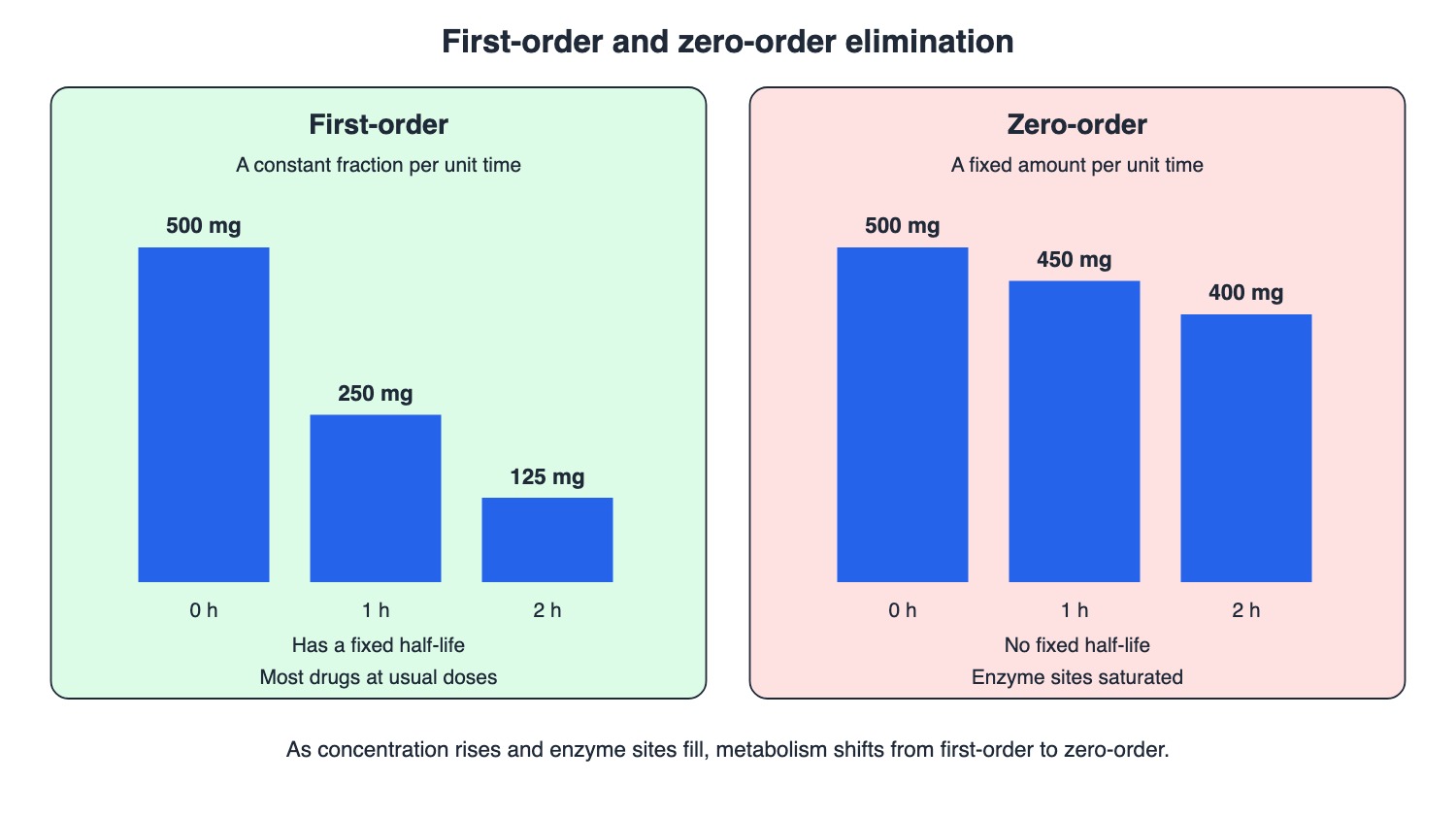
A constant fraction against a constant amount. Rising concentration can shift a drug from one to the other.
First-order | Zero-order | |
Amount removed | Constant fraction per unit time | Fixed amount per unit time |
Half-life | Fixed | No specific half-life |
When | Usual concentrations, enzyme sites free | Most enzyme sites occupied |
Metabolism has an upper limit. As drug concentration rises and enzyme sites fill, a drug shifts from first-order to zero-order kinetics, so small dose increases can then raise plasma levels sharply.
Cytochrome P-450
CYP450, a microsomal enzyme superfamily, is the most important phase I system. Induction and inhibition cause many interactions.
Effect | Examples | Result on the other drug |
Inducers | Rifampin, phenytoin, phenobarbital, carbamazepine, dexamethasone; cigarette smoke (CYP1A2) | Faster metabolism, lower levels, less effect |
Inhibitors | Cimetidine, ciprofloxacin, erythromycin, clarithromycin, azole antifungals, ritonavir, grapefruit juice | Slower metabolism, higher levels, more toxicity |
Which enzyme handles which drug explains the interaction. For example, a statin (CYP3A4) with clarithromycin (a CYP3A4 inhibitor) gives higher statin levels.
Enzyme | Some substrates | Some inhibitors |
CYP1A2 | Caffeine, theophylline, acetaminophen | Ciprofloxacin, fluvoxamine, cimetidine |
CYP2C9 | Phenytoin, (S)-warfarin, diclofenac | Fluconazole, amiodarone |
CYP2C19 | Diazepam, omeprazole | Fluoxetine, ketoconazole |
CYP2D6 | Codeine, tramadol, tamoxifen, beta blockers | Fluoxetine, paroxetine, quinidine |
CYP3A4 | Statins, calcium channel blockers, benzodiazepines, cyclosporine, tacrolimus | Azole antifungals, clarithromycin, erythromycin, ritonavir, grapefruit juice |
Age: neonates have partly developed microsomal enzymes and slow glucuronidation, which is why chloramphenicol can cause serious effects in them. In older adults, drugs cleared by this system reach higher levels and last longer, though glucuronidation itself is unaffected by age.
Genes: transporter genotypes can change drug levels; some raise statin levels and the risk of myopathy.
Excretion
Kidneys are the main route for water-soluble substances. Only unbound drug is filtered; about one-fifth of the plasma reaching the glomeruli is filtered.
Age: at 80 years, renal clearance is typically half of what it was at 30.
Urine pH (4.5–8.0): un-ionised drug is reabsorbed. Make urine alkaline to excrete a weak acid, such as aspirin in overdose. Acidifying urine does the reverse for weak acids.
Tubular secretion in the proximal tubule is active. Probenecid blocks the secretion of penicillin, raising and prolonging its plasma levels.
Bile: favours molecules over 300 g/mol with polar and lipophilic groups. Glucuronide conjugates are excreted this way.
Enterohepatic cycle: drug in bile is reabsorbed from the gut, so bile eliminates only what is not reabsorbed.
Other routes: lungs for volatile anaesthetics; breast milk can reach the infant.
Steady State and Drug-Level Monitoring
With regular dosing, levels keep rising for 5 to 6 half-lives until a steady state is reached. So a drug with a long half-life shows toxicity late: some benzodiazepines (diazepam, flurazepam, chlordiazepoxide) or their active metabolites have half-lives of up to 96 hours in older people, and toxicity may appear only days or weeks after starting.
This is also why a loading dose is used when a target level is needed quickly.
Therapeutic drug monitoring matters most for drugs with a narrow therapeutic index. Dosing guidelines for vancomycin now use Bayesian estimation, combining population models with the patient's measured levels.
How Age and Genes Change Clearance
Group | What changes | Practical result |
Older adults: liver | Phase I (oxidation, reduction, hydrolysis) slows; phase II (conjugation) largely unchanged; clearance of affected drugs often falls 30–40% | Prefer phase II drugs where possible; reduce doses |
Older adults: first pass | Falls about 1% a year after 40 | Higher levels of nitrates, propranolol, phenobarbital, verapamil, nifedipine |
Older adults: kidney | GFR falls about 8 mL/min/1.73 m² per decade after 40; creatinine often stays normal | Dose by creatinine clearance (for example, Cockcroft-Gault); lower dose or longer interval for digoxin, aminoglycosides and other renally cleared drugs |
Neonates | Half-lives of phenytoin, barbiturates, analgesics and cardiac glycosides 2–3 times longer; bilirubin and paracetamol conjugation immature (morphine conjugation mature) | GFR is 2–4 mL/min at birth and reaches adult levels (120 mL/min) by 8–12 months |
Genes | Elimination rates vary up to 40-fold | Slow acetylators (N-acetyltransferase) get more toxicity; TPMT is genotyped before azathioprine or 6-mercaptopurine |
The Three Formulas
Parameter | Formula |
Clearance | Rate of elimination ÷ plasma concentration, or k × Vd |
Elimination rate constant (k) | Clearance ÷ Vd |
Half-life (first-order only) | 0.693 ÷ k, which equals 0.693 × Vd ÷ clearance |
Worked example: Vd 40 L, clearance 4 L/h. k = 4 ÷ 40 = 0.1 per hour. Half-life = 0.693 ÷ 0.1 = 6.9 hours.
By arithmetic: each half-life halves what remains, so after 2 half-lives 25% is left, and after 5 about 3%. A loading dose follows from the definition of Vd: target concentration × Vd.
Traps the Examiner Sets
Half-life is constant only in first-order kinetics.
Phase II is synthetic; phase I is not.
Alkaline urine helps with weak acids such as aspirin, not weak bases.
Inducers lower the other drug's level; inhibitors raise it.
Rifampin is a classic inducer; cimetidine and grapefruit juice are inhibitors.
In old age phase I slows but phase II conjugation does not, and a normal creatinine can hide a low GFR.
Memory Hooks & Shortcuts
Shortcuts to lock in this article's numbers and lists. Each one only re-packages facts proven above.
🧠 First takes a Fraction, Zero takes a fixed sum — first-order removes a fraction; zero-order a fixed amount
🧠 0.693 is the half-life constant — half-life = 0.693 ÷ k
🧠 Alkali clears Acid — alkalinise the urine to excrete a weak acid such as aspirin
🧠 Rif, Phen, Phen, Carb speed things up — rifampin, phenytoin, phenobarbital, carbamazepine are inducers
🧠 Grapefruit grips the enzyme — grapefruit juice inhibits CYP
🧠 Pro blocks Pen — probenecid blocks penicillin secretion
Rapid-Revision Cards
Half-life formula
0.693 ÷ k = 0.693 × Vd ÷ clearance; first-order only.
Clearance
Rate of elimination ÷ plasma concentration.
k
Clearance ÷ Vd.
Loading dose
Target concentration × Vd.
First-order
Constant fraction; fixed half-life.
Zero-order
Fixed amount; no specific half-life.
Why first-order turns zero-order
Enzyme sites fill as concentration rises.
Phase I
Oxidation, reduction, hydrolysis; nonsynthetic.
Phase II
Conjugation; synthetic; more polar.
Most common phase II
Glucuronidation.
Prodrug
Inactive until converted to an active metabolite.
Main phase I system
Cytochrome P-450.
Classic inducers
Rifampin, phenytoin, phenobarbital, carbamazepine.
Classic inhibitors
Cimetidine, erythromycin, azoles, ritonavir, grapefruit juice.
Chloramphenicol in neonates
Slow glucuronidation.
CYP3A4 substrates
Statins, calcium channel blockers, benzodiazepines, cyclosporine, tacrolimus.
CYP2D6 substrates
Codeine, tramadol, tamoxifen, beta blockers.
Urine pH rule
Alkalinise for weak acids; acidifying reduces their excretion.
Aspirin overdose
Alkalinise the urine.
Probenecid and penicillin
Blocks tubular secretion; prolongs penicillin.
Renal clearance at age 80
About half of that at 30.
Filtered drug
Unbound only.
Biliary excretion favours
Molecules above 300 g/mol with polar and lipophilic groups.
Enterohepatic cycle
Bile drug reabsorbed from gut.
Time to steady state (MSD)
5 to 6 half-lives.
Old age and metabolism
Phase I slows; phase II largely unchanged.
First pass after 40
Falls about 1% a year.
GFR after 40
About −8 mL/min/1.73 m² per decade; creatinine may stay normal.
Neonatal conjugation
Bilirubin and paracetamol immature; morphine mature.
TPMT
Genotype before azathioprine / 6-MP.
Sources
Facts in this article were checked against these documents.
Overview of Pharmacokinetics; Drug Metabolism; Drug Excretion — MSD Manual Professional Edition, reviewed 2026 (link)
Pharmacokinetics in Older Adults; Pharmacokinetics in Children; Pharmacogenetics; Emerging Paradigms in Precision Dosing — MSD Manual Professional Edition, 2025–2026 (link)
Competency Based Undergraduate Curriculum, Pharmacology (PH) — National Medical Commission, 2024
Test Yourself: Practice Questions
Thirty questions in NEET PG style, including clinical vignettes.
Practice Questions (NEET PG pattern)
Original questions written in the style of the exam: +4 for a correct answer, −1 for a wrong one. Every answer was checked against the sources listed above. NEET PG papers are not published by NBEMS, so these are not past-paper questions.
Q1. A drug has a volume of distribution of 40 L and clearance of 4 L/h. Its half-life is about
(a) 16 hours
(b) 6.9 hours
(c) 10 hours
(d) 0.1 hours
Show answer
Answer: (b) — k = clearance ÷ Vd = 0.1 per hour; half-life = 0.693 ÷ 0.1 = 6.9 hours.
Q2. A drug has a half-life of 6 hours and first-order kinetics. What fraction remains after 12 hours?
(a) 75%
(b) 50%
(c) 12.5%
(d) 25%
Show answer
Answer: (d) — Two half-lives: 100 to 50 to 25%.
Q3. A drug's concentration falls by 50 mg every hour, whatever the starting level. It follows
(a) second-order kinetics
(b) enterohepatic cycling
(c) zero-order kinetics
(d) first-order kinetics
Show answer
Answer: (c) — A fixed amount per unit time is zero-order, with no specific half-life.
Q4. In first-order kinetics the amount of drug eliminated per unit time is
(a) constant
(b) independent of concentration
(c) zero
(d) proportional to the amount present
Show answer
Answer: (d) — It is a constant fraction of the drug in the body, so the amount changes with concentration.
Q5. Why can a small dose increase cause toxicity with a drug near saturation?
(a) It shifts to first-order kinetics
(b) It reduces protein binding only
(c) It increases renal filtration
(d) It shifts to zero-order kinetics
Show answer
Answer: (d) — As concentration increases, metabolism shifts from first-order to zero-order.
Q6. Which of these is a phase II reaction?
(a) Reduction
(b) Glucuronidation
(c) Hydrolysis
(d) Oxidation
Show answer
Answer: (b) — Glucuronidation is the most common phase II conjugation.
Q7. The most important enzyme system of phase I metabolism is
(a) monoamine oxidase
(b) cytochrome P-450
(c) xanthine oxidase
(d) acetylcholinesterase
Show answer
Answer: (b) — CYP450, a microsomal superfamily.
Q8. An inactive compound converted in the body to an active metabolite is a
(a) antagonist
(b) prodrug
(c) partial agonist
(d) conjugate
Show answer
Answer: (b) — A prodrug has an active metabolite.
Q9. A woman on an oral contraceptive starts rifampin for tuberculosis. The expected interaction is
(a) raised contraceptive level from enzyme inhibition
(b) displacement from albumin
(c) no interaction
(d) reduced contraceptive effect from enzyme induction
Show answer
Answer: (d) — Rifampin induces CYP enzymes, speeding the metabolism of other drugs, including estrogens.
Q10. Which of these inhibits CYP enzymes?
(a) Phenytoin
(b) Grapefruit juice
(c) Cigarette smoke
(d) Rifampin
Show answer
Answer: (b) — Grapefruit juice is an inhibitor; the others are inducers.
Q11. Chloramphenicol is hazardous in neonates mainly because of
(a) high protein binding
(b) slow glucuronidation
(c) induced CYP enzymes
(d) fast renal clearance
Show answer
Answer: (b) — In neonates, conversion to glucuronide is slow, with serious effects as with chloramphenicol.
Q12. A patient with aspirin overdose gets sodium bicarbonate. The urine is alkalinised to
(a) ionise the drug and reduce its tubular reabsorption
(b) increase its reabsorption
(c) inhibit its metabolism
(d) displace it from albumin
Show answer
Answer: (a) — Alkalinising urine enhances excretion of acetylsalicylic acid, a weak acid.
Q13. Acidifying the urine will
(a) decrease excretion of weak acids
(b) have no effect on weak acids
(c) increase excretion of weak acids
(d) stop glomerular filtration
Show answer
Answer: (a) — Acidification increases reabsorption and decreases excretion of weak acids.
Q14. Probenecid prolongs the action of penicillin by
(a) increasing its absorption
(b) blocking its tubular secretion
(c) inhibiting CYP450
(d) displacing it from albumin
Show answer
Answer: (b) — Probenecid blocks the rapid tubular secretion of penicillin.
Q15. Which fraction of a drug in plasma is filtered at the glomerulus?
(a) Unbound drug
(b) All drug in plasma
(c) Only ionised drug bound to protein
(d) Albumin-bound drug
Show answer
Answer: (a) — Only unbound drug is contained in the glomerular filtrate.
Q16. An 80-year-old's renal clearance compared with age 30 is typically
(a) about a tenth
(b) about double
(c) about half
(d) the same
Show answer
Answer: (c) — At age 80, clearance is typically reduced to half of what it was at 30.
Q17. A drug secreted in bile and reabsorbed from the intestine undergoes
(a) pinocytosis
(b) first-pass metabolism
(c) enterohepatic cycling
(d) redistribution
Show answer
Answer: (c) — In the enterohepatic cycle, a drug secreted in bile is reabsorbed from the intestine.
Q18. Drugs more likely to be excreted in bile have a molecular weight above
(a) 30 g/mol
(b) 300 g/mol
(c) 30,000 g/mol
(d) 3,000 g/mol
Show answer
Answer: (b) — Above 300 g/mol with both polar and lipophilic groups.
Q19. Which drugs are largely eliminated through the lungs?
(a) Digoxin
(b) Volatile anaesthetics
(c) Penicillins
(d) Aminoglycosides
Show answer
Answer: (b) — Exhalation is significant for volatile anaesthetics; other non-renal routes are generally minor.
Q20. For a drug with Vd 50 L, what loading dose gives a target plasma level of 4 mg/L?
(a) 200 mg
(b) 2,000 mg
(c) 54 mg
(d) 12.5 mg
Show answer
Answer: (a) — By the definition of Vd: amount = Vd × concentration = 50 × 4 = 200 mg.
Q21. A man on simvastatin is given clarithromycin and develops muscle pain. The likely mechanism is
(a) renal tubular blockade
(b) CYP3A4 induction lowering statin levels
(c) displacement from albumin
(d) CYP3A4 inhibition raising statin levels
Show answer
Answer: (d) — Statins are CYP3A4 substrates and clarithromycin is a CYP3A4 inhibitor; higher statin levels raise the risk of myopathy.
Q22. Codeine is a substrate of
(a) CYP1A2
(b) CYP2C19
(c) CYP2D6
(d) CYP2E1
Show answer
Answer: (c) — CYP2D6 handles codeine, tramadol, tamoxifen and beta blockers.
Q23. According to the MSD Manual, with regular dosing drug levels keep rising until steady state for about
(a) 2 half-lives
(b) 10 to 12 half-lives
(c) 5 to 6 half-lives
(d) 1 half-life
Show answer
Answer: (c) — Concentrations of chronically used drugs increase for 5 to 6 half-lives until steady state, so toxicity of long half-life drugs can appear late.
Q24. In older adults, which metabolic pathway is least affected by age?
(a) Oxidation (phase I)
(b) Reduction (phase I)
(c) Hydrolysis (phase I)
(d) Conjugation (phase II), such as glucuronidation
Show answer
Answer: (d) — Age does not greatly affect phase II conjugation, so phase II drugs may be preferred in older patients.
Q25. An 82-year-old has a normal serum creatinine. For dosing a renally cleared drug, this
(a) means no dose change is ever needed
(b) can mislead, because low muscle mass keeps creatinine normal despite a lower GFR
(c) proves renal function is normal
(d) reflects liver function
Show answer
Answer: (b) — GFR falls about 8 mL/min/1.73 m² per decade after 40, but creatinine often stays normal; use creatinine clearance to dose.
Q26. In neonates, which conjugation pathway is already fully mature?
(a) None of them
(b) Bilirubin conjugation
(c) Paracetamol (acetaminophen) conjugation
(d) Morphine conjugation
Show answer
Answer: (d) — Bilirubin and paracetamol conjugation mature late; enzymes for morphine conjugation are mature even in preterm infants.
Q27. Before azathioprine is started, which test guides the starting dose?
(a) G6PD level
(b) TPMT genotype
(c) HLA-B*1502
(d) Acetylator status
Show answer
Answer: (b) — Patients needing azathioprine or 6-mercaptopurine are tested for thiopurine methyltransferase genotype.
Q28. A man with COPD on theophylline is started on ciprofloxacin for pneumonia and develops theophylline toxicity. The mechanism is
(a) reduced renal excretion of theophylline
(b) theophylline displaces ciprofloxacin from albumin
(c) ciprofloxacin inhibits CYP1A2, which metabolises theophylline
(d) ciprofloxacin induces CYP3A4
Show answer
Answer: (c) — Theophylline is a CYP1A2 substrate; ciprofloxacin is a CYP1A2 inhibitor, so theophylline levels rise.
Q29. A heavy smoker stable on theophylline quits smoking. Over the next weeks his theophylline level is likely to
(a) fall, because smoking inhibited CYP1A2
(b) rise, because cigarette smoke had been inducing CYP1A2
(c) fall because of increased renal excretion
(d) stay the same
Show answer
Answer: (b) — Cigarette smoke is a CYP1A2 inducer; removing the inducer slows theophylline metabolism.
Q30. A 79-year-old started on diazepam is fine for a week, then becomes increasingly drowsy and confused. The best explanation is
(a) enzyme induction
(b) tolerance
(c) an allergic reaction
(d) diazepam's half-life can reach 96 hours in older people, so levels keep rising for days before steady state
Show answer
Answer: (d) — Levels rise for 5–6 half-lives; with long half-lives in older adults, toxicity may appear only after days or weeks.
Active Recall
From memory: compare phase I and II reactions; compare first-order and zero-order kinetics with an example; name common enzyme inducers and inhibitors and predict their effect; explain how urine pH and probenecid change excretion; and calculate half-life and loading dose.