Cholinergic and Anticholinergic Drugs for NEET PG Pharmacology: Neostigmine, Atropine, Pralidoxime and Organophosphate Poisoning
Start Here
🎯 Exam priority: High. Organophosphate poisoning is one of the most asked toxicology topics, and autonomic drugs underpin cardiology, anaesthesia and ophthalmology questions. Learn the signs, the two antidotes, and which drugs enter the brain.
CBME mapping: PH 2.1 (cholinergic and anticholinergic drugs) and PH 9 (poisoning).
The Autonomic Layout
Acetylcholine is released by all preganglionic fibres (sympathetic and parasympathetic), all postganglionic parasympathetic fibres, and the sympathetic fibres to sweat glands and piloerector muscles.
Noradrenaline is released by most postganglionic sympathetic fibres.
The vagus carries about 75% of all parasympathetic fibres. Sympathetic is catabolic (fight or flight); parasympathetic is anabolic (rest and restore).
Acetylcholine acts on two receptor families, muscarinic and nicotinic; which signs appear depends on which are stimulated or blocked.
Direct Cholinergic Agonists
Bethanechol: post-operative and post-partum non-obstructive urinary retention and neurogenic bladder atony. Contraindicated in hyperthyroidism, peptic ulcer and asthma, among others.
Pilocarpine (oral): dry mouth after head-and-neck radiotherapy and in Sjögren syndrome. Avoid when miosis is undesirable, as in acute iritis and angle-closure glaucoma, and in uncontrolled asthma.
Anticholinesterases
These block cholinesterase, so acetylcholine accumulates at both muscarinic and nicotinic sites.
Anticholinesterase | Key use (label) | Remember |
Neostigmine | Reverses non-depolarising neuromuscular block after surgery | Does not readily cross the blood-brain barrier; give atropine or glycopyrrolate with it |
Pyridostigmine | Myasthenia gravis (oral) | Contraindicated in mechanical gut or urinary obstruction; caution in asthma |
Edrophonium | Diagnosis of myasthenia gravis; myasthenic vs cholinergic crisis | Very short acting: not for maintenance |
Physostigmine | Reverses central effects of the anticholinergic syndrome (atropine, scopolamine, datura) | Acts in the CNS |
Donepezil (and tacrine) | Alzheimer disease | Covered with CNS drugs |
Myasthenic vs cholinergic crisis: sudden weakness in a treated myasthenic can be worsening disease (myasthenic crisis) or overtreatment with anticholinesterases (cholinergic crisis); edrophonium is used to evaluate this, only once breathing is secured.
Antimuscarinics
Antimuscarinic | Main use (label) | Remember |
Atropine | Antisialagogue, symptomatic bradycardia, organophosphate and muscarinic mushroom poisoning | Tertiary amine: enters the brain; may precipitate acute glaucoma |
Glycopyrrolate | Pre-operative drying of secretions; with neostigmine | Quaternary: does not cross the blood-brain barrier |
Scopolamine (patch) | Motion sickness; post-operative nausea and vomiting | Tertiary amine |
Ipratropium | Maintenance bronchodilator in COPD | Inhaled |
Tiotropium | Once-daily maintenance in COPD (and asthma ≥ 6 years) | Acts on M3 in airway smooth muscle; not for acute bronchospasm |
Oxybutynin | Urge incontinence, neurogenic bladder instability | Relaxes the detrusor |
Quaternary vs tertiary: glycopyrrolate (quaternary) barely crosses the blood-brain barrier; atropine and scopolamine (tertiary amines) cross easily, so they cause central effects. Atropine or glycopyrrolate is given with neostigmine, and physostigmine is the anticholinesterase used for central anticholinergic toxicity.
Atropine's block is competitive (surmountable): enough acetylcholine overcomes it.
Atropine overdose: palpitations, dilated pupils, difficulty swallowing, hot dry skin, thirst; toxic doses cause excitement, hallucinations, delirium and coma.
Organophosphate and Carbamate Poisoning
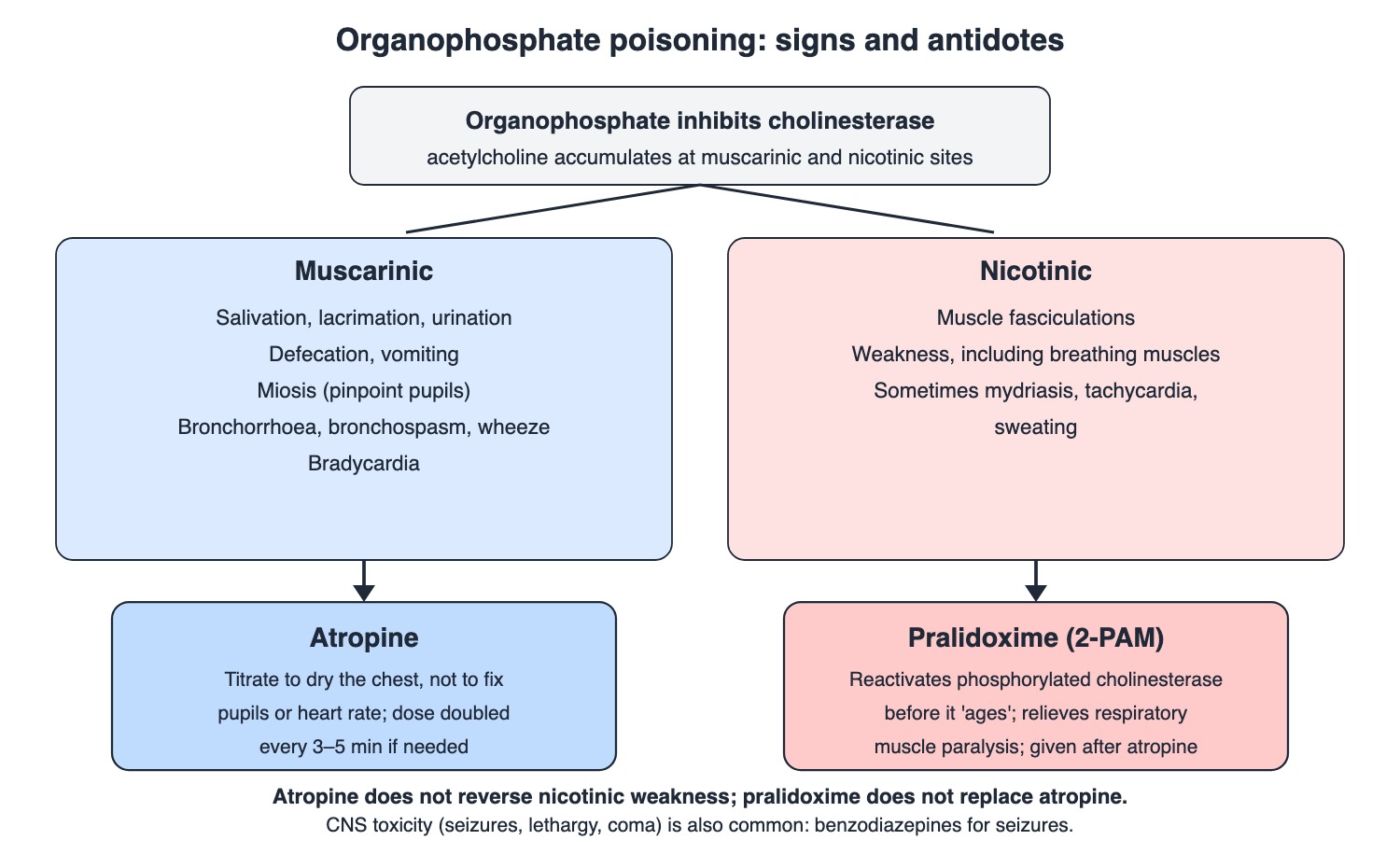
Organophosphate poisoning: muscarinic signs are treated with atropine, nicotinic weakness with pralidoxime. Drawn by TrackNation from the MSD Manual and the pralidoxime label.
Mechanism: both inhibit cholinesterase. Carbamates clear spontaneously within about 48 hours; organophosphates can bind irreversibly.
Muscarinic: salivation, lacrimation, urination, defecation, vomiting, miosis, bronchorrhoea and wheeze, bradycardia. Nicotinic: fasciculations and weakness (typical), sometimes mydriasis, tachycardia and sweating. CNS toxicity is common. Many organophosphates smell of garlic or petroleum.
Diagnosis is clinical; if unclear, improvement after 1 mg atropine supports it. RBC cholinesterase activity reflects severity.
Atropine: 2–3 mg IV, doubled every 3–5 minutes, titrated to dry the chest (bronchorrhoea and bronchospasm), not to normalise pupils or heart rate. Severe cases may need grams.
Pralidoxime: reactivates phosphorylated cholinesterase (mainly outside the brain) and slows its "ageing" into a form that cannot be reactivated. Its key effect is relieving respiratory muscle paralysis; it does not fix central respiratory depression, so atropine is always needed with it. MSD gives 1–2 g IV over 15–30 minutes after atropine.
Carbamates: MSD advises giving pralidoxime when the agent is unknown, but the pralidoxime label says it is not indicated for carbamate poisoning because it may increase carbaryl toxicity.
Decontaminate (remove clothes, wash skin; activated charcoal within 1 hour of ingestion); benzodiazepines for seizures.
Late effects: intermediate syndrome — proximal, cranial and respiratory weakness 1–3 days after exposure, resolving in 2–3 weeks; delayed axonal neuropathy 1–3 weeks after some agents (chlorpyrifos, triorthocresyl phosphate).
Traps the Examiner Sets
Atropine endpoint = dry chest, not pupil size.
Pralidoxime treats nicotinic (muscle) weakness; atropine treats muscarinic signs. Both are needed.
Sweat glands are sympathetic but cholinergic.
Glycopyrrolate (quaternary) stays out of the brain; atropine and scopolamine enter it.
Physostigmine, not neostigmine, reverses central anticholinergic toxicity.
Intermediate syndrome (1–3 days) ≠ delayed neuropathy (1–3 weeks).
Tiotropium is for maintenance, not acute bronchospasm.
Memory Hooks & Shortcuts
Shortcuts to lock in this article's numbers and lists. Each one only re-packages facts proven above.
🧠 SLUDGE + 3 Bs — Salivation, Lacrimation, Urination, Defecation, GI upset, Emesis + Bronchorrhoea, Bronchospasm, Bradycardia — muscarinic OP signs
🧠 Dry the chest, not the eyes — atropine is titrated to bronchial secretions, not pupils
🧠 Pralidoxime Pulls the Phosphate — 2-PAM reactivates phosphorylated cholinesterase before ageing
🧠 Quaternary stays Quiet — quaternary drugs (glycopyrrolate, neostigmine) stay out of the brain
🧠 Physo goes to the Head — physostigmine reverses central anticholinergic toxicity
🧠 Three days, three weeks — intermediate syndrome at 1–3 days; delayed neuropathy at 1–3 weeks
Rapid-Revision Cards
Cholinergic fibres
All preganglionic, all postganglionic parasympathetic, sympathetic to sweat glands and piloerectors.
Vagus share
About 75% of parasympathetic fibres.
OP muscarinic signs
Salivation, lacrimation, urination, defecation, vomiting, miosis, bronchorrhoea, bradycardia.
OP nicotinic signs
Fasciculations, weakness; sometimes mydriasis, tachycardia, sweating.
OP odour
Garlic or petroleum.
Atropine in OP
2–3 mg IV, double every 3–5 min; target dry chest.
Pralidoxime
Reactivates phosphorylated cholinesterase; slows ageing; relieves respiratory muscle paralysis.
2-PAM + atropine
Atropine always needed too (respiratory centre).
2-PAM in carbamates
Label: not indicated (may worsen carbaryl); MSD: give if agent unknown.
Intermediate syndrome
1–3 days; proximal, cranial, respiratory weakness; resolves 2–3 weeks.
Delayed OP neuropathy
1–3 weeks; chlorpyrifos, triorthocresyl phosphate.
Carbamate vs OP
Carbamate clears in ~48 h; OP can bind irreversibly.
Neostigmine
Reverses non-depolarising block; no CNS entry; give with atropine/glycopyrrolate.
Pyridostigmine
Oral, myasthenia gravis.
Edrophonium
Diagnosis of MG; crisis evaluation; too brief for maintenance.
Physostigmine
Reverses central anticholinergic syndrome (datura, atropine).
Glycopyrrolate
Quaternary; no CNS entry; drying secretions.
Atropine and scopolamine
Tertiary amines; enter the CNS.
Atropine uses
Antisialagogue, bradycardia, OP and mushroom poisoning.
Atropine toxicity
Dilated pupils, hot dry skin, thirst, delirium.
Tiotropium
M3 block in airways; maintenance COPD; not acute.
Oxybutynin
Detrusor relaxant for urge incontinence.
Bethanechol
Non-obstructive urinary retention; avoid in asthma, peptic ulcer, hyperthyroidism.
Pilocarpine oral
Dry mouth (radiotherapy, Sjögren); avoid in angle closure.
Sources
Facts in this article were checked against these documents.
MSD Manual Professional Edition: Organophosphate Poisoning and Carbamate Poisoning; Overview of the Autonomic Nervous System — Merck & Co. (MSD Manuals), 2025 (link)
Prescribing labels: Protopam (pralidoxime), atropine sulfate injection, Bloxiverz (neostigmine), Mestinon (pyridostigmine), Anticholium (physostigmine), Enlon (edrophonium), Salagen (pilocarpine), bethanechol, glycopyrrolate injection, Transderm Scop, ipratropium HFA, Spiriva Respimat (tiotropium), oxybutynin — DailyMed, US National Library of Medicine, current labels, accessed November 2026 (link)
Competency Based Undergraduate Curriculum, Pharmacology (PH 2.1, PH 9) — National Medical Commission, 2024
Test Yourself: Practice Questions
Twenty-five questions in NEET PG style, including clinical vignettes.
Practice Questions (NEET PG pattern)
Original questions written in the style of the exam: +4 for a correct answer, −1 for a wrong one. Every answer was checked against the sources listed above. NEET PG papers are not published by NBEMS, so these are not past-paper questions.
Q1. Sympathetic postganglionic fibres to sweat glands release
(a) acetylcholine
(b) adrenaline
(c) dopamine
(d) noradrenaline
Show answer
Answer: (a) — Cholinergic fibres include all preganglionic fibres, all postganglionic parasympathetic fibres and the sympathetic fibres to sweat glands and piloerectors.
Q2. Which nerve carries about 75% of all parasympathetic fibres?
(a) Vagus
(b) Glossopharyngeal
(c) Pelvic splanchnic
(d) Oculomotor
Show answer
Answer: (a) — The vagus contains about 75% of parasympathetic fibres.
Q3. A farmer has pinpoint pupils, profuse salivation, wheeze and bradycardia after spraying a pesticide. These are
(a) adrenergic effects
(b) muscarinic effects
(c) nicotinic effects
(d) dopaminergic effects
Show answer
Answer: (b) — Salivation, lacrimation, urination, defecation, vomiting, miosis, bronchorrhoea and bradycardia are muscarinic.
Q4. In organophosphate poisoning, fasciculations and muscle weakness are
(a) muscarinic effects
(b) nicotinic effects
(c) a sign of atropine toxicity
(d) due to central depression only
Show answer
Answer: (b) — Nicotinic symptoms include weakness and fasciculations; these are typical.
Q5. The end point for atropine in organophosphate poisoning is
(a) drying of bronchial secretions and relief of bronchospasm
(b) full dilatation of the pupils
(c) a heart rate above 120
(d) return of muscle power
Show answer
Answer: (a) — Atropine is given to relieve bronchospasm and bronchorrhoea rather than to normalise pupil size or heart rate.
Q6. The initial adult atropine dose in organophosphate poisoning, per the MSD Manual, is
(a) 10 mg IV once
(b) 1 mg orally
(c) 2 to 3 mg IV, doubled every 3 to 5 minutes as needed
(d) 0.6 mg once
Show answer
Answer: (c) — 2–3 mg IV (0.05 mg/kg in children), doubled every 3–5 minutes; grams may be needed.
Q7. Pralidoxime acts by
(a) reactivating phosphorylated cholinesterase before it ages
(b) blocking muscarinic receptors
(c) stimulating nicotinic receptors
(d) binding the organophosphate in the gut
Show answer
Answer: (a) — It reactivates cholinesterase inactivated by phosphorylation (mainly outside the CNS) and slows ageing to a non-reactivatable form.
Q8. Why must atropine be given along with pralidoxime?
(a) Atropine activates pralidoxime
(b) Pralidoxime is a muscarinic agonist
(c) Pralidoxime causes bradycardia
(d) Pralidoxime is less effective on the respiratory centre, where acetylcholine must still be blocked
Show answer
Answer: (d) — The label: atropine is always required concomitantly because pralidoxime is less effective in relieving depression of the respiratory centre.
Q9. According to its US label, pralidoxime is not indicated for poisoning by
(a) parathion
(b) anticholinesterase overdose in myasthenia
(c) carbamates such as carbaryl
(d) organophosphate nerve agents
Show answer
Answer: (c) — It may increase carbaryl toxicity. MSD nevertheless gives it when the agent is unknown.
Q10. Proximal and respiratory muscle weakness 1–3 days after organophosphate poisoning, despite treatment, is
(a) atropine toxicity
(b) myasthenic crisis
(c) the intermediate syndrome
(d) organophosphate-induced delayed neuropathy
Show answer
Answer: (c) — Intermediate syndrome: 1–3 days, resolves in 2–3 weeks. Delayed axonal neuropathy begins 1–3 weeks after some agents.
Q11. Carbamate inhibition of cholinesterase differs from organophosphate inhibition because carbamates
(a) only affect nicotinic receptors
(b) cannot be absorbed through skin
(c) bind irreversibly
(d) clear spontaneously within about 48 hours
Show answer
Answer: (d) — Carbamates are cleared in about 48 hours; organophosphates can bind irreversibly.
Q12. Neostigmine is used after surgery to
(a) reverse opioid overdose
(b) reverse non-depolarising neuromuscular blockade
(c) treat malignant hyperthermia
(d) reverse benzodiazepines
Show answer
Answer: (b) — Neostigmine (a competitive cholinesterase inhibitor) reverses non-depolarising neuromuscular blocking agents.
Q13. Atropine or glycopyrrolate is given with neostigmine to
(a) prolong neostigmine's action
(b) reverse the neuromuscular block itself
(c) cause sedation
(d) prevent muscarinic effects such as bradycardia
Show answer
Answer: (d) — Neostigmine raises acetylcholine at muscarinic and nicotinic sites; an anticholinergic is given before or with it.
Q14. Which anticholinesterase is used to reverse the central effects of datura (atropine/scopolamine) poisoning?
(a) Edrophonium
(b) Physostigmine
(c) Neostigmine
(d) Pyridostigmine
Show answer
Answer: (b) — Physostigmine reverses CNS effects of the anticholinergic syndrome, including tropane alkaloids from datura.
Q15. Glycopyrrolate causes fewer central side effects than atropine because it
(a) is a nicotinic antagonist
(b) is a tertiary amine
(c) is shorter acting
(d) is a quaternary ammonium compound that barely crosses the blood-brain barrier
Show answer
Answer: (d) — Its quaternary group limits passage across the blood-brain barrier; atropine and scopolamine are tertiary amines that penetrate easily.
Q16. Edrophonium is not used for maintenance in myasthenia gravis because
(a) it is not a cholinesterase inhibitor
(b) it is too toxic
(c) it crosses into the CNS
(d) its action is very brief
Show answer
Answer: (d) — Edrophonium is for diagnosis and for evaluating crises; its brief action rules out maintenance use.
Q17. Oral maintenance treatment of myasthenia gravis uses
(a) pyridostigmine
(b) pralidoxime
(c) physostigmine
(d) edrophonium
Show answer
Answer: (a) — Mestinon (pyridostigmine) is used in myasthenia gravis.
Q18. Bethanechol is indicated for
(a) motion sickness
(b) post-operative non-obstructive urinary retention
(c) urge incontinence
(d) glaucoma surgery
Show answer
Answer: (b) — Bethanechol: post-operative and post-partum non-obstructive retention and neurogenic bladder atony.
Q19. Oral pilocarpine is contraindicated in
(a) open-angle glaucoma
(b) Sjögren syndrome
(c) post-radiotherapy dry mouth
(d) angle-closure glaucoma and acute iritis
Show answer
Answer: (d) — It is avoided when miosis is undesirable, such as acute iritis and angle-closure glaucoma.
Q20. Tiotropium produces bronchodilation mainly by blocking
(a) nicotinic receptors
(b) H1 receptors
(c) M3 receptors on airway smooth muscle
(d) beta-2 receptors
Show answer
Answer: (c) — Tiotropium binds M1–M5 similarly; in airways it inhibits M3 on smooth muscle. It is not for acute bronchospasm.
Q21. A transdermal scopolamine patch is indicated for
(a) urinary retention
(b) bradycardia
(c) motion sickness
(d) myasthenia gravis
Show answer
Answer: (c) — Transderm Scop prevents nausea and vomiting of motion sickness and post-operative nausea.
Q22. Hot dry skin, dilated pupils, thirst and delirium after an overdose suggest toxicity from
(a) neostigmine
(b) an organophosphate
(c) pilocarpine
(d) atropine
Show answer
Answer: (d) — Atropine overdose: palpitation, dilated pupils, difficulty swallowing, hot dry skin, thirst; toxic doses cause delirium and coma.
Q23. Atropine should be used cautiously because it may precipitate
(a) bradycardia at normal doses
(b) acute angle-closure glaucoma
(c) miosis
(d) bronchospasm
Show answer
Answer: (b) — The label warns that atropine may precipitate acute glaucoma.
Q24. A woman with myasthenia gravis on pyridostigmine becomes acutely weak after her dose was raised. Once breathing is secured, edrophonium is used to
(a) reverse pyridostigmine
(b) test for organophosphate poisoning
(c) treat the crisis long term
(d) tell a myasthenic crisis from a cholinergic crisis
Show answer
Answer: (d) — Weakness may be worsening disease (myasthenic crisis) or overtreatment (cholinergic crisis); edrophonium helps evaluate this, after ventilation is secured.
Q25. Two weeks after organophosphate ingestion, treated successfully, a man develops a new peripheral neuropathy. The likely cause is
(a) atropine toxicity
(b) intermediate syndrome
(c) delayed axonal neuropathy from the organophosphate
(d) pralidoxime toxicity
Show answer
Answer: (c) — Some organophosphates (chlorpyrifos, triorthocresyl phosphate) cause an axonal neuropathy starting 1–3 weeks after exposure.
Active Recall
From memory: list which fibres are cholinergic; give the muscarinic and nicotinic signs of organophosphate poisoning; explain how atropine and pralidoxime are used and what each treats; list the anticholinesterases with one use each; compare glycopyrrolate with atropine; and describe the intermediate syndrome and delayed neuropathy.