Psychiatric Emergencies and Suicide Risk for NEET PG: Agitation, Restraint, Rapid Sedation, MHCA Emergency Rules and Suicide Assessment
Start Here
🎯 Exam priority: High. Expect: first steps with a violent patient, benzodiazepine vs antipsychotic for sedation, restraint rules, MHCA 2017 sections 94, 97 and 115, suicide sex ratio and methods, the highest-risk disorders, "asking does not plant the idea", the post-discharge danger period, lithium and clozapine, and ECT for suicidal depression.
CBME mapping: PS 12.1 (topic: psychiatric emergencies) — perform a suicide risk assessment. The wider Mental Healthcare Act is article 17.
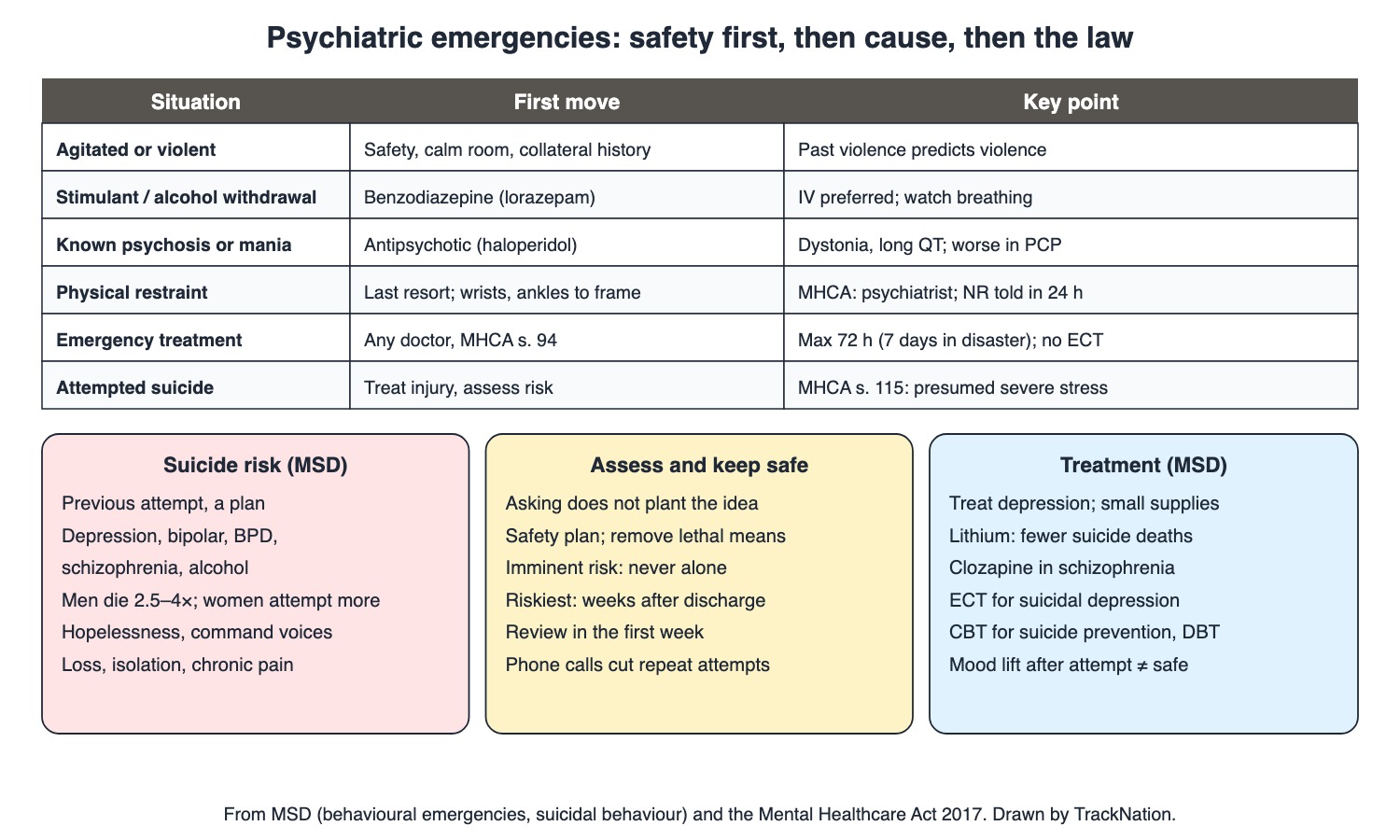
Psychiatric emergencies: agitation, sedation, restraint, emergency treatment law, attempted suicide; suicide risk, assessment and treatment. Drawn by TrackNation.
The Agitated or Violent Patient (MSD)
First decide: threat to self (suicide, self-neglect — psychosis, dementia, substance use) or threat to others. Causes: intoxication (alcohol, methamphetamine, cocaine, PCP), psychosis, mania, delirium, dementia. Prior violence is a strong predictor. Never assume the cause is psychiatric or intoxication, even with a known diagnosis or smell of alcohol; get collateral history at once.
De-escalate: calm quiet room, remove dangerous objects, sympathetic and confident manner, ask what would help; asking directly whether they intend to hurt someone does not make them act out. Counterproductive: challenging fears, threats, condescension, deception (hiding drugs in food, false promises).
Staff safety: door open, sit at the same level, don't answer hostility in kind; if violence is imminent, leave and summon 4–5 staff; don't bring restraints in unless you will use them.
Restraint is a last resort — never for punishment or staff convenience; caution in suicidal patients. Technique: one person per limb, leather restraint on each wrist and ankle tied to the bed frame, not the rail; never chest, neck or head; no gags. Monitor for injury, cardiac arrest and venous thromboembolism.
Rapid Sedation (Chemical Restraint)
Benzodiazepines (lorazepam, midazolam) are preferred for stimulant overdose and alcohol or benzodiazepine withdrawal; antipsychotics (haloperidol, olanzapine, aripiprazole, ziprasidone) for clear relapse of a known psychiatric disorder. A combination can work better than escalating one drug.
Benzodiazepines: IV preferred (IM absorption erratic); respiratory depression; flumazenil reverses but the behaviour may return; may disinhibit.
Antipsychotics: acute dystonia (benztropine can prevent; laryngeal dystonia may need intubation), akathisia, long QT, NMS; haloperidol can worsen PCP intoxication.
The Law in an Emergency (MHCA 2017)
Section 94 — emergency treatment: any registered medical practitioner, at a health establishment or in the community, with the nominated representative's consent where available, when immediately needed to prevent death or irreversible harm, serious harm to self or others, or serious property damage due to the illness. Includes transport for assessment. No ECT. Limited to 72 hours or until assessed (up to 7 days in a declared disaster). An advance directive does not apply to emergency treatment.
Section 97 — restraint: seclusion and solitary confinement are not allowed; physical restraint only when it is the only means to prevent imminent harm and is authorised by the psychiatrist in charge; for as short a time as possible; recorded at once; never as punishment or for shortage of staff; nominated representative informed within 24 hours; monthly report to the Board. Chaining in any form is prohibited (s. 95).
Section 115: a person who attempts suicide is presumed to have severe stress and shall not be tried and punished under IPC section 309; the government must provide care, treatment and rehabilitation.
Suicide: Who Is at Risk (MSD)
Over 720,000 suicide deaths a year worldwide — the third leading cause of death at 15–29. Women attempt more; men die 2.5–4 times as often. Pesticide self-poisoning is common in rural Asia; drug or toxin ingestion is the commonest attempt method. A note is left by about 1 in 6.
Nearly 90% who die by suicide have a psychiatric disorder. Highest SMRs: borderline personality disorder 45, anorexia 31, depression 20, bipolar 17, alcohol use, opioids, schizophrenia (up to 14% die by suicide). Depression is the commonest remediable risk factor; over a third have drunk alcohol before the act.
Risk factors and warning signs: previous attempt, detailed plans, family history, abuse, recent widowhood, separation, unemployment, isolation, chronic painful illness; agitation with severe insomnia, hopelessness, guilt, nihilistic delusions, command hallucinations, impulsivity. Self-harm without intent (NSSI) is not suicidal behaviour but is a risk factor — assess intent. Say "died by suicide", not "committed".
Assessment, Safety and Treatment
Ask every depressed patient about suicide — the fear that asking implants the idea is baseless. Treat every gesture seriously; treat the injury and assess risk. Acute risk lasts hours to days; a patient at imminent risk must not be left alone until in a secure place. A brief mood lift after an attempt does not mean safety.
Risk assessment: rapport, the attempt and its circumstances, mental state, substances, relationships, family interview, lethal means at home; tools like C-SSRS. Then a written safety plan, lethal-means counselling and crisis contacts.
Danger period: the days and weeks after discharge (high for 6–12 months) → follow-up within the first week; a phone call or two reduces repeat attempts; family keep the patient company and watch adherence. Early antidepressant treatment can raise risk as energy returns before mood → dispense sublethal amounts, warn family.
Treat: antidepressants; lithium reduces suicide deaths in mood disorders; clozapine in schizophrenia; intranasal esketamine; ECT for suicidal depression (ICMR psychosis STW also lists serious suicidal risk and severe violence as ECT indications); CBT for suicide prevention, DBT, family therapy.
Traps the Examiner Sets
Asking about suicide does not increase risk.
Benzodiazepine, not haloperidol, for stimulant or PCP agitation and alcohol withdrawal.
MHCA emergency treatment: 72 hours, never ECT.
Seclusion is not permitted under MHCA; restraint needs the psychiatrist in charge.
Memory Hooks & Shortcuts
Shortcuts to lock in this article's numbers and lists. Each one only re-packages facts proven above.
🧠 'Self or others?' — the first question in every emergency — assessment
🧠 'Benzo for booze and blow; antipsychotic for the known psychotic' — sedation
🧠 MHCA '94-72, no ECT; 97 — no seclusion, NR in 24; 115 — stress, not crime' — law
🧠 'Women try, men die' — sex ratio
🧠 'Ask, it won't plant it' — and watch the weeks after discharge — suicide care
Rapid-Revision Cards
First question
Threat to self or others?
Violence predictor
Past violence.
Never assume
Rule out medical cause.
De-escalate
Calm room, remove objects, speak directly.
Avoid
Threats, arguing, deception.
Imminent violence
Leave; call 4–5 staff.
Restraint
Last resort; frame not rail.
Stimulant / withdrawal
Benzodiazepine.
Known psychosis
Antipsychotic.
PCP
Avoid haloperidol.
Benzodiazepine risk
Respiratory depression.
MHCA s. 94
Any RMP; 72 h; no ECT.
MHCA s. 97
No seclusion; NR told in 24 h.
MHCA s. 115
Attempt = severe stress, no punishment.
Sex ratio
Women attempt; men die 2.5–4×.
Highest SMR
Borderline PD.
Top remediable risk
Depression.
Asking
Does not plant the idea.
Danger period
Weeks after discharge.
Anti-suicide drugs
Lithium; clozapine.
Suicidal depression
ECT.
Sources
Facts in this article were checked against these documents.
MSD Manual Professional: Behavioral Emergencies; Suicidal Behavior — Merck & Co. (MSD Manuals), reviewed 2024–25, updated Jan 2026 (link)
The Mental Healthcare Act, 2017 (Act 10 of 2017), sections 9, 94, 95, 97, 115 — Gazette of India, 2017 (link)
Standard Treatment Workflow: Psychosis — Indian Council of Medical Research, DHR, 2019 (link)
Competency Based Undergraduate Curriculum, Psychiatry (PS 12) — National Medical Commission, 2024
Test Yourself: Practice Questions
Thirty questions in NEET PG style, most of them clinical vignettes.
Practice Questions (NEET PG pattern)
Original questions written in the style of the exam: +4 for a correct answer, −1 for a wrong one. Every answer was checked against the sources listed above. NEET PG papers are not published by NBEMS, so these are not past-paper questions.
Q1. A man with known schizophrenia is brought in shouting and smelling of alcohol. Before attributing his behaviour to psychosis or drink you should
(a) sedate and discharge
(b) call it a relapse
(c) assume intoxication
(d) look for a general medical cause and get collateral history
Show answer
Answer: (d) — Never assume the cause.
Q2. The strongest predictor of future violence in a patient is
(a) a prior history of violence or aggression
(b) male sex
(c) young age
(d) low income
Show answer
Answer: (a) — MSD.
Q3. An angry patient in casualty is not yet violent. A helpful de-escalation step is to
(a) threaten to call the police
(b) move him to a calm, quiet room and remove objects that could harm
(c) argue with his complaints
(d) hide sedatives in his food
Show answer
Answer: (b) — Avoid threats and deception.
Q4. Asking an agitated patient directly whether he intends to hurt someone
(a) should be avoided
(b) is unethical
(c) provokes violence
(d) acknowledges feelings and does not make him more likely to act out
Show answer
Answer: (d) — Speak directly.
Q5. Violence appears imminent while you interview a patient alone. You should
(a) lock the door
(b) restrain him yourself
(c) leave the room and summon enough staff (4–5 people)
(d) turn your back calmly
Show answer
Answer: (c) — Show of force.
Q6. During an interview with a hostile patient, the interview-room door should be
(a) guarded from inside
(b) left open
(c) locked
(d) closed for privacy
Show answer
Answer: (b) — Staff safety.
Q7. Physical restraints may be used
(a) as punishment
(b) as a last resort to prevent imminent harm
(c) to stop wandering for staff convenience
(d) routinely for all admissions
Show answer
Answer: (b) — Never punishment or convenience.
Q8. Correct restraint technique is to attach the wrist and ankle restraints to the
(a) bed frame, not the rail, and never around chest or neck
(b) patient's chest
(c) bed rail
(d) neck
Show answer
Answer: (a) — One restraint per limb.
Q9. A restrained patient needs monitoring because of the risk of
(a) anaemia
(b) injury, cardiac arrest and venous thromboembolism
(c) cataract
(d) hyperthyroidism
Show answer
Answer: (b) — Frequent checks.
Q10. A young man agitated after cocaine use needs sedation. The preferred drug class is
(a) typical antipsychotic
(b) benzodiazepine
(c) lithium
(d) SSRI
Show answer
Answer: (b) — Also alcohol withdrawal.
Q11. A patient with known bipolar disorder in an acute manic relapse is violent. The preferred sedating class is
(a) benzodiazepine only
(b) opioid
(c) antihistamine
(d) antipsychotic
Show answer
Answer: (d) — Known psychiatric disorder.
Q12. Haloperidol should be avoided for agitation from
(a) phencyclidine (PCP) intoxication
(b) schizophrenia relapse
(c) acute mania
(d) delusional disorder
Show answer
Answer: (a) — May worsen it.
Q13. Lorazepam for rapid sedation is preferably given IV because
(a) IM is painful only
(b) oral is toxic
(c) IM absorption may be erratic
(d) IV avoids respiratory depression
Show answer
Answer: (c) — Watch breathing.
Q14. After high-dose benzodiazepine sedation, flumazenil must be used with caution because
(a) it causes hypertension
(b) it worsens dystonia
(c) it is an opioid
(d) the original agitation may return when sedation reverses
Show answer
Answer: (d) — Watch the patient after reversal.
Q15. Shortly after IM haloperidol a patient develops a twisted neck and upward-rolling eyes. This is
(a) acute dystonia
(b) tardive dyskinesia
(c) NMS
(d) seizure
Show answer
Answer: (a) — Benztropine can prevent it.
Q16. Under MHCA 2017 section 94, emergency treatment of a person with mental illness may be given by
(a) only a psychiatrist
(b) only a magistrate's order
(c) any registered medical practitioner, in hospital or the community
(d) only the police
Show answer
Answer: (c) — NR consent where available.
Q17. Emergency treatment under MHCA section 94 is limited to
(a) 7 days always
(b) 72 hours or until assessment at a mental health establishment
(c) 30 days
(d) 24 hours
Show answer
Answer: (b) — Up to 7 days in a declared disaster.
Q18. Which treatment is NOT permitted as emergency treatment under MHCA section 94?
(a) ECT
(b) transport to a mental health establishment
(c) sedation to prevent serious harm
(d) treating self-inflicted injury
Show answer
Answer: (a) — Explicit bar.
Q19. Under MHCA section 97, physical restraint must be
(a) used as deterrent
(b) ordered by any nurse
(c) used when staff are short
(d) authorised by the psychiatrist in charge and the nominated representative informed within 24 hours
Show answer
Answer: (d) — Monthly report to Board.
Q20. Under MHCA 2017, a person who attempts suicide is
(a) sent to jail
(b) presumed to have severe stress and not tried or punished
(c) fined
(d) always prosecuted
Show answer
Answer: (b) — Section 115.
Q21. Worldwide, suicide is which leading cause of death in people aged 15–29?
(a) tenth
(b) first
(c) fifth
(d) third
Show answer
Answer: (d) — Over 720,000 deaths a year.
Q22. Compared with women, men
(a) attempt suicide less often but die by suicide more often
(b) attempt more, die less
(c) attempt and die more often
(d) show no difference
Show answer
Answer: (a) — 2.5:1 to 4:1 deaths.
Q23. In the MSD table, the psychiatric condition with the highest suicide SMR is
(a) borderline personality disorder
(b) bulimia
(c) anxiety disorder
(d) PTSD
Show answer
Answer: (a) — SMR 45.
Q24. The single strongest historical risk factor for suicide on MSD's list is
(a) high income
(b) left-handedness
(c) marriage
(d) a previous suicide attempt
Show answer
Answer: (d) — Plus detailed plans.
Q25. A depressed patient hears voices telling him to kill himself. This feature
(a) is irrelevant
(b) suggests malingering
(c) lowers risk
(d) raises suicide risk (command hallucinations)
Show answer
Answer: (d) — Warning sign.
Q26. A resident hesitates to ask a depressed patient about suicide in case it puts the idea in her head. The correct view is that
(a) only psychiatrists may ask
(b) ask only if she raises it
(c) asking increases risk
(d) asking does not implant the idea and should be done for every depressed patient
Show answer
Answer: (d) — Baseless fear.
Q27. A depressed patient recently started on an SSRI has more energy but still low mood. The concern is that
(a) mania has started
(b) suicide risk may rise as energy returns before mood lifts
(c) he is cured
(d) the drug has failed
Show answer
Answer: (b) — Monitor closely.
Q28. A patient admitted after a suicide attempt is being discharged. The period of greatest risk is
(a) only during admission
(b) the first 5 years
(c) the first days and weeks after discharge — arrange follow-up within the first week
(d) after 1 year
Show answer
Answer: (c) — Stays high 6–12 months.
Q29. A mood stabiliser shown to reduce deaths by suicide in depression and bipolar disorder is
(a) valproate
(b) carbamazepine
(c) lamotrigine
(d) lithium
Show answer
Answer: (d) — Clozapine does this in schizophrenia.
Q30. A severely depressed patient is actively suicidal and refusing food. A rapidly effective treatment is
(a) ECT
(b) psychoanalysis
(c) vitamin therapy
(d) waiting for SSRI response
Show answer
Answer: (a) — Suicidal depression.
Active Recall
From memory: outline the approach to an agitated or violent patient, compare benzodiazepines and antipsychotics for rapid sedation, state the MHCA 2017 rules on emergency treatment, restraint and attempted suicide, and list suicide risk factors, assessment steps and treatments.