Endocrine System for NEET PG Pathology: Graves, Hashimoto, Thyroid Cancers, Diabetes, Hyperparathyroidism, Addison, Cushing, Phaeochromocytoma, MEN
Start Here
🎯 Exam priority: High. Expect: the commonest thyroid cancer and its spread, medullary carcinoma and calcitonin/RET, Graves antibody, Hashimoto histology and lymphoma risk, subacute thyroiditis giant cells, diabetes cut-offs and islet amyloid, parathyroid adenoma, Addison causes, Cushing disease vs ectopic ACTH, phaeochromocytoma 10% facts, and MEN components.
CBME mapping: PA 31.1–31.10. Diabetic kidney is in article 21; amyloid in article 6; pancreatic NETs in article 17.
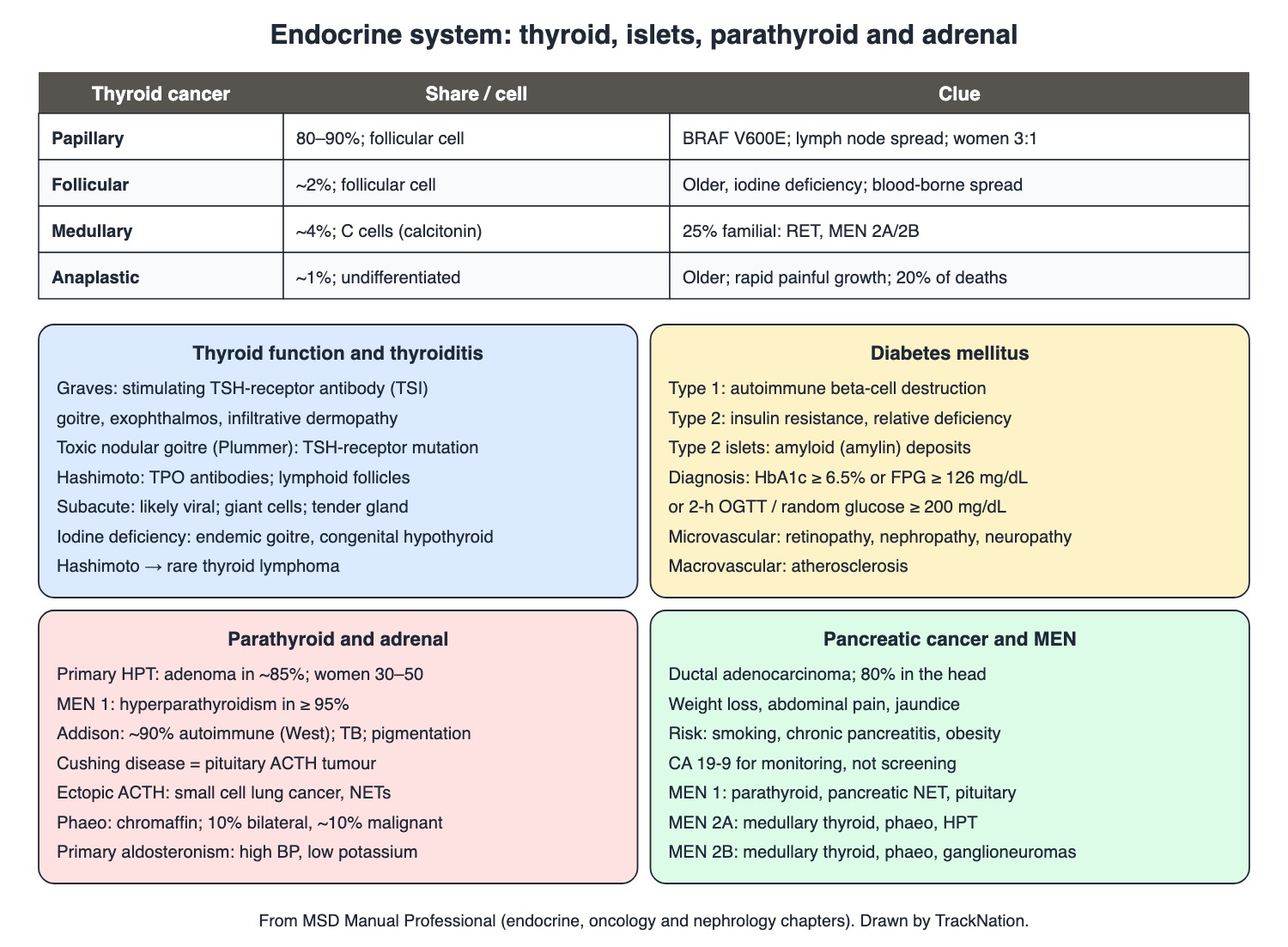
Thyroid, islets, parathyroid, adrenal and MEN. Drawn by TrackNation.
Thyroid Function and Thyroiditis
Simple goitre: non-cancerous thyroid enlargement without hormone excess, deficiency or inflammation. Iodine deficiency causes endemic goitre, goitrous hypothyroidism and congenital hypothyroidism (formerly endemic cretinism).
Graves disease — the commonest cause of hyperthyroidism: a stimulating autoantibody (TSI) against the TSH receptor (most autoantibodies inhibit). Goitre, exophthalmos, infiltrative dermopathy. Toxic nodular goitre (Plummer) can result from TSH-receptor gene mutations.
Hashimoto thyroiditis: chronic autoimmune thyroiditis, far commoner in women; painless goitre and hypothyroidism; high thyroid peroxidase antibodies; dense lymphocytes with lymphoid follicles and scarring; small rise in thyroid tumours, rarely lymphoma. The usual cause of primary hypothyroidism (low T4/T3, high TSH) where iodine is sufficient.
Subacute thyroiditis: likely viral; fever, tender thyroid, high ESR; transient hyperthyroidism then hypothyroidism; giant cells with less lymphocytic infiltrate.
Thyroid Carcinoma
From follicular cells (papillary, follicular, oncocytic, anaplastic) or parafollicular C cells (medullary).
Papillary: 80–90%; women 3:1; BRAF V600E; spreads by lymphatics to neck nodes (a third), sometimes lung.
Follicular: about 2%; older patients and iodine-deficient regions; more aggressive because it spreads through the blood (distant metastases).
Medullary: about 4%; C cells make calcitonin; 25% familial (RET) — MEN 2A and 2B.
Anaplastic: about 1% but 20% of thyroid cancer deaths; older patients; rapid, painful enlargement.
Diabetes Mellitus
Type 1: autoimmune destruction of beta cells (autoantibodies help diagnosis). Type 2: insulin resistance with relative deficiency; islets look normal but often contain amyloid (amylin).
Diagnosis: HbA1c ≥ 6.5%, fasting glucose ≥ 126 mg/dL, 2-hour OGTT ≥ 200 mg/dL, or random glucose ≥ 200 mg/dL with symptoms.
Complications: microvascular (retinopathy, nephropathy, neuropathy) and macrovascular (atherosclerosis).
Parathyroid, Adrenal and Pancreas
Primary hyperparathyroidism: a single adenoma in about 85%; women, ages 30–50. Think of MEN when young or multiglandular.
Addison disease (primary adrenal insufficiency): about 90% autoimmune in the US and Europe; the rest from granulomas (TB, histoplasmosis), tumour, amyloid, haemorrhage. Hypotension and hyperpigmentation with high ACTH.
Cushing syndrome: moon face, truncal obesity, bruising. ACTH-dependent: Cushing disease (pituitary tumour) or ectopic ACTH (small cell lung carcinoma, neuroendocrine tumours). ACTH-independent: glucocorticoid therapy, adrenal adenoma or carcinoma.
Phaeochromocytoma: catecholamine-secreting chromaffin tumour; persistent or paroxysmal hypertension; adrenal ones are bilateral in 10% (20% in children) and malignant in about 10%; diagnosed with plasma or urine metanephrines.
Primary aldosteronism: adrenal hyperplasia, adenoma or carcinoma → hypertension, weakness, hypokalaemia; high aldosterone with low renin.
Pancreatic cancer: ductal adenocarcinoma, 80% in the head; weight loss, pain, jaundice; risks smoking, chronic pancreatitis, obesity; CA 19-9 is for monitoring, not screening.
Syndrome | Components | Gene |
MEN 1 | Parathyroid (≥ 95%), pancreatic neuroendocrine tumours, pituitary | MEN1 (menin) |
MEN 2A | Medullary thyroid carcinoma, phaeochromocytoma, primary hyperparathyroidism | RET |
MEN 2B | Medullary thyroid carcinoma, phaeochromocytoma, GI ganglioneuromas | RET |
Traps the Examiner Sets
Papillary → lymph nodes; follicular → blood (bone, lung).
Graves antibody stimulates; most autoantibodies block.
Painful thyroid + giant cells = subacute; painless + lymphoid follicles = Hashimoto.
Cushing disease = pituitary; Cushing syndrome = any cause.
Medullary thyroid carcinoma → think calcitonin, RET, MEN 2.
Memory Hooks & Shortcuts
Shortcuts to lock in this article's numbers and lists. Each one only re-packages facts proven above.
🧠 Papillary Pops into nodes; Follicular Flows in blood — thyroid cancer spread
🧠 Medullary = Calcitonin + RET → MEN 2 — medullary carcinoma
🧠 Graves Gas pedal (stimulates); Hashimoto Hits the brakes (destroys) — thyroid autoimmunity
🧠 Subacute is Sore with giant cells — subacute thyroiditis
🧠 MEN 1 = 3 P's: Parathyroid, Pancreas, Pituitary — MEN 1
🧠 Phaeo = rule of 10s (bilateral, malignant) — phaeochromocytoma
Rapid-Revision Cards
Graves
Stimulating TSH-receptor antibody; goitre, exophthalmos, dermopathy.
Plummer
Toxic nodular goitre; TSH-receptor mutations.
Hashimoto
TPO antibodies; lymphoid follicles; rare lymphoma.
Subacute thyroiditis
Viral; tender; giant cells; high ESR.
Iodine deficiency
Endemic goitre; congenital hypothyroidism.
Papillary
80–90%; BRAF V600E; lymphatic spread.
Follicular
~2%; iodine deficiency; blood spread.
Medullary
~4%; C cells; calcitonin; RET.
Anaplastic
~1%; elderly; painful; 20% of deaths.
Type 1 DM
Autoimmune beta-cell loss.
Type 2 DM
Insulin resistance; islet amyloid.
DM cut-offs
HbA1c ≥ 6.5%; FPG ≥ 126; OGTT ≥ 200.
Primary HPT
Adenoma ~85%; women 30–50.
MEN 1
Parathyroid ≥ 95%, pancreas NET, pituitary; menin.
MEN 2A
MTC, phaeo, HPT; RET.
MEN 2B
MTC, phaeo, ganglioneuromas; RET.
Addison
~90% autoimmune (West); TB; pigmentation.
Cushing disease
Pituitary ACTH tumour.
Ectopic ACTH
Small cell lung cancer, NETs.
Phaeo
Chromaffin; 10% bilateral; ~10% malignant; metanephrines.
Primary aldosteronism
Hypertension, hypokalaemia; low renin.
Pancreatic cancer
Ductal; 80% head; CA 19-9 monitoring.
Sources
Facts in this article were checked against these documents.
MSD Manual Professional: Hyperthyroidism; Hypothyroidism; Hashimoto Thyroiditis; Subacute Thyroiditis; Simple Nontoxic Goiter; Thyroid Cancers — Merck & Co. (MSD Manuals), reviewed 2025–26 (link)
MSD Manual Professional: Overview of Diabetes Mellitus; Type 1 Diabetes — Merck & Co. (MSD Manuals), reviewed 2025–26 (link)
MSD Manual Professional: Hypercalcemia; Addison Disease; Cushing Syndrome; Pheochromocytoma; Primary Aldosteronism — Merck & Co. (MSD Manuals), reviewed 2025–26 (link)
MSD Manual Professional: Pancreatic Cancer; Multiple Endocrine Neoplasia Syndromes — Merck & Co. (MSD Manuals), reviewed 2025 (link)
Competency Based Undergraduate Curriculum, Pathology (PA 31) — National Medical Commission, 2024
Test Yourself: Practice Questions
Thirty questions in NEET PG style, most of them clinical vignettes.
Practice Questions (NEET PG pattern)
Original questions written in the style of the exam: +4 for a correct answer, −1 for a wrong one. Every answer was checked against the sources listed above. NEET PG papers are not published by NBEMS, so these are not past-paper questions.
Q1. A woman has hyperthyroidism, a diffuse goitre and protruding eyes. The pathogenesis is
(a) viral destruction of follicles
(b) a TSH-secreting pituitary tumour
(c) an inhibitory antibody against TPO
(d) a stimulating autoantibody against the TSH receptor
Show answer
Answer: (d) — Graves disease, the commonest cause of hyperthyroidism.
Q2. Which skin finding belongs to Graves disease?
(a) acanthosis nigricans only
(b) erythema nodosum
(c) infiltrative dermopathy
(d) vitiligo always
Show answer
Answer: (c) — With goitre and exophthalmos.
Q3. A toxic multinodular goitre (Plummer disease) can arise from
(a) iodine excess only
(b) giant cell infiltration
(c) TSH-receptor gene mutations causing continuous activation
(d) TPO antibodies
Show answer
Answer: (c) — Autonomous nodules.
Q4. A middle-aged woman has a painless firm goitre and hypothyroidism; thyroid peroxidase antibodies are very high. Histology would show
(a) papillae with clear nuclei
(b) giant cells around damaged follicles
(c) amyloid stroma
(d) dense lymphocytic infiltrate with lymphoid follicles and scarring
Show answer
Answer: (d) — Hashimoto thyroiditis.
Q5. A rare but recognised tumour that arises in long-standing Hashimoto thyroiditis is
(a) thyroid lymphoma
(b) medullary carcinoma
(c) parathyroid adenoma
(d) phaeochromocytoma
Show answer
Answer: (a) — Thyroid tumours are slightly more common in Hashimoto.
Q6. After a viral illness, a woman has fever, a painful tender thyroid, high ESR and transient hyperthyroidism. Histology shows
(a) lymphoid follicles
(b) giant cell infiltration with follicular disruption
(c) papillary fronds
(d) amyloid
Show answer
Answer: (b) — Subacute thyroiditis; hypothyroidism may follow.
Q7. In iodine-sufficient regions, the commonest cause of primary hypothyroidism is
(a) Hashimoto (autoimmune) thyroiditis
(b) thyroid cancer
(c) pituitary failure
(d) subacute thyroiditis
Show answer
Answer: (a) — Low T4/T3 with high TSH.
Q8. In severely iodine-deficient regions, a major consequence in newborns is
(a) Graves disease
(b) medullary carcinoma
(c) MEN 2
(d) congenital hypothyroidism (formerly endemic cretinism)
Show answer
Answer: (d) — Iodine deficiency also causes endemic goitre.
Q9. The commonest thyroid cancer is
(a) follicular carcinoma
(b) anaplastic carcinoma
(c) papillary carcinoma (80–90%)
(d) medullary carcinoma
Show answer
Answer: (c) — Women 3:1.
Q10. The commonest genetic driver of papillary thyroid carcinoma is
(a) TP53 only
(b) RAS only
(c) RET in all cases
(d) BRAF V600E
Show answer
Answer: (d) — BRAF V600E protein can be stained on biopsy.
Q11. The thyroid cancer that characteristically spreads through lymphatics to regional neck nodes is
(a) follicular carcinoma
(b) papillary carcinoma
(c) anaplastic carcinoma
(d) lymphoma only
Show answer
Answer: (b) — Lymphatic spread to regional nodes in a third.
Q12. An older patient from an iodine-deficient area has a thyroid cancer with distant blood-borne metastases. The likely type is
(a) medullary carcinoma
(b) Hashimoto lymphoma
(c) follicular carcinoma
(d) papillary carcinoma
Show answer
Answer: (c) — It spreads through the blood.
Q13. A thyroid cancer from parafollicular cells that secretes calcitonin is
(a) papillary carcinoma
(b) oncocytic carcinoma
(c) follicular carcinoma
(d) medullary carcinoma
Show answer
Answer: (d) — About 4% of thyroid cancers.
Q14. Familial medullary thyroid carcinoma is caused by mutation of
(a) VHL
(b) MEN1 (menin)
(c) the RET proto-oncogene
(d) BRAF
Show answer
Answer: (c) — 25% of cases are familial.
Q15. A patient has medullary thyroid carcinoma, phaeochromocytoma and primary hyperparathyroidism. The syndrome is
(a) MEN 2A
(b) von Hippel-Lindau
(c) MEN 2B
(d) MEN 1
Show answer
Answer: (a) — MEN 2B has ganglioneuromas instead of hyperparathyroidism.
Q16. An elderly patient has a rapidly enlarging, painful thyroid mass; histology shows an undifferentiated tumour. This is
(a) papillary carcinoma
(b) anaplastic carcinoma
(c) subacute thyroiditis
(d) follicular adenoma
Show answer
Answer: (b) — About 1% of cases but 20% of thyroid cancer deaths.
Q17. Type 1 diabetes is primarily due to
(a) glucagon excess
(b) insulin resistance
(c) islet amyloid
(d) autoimmune destruction of pancreatic beta cells
Show answer
Answer: (d) — Autoantibodies help confirm it.
Q18. Pancreatic islets in type 2 diabetes characteristically contain
(a) granulomas
(b) amyloid (amylin) deposits
(c) haemosiderin
(d) insulitis with lymphocytes always
Show answer
Answer: (b) — Islets look small but normal otherwise.
Q19. Which value diagnoses diabetes mellitus?
(a) fasting glucose 110 mg/dL
(b) HbA1c 5.9%
(c) 2-hour OGTT 160 mg/dL
(d) HbA1c 6.7%
Show answer
Answer: (d) — Cut-offs: HbA1c ≥ 6.5%, FPG ≥ 126, OGTT ≥ 200 mg/dL.
Q20. The microvascular complications of diabetes are
(a) retinopathy, nephropathy and neuropathy
(b) cataract only
(c) pancreatitis
(d) stroke, MI and gangrene
Show answer
Answer: (a) — Macrovascular disease is atherosclerosis.
Q21. A woman aged 45 has hypercalcaemia with high PTH. Surgery is most likely to find
(a) normal glands
(b) parathyroid carcinoma
(c) four-gland hyperplasia always
(d) a single parathyroid adenoma
Show answer
Answer: (d) — About 85% of primary hyperparathyroidism.
Q22. In MEN 1, the commonest endocrine abnormality is
(a) medullary thyroid carcinoma
(b) hyperparathyroidism (≥ 95%)
(c) Graves disease
(d) phaeochromocytoma
Show answer
Answer: (b) — Also pancreatic neuroendocrine and pituitary tumours.
Q23. In the US and Europe, the commonest cause of primary adrenal insufficiency is
(a) tuberculosis
(b) haemorrhage
(c) metastases
(d) autoimmune adrenalitis (~90%)
Show answer
Answer: (d) — TB and other granulomas cause many of the rest.
Q24. A patient with primary adrenal insufficiency has darkening of the skin. The other typical finding is
(a) hypertension
(b) hypokalaemia
(c) hypotension
(d) weight gain
Show answer
Answer: (c) — High ACTH drives the pigmentation.
Q25. Cushing syndrome caused by an ACTH-secreting pituitary tumour is called
(a) ectopic ACTH syndrome
(b) Nelson syndrome
(c) Conn syndrome
(d) Cushing disease
Show answer
Answer: (d) — Cushing syndrome is the general term.
Q26. A patient with a lung mass develops features of cortisol excess. The likely mechanism is
(a) ectopic ACTH from small cell carcinoma
(b) pituitary adenoma
(c) adrenal adenoma
(d) exogenous steroids
Show answer
Answer: (a) — Neuroendocrine tumours can do the same.
Q27. A patient has paroxysmal hypertension; plasma free metanephrines are high. The tumour arises from
(a) parafollicular cells
(b) chromaffin cells
(c) zona fasciculata
(d) zona glomerulosa
Show answer
Answer: (b) — Phaeochromocytoma.
Q28. Adrenal phaeochromocytomas are bilateral in about
(a) 10% (20% in children)
(b) 50%
(c) 90%
(d) never
Show answer
Answer: (a) — And malignant in about 10%.
Q29. A hypertensive patient has episodic weakness and hypokalaemia; aldosterone is high and renin low. The disorder is
(a) phaeochromocytoma
(b) Addison disease
(c) primary aldosteronism
(d) Cushing disease
Show answer
Answer: (c) — Adrenal hyperplasia, adenoma or carcinoma.
Q30. A smoker has weight loss, abdominal pain and jaundice; imaging shows a mass in the pancreatic head. The likely tumour and the marker used to monitor it are
(a) gastrinoma — gastrin
(b) acinar cell carcinoma — AFP
(c) ductal adenocarcinoma — CA 19-9
(d) insulinoma — insulin
Show answer
Answer: (c) — 80% arise in the head; CA 19-9 is not for screening.
Active Recall
From memory: explain Graves disease and toxic nodular goitre; contrast Hashimoto and subacute thyroiditis; give share, cell, gene and spread of each thyroid carcinoma; state diabetes types, islet changes and diagnostic cut-offs; name the usual lesion of primary hyperparathyroidism; list causes of Addison and Cushing syndromes; give phaeochromocytoma and primary aldosteronism features; and list MEN components.