Breast for NEET PG Pathology: Fibroadenoma, Fibrocystic Change, Phyllodes, DCIS, LCIS, Paget Disease, Invasive Carcinoma, HER2 and BRCA
Start Here
🎯 Exam priority: High. Expect: the commonest benign lump, fibroadenoma vs phyllodes, DCIS vs LCIS, Paget disease of the nipple, ductal vs lobular frequency, inflammatory carcinoma and dermal lymphatics, receptor groups and prognosis, and BRCA risks.
CBME mapping: PA 30.1–30.3. Oncogenes and tumour markers in general are in article 4; BRCA and the ovary in article 24.
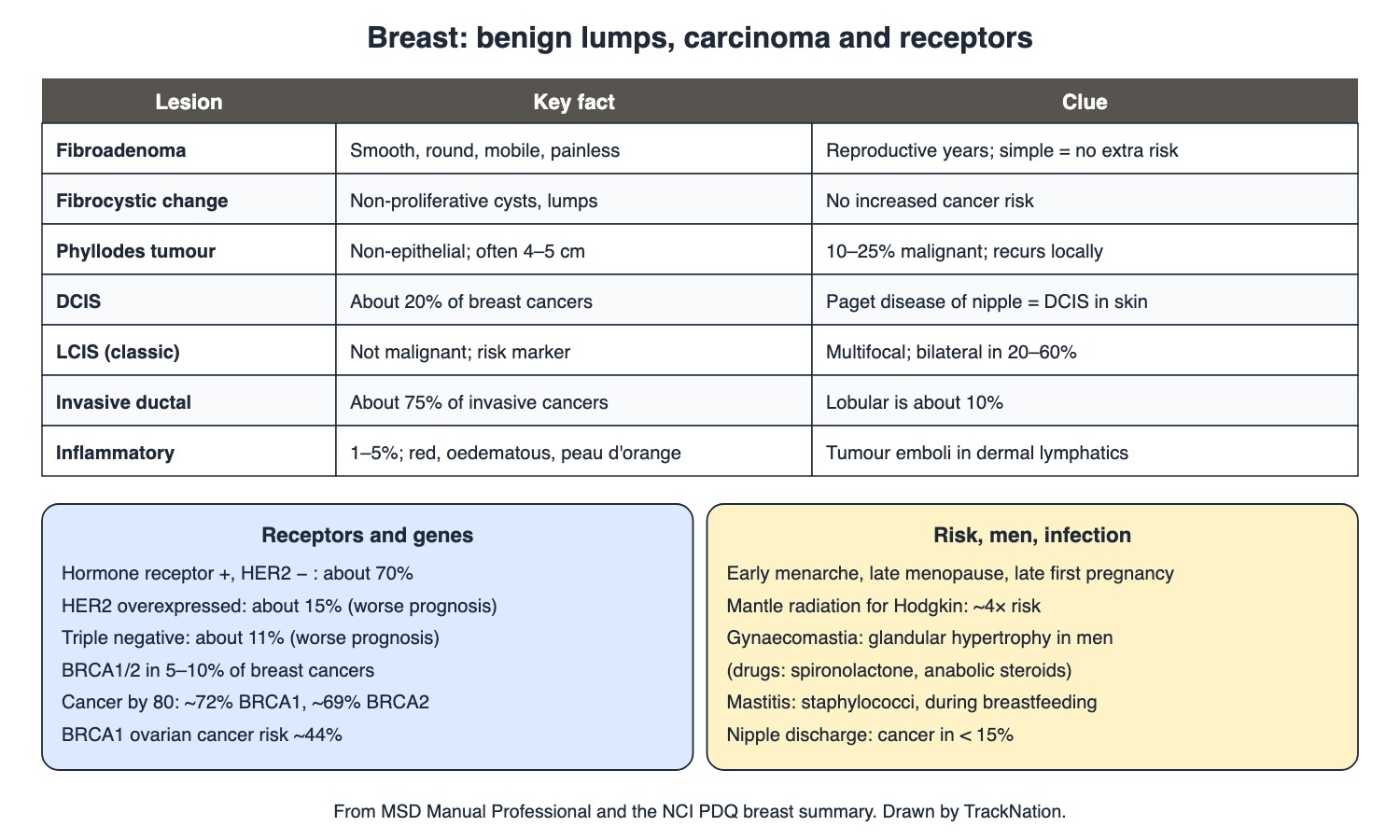
Benign breast lumps, carcinoma types, receptors and genes. Drawn by TrackNation.
Benign Breast Disease
Most breast masses are benign; the commonest are fibrocystic changes (non-proliferative cysts and lumps, no added cancer risk) and fibroadenomas.
Fibroadenoma: smooth, round, mobile, painless lump of the reproductive years; may shrink with time. Simple fibroadenomas carry no extra cancer risk; complex ones a slight increase.
Nipple discharge: cancer causes fewer than 15%; most are benign — intraductal papilloma, duct ectasia, fibrocystic change, pituitary tumour, drugs.
Mastitis: fever and a red, tender breast weeks into breastfeeding; staphylococci are the usual cause; abscess is rare.
Gynaecomastia: glandular breast hypertrophy in men (not fat — that is pseudogynaecomastia). Causes: persistent pubertal, idiopathic, drugs such as spironolactone, anabolic steroids, antiandrogens.
Phyllodes tumour: a non-epithelial (stromal) tumour, often 4–5 cm; 10–25% malignant; 20–35% recur locally.
Carcinoma In Situ and Invasive Carcinoma
DCIS: about 20% of breast cancers. Paget disease of the nipple is DCIS extending into the nipple skin — an eczematous or psoriasiform plaque with Paget cells in the epidermis.
Classic LCIS is not malignant but marks higher risk of invasive cancer in either breast; often multifocal and bilateral in 20–60%.
Invasive carcinoma: mostly adenocarcinoma — infiltrating ductal about 75%, infiltrating lobular about 10%. Fixation to skin or chest wall, skin nodules or ulcers, and matted axillary nodes indicate spread.
Inflammatory carcinoma: 1–5% of breast cancers; a clinical-pathological entity with red, oedematous, thickened ("peau d'orange") skin from tumour emboli in dermal lymphatics; poor prognosis.
Receptors, Genes and Risk
BRCA1/2 mutations in 5–10% of women with breast cancer. Risk of breast cancer by age 80: about 72% (BRCA1), 69% (BRCA2); lifetime ovarian cancer risk about 44% with BRCA1. Male carriers: 1–2% lifetime breast cancer risk.
Other risks: early menarche, late menopause, older age at first pregnancy, mantle-field radiation for Hodgkin lymphoma (about 4×).
Group | Share | Note |
Hormone receptor positive, HER2 negative | ~70% | The majority |
HER2 overexpressed | ~15% | Poorer prognosis at any stage |
Triple negative (ER, PR, HER2 absent) | ~11% | Poorer prognosis |
Traps the Examiner Sets
Paget disease of the nipple = DCIS in the skin, not the bone disease.
LCIS = risk marker for both breasts; DCIS = a true precursor in the same breast.
Inflammatory carcinoma = dermal lymphatic emboli, not infection.
Phyllodes is stromal (non-epithelial) and recurs; fibroadenoma is common and benign.
Memory Hooks & Shortcuts
Shortcuts to lock in this article's numbers and lists. Each one only re-packages facts proven above.
🧠 Fibroadenoma = breast mouse (mobile) — fibroadenoma
🧠 Paget's Patch on the nipple = DCIS reaching skin — Paget disease of nipple
🧠 LCIS = Lights up risk in Both breasts — LCIS
🧠 Inflammatory = Invaded lymphatics, not infection — inflammatory carcinoma
🧠 70-15-11: HR+, HER2+, triple negative — receptor groups
🧠 BRCA1 = 1 in 2 lifetime ovarian risk (~44%) — BRCA1
Rapid-Revision Cards
Commonest breast masses
Fibrocystic change, fibroadenoma.
Fibroadenoma
Smooth, round, mobile, painless; reproductive years.
Fibrocystic change
No added cancer risk.
Nipple discharge
Cancer in < 15%; papilloma, duct ectasia.
Mastitis
Staphylococci; breastfeeding.
Gynaecomastia
Glandular; spironolactone, steroids.
Phyllodes
Stromal; 4–5 cm; 10–25% malignant; recurs.
DCIS
About 20% of breast cancers.
Paget of nipple
DCIS in nipple skin; Paget cells.
LCIS
Not malignant; risk marker; bilateral 20–60%.
Invasive ductal
~75%.
Invasive lobular
~10%.
Inflammatory carcinoma
1–5%; dermal lymphatic emboli; peau d'orange.
HR+/HER2−
~70%.
HER2+
~15%; poorer prognosis.
Triple negative
~11%; poorer prognosis.
BRCA share
5–10% of breast cancers.
BRCA risk by 80
72% BRCA1; 69% BRCA2.
BRCA1 ovary
~44% lifetime.
Mantle radiation
~4× breast cancer risk.
Sources
Facts in this article were checked against these documents.
MSD Manual Professional: Breast Cancer; Inflammatory Breast Cancer; Paget Disease of the Nipple; Phyllodes Tumor of the Breast — Merck & Co. (MSD Manuals), reviewed 2025–26 (link)
MSD Manual Professional: Breast Masses; Nipple Discharge; Mastitis; Gynecomastia — Merck & Co. (MSD Manuals), reviewed 2024–26 (link)
PDQ Breast Cancer Treatment (Health Professional Version) — US National Cancer Institute, 2026 (link)
Competency Based Undergraduate Curriculum, Pathology (PA 30) — National Medical Commission, 2024
Test Yourself: Practice Questions
Twenty-four questions in NEET PG style, most of them clinical vignettes.
Practice Questions (NEET PG pattern)
Original questions written in the style of the exam: +4 for a correct answer, −1 for a wrong one. Every answer was checked against the sources listed above. NEET PG papers are not published by NBEMS, so these are not past-paper questions.
Q1. A 22-year-old has a smooth, round, very mobile, painless breast lump. The likely diagnosis is
(a) fibroadenoma
(b) phyllodes tumour
(c) fat necrosis
(d) invasive ductal carcinoma
Show answer
Answer: (a) — A lump of the reproductive years; simple ones carry no extra cancer risk.
Q2. Fibrocystic change of the breast
(a) is a malignant stromal tumour
(b) is not associated with increased cancer risk
(c) always needs excision
(d) is a precursor of DCIS
Show answer
Answer: (b) — It is non-proliferative.
Q3. The two commonest causes of a breast mass are
(a) abscess and lipoma
(b) carcinoma and phyllodes
(c) Paget disease and LCIS
(d) fibrocystic changes and fibroadenoma
Show answer
Answer: (d) — Most breast masses are benign.
Q4. A woman has spontaneous nipple discharge. The proportion of such cases caused by cancer is
(a) less than 15%
(b) about 50%
(c) about 80%
(d) none
Show answer
Answer: (a) — Intraductal papilloma, duct ectasia and fibrocystic change are commoner.
Q5. A breastfeeding mother develops fever and a red, tender, indurated breast a few weeks after delivery. The usual organism is
(a) Staphylococcus species
(b) Candida
(c) E. coli
(d) Streptococcus pneumoniae
Show answer
Answer: (a) — Abscess is rare; occasionally MRSA.
Q6. A man on spironolactone develops enlargement of the glandular breast tissue. This is
(a) lipoma
(b) pseudogynaecomastia
(c) gynaecomastia
(d) male breast cancer always
Show answer
Answer: (c) — Pseudogynaecomastia is fat, not gland.
Q7. A woman has a 5 cm breast tumour; histology shows a stromal (non-epithelial) neoplasm. The tumour and its malignant fraction are
(a) DCIS — 20%
(b) lobular carcinoma — 100%
(c) fibroadenoma — always benign
(d) phyllodes tumour — 10–25% malignant
Show answer
Answer: (d) — 20–35% recur locally.
Q8. A woman has a unilateral eczema-like plaque of the nipple and areola; biopsy shows malignant cells in the epidermis. This is
(a) Paget disease of bone
(b) Paget disease of the nipple (DCIS in the skin)
(c) eczema
(d) inflammatory carcinoma
Show answer
Answer: (b) — Paget cells in the epidermis.
Q9. Classic lobular carcinoma in situ is best described as
(a) a benign stromal tumour
(b) a non-malignant marker of increased invasive cancer risk in either breast
(c) an invasive carcinoma
(d) a precursor only of the same quadrant
Show answer
Answer: (b) — Often multifocal; bilateral in 20–60%.
Q10. LCIS is bilateral in about
(a) 1%
(b) 20–60% of cases
(c) 100%
(d) never
Show answer
Answer: (b) — It is often multifocal.
Q11. Ductal carcinoma in situ makes up about what share of breast cancers?
(a) 2%
(b) 90%
(c) 20%
(d) 60%
Show answer
Answer: (c) — Often found on mammography.
Q12. The commonest histological type of invasive breast cancer is
(a) phyllodes tumour
(b) infiltrating ductal carcinoma (~75%)
(c) medullary carcinoma
(d) infiltrating lobular carcinoma (~75%)
Show answer
Answer: (b) — Lobular is about 10%.
Q13. A woman's breast is red, oedematous and diffusely enlarged with peau d'orange skin but no palpable lump; biopsy shows tumour cells in dermal lymphatics. The diagnosis is
(a) inflammatory breast carcinoma
(b) fat necrosis
(c) mastitis
(d) breast abscess
Show answer
Answer: (a) — 1–5% of breast cancers; poor prognosis.
Q14. The proportion of breast cancers that overexpress HER2 is about
(a) 70%
(b) 15%
(c) 50%
(d) 1%
Show answer
Answer: (b) — HER2 overexpression correlates with poorer prognosis.
Q15. The commonest receptor profile of breast cancer is
(a) HER2 positive, hormone receptor negative
(b) receptor status unknown
(c) hormone receptor positive, HER2 negative
(d) triple negative
Show answer
Answer: (c) — About 70%.
Q16. A breast cancer lacking oestrogen, progesterone and HER2 receptors
(a) is triple negative and has a poorer prognosis
(b) is always lobular
(c) responds to tamoxifen
(d) has the best prognosis
Show answer
Answer: (a) — About 11% of breast cancers.
Q17. A woman with breast cancer carries a germline mutation that also gives about a 44% lifetime risk of ovarian cancer. The gene is
(a) TP53 only
(b) APC
(c) RB1
(d) BRCA1
Show answer
Answer: (d) — BRCA2 carries about 17% ovarian risk.
Q18. The proportion of women with breast cancer who carry a BRCA1 or BRCA2 mutation is about
(a) < 0.1%
(b) 50%
(c) 90%
(d) 5–10%
Show answer
Answer: (d) — Most breast cancers are sporadic.
Q19. The approximate risk of breast cancer by age 80 in a BRCA1 carrier is
(a) 30%
(b) 12%
(c) 72%
(d) 100%
Show answer
Answer: (c) — About 69% for BRCA2.
Q20. After mantle-field radiation for Hodgkin lymphoma, a woman's later breast cancer risk is
(a) lower
(b) unchanged
(c) doubled only in men
(d) about four times higher
Show answer
Answer: (d) — Over the next 20–30 years.
Q21. Which of these increases breast cancer risk?
(a) early menopause
(b) early menarche
(c) breastfeeding
(d) early first pregnancy
Show answer
Answer: (b) — Late menopause and older age at first pregnancy also raise risk.
Q22. On examination of a breast cancer, which finding suggests spread?
(a) bilateral tenderness before menses
(b) matted or fixed axillary lymph nodes
(c) a soft cyst
(d) a mobile lump
Show answer
Answer: (b) — Also fixation to skin or chest wall and skin nodules.
Q23. A man who carries a BRCA mutation has a lifetime breast cancer risk of about
(a) 40%
(b) zero
(c) 70%
(d) 1–2%
Show answer
Answer: (d) — Breast cancer is uncommon in men.
Q24. Which breast lesion recurs locally in 20–35% of cases after excision?
(a) simple fibroadenoma
(b) lactational mastitis
(c) phyllodes tumour
(d) fibrocystic change
Show answer
Answer: (c) — Wide excision is the usual treatment.
Active Recall
From memory: name the commonest benign breast masses and describe a fibroadenoma; give the causes of nipple discharge, mastitis and gynaecomastia; describe the phyllodes tumour; contrast DCIS, LCIS and Paget disease of the nipple; give the shares of ductal and lobular carcinoma; explain inflammatory carcinoma; and list the receptor groups and BRCA risks.