Filariasis, Dengue, Chikungunya and Kala-azar for NEET PG PSM: MDA Doses, Dengue Phases and Tests, Kala-azar Treatment
Start Here
🎯 Exam priority: Medium–high. Dengue management and the filariasis MDA are the most tested. Malaria and JE are in the previous article.
CBME mapping: CM 3.6, CM 3.7, CM 8.
Disease | Agent | Vector in India | Remember |
Lymphatic filariasis | Wuchereria bancrofti (99.4%) | Culex quinquefasciatus | Microfilariae are nocturnal: take blood at night |
Dengue | Dengue virus, 4 serotypes | Aedes aegypti, also Ae. albopictus | Secondary infection carries the higher risk of severe disease |
Chikungunya | Alphavirus, family Togaviridae | Aedes aegypti | Incapacitating joint pain |
Kala-azar | Leishmania donovani | Sand fly, Phlebotomus argentipes | Fever over 2 weeks with splenomegaly |
Lymphatic Filariasis
Burden: 345 endemic districts and about 740 million people at risk (2023).
Elimination threshold: microfilaria rate below 1% or antigenaemia rate below 2%. India aims to reach this by the end of 2027.
Adult worms live 6–7 years. Chronic disease: lymphoedema and hydrocele.
Night blood survey: microfilariae are nocturnal, so sample at night. Antigen is tested with a filariasis test strip.
Mass drug administration (MDA) treats everyone eligible in an area with Mf rate above 1%, whether infected or not. India's enhanced five-pronged strategy (2023) runs it in mission mode with directly observed consumption, aiming for over 90% coverage.
DA: DEC + albendazole, yearly for 5–6 years.
IDA: ivermectin + DEC + albendazole, yearly for 2–3 years. Ivermectin is dosed by height with a dose pole.
Age | DEC (100 mg tablets) | Albendazole |
2–5 years | 100 mg (1 tablet) | 400 mg |
6–14 years | 200 mg (2 tablets) | 400 mg |
15 years and above | 300 mg (3 tablets) | 400 mg |
Drug | Do not give to |
DEC and albendazole | Children under 2, pregnant women, the seriously ill |
Ivermectin | Children under 5 or under 90 cm tall, pregnant women, mothers within one week of delivery, active serious illness |
People on regular medicines for uncomplicated hypertension, diabetes or TB can take MDA drugs.
Stopping MDA: a Transmission Assessment Survey tests school children in classes 4–8.
Morbidity care: lymphoedema needs washing, treating entry lesions, elevating the foot, exercise, proper footwear and managing acute attacks. Hydrocele is treated surgically; over 2.13 lakh hydrocelectomies have been done under the programme.
Dengue
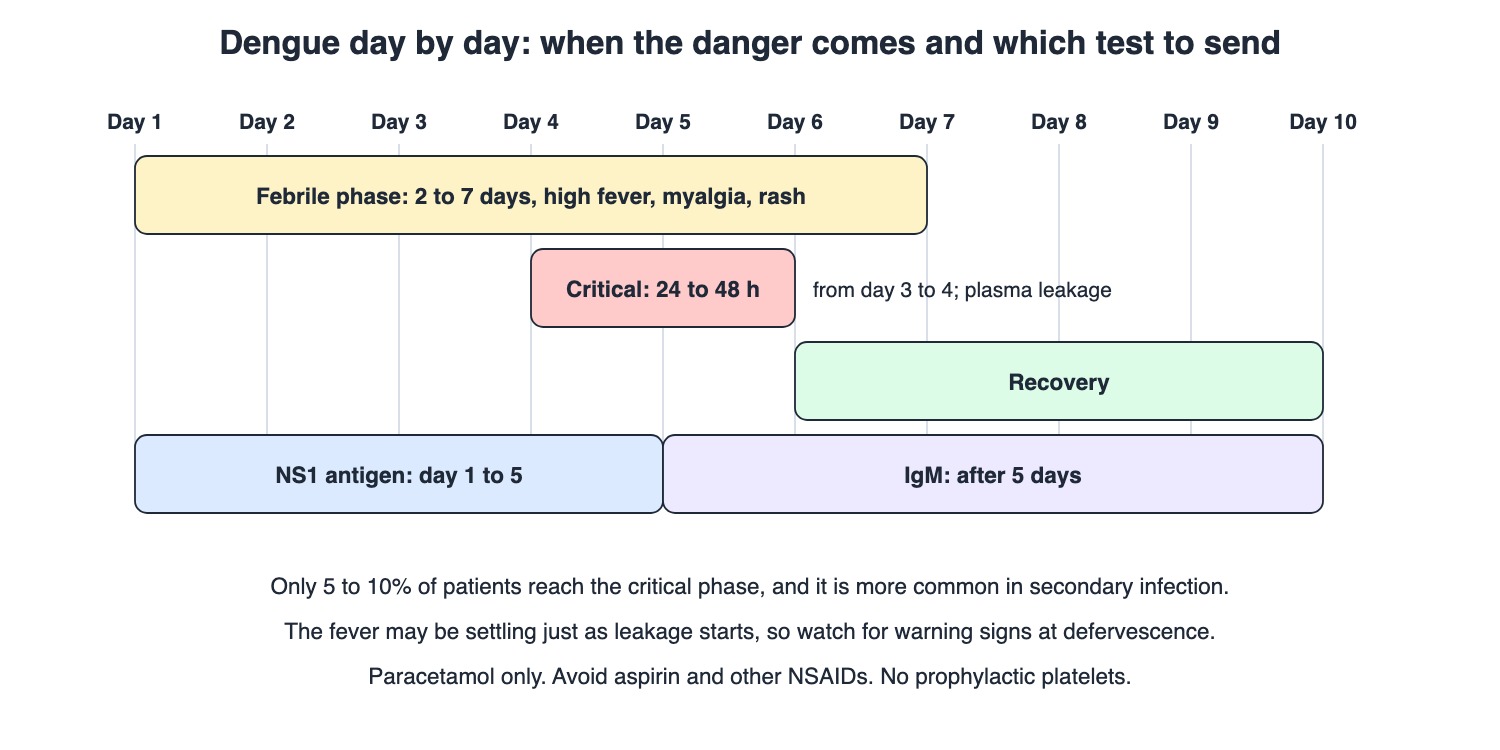
The dangerous window opens as fever settles. NS1 suits the first 5 days and IgM after that.
Virus: four serotypes, DENV-1 to 4. Infection gives only a few months of cross-protection against other serotypes, and a second infection carries the higher risk of severe disease.
Vector: Aedes aegypti, which lays eggs singly on damp surfaces just above the water line.
Clinical description: fever of 2–7 days with two or more of headache, retro-orbital pain, myalgia, arthralgia, rash, bleeding, low platelets or white cells, or warning signs.
Tests: NS1 for day 1–5, IgM after 5 days. A rapid test positive counts only as probable dengue.
Numbers: 2,33,519 cases and 297 deaths in 2024; 1,21,824 cases and 131 deaths in 2025.
Warning signs: persistent vomiting; abdominal pain and tenderness; lethargy or restlessness; bleeding; fainting; ascites or pleural effusion; liver over 2 cm; rising haematocrit with a rapid fall in platelets.
Group | Meaning | Who |
A (mild) | No warning signs | Fever with non-specific symptoms; platelets and haematocrit usually normal |
B (moderate) | Warning signs, or high-risk factors | B1 warning signs; B2 comorbidities and other risks |
C (severe) | Shock, severe bleeding or organ dysfunction | Severe plasma leakage with shock or respiratory distress |
Treatment rules
No specific antiviral. Paracetamol for fever, up to 4 g a day in adults. Avoid aspirin and NSAIDs, and avoid IM injections.
Oral fluids for mild disease; crystalloids are the preferred IV fluid.
No prophylactic platelet transfusion.
Too much or too rapid IV fluid causes overload, so review often.
Chikungunya
First isolated in Tanzania in 1953. An Alphavirus of the family Togaviridae.
Suspected case: acute fever and arthralgia or arthritis, with or without rash.
Confirmed by IgM ELISA, virus isolation, or viral RNA by RT-PCR.
Telling it from dengue: severe, incapacitating joint pain, and severe thrombocytopenia is rare.
Pain relief: paracetamol first. Avoid NSAIDs in pregnancy, and in children in the first 14 days of illness.
Kala-azar
Where: four endemic states: Bihar, Jharkhand, West Bengal and Uttar Pradesh. It is notifiable in all of them.
Incubation: four months to one year in India.
Suspect case: fever over 2 weeks with splenomegaly and hepatomegaly, not responding to antimalarials and antibiotics, in someone from an endemic area.
Tests: rapid diagnostic test for screening. It can stay positive for a long time, so do not use it in someone with past kala-azar.
PKDL: hypopigmented or erythematous macules that may become papular or nodular, especially on the face. Easily mistaken for leprosy. These patients are a reservoir, which is why they matter for elimination.
Elimination target: below 1 case per 10,000 population at block level.
Vector control: indoor residual spraying with synthetic pyrethroid, which replaced DDT from 2015 because of resistance.
Use | Regimen |
Kala-azar, first choice | Liposomal amphotericin B, 10 mg/kg as a single dose |
Next options | Miltefosine for 28 days; amphotericin B 15 alternate-day injections; miltefosine with paromomycin |
PKDL, first choice | Miltefosine 100 mg a day for 12 weeks |
Traps the Examiner Sets
Ivermectin goes by height; DEC goes by age. DEC is not for children under 2, ivermectin not for under 5.
IDA is 2–3 years; DA is 5–6 years.
Dengue: NS1 early, IgM late. Rapid test positive is only probable.
Platelet count alone does not call for platelet transfusion.
Kala-azar elimination is measured at block level, not district level.
First choice differs: kala-azar is liposomal amphotericin B, PKDL is miltefosine.
Memory Hooks & Shortcuts
Shortcuts to lock in this article's numbers and lists. Each one only re-packages facts proven above.
🧠 1-2-3 by age — DEC tablets: 1 for ages 2–5, 2 for ages 6–14, 3 for 15 and above
🧠 Tall for Ivermectin — ivermectin is dosed by height and starts at 90 cm
🧠 IDA is faster: 2–3 versus 5–6 — triple-drug rounds needed compared with DA
🧠 NS1 early, IgM late, split at day 5 — dengue test choice
🧠 Falling fever, rising danger — the critical phase begins as the fever settles
🧠 Spleen plus two weeks — the kala-azar suspect case
🧠 10 once, or 100 for 12 — L-AmB 10 mg/kg once for kala-azar; miltefosine 100 mg for 12 weeks for PKDL
Rapid-Revision Cards
LF burden
345 endemic districts; about 740 million at risk.
LF elimination threshold
Mf rate <1% or antigenaemia <2%; India's target end of 2027.
LF parasite and vector
W. bancrofti (99.4%); Culex quinquefasciatus.
DEC dose by age
2–5 y 100 mg; 6–14 y 200 mg; 15+ y 300 mg.
Albendazole in MDA
400 mg.
Ivermectin dosing
By height, using a dose pole.
DA vs IDA rounds
DA 5–6 years; IDA 2–3 years.
MDA coverage aim
Over 90%, with directly observed consumption.
No DEC under
2 years.
No ivermectin under
5 years or 90 cm.
Lymphoedema care
Wash, treat entry lesions, elevate, exercise, footwear, treat acute attacks.
Dengue serotypes
Four; DENV-1 to 4.
Dengue vector
Aedes aegypti; also Ae. albopictus.
Dengue fever duration
2–7 days.
Dengue critical phase
After day 3–4; lasts 24–48 hours.
Dengue tests
NS1 days 1–5; IgM after day 5.
RDT positive dengue
Probable, not confirmed.
Dengue fever treatment
Paracetamol; avoid aspirin and NSAIDs.
Prophylactic platelets
Not recommended.
Dengue groups
A mild, B warning signs or risk, C severe.
Chikungunya
Alphavirus, Togaviridae; Aedes; disabling joint pain.
Kala-azar vector
Phlebotomus argentipes.
Kala-azar suspect case
Fever >2 weeks with spleen and liver enlargement in an endemic area.
Kala-azar first line
Liposomal amphotericin B 10 mg/kg once.
PKDL first line
Miltefosine 100 mg a day for 12 weeks.
Kala-azar elimination
<1 per 10,000 at block level.
Kala-azar endemic states
Bihar, Jharkhand, West Bengal, Uttar Pradesh.
Sources
Facts in this article were checked against these documents.
Revised Guideline on Elimination of Lymphatic Filariasis — NCVBDC, MoHFW, 2024 (link)
National Guidelines for Clinical Management of Dengue Fever — NCVBDC, MoHFW, 2023 (link)
National Guidelines for Clinical Management of Chikungunya Fever — NCVBDC, MoHFW, 2023 (link)
Dengue cases and deaths in the country, 2021–2026 (provisional to 30 April 2026) — NCVBDC, 2026 (link)
Operational Guidelines on Kala-azar (Visceral Leishmaniasis) Elimination — NVBDCP, MoHFW, 2015 (link)
Operational definitions in the kala-azar elimination programme — NVBDCP, MoHFW, 2021 (link)
Decentralization of procurement of synthetic pyrethroid under the kala-azar programme — NCVBDC, 27 March 2026 (link)
Test Yourself: Practice Questions
Twenty-five questions in NEET PG style.
Practice Questions (NEET PG pattern)
Original questions written in the style of the exam: +4 for a correct answer, −1 for a wrong one. Every answer was checked against the sources listed above. NEET PG papers are not published by NBEMS, so these are not past-paper questions.
Q1. During a filariasis MDA round, a healthy 4-year-old girl 100 cm tall comes for tablets under the IDA regimen. She should receive
(a) DEC and albendazole, but not ivermectin
(b) albendazole alone
(c) all three drugs
(d) no drugs
Show answer
Answer: (a) — Ivermectin is not for children under 5 years or under 90 cm. She is over 2, so DEC and albendazole are given.
Q2. The DEC dose for a 10-year-old in MDA is
(a) 100 mg
(b) 6 mg/kg
(c) 200 mg
(d) 300 mg
Show answer
Answer: (c) — 2–5 years 100 mg, 6–14 years 200 mg, 15 and above 300 mg.
Q3. In the IDA regimen, the dose of ivermectin is decided by
(a) weight measured on a scale
(b) microfilaria count
(c) age
(d) height
Show answer
Answer: (d) — Ivermectin is given by height, using a colour-coded dose pole.
Q4. How many annual rounds of IDA are planned, compared with DA?
(a) 1 year against 3 years
(b) 2–3 years against 5–6 years
(c) 10 years for both
(d) 5–6 years against 2–3 years
Show answer
Answer: (b) — The annual dose is repeated for 5–6 years for DA and 2–3 years for IDA, aiming at over 90% compliance.
Q5. Filariasis ceases to be a public health problem when the microfilaria rate falls below
(a) 0.1%
(b) 10%
(c) 1%
(d) 5%
Show answer
Answer: (c) — Microfilaria rate below 1% or antigenaemia rate below 2%.
Q6. The vector responsible for most lymphatic filariasis in India is
(a) Mansonia annulifera
(b) Culex quinquefasciatus
(c) Aedes aegypti
(d) Anopheles stephensi
Show answer
Answer: (b) — W. bancrofti transmitted by Culex quinquefasciatus accounts for 99.4% of the problem.
Q7. A night blood survey is done for filariasis because
(a) the vector is only active at dawn
(b) microfilariae show nocturnal periodicity
(c) adult worms only feed at night
(d) antigen appears only at night
Show answer
Answer: (b) — Microfilariae exhibit nocturnal periodicity.
Q8. A patient with long-standing lymphoedema asks how to reduce acute attacks. The most useful advice is
(a) lifelong oral antibiotics in every case
(b) bed rest and avoiding footwear
(c) surgical excision of the limb skin
(d) regular washing and care of entry lesions
Show answer
Answer: (d) — Washing, treating entry lesions, elevation, exercise and footwear form the package; bacterial entry drives acute attacks.
Q9. A patient has had dengue-like fever for 2 days. The best test to confirm infection is
(a) IgG ELISA
(b) IgM ELISA
(c) Blood culture
(d) NS1 antigen
Show answer
Answer: (d) — NS1 for samples collected from day 1 to 5, IgM after 5 days.
Q10. A patient has fever for 7 days. Which test is most suitable?
(a) IgM ELISA
(b) Peripheral smear for parasites
(c) NS1 antigen
(d) Widal test
Show answer
Answer: (a) — After day 5, IgM is the recommended test.
Q11. An RDT for dengue NS1 is positive in a febrile patient. Under the guideline this is a
(a) probable case
(b) confirmed case
(c) false positive
(d) suspected case only if IgG is positive
Show answer
Answer: (a) — A positive RDT counts as probable because of poor sensitivity and specificity of current RDTs.
Q12. A dengue patient's fever settled on day 4, but she now has persistent vomiting, abdominal tenderness and a rising haematocrit with falling platelets. This is
(a) dengue with warning signs (Group B)
(b) recovery phase
(c) severe dengue with shock (Group C)
(d) dengue without warning signs (Group A)
Show answer
Answer: (a) — These are warning signs of the critical phase. There is no shock, severe bleeding or organ dysfunction yet.
Q13. The critical phase of dengue usually starts
(a) only after the fever returns
(b) after 2 weeks
(c) after the 3rd or 4th day of fever and lasts 24 to 48 hours
(d) on day 1 and lasts 7 days
Show answer
Answer: (c) — It begins after the 3rd or 4th day of fever and may last about 24 to 48 hours.
Q14. A man with dengue has a platelet count of 18,000/mm³, no bleeding and stable vitals. The next step is
(a) continue monitoring without platelet transfusion
(b) give a prophylactic platelet transfusion
(c) give IM vitamin K
(d) give fresh frozen plasma
Show answer
Answer: (a) — Platelet transfusion is not recommended for thrombocytopenia as prophylaxis.
Q15. Which drug should be avoided for fever in dengue?
(a) Ibuprofen
(b) Ondansetron
(c) Paracetamol
(d) Oral rehydration solution
Show answer
Answer: (a) — Aspirin and NSAIDs must be avoided because of the risk of mucosal bleeds; use paracetamol.
Q16. Severe dengue includes all EXCEPT
(a) shock from plasma leakage
(b) severe bleeding
(c) leucopenia alone
(d) severe organ dysfunction
Show answer
Answer: (c) — Severe dengue means severe plasma leakage, severe bleeding or organ dysfunction. Leucopenia is common in mild disease.
Q17. Dengue serotypes are
(a) two
(b) six
(c) four: DENV-1 to DENV-4
(d) one with many subtypes only
Show answer
Answer: (c) — DENV-1, 2, 3 and 4. Immunity gives cross-protection for only a few months.
Q18. A patient has fever with severe, disabling joint pain in both wrists and ankles. Platelets are normal. The likely infection, spread by Aedes, is
(a) Japanese encephalitis
(b) chikungunya
(c) kala-azar
(d) dengue haemorrhagic fever
Show answer
Answer: (b) — Incapacitating arthralgia marks chikungunya; severe thrombocytopenia is rare.
Q19. Chikungunya virus belongs to the family
(a) Bunyaviridae
(b) Togaviridae
(c) Flaviviridae
(d) Reoviridae
Show answer
Answer: (b) — Genus Alphavirus, family Togaviridae.
Q20. A patient from Bihar has fever for 4 weeks, splenomegaly and hepatomegaly, not responding to antimalarials or antibiotics. The most likely diagnosis is
(a) typhoid
(b) chikungunya
(c) kala-azar
(d) dengue
Show answer
Answer: (c) — This fits the suspect case definition: fever over 2 weeks with splenomegaly and hepatomegaly in an endemic area.
Q21. The first drug of choice for kala-azar in India is
(a) miltefosine for 12 weeks
(b) sodium stibogluconate for 30 days
(c) pentamidine
(d) liposomal amphotericin B, 10 mg/kg single dose
Show answer
Answer: (d) — Single-dose liposomal amphotericin B is first choice; miltefosine for 28 days follows.
Q22. The first drug of choice for PKDL is
(a) liposomal amphotericin B, single dose
(b) miltefosine 100 mg daily for 12 weeks
(c) chloroquine
(d) dapsone
Show answer
Answer: (b) — Miltefosine 100 mg orally per day for 12 weeks.
Q23. Kala-azar elimination is defined as an annual incidence of less than
(a) 10 cases per lakh at state level
(b) 1 case per 1,000 at district level
(c) 1 case per 10,000 population at block level
(d) zero cases nationally
Show answer
Answer: (c) — Below one case per 10,000 population at block level.
Q24. A man treated for kala-azar 2 years ago now has fever and splenomegaly. Why is the rapid test unhelpful?
(a) It cannot be used in men
(b) It may remain positive for a long time
(c) It only detects PKDL
(d) It works only in children
Show answer
Answer: (b) — In suspected cases with past kala-azar, the RDT should not be used; it may remain positive for a long period.
Q25. Why does the programme search actively for PKDL cases?
(a) They need ICU care
(b) They spread by droplets
(c) They are a reservoir for transmission
(d) They are highly fatal
Show answer
Answer: (c) — PKDL cases serve as a reservoir for disease transmission during the inter-epidemic period.
Active Recall
From memory: give the MDA drugs, doses and exclusions for filariasis and the elimination threshold; the dengue phases, warning signs, test timing and treatment rules; what sets chikungunya apart; and the kala-azar suspect case, treatment, PKDL treatment and elimination target.