HIV and NACP for NEET PG PSM: India's Epidemic 2025, 95-95-95, TLD, PEP, Vertical Transmission and the HIV Act
Start Here
🎯 Exam priority: Medium–high. Expect a needlestick scenario, the first-line regimen, infant prophylaxis, and one current number. The epidemic figures here are from the 2025 estimation round.
CBME mapping: CM 8 (epidemiology of communicable diseases and national programmes).
India's Epidemic
Indicator (2024) | Value |
People living with HIV (PLHIV) | 25.61 lakh, second largest number in the world |
Adult prevalence (15–49 years) | 0.20% (male 0.21%, female 0.19%) |
Incidence | 0.05 per 1,000 uninfected population |
New infections, 2010 to 2024 | Down 48.70% |
AIDS-related deaths, 2010 to 2024 | Down 81.40% |
Vertical transmission rate | 10.25% (target below 5%) |
Highest PLHIV number | Maharashtra 3.99 lakh, then Andhra Pradesh 3.10 lakh |
Prevalence above 1% | Mizoram and Nagaland |
Highest incidence | Mizoram (0.90 per 1,000) |
India has a concentrated epidemic: prevalence is far higher in key populations than in adults overall.
Group | Sero-prevalence (2024) |
People who inject drugs | 8.79% (highest) |
Hijra/transgender persons | 2.84% |
Men who have sex with men | 2.12% |
In 2024-25, 73% of newly detected people reported heterosexual transmission. The subtype that predominates in India is HIV-1 subtype C.
These figures are model-based, using the UNAIDS-recommended Spectrum tool, so each comes with an uncertainty range.
NACP and 95-95-95
NACP Phase V ran from 1 April 2021 to 31 March 2026 as a central sector scheme. It aims to cut new infections and AIDS-related deaths by 80% from the 2010 baseline, reach universal STI services, eliminate vertical transmission of HIV and syphilis, and end stigma. SDG 3.3 aims to end AIDS as a public health threat by 2030.
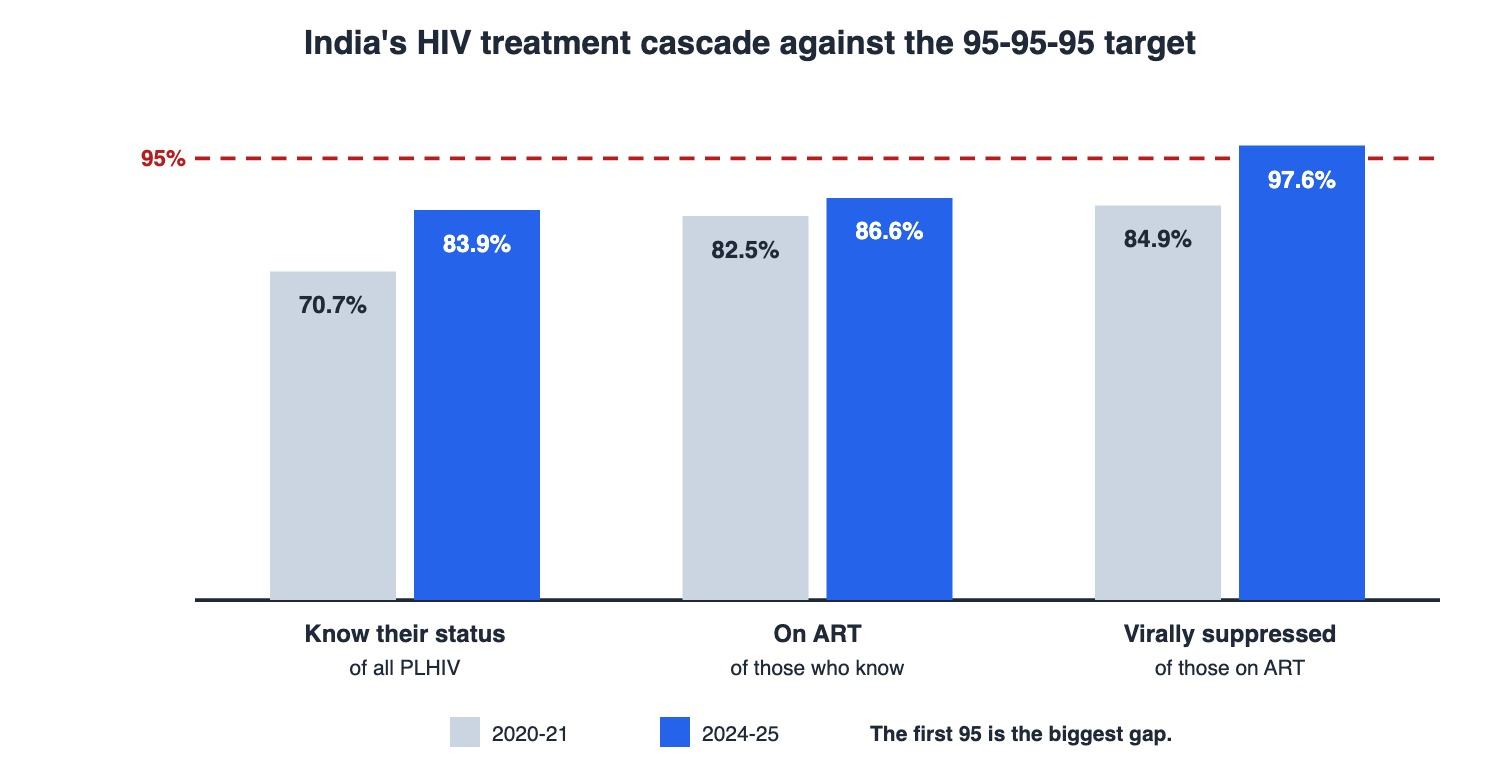
95% of PLHIV should know their status, 95% of those on ART, and 95% of those virally suppressed. India's gap is largest at the first 95.
ART access: 18.60 lakh people on ART in March 2025, through about 800 ART centres.
Index testing: offering testing to spouses, biological children and partners of people with HIV.
Sampoorna Suraksha: prevention services for at-risk people who test negative.
Helpline: 1097.
Testing
Testing is voluntary, with pre-test and post-test counselling and informed consent. A person can opt out without losing other services.
Strategy III, used for the general population, runs three different assays. A1 has high sensitivity; A2 and A3 have high specificity.
A person is reported negative if the first test is non-reactive, and positive only when all three are reactive.
The window period is the time between infection and when a test can detect it, so a negative test may need repeating.
Infants under 18 months: maternal antibodies persist, so diagnosis uses a nucleic acid test, first at 6 weeks.
Treatment
Treat All: everyone with HIV starts ART, regardless of clinical stage or CD4 count (national programme since 2017).
Rapid initiation: within 7 days of diagnosis, preferably the same day, unless an active opportunistic infection needs treating first.
First line (age over 10 years, weight over 30 kg): TLD, meaning tenofovir 300 mg + lamivudine 300 mg + dolutegravir 50 mg, one fixed-dose tablet once daily.
Monitoring: viral load at 6 months, 12 months, then every 12 months.
Suppression: below 1,000 copies/ml after at least 6 months on ART. Virological failure: two consecutive values of 1,000 copies/ml or more.
HIV with TB: start ART within 2 weeks of starting TB treatment, regardless of CD4. With TB meningitis, delay ART at least 4 weeks. Give cotrimoxazole to all.
Opportunistic Infections
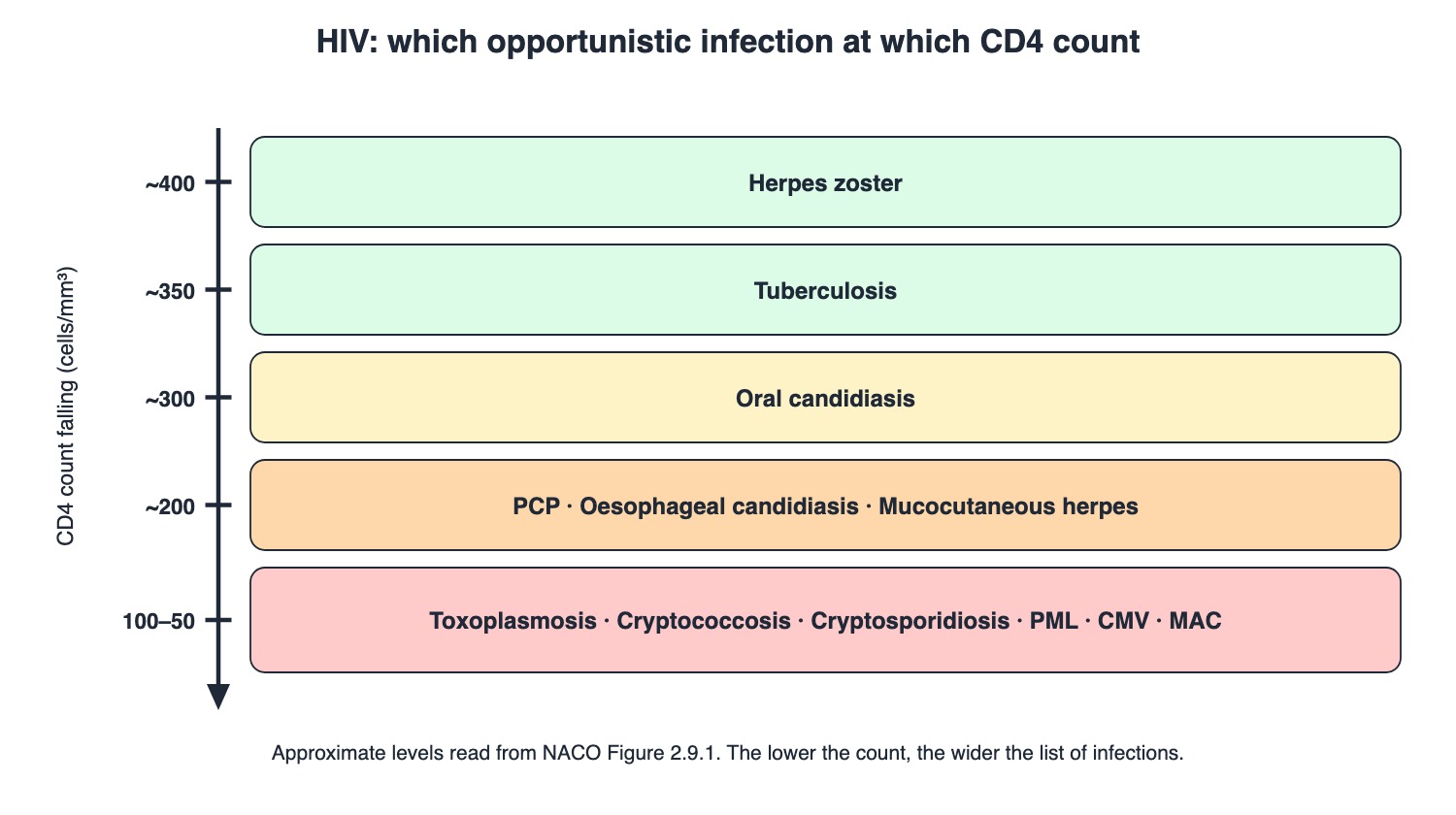
NACO's sequence: as CD4 falls, the list of infections widens. Levels are approximate.
Cotrimoxazole prophylaxis starts at CD4 below 350 cells/mm³ or WHO clinical stage 3 or 4. Start it first, then ART.
Needlestick: Post-Exposure Prophylaxis
Step | What to know |
Timing | First dose ideally within 2 hours, preferably within 72 hours; do not wait for the source's result |
Duration | 28 days |
Adult regimen | TLD, one tablet once daily (over 10 years and over 30 kg) |
Alternative | Tenofovir + lamivudine with lopinavir/ritonavir, or tenofovir + lamivudine + efavirenz |
Risk | Average seroconversion after percutaneous exposure: 0.3% |
Who gets it under NACP | All occupational exposures and victims of sexual assault, not unprotected sex or other high-risk exposure |
Follow-up | HIV test at 6 weeks, 3 months and 6 months |
Grading the exposure
Category | Example |
Mild | Small volume on a mucous membrane or non-intact skin; subcutaneous injection with a small-bore needle |
Moderate | Large volume on a mucous membrane; superficial cut or needlestick with a solid needle |
Severe | Large-volume percutaneous exposure: high-calibre needle (>18 G) visibly contaminated with blood, a deep wound, or material used in a vein or artery |
Never recap a needle. Testing the source must not delay the first dose: start PEP, then seek advice.
Vertical Transmission (EVTHS)
India now aims for dual elimination of HIV and syphilis. Every pregnant or breastfeeding woman with HIV starts triple-drug ART, regardless of CD4 count and stage, and continues for life. Syphilis in pregnancy is treated with injection benzathine penicillin G.
A viral load between 32 and 36 weeks sets the infant's risk:
Infant risk | When | Prophylaxis | Duration |
Low | Mother's viral load suppressed (below 1,000 copies/ml) any time after 32 weeks | Syrup nevirapine | Birth to 6 weeks |
High | Mother not on ART; viral load not done or not suppressed after 32 weeks; mother newly diagnosed within 6 weeks of delivery | Syrup nevirapine + syrup zidovudine | 6 weeks if replacement fed; 12 weeks if breastfed |
All HIV-exposed infants get cotrimoxazole from 6 weeks, until HIV is reliably excluded.
Early infant diagnosis is at 6 weeks of age or the earliest opportunity.
STI Kits Under NACP
NACP treats STIs by syndromic case management using pre-packaged, colour-coded kits. The 2024 national guidelines list eight kits:
Kit | Contents | Syndrome |
1 Grey | Azithromycin 1 g + cefixime 800 mg, single dose | Urethral discharge, cervicitis, painful scrotal swelling |
2 Green | Secnidazole 2 g + fluconazole 150 mg, single dose | Vaginitis |
3 White | Benzathine penicillin G 2.4 MU + azithromycin 1 g | Genital ulcer: syphilis and chancroid |
4 Blue | Doxycycline for 14 days + azithromycin 1 g | As kit 3, when penicillin is unavailable or the patient is allergic |
5 Red | Acyclovir 400 mg three times a day for 7 days | Genital ulcer: herpes |
6 Yellow | Cefixime 800 mg + metronidazole and doxycycline for 14 days | Lower abdominal pain, PID |
7 Black | Doxycycline for 21 days | Inguinal bubo; LGV proctitis |
8 Brown | Cefixime 800 mg + doxycycline for 7 days | Anorectal discharge |
The HIV and AIDS Act 2017
Discrimination is prohibited, including in employment, health care and education (section 3).
No test or treatment without informed consent (section 5), and consent includes pre-test and post-test counselling. A court order is one exception.
Complaints Officer in establishments of 100 or more persons, and 20 or more in health care.
Ombudsman: every state government must appoint one or more.
Establishments where workers may be exposed must provide universal precautions.
Traps the Examiner Sets
Prevalence is low (0.20%), but the absolute number is the world's second largest.
Highest prevalence: Mizoram and Nagaland. Highest number: Maharashtra. Do not swap them.
Highest in key populations: people who inject drugs, not sex workers or MSM.
PEP is 28 days. Do not wait for the source's test before giving it.
A high-risk breastfed infant gets 12 weeks of dual prophylaxis, not 6.
Complaints Officer threshold: 100 generally, 20 in health care.
Memory Hooks & Shortcuts
Shortcuts to lock in this article's numbers and lists. Each one only re-packages facts proven above.
🧠 25-20 — 25.61 lakh people, 0.20% prevalence
🧠 Know, Take, Suppress — the three 95s in order
🧠 2-72-28 — PEP: ideally 2 hours, within 72 hours, for 28 days
🧠 TLD = one pill for all — first-line ART, and PEP in adults
🧠 6-12-then yearly — viral load schedule
🧠 Breast doubles it — high-risk infant: 6 weeks with replacement feeds, 12 with breastfeeding
🧠 100, but 20 in hospitals — Complaints Officer threshold
Rapid-Revision Cards
PLHIV in India, 2024
25.61 lakh; second largest number globally.
Adult prevalence, 2024
0.20% (male 0.21%, female 0.19%).
Prevalence above 1%
Mizoram and Nagaland.
Most PLHIV
Maharashtra 3.99 lakh, then Andhra Pradesh 3.10 lakh.
New infections 2010–24
Down 48.70%.
AIDS deaths 2010–24
Down 81.40%.
Vertical transmission rate 2024
10.25%; target below 5%.
Highest key population
People who inject drugs, 8.79%.
95-95-95 in 2024-25
83.9–86.6–97.6.
NACP-V goal
80% fewer new infections and AIDS deaths than 2010.
Treat All
ART regardless of stage or CD4, since 2017.
Rapid ART
Within 7 days, preferably same day.
First-line ART
TLD: tenofovir + lamivudine + dolutegravir, once daily.
Viral load schedule
6 months, 12 months, then every 12 months.
Virological failure
Two consecutive values ≥1,000 copies/ml.
ART with TB
Within 2 weeks of TB treatment; delay ≥4 weeks in TB meningitis.
Cotrimoxazole start
CD4 <350 or WHO stage 3–4.
OIs around CD4 200
PCP, oesophageal candidiasis, mucocutaneous herpes.
PEP timing
Ideally within 2 hours, preferably within 72 hours; 28 days.
PEP regimen
TLD once daily in adults.
Percutaneous HIV risk
0.3%.
Infant prophylaxis, low risk
Syrup nevirapine, birth to 6 weeks.
Infant prophylaxis, high risk
Nevirapine + zidovudine: 6 weeks ERF, 12 weeks EBF.
Exposed infant at 6 weeks
Cotrimoxazole + early infant diagnosis.
Strategy III
Three assays; A1 sensitive, A2 and A3 specific; positive only if all three reactive.
STI kits under NACP
Eight colour-coded kits: grey, green, white, blue, red, yellow, black, brown.
Kit for PID
Kit 6, yellow.
Kit for herpetic ulcer
Kit 5, red, acyclovir.
HIV Act 2017
Consent; no discrimination; Complaints Officer at 100 (20 in health care); state Ombudsman.
Sources
Facts in this article were checked against these documents.
India HIV Estimation 2025: Technical Report — NACO and ICMR-NIRDHDS, 2025 (link)
Sankalak: Status of National AIDS & STD Response, Seventh Edition — NACO, 2025 (link)
National Guidelines for HIV Care and Treatment — NACO, MoHFW, 2021 (link)
National Guidelines for Elimination of Vertical Transmission of HIV and Syphilis — NACO, MoHFW, 2024 (link)
National HIV Counselling and Testing Services Guidelines — NACO, MoHFW, 2024 (link)
National Technical Guidelines on Sexually Transmitted Infections and Reproductive Tract Infections — NACO, MoHFW, 2024 (link)
The HIV and AIDS (Prevention and Control) Act, 2017 (No. 16 of 2017) — Gazette of India, 2017 (link)
Test Yourself: Practice Questions
Twenty-six questions in NEET PG style.
Practice Questions (NEET PG pattern)
Original questions written in the style of the exam: +4 for a correct answer, −1 for a wrong one. Every answer was checked against the sources listed above. NEET PG papers are not published by NBEMS, so these are not past-paper questions.
Q1. A nurse has a deep needlestick from a large-bore needle used on an HIV-positive patient. The most appropriate immediate step is to
(a) wait for the source's viral load before deciding
(b) start PEP at once, without waiting for the source's test results
(c) give hepatitis B immunoglobulin alone
(d) test the nurse and start PEP only if positive
Show answer
Answer: (b) — First dose ideally within 2 hours. HIV testing of the source must not delay the decision to start PEP.
Q2. The duration of HIV post-exposure prophylaxis is
(a) 3 months
(b) 28 days
(c) 14 days
(d) 7 days
Show answer
Answer: (b) — PEP continues for 28 days.
Q3. The preferred adult PEP regimen under NACO is
(a) zidovudine + lamivudine + nevirapine
(b) tenofovir + lamivudine + dolutegravir
(c) tenofovir + emtricitabine alone
(d) stavudine + lamivudine + efavirenz
Show answer
Answer: (b) — One fixed-dose tablet of TLD once daily for adolescents and adults over 10 years and over 30 kg.
Q4. The average risk of HIV seroconversion after a percutaneous exposure is
(a) 0.03%
(b) 30%
(c) 0.3%
(d) 3%
Show answer
Answer: (c) — NACO quotes 0.3%; the real risk depends on the amount of virus transmitted.
Q5. A doctor has a superficial cut from a solid needle. Under NACO's categories this exposure is
(a) moderate
(b) not an exposure
(c) severe
(d) mild
Show answer
Answer: (a) — Moderate includes a superficial cut or needlestick with a solid needle. Severe involves a large-volume percutaneous exposure.
Q6. NACP provides PEP for
(a) only source-positive exposures
(b) any high-risk sexual exposure
(c) occupational exposures and victims of sexual assault
(d) only health workers
Show answer
Answer: (c) — NACP covers all occupational exposures and victims of sexual assault, not unprotected sexual behaviour or other high-risk exposure.
Q7. A 30-year-old is newly diagnosed with HIV. CD4 is 620 cells/mm³ and she is well. The correct action is to
(a) start only after a WHO stage 3 illness
(b) wait until CD4 is below 200
(c) start ART now, preferably the same day
(d) wait until CD4 is below 350
Show answer
Answer: (c) — Treat All: ART regardless of clinical stage or CD4 count, ideally same-day or within 7 days.
Q8. The preferred first-line ART regimen for adults in India is
(a) zidovudine + lamivudine + efavirenz
(b) tenofovir + lamivudine + dolutegravir
(c) lopinavir/ritonavir monotherapy
(d) tenofovir + lamivudine + nevirapine
Show answer
Answer: (b) — TLD as a single fixed-dose tablet once a day for those over 10 years and over 30 kg.
Q9. A patient on first-line ART had a viral load 6 months after starting. When is the next routine viral load?
(a) At 7 months
(b) At 12 months
(c) At 24 months
(d) Only if symptomatic
Show answer
Answer: (b) — Viral load is done at 6 months, 12 months, and then every 12 months.
Q10. Virological failure in the national programme is defined as
(a) CD4 below 200
(b) any new opportunistic infection
(c) a single viral load above 50 copies/ml
(d) two consecutive viral loads of 1,000 copies/ml or more
Show answer
Answer: (d) — Two consecutive HIV-1 viral load values of 1,000 copies/ml or more, after 6 months on ART.
Q11. A man with HIV and pulmonary TB has just started TB treatment. ART should begin
(a) after TB treatment ends
(b) within 2 weeks, regardless of CD4
(c) only if CD4 is below 200
(d) after the intensive phase
Show answer
Answer: (b) — ART as soon as possible within two weeks of starting TB treatment, except in TB meningitis, where it is delayed at least 4 weeks.
Q12. A man with HIV has TB meningitis. ART should be
(a) delayed at least 4 weeks
(b) never started
(c) started the same day
(d) started within 2 weeks
Show answer
Answer: (a) — Among PLHIV with TB meningitis, ART should be delayed at least 4 weeks.
Q13. Cotrimoxazole prophylaxis in adults under NACO starts at a CD4 count below
(a) 100 cells/mm³
(b) 350 cells/mm³
(c) 200 cells/mm³
(d) 500 cells/mm³
Show answer
Answer: (b) — CD4 below 350 cells/mm³, or WHO clinical stage 3 or 4.
Q14. A breastfed infant is born to a mother whose viral load was not suppressed after 32 weeks. The infant needs
(a) syrup nevirapine alone for 6 weeks
(b) syrup zidovudine alone for 28 days
(c) no prophylaxis
(d) syrup nevirapine plus zidovudine for 12 weeks
Show answer
Answer: (d) — High-risk infant: dual prophylaxis; 12 weeks with breastfeeding, 6 weeks with replacement feeding.
Q15. An infant's mother had a suppressed viral load at 34 weeks. The prophylaxis is
(a) syrup nevirapine from birth till 6 weeks
(b) syrup nevirapine plus zidovudine for 12 weeks
(c) none
(d) syrup zidovudine for 28 days
Show answer
Answer: (a) — Low-risk infants get single-drug prophylaxis from birth till 6 weeks.
Q16. An HIV-exposed infant comes for the 6-week visit. Which is correct?
(a) Start cotrimoxazole and do early infant diagnosis
(b) Antibody test at 6 weeks confirms infection
(c) Stop routine vaccines
(d) Wait until 18 months to test
Show answer
Answer: (a) — All exposed infants get cotrimoxazole at 6 weeks; the nucleic acid test is done at 6 weeks or at the earliest opportunity.
Q17. In HIV testing Strategy III, the first assay should have
(a) high sensitivity
(b) high specificity
(c) the longest window period
(d) low cost only
Show answer
Answer: (a) — A1 is highly sensitive; A2 and A3 are highly specific.
Q18. Under Strategy III, a person is reported HIV-positive when
(a) the fourth-generation test is reactive
(b) the first test is reactive
(c) any two tests are reactive
(d) all three tests are reactive
Show answer
Answer: (d) — HIV-positive when all three tests show reactive results.
Q19. According to the 2025 estimates, adult HIV prevalence in India is
(a) 0.50%
(b) 2.0%
(c) 0.20%
(d) 0.02%
Show answer
Answer: (c) — 0.20% in 2024 (uncertainty bound 0.17–0.24), with 25.61 lakh PLHIV.
Q20. The state with the largest estimated number of PLHIV is
(a) Andhra Pradesh
(b) Mizoram
(c) Maharashtra
(d) Uttar Pradesh
Show answer
Answer: (c) — Maharashtra 3.99 lakh, then Andhra Pradesh 3.10 lakh. Mizoram has very high prevalence, not the largest number.
Q21. Among key populations in India, HIV sero-prevalence is highest in
(a) hijra/transgender persons
(b) men who have sex with men
(c) people who inject drugs
(d) truckers
Show answer
Answer: (c) — People who inject drugs: 8.79%, ahead of H/TG persons (2.84%) and MSM (2.12%).
Q22. India's progress on 95-95-95 in 2024-25 was
(a) 83.9%-86.6%-97.6%
(b) 70.7%-82.5%-84.9%
(c) 95%-95%-95%
(d) 60%-70%-80%
Show answer
Answer: (a) — Up from 70.7-82.5-84.9 in 2020-21. The first 95, knowing one's status, is the biggest gap.
Q23. A hospital with 40 employees must, under the HIV and AIDS Act 2017, have a
(a) National AIDS Tribunal
(b) Blood Bank Officer
(c) Complaints Officer
(d) State Ombudsman
Show answer
Answer: (c) — The Complaints Officer requirement applies at 100 or more persons, but at 20 or more in health care establishments.
Q24. A hospital tests a patient for HIV before surgery without telling him. Under the HIV and AIDS Act 2017 this is
(a) allowed for any planned surgery
(b) the surgeon's choice
(c) a breach of the informed consent requirement
(d) allowed if the result is kept secret
Show answer
Answer: (c) — No HIV test shall be performed without informed consent, which includes pre-test and post-test counselling.
Q25. A woman has lower abdominal pain and pelvic inflammatory disease. Under NACP's colour-coded STI kits she receives
(a) Kit 2 (green)
(b) Kit 5 (red)
(c) Kit 1 (grey)
(d) Kit 6 (yellow)
Show answer
Answer: (d) — Kit 6 contains cefixime, metronidazole and doxycycline for lower abdominal pain and PID.
Q26. A man has a painful genital ulcer with grouped vesicles, suggesting herpes. The NACP kit is
(a) Kit 5 (red), acyclovir
(b) Kit 7 (black), doxycycline
(c) Kit 3 (white), benzathine penicillin
(d) Kit 1 (grey), azithromycin and cefixime
Show answer
Answer: (a) — Kit 5 contains acyclovir for herpetic ulcers; kit 3 is for syphilis and chancroid.
Active Recall
From memory: state India's HIV burden, the highest-prevalence group and the 95-95-95 progress; the rule for starting ART and the first-line regimen; the viral load schedule; how to manage a needlestick; how to choose infant prophylaxis; and the main duties under the HIV and AIDS Act 2017.