GS I Model Answers: Princely States (2021) and Linguistic Reorganisation (2026), with Notes on Why Each Part Scores
GS I Model Answer 1: Integrating the Princely States
🎯 Exam priority: High-yield. Read each model answer twice: once for the content, once for the shape. The shape is what you will reuse.
Answer 1: GS I 2021, Question 3 (10 marks, 150 words)
📝 Question: Assess the main administrative issues and socio-cultural problems in the integration process of Indian Princely States.
Plan (30 seconds): two demands, administrative and socio-cultural, plus 'assess', which needs a judgment at the end.
⏱️ 7-minute plan: 1 min to read and number the demands, 4½ min to write, ½ min for the sketch, 1 min to check that every demand is answered.
The model answer
When British paramountcy lapsed in 1947, about 565 princely states were to become legally independent, and the choice to join India or Pakistan lay with their rulers, not their people.
Administrative issues
Rulers' ambitions: Travancore announced independence; the Nawab of Bhopal resisted joining the Constituent Assembly.
Hard cases: Junagadh (settled by plebiscite), Hyderabad (Standstill Agreement, then army action in September 1948), Kashmir and Manipur (Merger Agreement, September 1949).
Fragmentation: Saurashtra alone had 14 big and 119 small states to be merged into viable units.
✏️ Draw this here in your answer (about 30 seconds): it replaces the list of hard cases and shows the scale at a glance.
Socio-cultural problems
The Nizam's Razakars turned integration into communal violence.
Distinct regional identities needed reassurance, so the government offered autonomy to some regions.
Overall, Sardar Patel's mix of persuasion through the Instrument of Accession and firmness, helped by people's wish to join India, made integration largely peaceful.
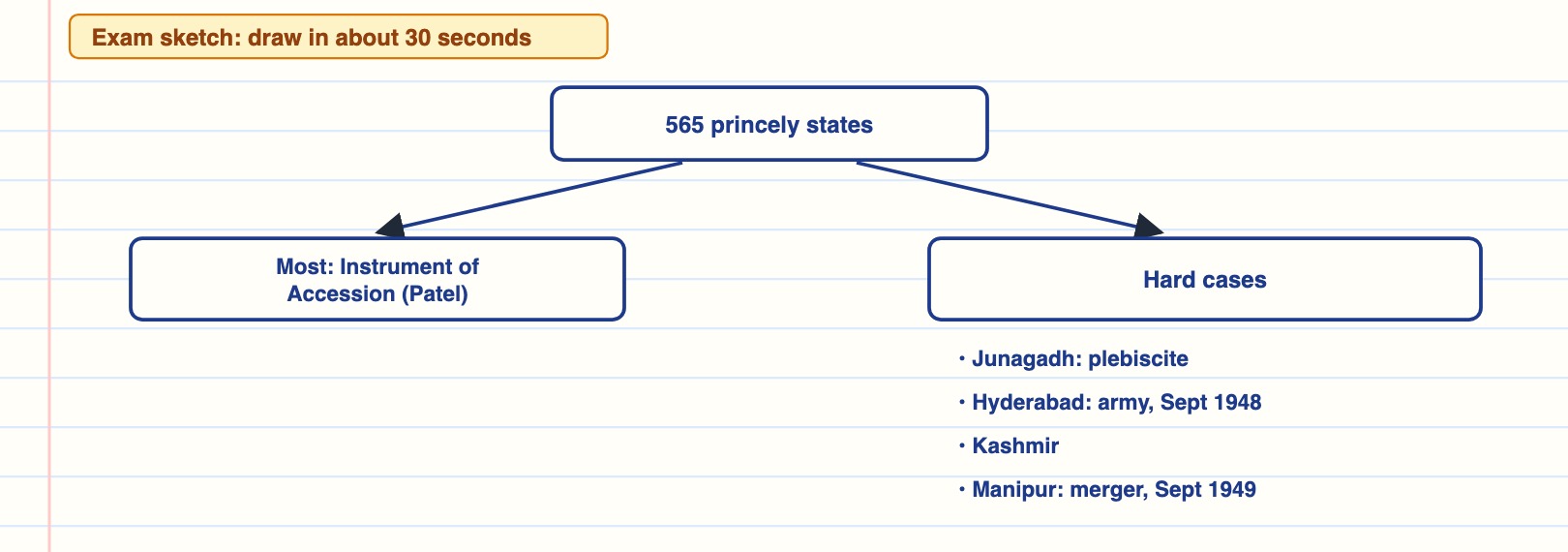
131 words. Staying a little under the limit is fine; the marks are in covering every demand.
Why it scores
Part | What it does |
Opening | One fact (565 states) and the core problem (rulers decide) in two lines |
Two headings | Mirror the two demands exactly, so the examiner can tick both |
Named cases | Junagadh, Hyderabad, Kashmir, Manipur, with one detail each: depth in few words |
One number | Saurashtra's 14 + 119 states shows the administrative scale |
Closing judgment | 'Assess' is answered: largely peaceful, and why |
A weaker version narrates Hyderabad for 100 words and never reaches the socio-cultural side. It answers half the question.
GS I Model Answer 2: Linguistic Reorganisation
Answer 2: GS I 2026, Question 12 (15 marks, 250 words)
📝 Question: Linguistic reorganization of Indian States was driven by popular pressure from below. Comment.
Plan: 'Comment' on a claim, so agree where it holds, qualify where it does not, and give a view. Budget: introduction 35, evidence for 'from below' 90, qualifications 80, conclusion 40.
⏱️ 11-minute plan: 1 min to plan, 8 min to write, 1 min for the sketch, 1 min to check every demand.
The model answer
Colonial provinces were drawn for administrative convenience. The Congress had accepted linguistic units for its own organisation after the Nagpur session of 1920, but after Partition its leaders feared that language-based states could cause disintegration and postponed the question.
Where pressure from below was decisive
Andhra: the Vishalandhra movement and Potti Sriramulu's fast, which ended in his death after 56 days, forced the announcement of Andhra state in December 1952.
This led to the States Reorganisation Commission (1953) and the States Reorganisation Act, 1956: 14 states and six union territories.
Popular agitations later produced Maharashtra and Gujarat (1960) and Punjab's statehood (1966).
NCERT's own verdict: people agitated "against the wishes of the leaders", and the leadership chose linguistic states "under popular pressure".
✏️ Draw this here in your answer (about 30 seconds): a dated timeline with the two forces the 'comment' turns on.
Where the claim needs qualifying
The decision was made from above, through a commission and an Act of Parliament, and drawn so that diversity was reflected without harming unity.
Language did not stay the only basis: the north-eastern states and the three states of 2000 (Chhattisgarh, Uttarakhand, Jharkhand) rested on ethnic, tribal and regional grounds.
The claim is largely true about the trigger, but the outcome came from democratic accommodation. Far from causing disintegration, it strengthened national unity and opened politics to people beyond a small English-speaking elite.
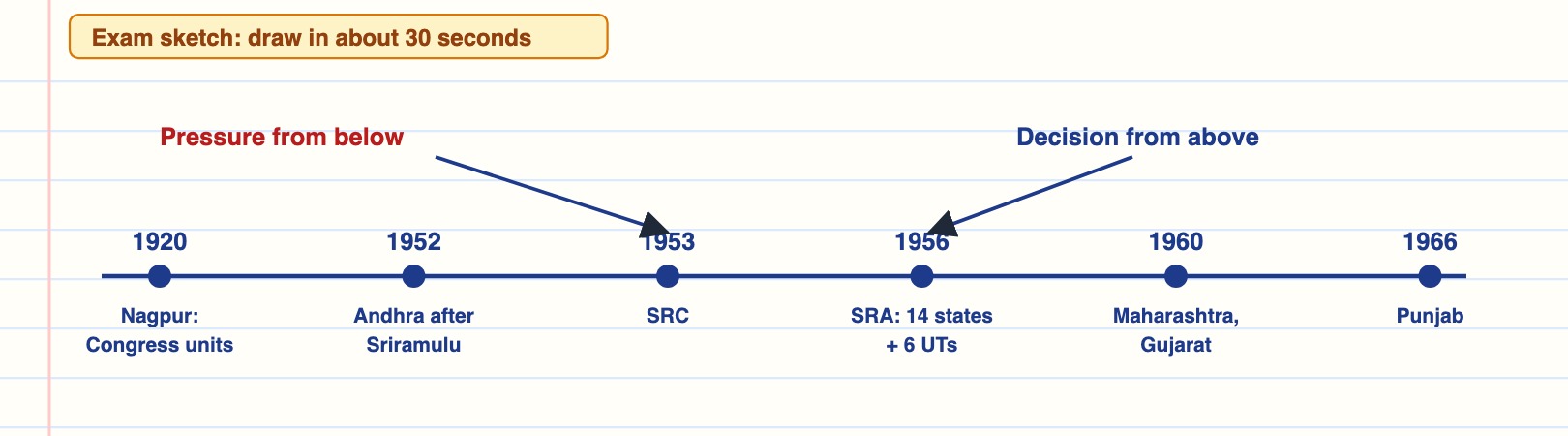
215 words, leaving time to draw a quick timeline (1920 → 1952 → 1953 → 1956 → 1960 → 1966 → 2000) if you are ahead of time.
Why it scores
Part | What it does |
Introduction | Gives the background the claim reacts to: leaders' fear and postponement |
'Where it was decisive' | Agrees with dated evidence: 1952, 1953, 1956, 1960, 1966 |
'Where it needs qualifying' | Shows the other side: the state's role and other bases for states |
Source named | Quoting NCERT's verdict adds authority in a few words |
Conclusion | Takes a clear view (true about the trigger) and links to national unity today |
A weaker version retells the Andhra story and ends "thus it was driven from below", with no qualification. A 'comment' answer without a counterpoint usually stays in the middle band.
What to Reuse, and Your Turn
What to reuse from these two answers
Headings that copy the question's own demands ("Administrative issues", "Socio-cultural problems").
One detail per example. "Hyderabad: Standstill Agreement, army action September 1948" says more than a paragraph of narrative.
Dates as evidence, not as a list. Each date supports a point.
A sourced verdict. In history questions, the NCERT's or a historian's judgment, briefly quoted, carries weight.
An ending that answers the directive: 'assess' gets an assessment; 'comment' gets a view.
Your turn
Write these in the time limits, then compare with the models above and with the subject articles:
GS I 2025: "Trace India's consolidation process during early phase of independence in terms of polity, economy, education and international relations." (Post-independence playlist, articles 01, 03, 04 and 05.)
GS I 2026: "The model of planned economy was adopted in India to address the regional imbalances left behind by colonial rule. Comment." (Post-independence article 04.)
Further Reading
PIB press releases, ministry websites and annual reports, the Gazette of India, MEA and UN documents and the official sources named in each note — the primary sources behind every fact above.
Test Yourself: Practice Questions & PYQs
12 questions on the two model answers, then the real questions to practise.
Practice Questions
Q1. About how many princely states were to become legally independent in 1947?
(a) 345
(b) 29
(c) 565
(d) 118
Show answer
Answer: (c) — NCERT gives 565.
Q2. Under the lapse of paramountcy, who decided whether a princely state would join India or Pakistan?
(a) The ruler
(b) The Constituent Assembly
(c) A plebiscite in every state
(d) The British Crown
Show answer
Answer: (a) — The choice was left to rulers, not people.
Q3. How was the Junagadh issue resolved?
(a) A plebiscite
(b) A Standstill Agreement
(c) A Merger Agreement
(d) Army action in September 1948
Show answer
Answer: (a) — The plebiscite confirmed the people's wish to join India.
Q4. When did the Indian army move against the Nizam's forces?
(a) August 1947
(b) December 1952
(c) September 1948
(d) January 1950
Show answer
Answer: (c) — After the Standstill Agreement of November 1947.
Q5. Saurashtra had how many big and small states?
(a) 7 big and 50 small
(b) 26 small
(c) 565 in all
(d) 14 big and 119 small
Show answer
Answer: (d) — 26 small states were in today's Odisha.
Q6. After which Congress session was the linguistic principle used to reorganise the Congress itself?
(a) Lahore, 1929
(b) Haripura, 1938
(c) Karachi, 1931
(d) Nagpur, 1920
Show answer
Answer: (d) — It shaped the Congress's provincial committees.
Q7. Potti Sriramulu died after a fast of how many days?
(a) 21
(b) 100
(c) 30
(d) 56
Show answer
Answer: (d) — Andhra state was announced in December 1952.
Q8. The States Reorganisation Act, 1956 created
(a) 28 states and 8 UTs
(b) 22 states
(c) 14 states and 6 union territories
(d) 16 states and 3 UTs
Show answer
Answer: (c) — After the 1953 commission.
Q9. Consider the following statements:
1. Maharashtra and Gujarat were created in 1960 after a popular agitation.
2. Punjab's statehood came in 1966.
3. All post-1956 states were created on the basis of language.
Which of the statements given above are correct?
(a) 1 and 2 only
(b) 2 and 3 only
(c) 1 and 3 only
(d) 1, 2 and 3
Show answer
Answer: (a) — 1 and 2 are correct. Language did not remain the sole basis.
Q10. Which states were created in 2000?
(a) Haryana, Himachal and Punjab
(b) Chhattisgarh, Uttarakhand and Jharkhand
(c) Meghalaya, Manipur and Tripura
(d) Telangana, Goa and Mizoram
Show answer
Answer: (b) — On grounds of regional identity and development.
Q11. A 'comment' answer on a claim should
(a) agree where it holds, qualify where it does not, and give a view
(b) only agree
(c) avoid a conclusion
(d) only disagree
Show answer
Answer: (a) — The counterpoint lifts the answer out of the middle band.
Q12. NCERT's verdict on linguistic reorganisation is that it
(a) caused disintegration
(b) had no effect on politics
(c) was reversed in 1960
(d) strengthened national unity
Show answer
Answer: (d) — It also opened politics beyond the English-speaking elite.
Mains Practice Questions
Use these to frame full-length answers. You don't have to answer one exactly — they show the angles UPSC tests, so let them guide which points you cover.
Rewrite Answer 1 in 150 words using a two-column table for the hard cases.
Write the 2025 GS I consolidation question in 11 minutes and mark it with article 08.
What would change if Answer 2's question said 'Critically examine' instead of 'Comment'?
UPSC Mains — Previous Years’ Questions on this topic (last 10 years)
These are the actual GS Mains questions UPSC has asked on this theme — real proof of how, and when, it is tested. Try to write a full answer to each.
2021 (GS-I): Assess the main administrative issues and socio-cultural problems in the integration process of Indian Princely States.
2026 (GS-I): Linguistic reorganization of Indian States was driven by popular pressure from below. Comment.
2025 (GS-I): Trace India's consolidation process during early phase of independence in terms of polity, economy, education and international relations.