Helminths for NEET PG Microbiology: Hookworm, Strongyloides, Filariasis, Cysticercosis, Hydatid, Schistosomes, Flukes and Infective Anaemia
Start Here
🎯 Exam priority: High. Expect: route of infection for each worm, Löffler syndrome, hookworm anaemia, Strongyloides hyperinfection triggers, tape test, Trichuris prolapse, filarial vector, periodicity and India's MDA drugs, neurocysticercosis, hydatid hosts and cyst rupture, B12-stealing fish tapeworm, schistosome-linked bladder cancer, and fluke–food matching.
CBME mapping: MI3.9 (with MI4.x). Fact-checked against the MSD Manual and India's revised guideline on elimination of lymphatic filariasis (2024).
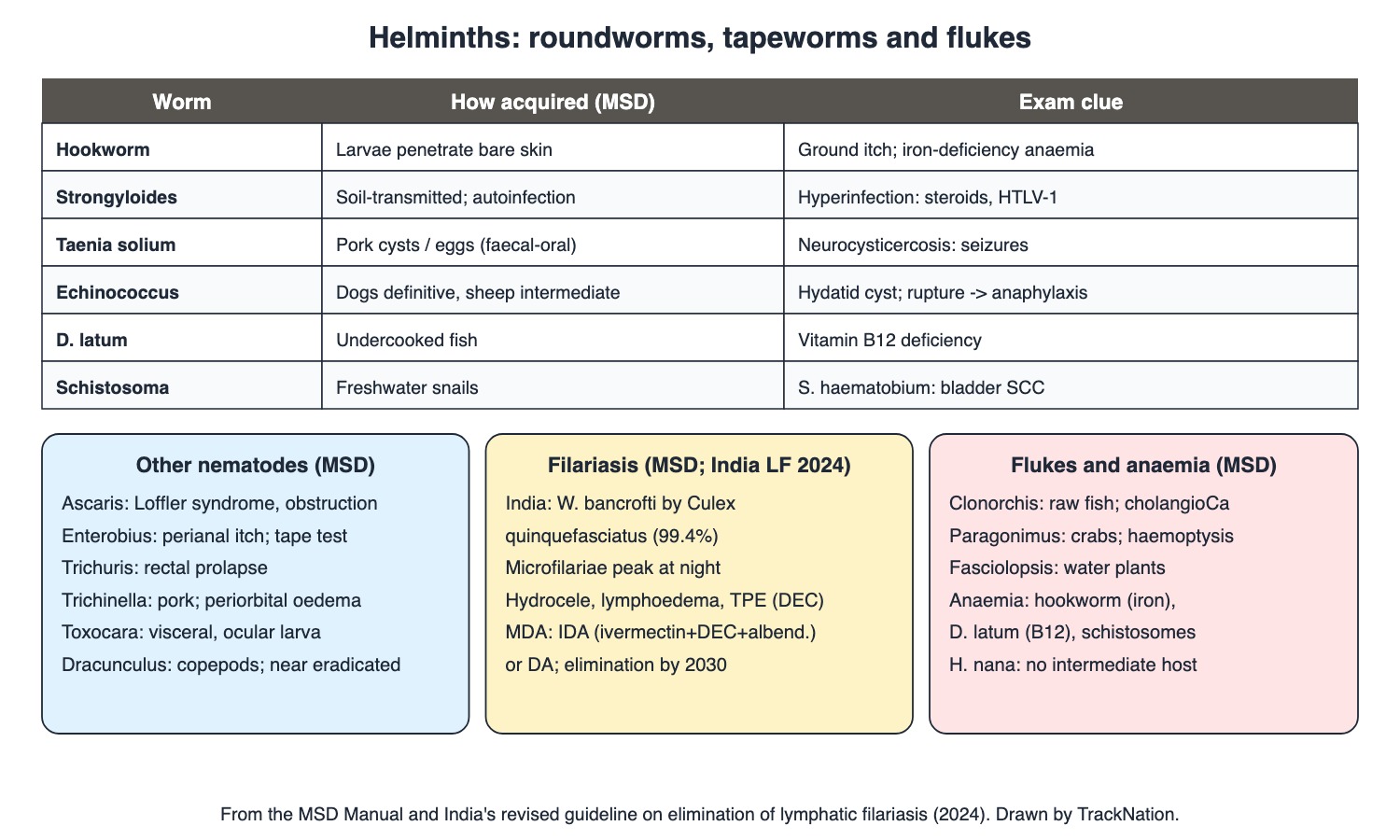
Roundworms, tapeworms and flukes. Drawn by TrackNation.
Intestinal and Tissue Nematodes (MSD)
Ascaris: lung phase (cough, wheeze, eosinophilia — Löffler syndrome) then gut phase; adults can block the intestine, bile or pancreatic ducts. Albendazole, mebendazole or ivermectin (pyrantel in pregnancy).
Hookworm (Ancylostoma duodenale, Necator americanus): filariform larvae penetrate bare skin (ground itch) → chronic blood loss → a major cause of iron-deficiency anaemia.
Strongyloides: autoinfection sustains decades-long infection; hyperinfection with corticosteroids, immunosuppression or HTLV-1 spreads larvae to organs with polymicrobial bacteraemia and meningitis. Ivermectin.
Enterobius (pinworm): perianal itch in school children; cellophane tape test. Trichuris: lemon-shaped eggs; heavy infection → rectal prolapse, anaemia.
Trichinella: undercooked pork or game → periorbital oedema, myalgia, fever, eosinophilia. Toxocara (from animals): visceral and ocular larva migrans. Dracunculus: drinking water with infected copepods; now close to eradication.
Lymphatic Filariasis (MSD, India's LF Programme)
Spread by mosquitoes; in India, Wuchereria bancrofti carried by Culex quinquefasciatus causes 99.4% of the problem (Brugia malayi in pockets).
Microfilaraemia peaks at night in most areas (night blood surveys). Disease: adenolymphangitis, hydrocele, lymphoedema, elephantiasis, and tropical pulmonary eosinophilia (responds to DEC).
Treatment: diethylcarbamazine; doxycycline kills the Wolbachia endosymbionts.
India's elimination drive: mass drug administration with IDA (ivermectin + DEC + albendazole) or DA (DEC + albendazole), morbidity management (MMDP), an enhanced five-pronged strategy since 2023, aligned to the 2030 global target.
Tapeworms and Flukes (MSD)
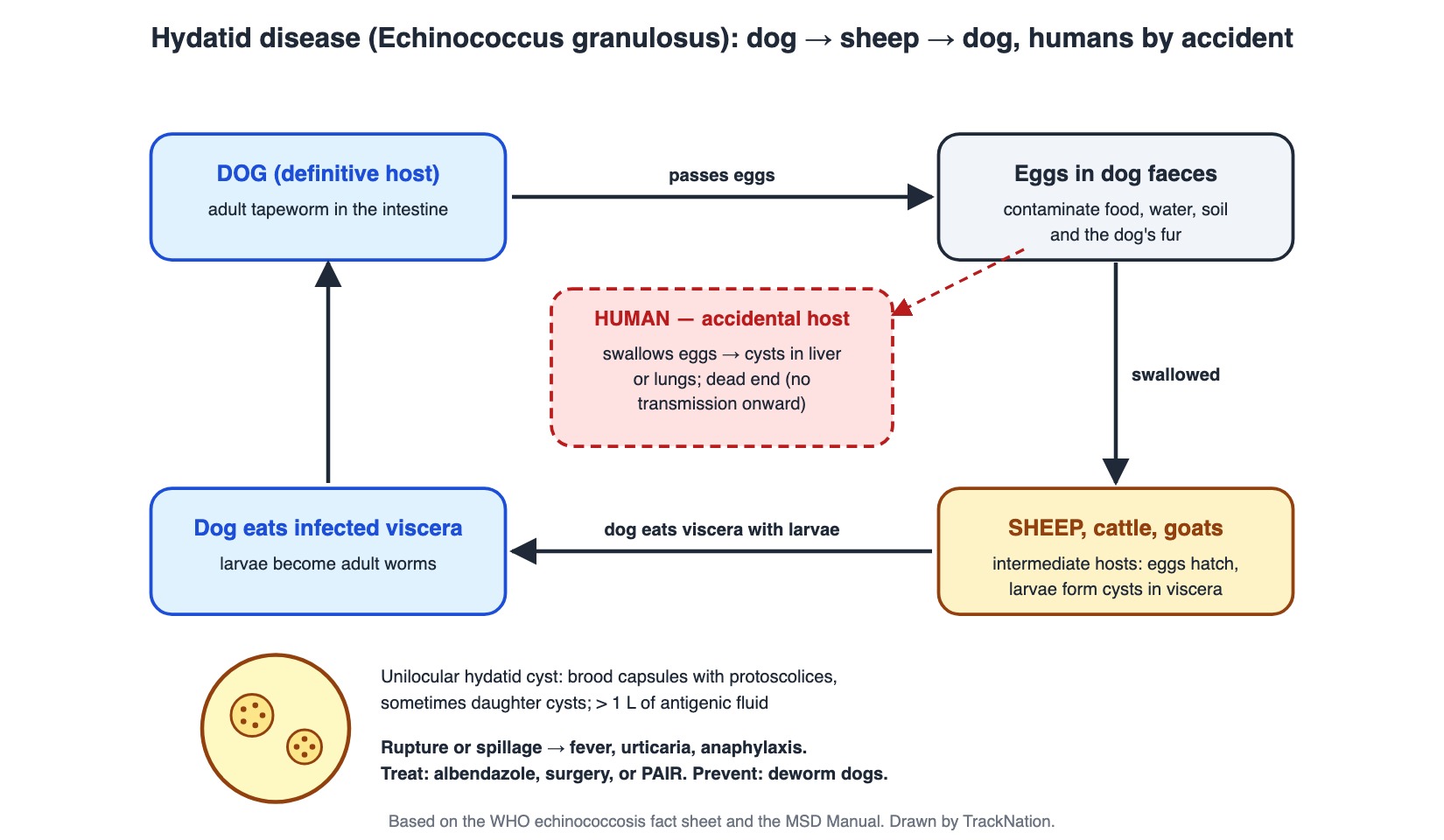
The hydatid (Echinococcus granulosus) life cycle and the cyst. Drawn by TrackNation.
Taenia solium: undercooked pork with cysticerci gives the adult worm; eggs give cysticercosis — neurocysticercosis causes seizures, and fewer than half have the adult worm. Adults: praziquantel or niclosamide; neurocysticercosis: steroids, antiseizure drugs, sometimes albendazole/praziquantel.
Echinococcus granulosus (hydatid): dogs are definitive hosts; herbivores such as sheep and humans are intermediate hosts; liver and lung cysts; rupture → anaphylaxis; PAIR, surgery, albendazole. E. multilocularis → alveolar disease.
Diphyllobothrium (fish tapeworm) steals vitamin B12 → megaloblastic anaemia. Hymenolepis nana needs no intermediate host.
Schistosomes (freshwater snails): S. mansoni/japonicum → bloody diarrhoea; S. haematobium → haematuria and squamous cell carcinoma of the bladder. Praziquantel.
Food-borne flukes: Clonorchis (raw freshwater fish → cholangiocarcinoma), Fasciolopsis buski (aquatic plants such as water chestnut), Paragonimus (raw crabs/crayfish → cough, chest pain, haemoptysis).
Infective causes of anaemia: hookworm and schistosomes (blood loss → iron deficiency), Trichuris, fish tapeworm (B12), and malaria (haemolysis; article 20).
Traps the Examiner Sets
Pork meat → adult T. solium; eggs → cysticercosis.
Steroids can turn quiet Strongyloides into fatal hyperinfection.
Dogs, not sheep, are the definitive host of Echinococcus.
Bladder squamous carcinoma → S. haematobium; cholangiocarcinoma → Clonorchis.
India's LF is overwhelmingly W. bancrofti spread by Culex quinquefasciatus.
Memory Hooks & Shortcuts
Shortcuts to lock in this article's numbers and lists. Each one only re-packages facts proven above.
🧠 'Hookworm: Hole in the foot, Hole in the iron store' — hookworm
🧠 'Strongyloides + Steroids = Sepsis' — Strongyloides
🧠 'Pork Meat = Mature worm; Pork Eggs = Encysted brain' — Taenia solium
🧠 'Dog is the Definitive host of the hyDatid' — Echinococcus
🧠 Flukes by food: 'Fish → Clonorchis, Crab → Paragonimus, Chestnut → Fasciolopsis' — flukes
Rapid-Revision Cards
Löffler syndrome
Lung larval migration: Ascaris, hookworm.
Ascaris
Bowel/biliary obstruction.
Hookworm
Skin entry; iron-deficiency anaemia.
Strongyloides
Autoinfection; hyperinfection with steroids, HTLV-1.
Enterobius
Perianal itch; tape test.
Trichuris
Rectal prolapse.
Trichinella
Pork; periorbital oedema, myalgia.
Dracunculus
Copepods; near eradicated.
India LF
W. bancrofti; Culex quinquefasciatus.
LF periodicity
Nocturnal.
LF disease
Hydrocele, lymphoedema, TPE.
LF drugs
DEC; doxycycline (Wolbachia).
India MDA
IDA or DA; 2030.
T. solium
Pork → adult; eggs → cysticercosis.
Echinococcus
Dog definitive; rupture anaphylaxis; PAIR.
Fish tapeworm
B12 deficiency.
H. nana
No intermediate host.
S. haematobium
Haematuria; bladder SCC.
Clonorchis
Raw fish; cholangiocarcinoma.
Paragonimus
Crabs; haemoptysis.
Toxocara
Visceral/ocular larva migrans.
Sources
Facts in this article were checked against these documents.
MSD Manual Professional: nematode, cestode and trematode infection pages (ascariasis to paragonimiasis) — Merck & Co. (MSD Manuals), 2024–26 (link)
Revised Guideline on Elimination of Lymphatic Filariasis — National Center for Vector Borne Diseases Control, MoHFW, 2024
Competency Based Undergraduate Curriculum, Vol I: Microbiology (MI3.9) — National Medical Commission, 2024
Test Yourself: Practice Questions
Thirty questions in NEET PG style, many of them clinical vignettes.
Practice Questions (NEET PG pattern)
Original questions written in the style of the exam: +4 for a correct answer, −1 for a wrong one. Every answer was checked against the sources listed above. NEET PG papers are not published by NBEMS, so these are not past-paper questions.
Q1. Cough, wheeze and eosinophilia from larvae migrating through the lungs (e.g. Ascaris) is called
(a) tropical pulmonary eosinophilia
(b) hyperinfection
(c) Löffler syndrome
(d) Katayama fever
Show answer
Answer: (c) — MSD.
Q2. A complication of heavy Ascaris infection is
(a) intestinal or biliary obstruction by adult worms
(b) rectal prolapse only
(c) bladder cancer
(d) neurocysticercosis
Show answer
Answer: (a) — MSD.
Q3. Hookworm larvae infect humans by
(a) ingestion of undercooked pork
(b) penetrating bare skin
(c) mosquito bite
(d) inhalation
Show answer
Answer: (b) — Ground itch.
Q4. A major cause of iron-deficiency anaemia in endemic regions is
(a) hookworm
(b) Clonorchis
(c) Toxocara
(d) Enterobius
Show answer
Answer: (a) — Chronic blood loss.
Q5. A patient given high-dose steroids develops polymicrobial sepsis and larvae in sputum. The worm is
(a) hookworm
(b) Ascaris
(c) Trichuris
(d) Strongyloides stercoralis (hyperinfection)
Show answer
Answer: (d) — Autoinfection.
Q6. Strongyloides hyperinfection is linked with co-infection by
(a) HBV
(b) HPV
(c) HTLV-1
(d) EBV
Show answer
Answer: (c) — MSD.
Q7. Strongyloidiasis is treated with
(a) praziquantel
(b) DEC
(c) ivermectin (or albendazole)
(d) metronidazole
Show answer
Answer: (c) — MSD.
Q8. A school child has perianal itching. The best test is
(a) cellophane tape test for Enterobius eggs
(b) stool culture
(c) blood smear
(d) serology
Show answer
Answer: (a) — Pinworm.
Q9. Rectal prolapse in a child with heavy worm infection suggests
(a) Enterobius
(b) Ascaris
(c) Taenia
(d) Trichuris trichiura
Show answer
Answer: (d) — Lemon-shaped eggs.
Q10. Periorbital oedema, myalgia, fever and eosinophilia after eating undercooked pork suggest
(a) trichinosis
(b) cysticercosis
(c) toxocariasis
(d) fascioliasis
Show answer
Answer: (a) — MSD.
Q11. Dracunculiasis is acquired by
(a) mosquito bite
(b) skin penetration in soil
(c) drinking water containing infected copepods
(d) eating pork
Show answer
Answer: (c) — Near eradication.
Q12. In India, lymphatic filariasis is mainly caused by
(a) Wuchereria bancrofti transmitted by Culex quinquefasciatus
(b) Loa loa by Chrysops
(c) Brugia timori by Anopheles
(d) Onchocerca by blackflies
Show answer
Answer: (a) — 99.4%.
Q13. Blood for microfilariae in most endemic areas is collected
(a) after a fatty meal
(b) at night
(c) at noon
(d) any time
Show answer
Answer: (b) — Nocturnal periodicity.
Q14. Chronic lymphatic filariasis typically causes
(a) hydrocele, lymphoedema and elephantiasis
(b) rectal prolapse
(c) megacolon
(d) cholangiocarcinoma
Show answer
Answer: (a) — Also TPE.
Q15. Doxycycline helps in filariasis by killing
(a) snails
(b) Wolbachia endosymbionts
(c) the mosquito
(d) microfilariae directly
Show answer
Answer: (b) — Kills adult worms.
Q16. India's triple-drug MDA for filariasis (IDA) consists of
(a) doxycycline, DEC and ivermectin
(b) mebendazole, ivermectin and pyrantel
(c) praziquantel, albendazole and DEC
(d) ivermectin, DEC and albendazole
Show answer
Answer: (d) — DA = DEC + albendazole.
Q17. Neurocysticercosis results from ingesting
(a) undercooked beef
(b) raw fish
(c) undercooked pork cysticerci only
(d) Taenia solium eggs
Show answer
Answer: (d) — Pork meat gives adult worm.
Q18. Undercooked pork containing cysticerci leads to
(a) hydatid disease
(b) schistosomiasis
(c) adult Taenia solium in the intestine
(d) trichuriasis
Show answer
Answer: (c) — MSD.
Q19. Adult intestinal tapeworms are treated with
(a) praziquantel or niclosamide
(b) chloroquine
(c) DEC
(d) ivermectin only
Show answer
Answer: (a) — MSD.
Q20. The definitive host of Echinococcus granulosus is the
(a) pig
(b) dog
(c) human
(d) sheep
Show answer
Answer: (b) — Herbivores and humans intermediate.
Q21. Spillage of hydatid cyst fluid during surgery can cause
(a) bladder cancer
(b) B12 deficiency
(c) anaphylaxis
(d) neurocysticercosis
Show answer
Answer: (c) — MSD.
Q22. Hydatid cysts can be managed by puncture, aspiration, injection of scolicidal agent and reaspiration, known as
(a) TACE
(b) RFA
(c) ERCP
(d) PAIR
Show answer
Answer: (d) — Plus albendazole.
Q23. Megaloblastic anaemia from a tapeworm is caused by
(a) Echinococcus
(b) Taenia saginata
(c) Hymenolepis nana
(d) Diphyllobothrium (fish tapeworm)
Show answer
Answer: (d) — Takes up B12.
Q24. The tapeworm whose life cycle needs no intermediate host is
(a) Diphyllobothrium
(b) Hymenolepis nana
(c) Taenia solium
(d) Echinococcus
Show answer
Answer: (b) — Dwarf tapeworm.
Q25. Squamous cell carcinoma of the bladder is linked with
(a) Paragonimus
(b) S. mansoni
(c) Clonorchis
(d) Schistosoma haematobium
Show answer
Answer: (d) — Haematuria.
Q26. Schistosomes complete their life cycle in
(a) freshwater snails
(b) crabs
(c) copepods
(d) mosquitoes
Show answer
Answer: (a) — Praziquantel.
Q27. Cholangiocarcinoma is associated with the liver fluke acquired from
(a) water plants (Fasciolopsis)
(b) pork (Taenia)
(c) crabs (Paragonimus)
(d) undercooked freshwater fish (Clonorchis)
Show answer
Answer: (d) — MSD.
Q28. Fasciolopsis buski is acquired by eating
(a) raw crabs
(b) undercooked pork
(c) aquatic plants such as water chestnut
(d) raw fish
Show answer
Answer: (c) — Snail intermediate host.
Q29. Haemoptysis after eating raw freshwater crabs suggests
(a) Toxocara
(b) Paragonimus westermani
(c) Echinococcus
(d) Clonorchis
Show answer
Answer: (b) — Lung fluke.
Q30. Ocular larva migrans is caused by
(a) Trichinella
(b) Loa loa
(c) Onchocerca
(d) Toxocara
Show answer
Answer: (d) — From animal ascarids.
Active Recall
From memory: give the route and key clue for each major nematode, explain Strongyloides hyperinfection, describe filariasis in India with vector, periodicity, disease and MDA drugs, distinguish Taenia solium infection from cysticercosis, describe hydatid disease, link tapeworms and flukes to their foods and complications, and list the worms that cause anaemia.