Levels of Prevention and Screening: Primordial to Tertiary, Lead Time, Sensitivity, Specificity, PPV (NEET PG PSM)
Start Here
🎯 Exam priority: High-yield (Tier 1). Classic one-liners ("rehabilitation is which level?", "screening is which level?", "what does high prevalence do to PPV?") plus short calculations. Every row below was checked against WHO's Basic Epidemiology.
CBME mapping: CM 1 (levels of prevention), CM 7–8 (screening).
The Four Levels of Prevention
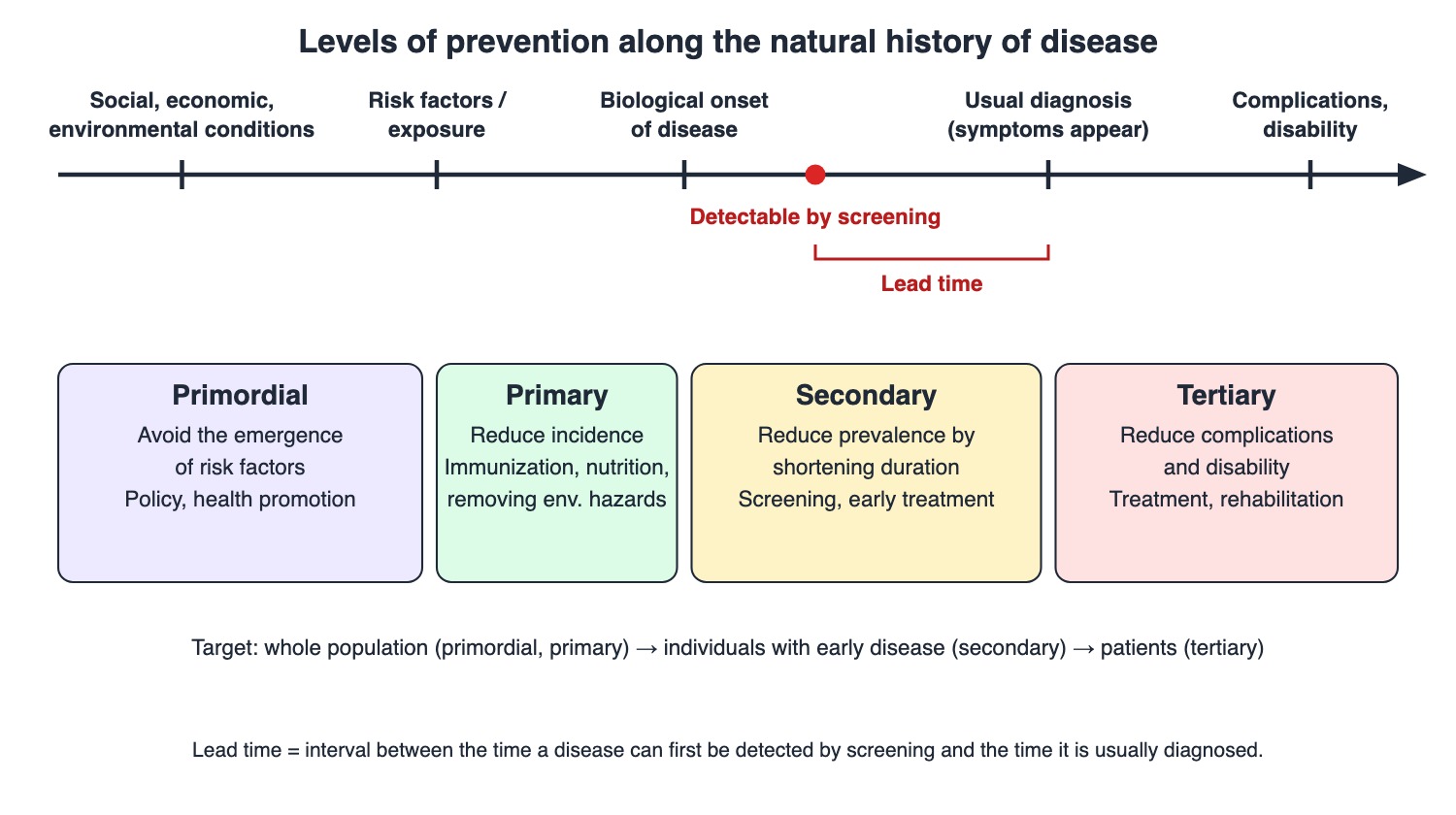
The four levels of prevention placed on the natural history of disease. Secondary prevention acts in the window between biological onset and the usual time of diagnosis; screening shifts diagnosis earlier by the lead time.
Level | Phase of disease | Aim | Examples | Target |
Primordial | Underlying social, economic, environmental conditions | Avoid the emergence of risk factors and unhealthy patterns of living | National nutrition policy, tobacco taxation, city planning for active transport | Total population or selected groups |
Primary | Specific causal factors present, disease not yet begun | Reduce incidence | Immunization, nutrition, removing environmental risks, smoking cessation | Total population, groups or high-risk individuals |
Secondary | Early disease (onset to the usual time of diagnosis) | Reduce prevalence by shortening duration; stop progression | Screening, early diagnosis and treatment (cervical screening, BP screening, school eye and hearing tests) | Individuals with early disease |
Tertiary | Late or established disease | Reduce complications, impairment and disability | Treatment, rehabilitation (stroke, polio, blindness) | Patients |
Primordial prevention tackles the social, economic and cultural patterns that raise risk before risk factors appear — for example national nutrition policy or reducing tobacco use through taxation and price.
Primary prevention lowers incidence by controlling specific causes and risk factors.
Secondary prevention works between onset and the usual time of diagnosis and lowers prevalence by shortening duration. It needs a disease with an early, detectable, treatable phase, a safe accurate test and an effective intervention.
Tertiary prevention reduces the progress and complications of established disease — rehabilitation after polio, stroke, injury or blindness.
Population Strategy, High-Risk Strategy and the Prevention Paradox
Population (mass) strategy: shift the whole distribution of a risk factor (blood pressure, cholesterol) slightly lower. No need to identify the high-risk group; most cases arise in the large middle of the distribution.
Prevention paradox: a measure that brings large benefits to the community offers little to each individual — most people wear seat-belts all their lives without ever being in a crash.
High-risk individual strategy: target those above a cut-off (e.g. smoking-cessation programmes for smokers). Efficient for those at greatest risk, but they may contribute little to the total burden.
Screening: Definition, Types and Criteria
Screening is the use of tests on a large scale to identify disease (or risk factors) in apparently healthy people. A positive screening test is not a diagnosis — it needs individual follow-up.
Type | What it means |
Mass screening | Screening the whole population, or a large subset |
Multiple / multiphasic | Several screening tests applied at the same time |
Targeted | Groups with specific exposures, e.g. lead-battery workers — common in occupational health |
Case-finding / opportunistic | Screening patients who consult a doctor for some other reason |
Area | WHO requirement for a screening programme |
Disorder | Well-defined; known prevalence |
Natural history | Long period between first signs and overt disease; medically important; an effective remedy exists |
Test | Simple and safe; distribution of test values in affected and unaffected people known |
Finance and facilities | Cost-effective; facilities available or easily provided |
Acceptability and equity | Follow-up after a positive result agreed and acceptable; equitable access; safe effective treatment available |
Low prevalence does not rule screening out if the consequences are serious: newborn screening for phenylketonuria is cost-effective even though the disease is rare, because a special diet allows normal development.
Lead time = the interval between the time a disease can first be detected by screening and the time it is usually diagnosed. Screening helps only if the lead time is reasonably long — noise-induced hearing loss has a very long lead time, pancreatic cancer a short one.
Validity of a Screening Test
Disease present | Disease absent | |
Test positive | a — true positive | b — false positive |
Test negative | c — false negative | d — true negative |
Sensitivity = a/(a+c): when the disease is present, how often the test detects it.
Specificity = d/(b+d): when the disease is absent, how often the test is negative.
Positive predictive value = a/(a+b); negative predictive value = d/(c+d).
A test is reliable if it gives consistent results and valid if it classifies people correctly (measured by sensitivity and specificity).
The trade-off: loosening the criteria for a positive test raises sensitivity but lowers specificity; tightening them does the reverse. For a serious condition in newborns we accept lower specificity to get high sensitivity.
Worked example — why prevalence changes PPV
Population of 10,000 (test: sensitivity 90%, specificity 95%) | Prevalence 10% | Prevalence 1% |
People with the disease | 1,000 | 100 |
True positives (90%) | 900 | 90 |
False positives (5% of the healthy) | 450 | 495 |
Positive predictive value | 67% | 15% |
The same test gives a PPV of 67% where the disease is common and only 15% where it is rare, because false positives come from the much larger healthy group. Sensitivity and specificity do not change; predictive values do.
Biases That Make Screening Look Better Than It Is
Lead-time bias: screening finds a disease earlier, but if the earlier diagnosis does not change its course, survival measured from diagnosis looks longer without anyone living longer.
Length bias: screening preferentially picks up slower-growing, less aggressive disease, which spends longer in the detectable pre-symptomatic phase — so screen-detected cases look milder.
The fair test of a screening programme is a fall in mortality in a randomized trial, not longer survival after diagnosis.
Note: WHO's Basic Epidemiology uses "length/time bias" for the situation where earlier diagnosis only lengthens the time a person knows of the disease; the definitions above follow the U.S. National Cancer Institute.
Rapid-Revision Cards
Primordial prevention
Prevent risk factors from emerging — policy, taxation, health promotion.
Primary prevention reduces…
Incidence (immunization, nutrition, removing environmental risks).
Secondary prevention reduces…
Prevalence, by shortening duration — screening, early treatment.
Tertiary prevention
Limit complications and disability — treatment, rehabilitation.
Prevention paradox
Big community benefit, little benefit to most individuals (seat-belts).
Screening definition
Large-scale tests to detect disease in apparently healthy people.
Case-finding
Opportunistic screening of patients attending for another reason.
Multiphasic screening
Several tests at the same time.
Lead time
Time from screen-detectability to usual diagnosis.
Long vs short lead time examples
Noise-induced hearing loss (long); pancreatic cancer (short).
Sensitivity / specificity
a/(a+c) · d/(b+d).
PPV / NPV
a/(a+b) · d/(c+d).
Effect of lower prevalence on PPV
PPV falls; sensitivity and specificity unchanged.
Lead-time bias
Earlier diagnosis inflates survival without changing outcome.
Length bias
Screening over-detects slow-growing disease.
Sources
Sources
Facts in this article were checked against these documents.
Basic Epidemiology, 2nd ed. — Chapter 6: Epidemiology and prevention (levels of prevention, screening) — World Health Organization, 2006 (link)
Crunching numbers: what cancer screening statistics really tell us — U.S. National Cancer Institute, web page, accessed 2026-10-24 (link)
CBME Curriculum 2024, Vol. II — Community Medicine (CM 1, CM 7, CM 8) — National Medical Commission, 2024
Test Yourself: Practice Questions
Sixteen questions in NEET PG style.
Practice Questions (NEET PG pattern)
Original questions written in the style of the exam: +4 for a correct answer, −1 for a wrong one. Every answer was checked against the sources listed above. NEET PG papers are not published by NBEMS, so these are not past-paper questions.
Q1. A government raises tobacco taxes to stop young people from ever taking up smoking. This is
(a) primordial prevention
(b) primary prevention
(c) secondary prevention
(d) tertiary prevention
Show answer
Answer: (a) — Primordial prevention prevents the emergence of the social, economic and cultural patterns that raise risk; WHO cites tobacco taxation as an example.
Q2. Immunization of children against measles is an example of
(a) primary prevention
(b) secondary prevention
(c) tertiary prevention
(d) primordial prevention
Show answer
Answer: (a) — Primary prevention limits incidence by controlling specific causes; immunization is WHO's example.
Q3. Pap-smear screening of women aged 30–60 is primarily
(a) secondary prevention
(b) primordial prevention
(c) primary prevention
(d) tertiary prevention
Show answer
Answer: (a) — Secondary prevention aims at early detection and treatment between onset and the usual time of diagnosis; WHO uses cervical cancer screening as its example.
Q4. Secondary prevention mainly aims to reduce the
(a) incidence of disease
(b) emergence of risk factors
(c) prevalence of disease
(d) number of births
Show answer
Answer: (c) — By shortening duration through early diagnosis and treatment, secondary prevention reduces prevalence.
Q5. Physiotherapy and vocational training for a stroke survivor are examples of
(a) primary prevention
(b) tertiary prevention
(c) secondary prevention
(d) primordial prevention
Show answer
Answer: (b) — Tertiary prevention reduces the progress or complications of established disease, including rehabilitation.
Q6. Seat-belt laws benefit the population greatly but most individuals who wear seat-belts never gain from them. This is the
(a) ecological fallacy
(b) lead-time bias
(c) prevention paradox
(d) iceberg phenomenon
Show answer
Answer: (c) — WHO describes this as the prevention paradox.
Q7. A doctor measures the blood pressure of every adult who visits the clinic for a cough. This is
(a) targeted screening
(b) multiphasic screening
(c) case-finding (opportunistic) screening
(d) mass screening
Show answer
Answer: (c) — Case-finding or opportunistic screening is aimed at patients who consult a practitioner for another reason.
Q8. Applying several screening tests at the same time to the same group is called
(a) selective screening only
(b) targeted screening
(c) case-finding
(d) multiphasic screening
Show answer
Answer: (d) — Multiple or multiphasic screening uses several screening tests at the same time.
Q9. The interval between the time a disease can be detected by screening and the time it is usually diagnosed is the
(a) latent period of infection
(b) lead time
(c) incubation period
(d) window period
Show answer
Answer: (b) — WHO defines lead time as this interval and requires a reasonably long lead time for screening to help.
Q10. For which condition is screening least useful because the lead time is usually short?
(a) Cervical cancer
(b) Phenylketonuria
(c) Noise-induced hearing loss
(d) Pancreatic cancer
Show answer
Answer: (d) — WHO contrasts noise-induced hearing loss (very long lead time) with pancreatic cancer (usually short).
Q11. The proportion of people without the disease who test negative is the
(a) negative predictive value
(b) positive predictive value
(c) sensitivity
(d) specificity
Show answer
Answer: (d) — Specificity = d/(b+d): when the disease is absent, how often the test is negative.
Q12. Lowering the cut-off for a positive test (making the criteria less strict) will usually
(a) decrease sensitivity and increase specificity
(b) leave both unchanged
(c) increase both sensitivity and specificity
(d) increase sensitivity and decrease specificity
Show answer
Answer: (d) — Reducing the strictness of the criteria increases sensitivity but reduces specificity, and vice versa.
Q13. The negative predictive value of a test is
(a) d/(c+d)
(b) d/(b+d)
(c) a/(a+b)
(d) a/(a+c)
Show answer
Answer: (a) — NPV = probability of not having the disease when the test is negative = d/(c+d).
Q14. A test with sensitivity 90% and specificity 95% is used where prevalence is 1%. Its positive predictive value is closest to
(a) 95%
(b) 90%
(c) 15%
(d) 67%
Show answer
Answer: (c) — In 10,000 people: 90 true positives and 495 false positives, so PPV = 90/585 ≈ 15%. At 10% prevalence the same test gives 67%.
Q15. Screening detects a disproportionate number of slow-growing, less aggressive cancers. This is called
(a) lead-time bias
(b) recall bias
(c) length bias
(d) observer bias
Show answer
Answer: (c) — Length bias: screening is more likely to pick up slower-growing cancers that stay longer in the detectable pre-symptomatic phase.
Q16. Newborn screening for phenylketonuria is justified despite the disease's rarity mainly because
(a) it is a notifiable disease
(b) the test is always 100% sensitive
(c) the disease has a short lead time
(d) early dietary treatment prevents serious, lifelong disability
Show answer
Answer: (d) — WHO notes PKU screening is highly cost-effective because a special diet from birth allows normal development.
Active Recall
From memory, draw the natural-history line and place the four levels of prevention on it with one example each; then write the formulas for sensitivity, specificity, PPV and NPV and explain why PPV falls when prevalence falls.