Pelvic Organ Prolapse and Urinary Incontinence for NEET PG OBG: POP-Q Stages, Risk Factors, Pessary vs Surgery, and Stress vs Urge Incontinence
Start Here
🎯 Exam priority: Moderate–high. Expect: POP-Q stages, risk factors, naming of compartment prolapses, splinting, first-line treatment by stage, pessary vs surgery, colpocleisis, recurrence site, and the four types of urinary incontinence with their treatment.
CBME mapping: OG26 and OG31. Genital tract fistulae are not covered in this article yet.
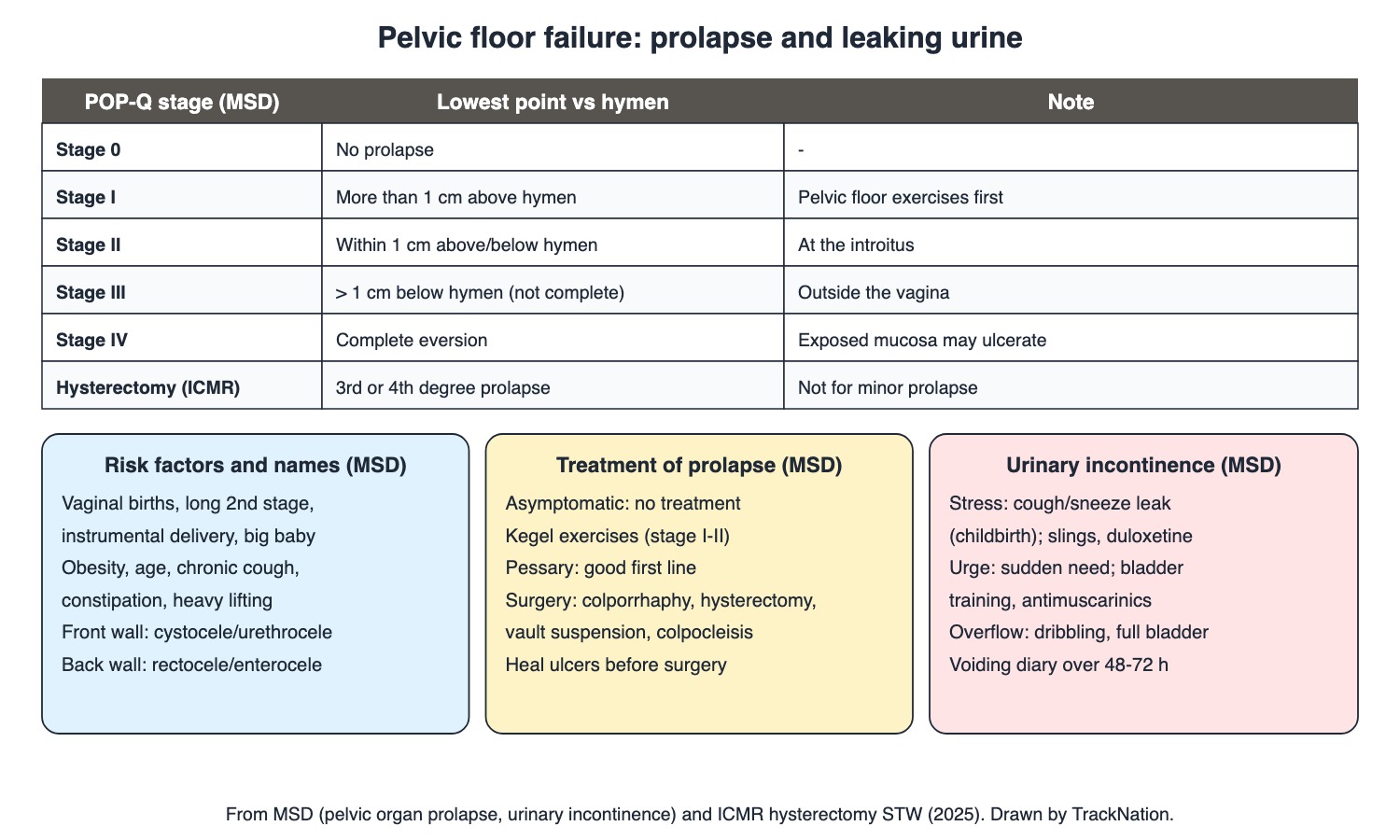
POP-Q stages, prolapse types and treatment, and urinary incontinence. Drawn by TrackNation.
Pelvic Organ Prolapse: What and Why (MSD)
Prolapse = hernia-like laxity of the ligaments, fascia and muscles of the pelvic floor; symptomatic in about 8.3% of women in one large study.
Risk factors: vaginal births (especially long second stage, instrumental delivery, large baby), obesity, age, pelvic surgery, chronically raised intra-abdominal pressure (constipation, heavy lifting, chronic cough), connective-tissue disorders.
Names: anterior wall — cystocele (bladder) or urethrocele; posterior wall — rectocele (rectum) or enterocele (small bowel + peritoneum); uterine prolapse; vault (apical) prolapse after hysterectomy. Usually several coexist.
Symptoms: vaginal bulge (commonest), pressure, urinary incontinence or retention, difficulty emptying the bowel — women may splint the posterior wall with fingers to defecate; sexual problems. Exposed mucosa can thicken and ulcerate.
Staging and Treatment (MSD, ICMR)
POP-Q (preferred; older Baden–Walker): 0 none; I >1 cm above the hymen; II within 1 cm of the hymen; III >1 cm below the hymen; IV complete eversion.
Asymptomatic prolapse needs no treatment. Pelvic floor (Kegel) exercises are first line for stage I–II; prolapse beyond the introitus will not respond to exercises — a pessary is a good first-line option.
Surgery: anterior/posterior colporrhaphy, hysterectomy, vault suspension, colpocleisis (closing the vagina; Le Fort with the uterus in place) for frail women not wanting intercourse. Heal ulcers first; defer vaginal repair until childbearing is complete; recurrence is commonest on the anterior wall.
ICMR (2025): third- or fourth-degree uterovaginal prolapse is an indication for hysterectomy; minor prolapse is not.
Urinary Incontinence (MSD)
Stress: leak with cough, sneeze, laugh, lifting — second commonest in women, mainly from childbirth; worse with obesity. Treat with pelvic floor exercises, suburethral slings, bulking agents; duloxetine raises sphincter tone.
Urge: leak right after a sudden irrepressible urge; commonest in older adults. Bladder training, antimuscarinics (relax the detrusor), beta-3 agonists (e.g. vibegron), botulinum toxin or sacral neuromodulation if refractory.
Overflow: dribbling from an overfull bladder. Functional: cognitive/physical barriers. Mixed: usually urge + stress.
Assessment: history, examination, voiding diary over 48–72 hours, pad tests; review drugs.
Traps the Examiner Sets
Rectocele is posterior; cystocele is anterior.
Kegel exercises help stage I–II, not prolapse beyond the introitus.
Leak with coughing = stress; leak after urgency = urge.
Le Fort colpocleisis closes the vagina — only for women not wanting intercourse.
Memory Hooks & Shortcuts
Shortcuts to lock in this article's numbers and lists. Each one only re-packages facts proven above.
🧠 'Cysto front, Recto back' — cystocele anterior, rectocele posterior — names
🧠 POP-Q '1 above, ±1, 1 below, all out' for stages I–IV — staging
🧠 Treatment ladder 'Watch → Kegel → Pessary → Repair' — treatment
🧠 Incontinence: 'Stress = Sneeze; Urge = Urgent; Overflow = Over-full' — incontinence
🧠 'Le Fort shuts the door' — colpocleisis only if no intercourse planned — colpocleisis
Rapid-Revision Cards
Prolapse cause
Pelvic floor laxity.
Main risk
Vaginal births.
Other risks
Obesity, age, cough, constipation.
Anterior wall
Cystocele/urethrocele.
Posterior wall
Rectocele/enterocele.
Vault prolapse
After hysterectomy.
Commonest symptom
Vaginal bulge.
Splinting
Rectocele.
POP-Q I
>1 cm above hymen.
POP-Q II
Within 1 cm of hymen.
POP-Q III
>1 cm below hymen.
POP-Q IV
Complete eversion.
Asymptomatic
No treatment.
Stage I–II
Kegel exercises.
Beyond introitus
Pessary first line.
Le Fort
Colpocleisis, uterus left.
Recurrence
Anterior wall.
ICMR hysterectomy
3rd/4th degree prolapse.
Stress UI
Cough leak; sling, duloxetine.
Urge UI
Urgency; antimuscarinics.
Overflow
Dribbling, full bladder.
Sources
Facts in this article were checked against these documents.
MSD Manual Professional: Overview of Pelvic Organ Prolapse; Anterior and Posterior Vaginal Wall Prolapse; Uterine and Apical Prolapse; Urinary Incontinence in Adults — Merck & Co. (MSD Manuals), 2025–26 (link)
Standard Treatment Workflow: Hysterectomy for Benign Gynaecological Conditions — Indian Council of Medical Research / DHR, 2025
Competency Based Undergraduate Curriculum, Vol III: Obstetrics & Gynaecology (OG26, OG31) — National Medical Commission, 2024
Test Yourself: Practice Questions
Thirty questions in NEET PG style, most of them clinical vignettes.
Practice Questions (NEET PG pattern)
Original questions written in the style of the exam: +4 for a correct answer, −1 for a wrong one. Every answer was checked against the sources listed above. NEET PG papers are not published by NBEMS, so these are not past-paper questions.
Q1. Pelvic organ prolapse results from
(a) laxity of pelvic floor ligaments, fascia and muscles
(b) infection
(c) a tumour
(d) hormone excess
Show answer
Answer: (a) — Hernia-like.
Q2. Which obstetric factor increases prolapse risk?
(a) short labour in a primigravida
(b) elective caesarean
(c) prolonged second stage and instrumental delivery
(d) nulliparity
Show answer
Answer: (c) — Also large baby.
Q3. A non-obstetric risk factor for prolapse is
(a) chronic cough or constipation
(b) young age
(c) oral contraceptive use
(d) low BMI
Show answer
Answer: (a) — Raised abdominal pressure.
Q4. Prolapse of the anterior vaginal wall containing bladder is a
(a) cystocele
(b) vault prolapse
(c) enterocele
(d) rectocele
Show answer
Answer: (a) — MSD.
Q5. A posterior vaginal wall bulge containing small bowel and peritoneum is an
(a) cystocele
(b) rectocele
(c) urethrocele
(d) enterocele
Show answer
Answer: (d) — Rectocele = rectum.
Q6. A woman must press on the back wall of her vagina to pass stool. She has a
(a) urethral diverticulum
(b) cystocele
(c) rectocele (splinting)
(d) fistula
Show answer
Answer: (c) — MSD.
Q7. After hysterectomy, descent of the vaginal cuff is called
(a) cystocele
(b) procidentia uteri
(c) apical (vault) prolapse
(d) enterocele only
Show answer
Answer: (c) — MSD.
Q8. The commonest presenting symptom of uterine prolapse is
(a) fever
(b) a vaginal bulge
(c) bleeding
(d) infertility
Show answer
Answer: (b) — May be intermittent.
Q9. In POP-Q, stage II means the lowest point is
(a) within 1 cm above or below the hymen
(b) more than 1 cm below the hymen
(c) more than 1 cm above the hymen
(d) complete eversion
Show answer
Answer: (a) — At introitus.
Q10. POP-Q stage IV is
(a) 1 cm above the hymen
(b) complete eversion
(c) no prolapse
(d) at the hymen
Show answer
Answer: (b) — MSD.
Q11. POP-Q stage I means the lowest point is
(a) complete eversion
(b) at the hymen exactly
(c) more than 1 cm above the hymen
(d) below the hymen
Show answer
Answer: (c) — Inside vagina.
Q12. A woman has stage I prolapse found incidentally and no symptoms. Management:
(a) no treatment needed
(b) Le Fort colpocleisis
(c) hysterectomy
(d) pessary for life
Show answer
Answer: (a) — MSD.
Q13. First-line therapy for symptomatic stage I–II prolapse is
(a) colpocleisis
(b) oestrogen alone
(c) pelvic floor (Kegel) exercises
(d) hysterectomy
Show answer
Answer: (c) — MSD.
Q14. Uterine prolapse beyond the introitus in a woman who wants to avoid surgery: first-line option
(a) antibiotics
(b) observation only
(c) Kegel exercises alone
(d) a vaginal pessary
Show answer
Answer: (d) — Exercises won't work here.
Q15. A frail 82-year-old with complete prolapse, not sexually active, unfit for long surgery. Option:
(a) colpocleisis (Le Fort if uterus left in place)
(b) Kegel exercises
(c) observation
(d) sacrocolpopexy by laparotomy
Show answer
Answer: (a) — Closes vagina.
Q16. A prolapse with an ulcerated cervix should have surgery
(a) immediately
(b) only with radiation
(c) after the ulcers heal
(d) never
Show answer
Answer: (c) — MSD.
Q17. After prolapse surgery, recurrence is commonest in the
(a) anterior vaginal wall
(b) posterior wall
(c) vault
(d) perineum
Show answer
Answer: (a) — MSD.
Q18. Vaginal repair for prolapse in a 30-year-old is usually deferred because
(a) ovaries are removed
(b) it is illegal
(c) it causes infertility
(d) a later vaginal birth may disrupt the repair
Show answer
Answer: (d) — MSD.
Q19. The surgical repair of a cystocele or rectocele is
(a) salpingectomy
(b) anterior or posterior colporrhaphy
(c) myomectomy
(d) cone biopsy
Show answer
Answer: (b) — MSD.
Q20. Per ICMR, hysterectomy is indicated for
(a) third or fourth degree uterovaginal prolapse
(b) minor prolapse
(c) white discharge
(d) cervicitis
Show answer
Answer: (a) — 2025 STW.
Q21. A woman leaks urine when she coughs or laughs. Type:
(a) overflow incontinence
(b) stress incontinence
(c) urge incontinence
(d) functional incontinence
Show answer
Answer: (b) — Childbirth.
Q22. A woman has a sudden, irresistible urge and leaks a large volume before reaching the toilet. Type:
(a) urge incontinence
(b) stress incontinence
(c) fistula
(d) overflow
Show answer
Answer: (a) — Detrusor overactivity.
Q23. The commonest type of incontinence in older adults is
(a) functional
(b) urge incontinence
(c) overflow
(d) stress incontinence
Show answer
Answer: (b) — MSD.
Q24. Constant dribbling from an overfull bladder is
(a) overflow incontinence
(b) stress incontinence
(c) mixed
(d) urge incontinence
Show answer
Answer: (a) — MSD.
Q25. The commonest mixed pattern is
(a) stress with overflow
(b) none
(c) urge with stress incontinence
(d) overflow with functional
Show answer
Answer: (c) — MSD.
Q26. A voiding diary for incontinence is kept for
(a) 1 hour
(b) 1 year
(c) 1 month
(d) 48–72 hours
Show answer
Answer: (d) — MSD.
Q27. Antimuscarinic drugs treat urge incontinence by
(a) blocking alpha receptors
(b) increasing urine output
(c) tightening the sphincter
(d) relaxing the detrusor
Show answer
Answer: (d) — Caution in elderly.
Q28. For stress incontinence due to sphincter deficiency, a surgical option is
(a) a suburethral sling
(b) bladder augmentation
(c) sacral neuromodulation
(d) TURP
Show answer
Answer: (a) — Or bulking agents.
Q29. A drug that increases urinary sphincter tone in stress incontinence is
(a) duloxetine
(b) furosemide
(c) vibegron
(d) oxybutynin
Show answer
Answer: (a) — SNRI.
Q30. Stress incontinence is usually worse in women with
(a) caesarean births only
(b) obesity
(c) nulliparity only
(d) low BMI
Show answer
Answer: (b) — MSD.
Active Recall
From memory: define pelvic organ prolapse and its risk factors, name the compartment prolapses, give the POP-Q stages, outline treatment from exercises to pessary to surgery including ICMR hysterectomy rules, and distinguish and treat stress, urge, overflow and mixed incontinence.