National Health Policies and Programmes for NEET PG PSM: Alma-Ata, Health Committees, NHP 2017, PM-JAY and Leprosy 2025
Start Here
🎯 Exam priority: Medium–high. Committee-to-recommendation matching, the elements of primary health care and policy targets are classic. Leprosy changed in April 2025, so older notes on PB treatment are out of date.
CBME mapping: CM 12.4, CM 15.3, CM 16.4, CM 17.3, CM 17.4. Immunization, TB, malaria, HIV, NCDs, family planning and nutrition programmes have their own articles.
Primary Health Care and Alma-Ata
The Declaration of Alma-Ata came from the International Conference on Primary Health Care, 6–12 September 1978. Primary health care provides promotive, preventive, curative and rehabilitative services.
The eight elements ("at least"):
Education on prevailing health problems and how to prevent them
Food supply and proper nutrition
Safe water and basic sanitation
Maternal and child health, including family planning
Immunization against major infectious diseases
Prevention and control of locally endemic diseases
Appropriate treatment of common diseases and injuries
Provision of essential drugs
Its approach: involving sectors beyond health (intersectoral coordination), community self-reliance and participation, and supportive referral systems.
The Health Committees
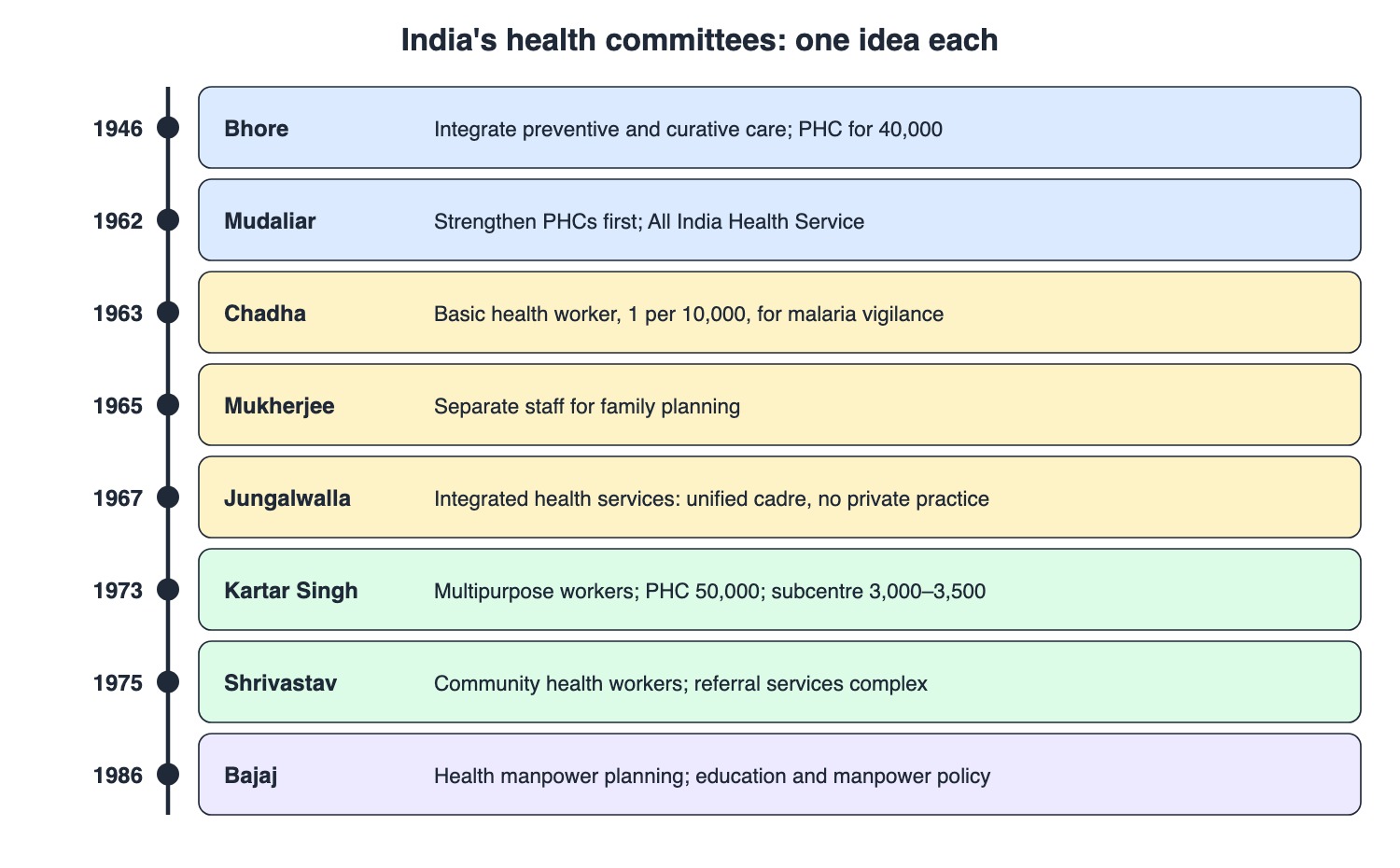
Learn each committee by its single big idea, then the population norm it set.
Committee | Year | Formal name or focus | Remember it for |
Bhore | 1946 | Health Survey & Development Committee | Integrating preventive and curative care; PHC for 40,000; the '3 million plan'; 'social physicians' |
Mudaliar | 1962 | Health Survey and Planning Committee | Strengthen existing PHCs before opening new ones; All India Health Service |
Chadha | 1963 | Malaria maintenance phase | Basic health worker, 1 per 10,000 |
Mukherjee | 1965 | Family planning review | Separate staff for family planning |
Jungalwalla | 1967 | Committee on Integration of Health Services | Unified cadre, equal pay, no private practice by government doctors |
Kartar Singh | 1973 | Multipurpose workers under Health and Family Planning | Multipurpose worker cadre; PHC 50,000; subcentre 3,000–3,500 |
Shrivastav | 1975 | Group on Medical Education and Support Manpower | Health workers from the community; referral services complex |
Bajaj | 1986 | Health Manpower Planning, Production and Management | Medical and health education policy, manpower policy |
National Health Policy 2017
NHP 2017 aims at universal access to good quality care without financial hardship, with a preventive and promotive orientation.
Goal | NHP 2017 target | Latest |
Public health spending | 2.5% of GDP by 2025 (from 1.15%) | — |
Life expectancy | 70 by 2025 (from 67.5) | 70.6 (2020-24): met |
TFR | 2.1 by 2025 | 1.9 (SRS 2024): met nationally |
Infant mortality | 28 by 2019 | 24 (2024): met |
Under-five mortality | 23 by 2025 | 28 (2024): not met |
Neonatal mortality | 16 by 2025 | 18 (2024): not met |
Stillbirth rate | Single digit by 2025 | 7 (2024): met |
MMR | 100 by 2020 | 87 (2022-24): met |
Money: state health spending above 8% of their budgets; up to two-thirds or more of resources to primary care.
Beds: at least 2 per 1,000 population, accessible within the golden hour.
Immunization: over 90% of newborns fully immunized by one year of age by 2025.
Tobacco: relative reduction in current use of 15% by 2020 and 30% by 2025.
Ayushman Bharat PM-JAY
Health insurance cover of ₹5 lakh per family per year.
Since the 2024 Cabinet decision, everyone aged 70 and above is eligible, irrespective of income, with a distinct card.
Seniors in families already covered get a separate top-up of up to ₹5 lakh a year that they do not share with younger family members.
Leprosy (NLEP)
Leprosy is caused by Mycobacterium leprae and spreads by droplets from the nose and mouth during close, frequent contact with untreated cases.
Cardinal signs (any one):
Definite loss of sensation in a pale or reddish skin patch
Thickened or enlarged peripheral nerve with sensory loss or muscle weakness
Bacilli on slit-skin smear
Revised classification (India, in force 1 April 2025):
Type | Skin lesions | Nerve involvement | Slit-skin smear |
Paucibacillary (PB) | 1–5 | None | Negative |
Multibacillary (MB) | More than 5 | One or more | Positive |
Revised treatment: PB now gets the same three drugs as MB, replacing the two-drug regimen. Patients already on treatment on 31 March 2025 finish their old course.
Adult | Duration | Dapsone | Clofazimine | Rifampicin |
PB | 6 months | 100 mg daily | 300 mg monthly + 50 mg daily | 600 mg monthly |
MB | 12 months | 100 mg daily | 300 mg monthly + 50 mg daily | 600 mg monthly |
Contacts: single-dose rifampicin as post-exposure prophylaxis.
Programme: NLEP since 1983. Elimination as a public health problem means under 1 case per 10,000, reached nationally in December 2005.
Now (2024-25): prevalence 0.57 per 10,000; child cases 4.68%; grade 2 disability 1.31 per million. Leprosy became a notifiable disease in 2025.
Goal: zero transmission, zero disability and zero discrimination by 2027.
Mental Health, Elderly Care and Tobacco
National Mental Health Programme: 1982. The District Mental Health Programme followed in 1996, based on the Bellary model: early detection and treatment, training of general physicians and health workers, public awareness and simple record keeping.
National Programme for Health Care of the Elderly (NPHCE): 2010. Home visits by trained health workers, a weekly clinic at PHCs, dedicated services at CHCs and district hospitals, and Regional Geriatric Centres.
National Tobacco Control Programme: 2007-08. It enforces COTPA 2003, supports the WHO Framework Convention on Tobacco Control and sets up cessation facilities. Prevalence is tracked by the Global Adult Tobacco Survey.
Traps the Examiner Sets
Bhore's PHC norm is 40,000; Kartar Singh's is 50,000.
Multipurpose workers: Kartar Singh, not Shrivastav.
Alma-Ata lists eight elements; essential drugs and safe water are both on the list.
PB leprosy treatment is now three drugs, still for 6 months.
Any nerve involvement makes a case multibacillary under the revised classification.
NHP 2017's target for public health spending is 2.5% of GDP. It has both a 2019 IMR target and a 2025 U5MR target; do not mix them.
Memory Hooks & Shortcuts
Shortcuts to lock in this article's numbers and lists. Each one only re-packages facts proven above.
🧠 Bhore 40, Kartar 50 — PHC population norms, in thousands
🧠 Kartar made them Multi — Kartar Singh: multipurpose workers
🧠 ELEMENTS: 8 boxes, drugs last — the Alma-Ata list ends with essential drugs
🧠 2.5 by 2025 — NHP 2017 health spending target
🧠 5 or a nerve — more than 5 lesions, or any nerve, makes leprosy MB
🧠 6 and 12, same three drugs — PB and MB durations since April 2025
🧠 Bellary for the district — DMHP model
Rapid-Revision Cards
Alma-Ata
1978; primary health care; eight elements.
Eight elements of PHC
Education, nutrition, water and sanitation, MCH and family planning, immunization, endemic disease control, treatment of common conditions, essential drugs.
Bhore 1946
Integration of preventive and curative care; PHC for 40,000.
Mudaliar 1962
Strengthen PHCs first; All India Health Service.
Chadha 1963
Basic health worker, 1 per 10,000.
Mukherjee 1965
Separate family planning staff.
Jungalwalla 1967
Integration of health services; unified cadre.
Kartar Singh 1973
Multipurpose workers; PHC 50,000; subcentre 3,000–3,500.
Shrivastav 1975
Community health workers; referral services complex.
Bajaj 1986
Health manpower planning.
NHP 2017 spending
2.5% of GDP by 2025; states over 8% of budget.
NHP 2017 life expectancy
70 by 2025.
NHP 2017 mortality targets
IMR 28 (2019), U5MR 23, NMR 16 (2025), MMR 100 (2020).
NHP 2017 beds
At least 2 per 1,000.
PM-JAY cover
₹5 lakh per family per year; all aged 70+ eligible.
70+ top-up
Up to ₹5 lakh a year, not shared with younger family members.
Leprosy PB
1–5 lesions, no nerve, smear negative.
Leprosy MB
>5 lesions, or any nerve, or smear positive.
PB treatment now
Three drugs for 6 months, from 1 April 2025.
MB treatment
Three drugs for 12 months.
Adult MDT doses
Dapsone 100 mg daily; clofazimine 300 mg monthly + 50 mg daily; rifampicin 600 mg monthly.
Leprosy contacts
Single-dose rifampicin.
Leprosy elimination
<1 per 10,000; reached nationally December 2005.
Leprosy 2024-25
Prevalence 0.57 per 10,000; G2D 1.31 per million; child cases 4.68%.
NMHP and DMHP
1982 and 1996; Bellary model.
NPHCE
2010; weekly clinic at PHCs; Regional Geriatric Centres.
NTCP
2007-08; COTPA 2003.
Sources
Facts in this article were checked against these documents.
Declaration of Alma-Ata — WHO, 1978 (link)
National Health Committees — National Institute of Health and Family Welfare, accessed November 2026 (link)
National Health Policy 2017 — MoHFW, 2017 (link)
Cabinet approves health coverage to all senior citizens of 70 years and above under AB PM-JAY — Prime Minister's Office, 2024 (link)
Revised treatment regimen for PB and MB cases in India (D.O. letter) — Director General of Health Services, 6 March 2025 (link)
National Leprosy Eradication Programme — DGHS, MoHFW, accessed November 2026 (link)
Leprosy fact sheet — WHO, accessed November 2026 (link)
National Mental Health Programme; NPHCE; National Tobacco Control Programme — National Health Mission, accessed November 2026 (link)
Test Yourself: Practice Questions
Twenty-five questions in NEET PG style.
Practice Questions (NEET PG pattern)
Original questions written in the style of the exam: +4 for a correct answer, −1 for a wrong one. Every answer was checked against the sources listed above. NEET PG papers are not published by NBEMS, so these are not past-paper questions.
Q1. The Declaration of Alma-Ata was adopted in
(a) 1946
(b) 1986
(c) 2000
(d) 1978
Show answer
Answer: (d) — International Conference on Primary Health Care, Alma-Ata, 6–12 September 1978.
Q2. Which of the following is NOT among the elements of primary health care in the Alma-Ata declaration?
(a) Provision of specialist surgical care
(b) Safe water and basic sanitation
(c) Provision of essential drugs
(d) Immunization against major infectious diseases
Show answer
Answer: (a) — The eight elements cover education, nutrition, water and sanitation, MCH with family planning, immunization, endemic disease control, treatment of common conditions, and essential drugs.
Q3. A district officer brings the agriculture, education and public works departments together to reduce child malnutrition. This reflects which primary health care principle?
(a) Tertiary referral
(b) Vertical programming
(c) Appropriate technology only
(d) Intersectoral coordination
Show answer
Answer: (d) — Primary health care involves all related sectors besides health and demands their coordinated effort.
Q4. Integration of preventive and curative services at all administrative levels was recommended by the
(a) Bajaj Committee
(b) Kartar Singh Committee
(c) Mukherjee Committee
(d) Bhore Committee
Show answer
Answer: (d) — Bhore (Health Survey & Development Committee), 1946.
Q5. Which committee recommended that existing PHCs be strengthened before new ones are opened?
(a) Chadha Committee
(b) Shrivastav Committee
(c) Mudaliar Committee
(d) Bhore Committee
Show answer
Answer: (c) — Mudaliar, 1962, also recommended an All India Health Service.
Q6. The concept of multipurpose workers came from the
(a) Kartar Singh Committee
(b) Jungalwalla Committee
(c) Bhore Committee
(d) Mudaliar Committee
Show answer
Answer: (a) — The 1973 Committee on Multipurpose Workers under Health and Family Planning.
Q7. Under the Kartar Singh Committee, one PHC was to cover a population of
(a) 50,000
(b) 1,00,000
(c) 40,000
(d) 30,000
Show answer
Answer: (a) — One PHC per 50,000, divided into 16 subcentres of 3,000–3,500.
Q8. The Jungalwalla Committee is remembered for
(a) family planning staffing
(b) multipurpose workers
(c) the 3 million plan
(d) integration of health services
Show answer
Answer: (d) — The Committee on Integration of Health Services: unified cadre, common seniority, abolition of private practice by government doctors.
Q9. The Shrivastav Committee was set up as the
(a) Expert Committee for Health Manpower Planning
(b) Group on Medical Education and Support Manpower
(c) Committee on Integration of Health Services
(d) Health Survey and Planning Committee
Show answer
Answer: (b) — It proposed health workers from the community and a referral services complex.
Q10. National Health Policy 2017 aims to raise public health expenditure to
(a) 2.5% of GDP by 2025
(b) 8% of GDP by 2025
(c) 5% of GDP by 2030
(d) 1.15% of GDP by 2020
Show answer
Answer: (a) — From 1.15% to 2.5% of GDP by 2025. The 8% figure refers to state budgets.
Q11. The NHP 2017 target for the under-five mortality rate by 2025 is
(a) 16
(b) 23
(c) 100
(d) 28
Show answer
Answer: (b) — U5MR 23 by 2025; IMR 28 by 2019; neonatal mortality 16 by 2025; MMR 100 by 2020.
Q12. Comparing NHP 2017 targets with SRS 2024, which has NOT yet been reached?
(a) MMR of 100
(b) Neonatal mortality of 16
(c) TFR of 2.1
(d) Infant mortality of 28
Show answer
Answer: (b) — NMR is 18 against a target of 16. IMR is 24, TFR 1.9 and MMR 87, all past their targets.
Q13. NHP 2017 proposes how many hospital beds per 1,000 population?
(a) At least 5
(b) At least 10
(c) At least 1
(d) At least 2
Show answer
Answer: (d) — At least two beds per thousand, accessible within the golden hour.
Q14. A 72-year-old from a well-off family has no health insurance. Under AB PM-JAY he
(a) must wait until 80
(b) is eligible, irrespective of income
(c) is ineligible because of income
(d) is eligible only if below the poverty line
Show answer
Answer: (b) — All senior citizens aged 70 and above are eligible irrespective of income.
Q15. A patient has 3 hypopigmented anaesthetic patches, no nerve involvement and a negative smear. Under India's revised classification this is
(a) multibacillary, treated for 12 months
(b) paucibacillary, treated for 6 months with two drugs
(c) not leprosy
(d) paucibacillary, treated for 6 months with three drugs
Show answer
Answer: (d) — PB: 1–5 lesions, no nerve, smear negative. From 1 April 2025 PB gets three drugs for 6 months.
Q16. A patient has 3 skin patches and one thickened ulnar nerve. Under the revised classification this case is
(a) indeterminate
(b) tuberculoid, needing no drugs
(c) multibacillary
(d) paucibacillary
Show answer
Answer: (c) — One or more nerves involved makes the case MB.
Q17. The monthly supervised dose of rifampicin in adult leprosy is
(a) 600 mg
(b) 100 mg
(c) 450 mg
(d) 300 mg
Show answer
Answer: (a) — Rifampicin 600 mg monthly, clofazimine 300 mg monthly with 50 mg daily, dapsone 100 mg daily.
Q18. Contacts of a new leprosy patient are offered
(a) six months of dapsone
(b) no intervention
(c) BCG revaccination only
(d) single-dose rifampicin
Show answer
Answer: (d) — Single-dose rifampicin as post-exposure prophylaxis.
Q19. Leprosy elimination as a public health problem means a prevalence of less than
(a) 1 per 10,000
(b) 1 per 1,000
(c) 1 per 1,00,000
(d) 10 per 10,000
Show answer
Answer: (a) — Below 1 per 10,000, reached nationally in December 2005.
Q20. Leprosy spreads mainly through
(a) sexual contact
(b) droplets from the nose and mouth during close contact
(c) mosquito bites
(d) contaminated water
Show answer
Answer: (b) — Droplets during close and frequent contact with untreated cases.
Q21. Which is a cardinal sign of leprosy?
(a) Loss of sensation in a pale skin patch
(b) Fever
(c) Weight loss
(d) Lymph node enlargement
Show answer
Answer: (a) — Sensory loss in a patch, thickened nerve with loss of function, or bacilli on skin smear.
Q22. The District Mental Health Programme was based on the
(a) Kerala model
(b) Bhore model
(c) Bellary model
(d) Alma-Ata model
Show answer
Answer: (c) — DMHP, 1996, was based on the Bellary model.
Q23. The National Mental Health Programme began in
(a) 1982
(b) 1975
(c) 2010
(d) 1996
Show answer
Answer: (a) — NMHP 1982; DMHP 1996.
Q24. Under NPHCE, weekly geriatric clinics are held at
(a) subcentres only
(b) PHCs
(c) medical colleges only
(d) Regional Geriatric Centres only
Show answer
Answer: (b) — Regular monitoring through a weekly clinic at PHCs.
Q25. The law enforced under the National Tobacco Control Programme is
(a) COTPA 2003
(b) the Clinical Establishments Act
(c) the PC-PNDT Act
(d) the Factories Act
Show answer
Answer: (a) — The Cigarettes and Other Tobacco Products Act, 2003.
Active Recall
From memory: list the eight elements of primary health care; match each committee to its year and main idea; give the NHP 2017 targets and say which are met; explain PM-JAY's 70-plus cover; classify and treat leprosy under the 2025 rules; and give the start years of NMHP, DMHP, NPHCE and NTCP.