Other Antibacterials and TB Drugs for NEET PG Pharmacology: Fluoroquinolones, Aminoglycosides, Metronidazole, NTEP Regimens, BPaLM
Start Here
🎯 Exam priority: Very high. Expect: the TB regimen and its toxicities, a tendon rupture on a fluoroquinolone, tooth staining in a child, deafness on gentamicin plus furosemide, metronidazole with alcohol or disulfiram, and chloramphenicol in a newborn.
CBME mapping: PH 8.4–8.6. TB regimens follow NTEP: the ICMR/NTEP drug-sensitive TB workflow (2022) and the DR-TB guidelines (November 2024).
TB Drugs (NTEP)
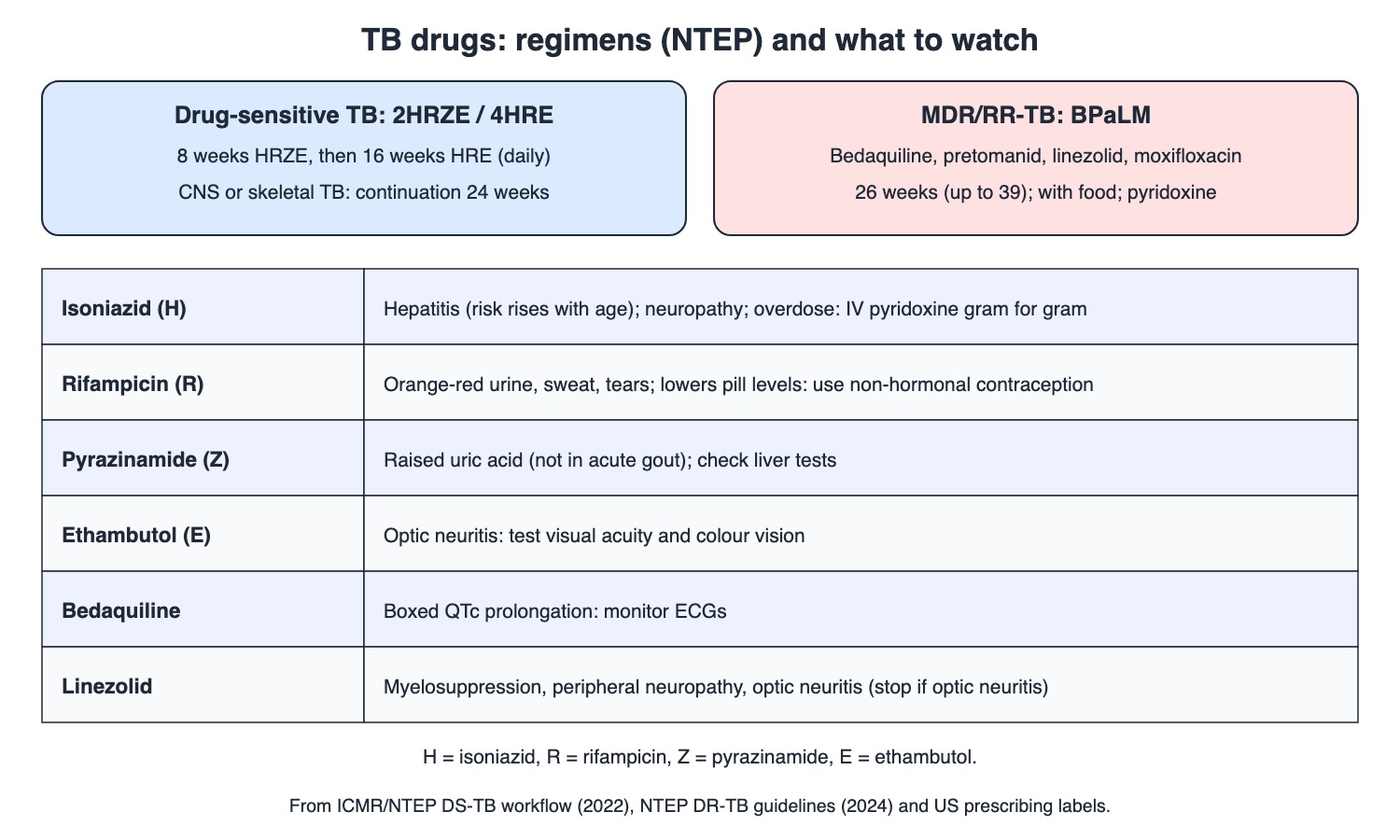
TB regimens under NTEP and the key toxicity of each drug. Drawn by TrackNation.
Drug-sensitive TB: 2HRZE/4HRE — 8 weeks (56 doses) of HRZE, then 16 weeks (112 doses) of HRE; only pyrazinamide is dropped. CNS and skeletal TB: continuation phase extended to 24 weeks.
MDR-TB = resistant to both H and R. BPaLM (bedaquiline, pretomanid, linezolid, moxifloxacin) for 26 weeks (up to 39), taken with food; pyridoxine reduces neuropathy.
Linezolid in BPaLM: optic neuritis of any grade → stop permanently; grade 2 neuropathy → reduce to 300 mg/day.
Other Antibacterials
Drug | Key warning (label) |
Azithromycin | QT prolongation and torsades |
Levofloxacin (fluoroquinolone) | Boxed: tendinitis/tendon rupture, peripheral neuropathy, CNS effects, worsens myasthenia gravis; QT prolongation |
Doxycycline (tetracycline) | Permanent tooth discoloration if used in late pregnancy or under age 8; photosensitivity |
Gentamicin (aminoglycoside) | Nephrotoxicity, vestibular and auditory ototoxicity, neuromuscular blockade; avoid with furosemide |
Co-trimoxazole | Blocks folate synthesis (trimethoprim inhibits DHFR); SJS/TEN; hyperkalaemia at high (PCP) doses |
Clindamycin | Boxed: C. difficile-associated diarrhoea |
Metronidazole | Carcinogenic in rodents (avoid unnecessary use); encephalopathy, neuropathy; psychosis with disulfiram |
Nitrofurantoin | Pulmonary reactions; not if CrCl < 60 mL/min; not at term pregnancy (neonatal haemolysis) |
Chloramphenicol | Fatal blood dyscrasias including aplastic anaemia; gray syndrome in newborns |
Traps the Examiner Sets
Rifampicin turns body fluids orange-red and makes the pill unreliable.
Ethambutol: check colour vision. Pyrazinamide: uric acid. Isoniazid: liver and nerves.
Isoniazid overdose: IV pyridoxine gram for gram.
No tetracyclines in late pregnancy or under 8 years.
Aminoglycoside + loop diuretic = more ototoxicity.
Memory Hooks & Shortcuts
Shortcuts to lock in this article's numbers and lists. Each one only re-packages facts proven above.
🧠 RIPE: Red fluids (R), Isoniazid liver and nerves, Pyrazinamide uric acid, Eyes (E) — first-line TB drug toxicities
🧠 2 then 4: HRZE then HRE — intensive then continuation phase
🧠 Quinolones Quit tendons — tendon rupture
🧠 Tetracycline Tints Teeth — permanent discoloration under 8 years
🧠 Gentamicin + Furosemide = Fading hearing — additive ototoxicity
🧠 Chloramphenicol Colours the baby Grey — gray syndrome
Rapid-Revision Cards
DS-TB (NTEP)
2HRZE/4HRE: 56 + 112 doses, daily.
CNS/skeletal TB
Continuation 24 weeks.
MDR-TB
Resistant to H and R.
BPaLM
Bdq, pretomanid, Lzd, moxi; 26 wk (≤ 39); with food.
Linezolid in BPaLM
Optic neuritis → stop; grade 2 neuropathy → 300 mg.
Isoniazid
Hepatitis (age), neuropathy; overdose: IV pyridoxine g-for-g.
Rifampicin
Orange fluids; non-hormonal contraception.
Pyrazinamide
Uric acid; LFTs; not in acute gout.
Ethambutol
Optic neuritis; colour vision.
Bedaquiline
QTc; ECGs.
Fluoroquinolones
Tendon rupture, neuropathy, CNS, myasthenia; QT.
Azithromycin
QT/torsades.
Tetracyclines
Teeth (late pregnancy, < 8 y); photosensitivity.
Aminoglycosides
Nephro-, oto-toxicity, NM block; avoid with furosemide.
Co-trimoxazole
DHFR (TMP); SJS; hyperkalaemia.
Clindamycin
C. difficile.
Metronidazole
Disulfiram psychosis; neuropathy; rodent carcinogen.
Nitrofurantoin
Lungs; CrCl < 60 no; not at term.
Chloramphenicol
Aplastic anaemia; gray baby.
Sources
Facts in this article were checked against these documents.
Standard Treatment Workflow: Drug-Sensitive Tuberculosis (NTEP) — Indian Council of Medical Research / Central TB Division, MoHFW, March 2022
National Guidelines for Management of Drug-Resistant TB — Central TB Division, MoHFW (NTEP), November 2024
Prescribing labels: Zithromax, levofloxacin, doxycycline, gentamicin, Bactrim, Cleocin, Flagyl, Macrobid, chloramphenicol, Rifadin, isoniazid, ethambutol, pyrazinamide, Sirturo — DailyMed, US National Library of Medicine, current labels, accessed November 2026 (link)
Competency Based Undergraduate Curriculum, Pharmacology (PH 8.4–8.6) — National Medical Commission, 2024
Test Yourself: Practice Questions
Twenty-four questions in NEET PG style, most of them clinical vignettes.
Practice Questions (NEET PG pattern)
Original questions written in the style of the exam: +4 for a correct answer, −1 for a wrong one. Every answer was checked against the sources listed above. NEET PG papers are not published by NBEMS, so these are not past-paper questions.
Q1. A new sputum-positive patient with drug-sensitive pulmonary TB starts NTEP treatment. The regimen is
(a) 2HRZE / 4HRE, daily
(b) 2HRZE / 4HR thrice weekly
(c) 6 months of isoniazid alone
(d) BPaLM
Show answer
Answer: (a) — 8 weeks (56 doses) HRZE, then 16 weeks (112 doses) HRE.
Q2. A child with tuberculous meningitis is on NTEP treatment. The continuation phase is
(a) replaced by BPaLM
(b) stopped after 4 weeks
(c) the same 16 weeks
(d) extended to 24 weeks
Show answer
Answer: (d) — CNS and skeletal TB need a longer continuation phase.
Q3. In the continuation phase of drug-sensitive TB treatment, the drug that is stopped is
(a) isoniazid
(b) ethambutol
(c) pyrazinamide
(d) rifampicin
Show answer
Answer: (c) — NTEP: only pyrazinamide is stopped.
Q4. A patient's TB is resistant to both isoniazid and rifampicin but sensitive to fluoroquinolones. NTEP's 6-month regimen is
(a) BPaLM: bedaquiline, pretomanid, linezolid, moxifloxacin
(b) isoniazid preventive therapy
(c) streptomycin alone
(d) 2HRZE/4HRE
Show answer
Answer: (a) — 26 weeks (extendable to 39), with food.
Q5. On BPaLM, a patient develops blurred vision; optic neuritis is diagnosed. NTEP advises
(a) stopping linezolid permanently
(b) adding ethambutol
(c) halving linezolid
(d) continuing unchanged
Show answer
Answer: (a) — Optic neuritis at any grade → permanent discontinuation of linezolid.
Q6. A woman on rifampicin for TB asks about her oral contraceptive pill. The label advises
(a) no change
(b) using non-hormonal contraception, as rifampicin lowers pill levels
(c) stopping TB treatment
(d) doubling the pill
Show answer
Answer: (b) — Rifampicin reduces oral contraceptive exposure.
Q7. A patient two weeks into TB treatment is alarmed that his urine and tears are orange-red. This is due to
(a) rifampicin — harmless discoloration
(b) isoniazid hepatitis
(c) ethambutol
(d) haematuria from pyrazinamide
Show answer
Answer: (a) — Rifadin label (also stains soft contact lenses).
Q8. An elderly man on isoniazid develops jaundice after several months of treatment. The label says isoniazid hepatitis
(a) is harmless
(b) can be severe or fatal, even after months, and its risk rises with age
(c) occurs only in the first week
(d) never happens in the elderly
Show answer
Answer: (b) — Boxed warning.
Q9. A young woman takes a large overdose of isoniazid tablets and is fitting. The specific treatment is
(a) IV pyridoxine, gram for gram with the isoniazid dose
(b) N-acetylcysteine
(c) naloxone
(d) flumazenil
Show answer
Answer: (a) — Isoniazid label overdose section.
Q10. A patient on TB treatment notices difficulty distinguishing red from green. The likely culprit is
(a) ethambutol optic neuritis
(b) rifampicin
(c) isoniazid
(d) pyrazinamide
Show answer
Answer: (a) — Test visual acuity and colour discrimination.
Q11. On TB treatment, a man develops acute gout with a raised serum uric acid. The drug responsible is
(a) isoniazid
(b) ethambutol
(c) pyrazinamide
(d) rifampicin
Show answer
Answer: (c) — Baseline uric acid and LFTs; contraindicated in acute gout.
Q12. Before and during bedaquiline therapy, the boxed warning requires
(a) audiometry
(b) ECG monitoring for QTc prolongation
(c) colour vision tests
(d) uric acid checks
Show answer
Answer: (b) — Sirturo boxed warning.
Q13. A 60-year-old on levofloxacin for pneumonia develops an Achilles tendon rupture. This is
(a) gout
(b) fluoroquinolone-associated tendon rupture
(c) plantar fasciitis
(d) DVT
Show answer
Answer: (b) — Boxed warning: tendinitis, tendon rupture, neuropathy, CNS effects, myasthenia exacerbation.
Q14. A woman with myasthenia gravis needs an antibiotic. Which class carries a boxed warning for worsening myasthenia?
(a) Nitrofurans
(b) Fluoroquinolones
(c) Cephalosporins
(d) Penicillins
Show answer
Answer: (b) — Levofloxacin label.
Q15. A 5-year-old was treated repeatedly with a tetracycline. The permanent effect to expect is
(a) deafness
(b) aplastic anaemia
(c) tendon rupture
(d) yellow-grey-brown tooth discoloration
Show answer
Answer: (d) — Avoid in the last half of pregnancy and under age 8.
Q16. A patient on doxycycline gets an exaggerated sunburn after a day outdoors. The label calls this
(a) photosensitivity
(b) porphyria
(c) lupus
(d) allergy to sunscreen
Show answer
Answer: (a) — Exaggerated sunburn reaction with tetracyclines.
Q17. A patient with renal impairment on gentamicin is also given IV furosemide and becomes deaf and unsteady. The label explains
(a) aminoglycoside ototoxicity, worsened by potent diuretics
(b) vitamin B12 deficiency
(c) Meniere disease
(d) furosemide allergy
Show answer
Answer: (a) — Avoid gentamicin with ethacrynic acid or furosemide; vestibular and auditory toxicity.
Q18. An HIV patient on high-dose co-trimoxazole for Pneumocystis pneumonia develops a high potassium. The cause is
(a) lab error
(b) trimethoprim at high dose raising potassium
(c) renal tubular acidosis from HIV only
(d) sulfamethoxazole causing hypokalaemia
Show answer
Answer: (b) — Reversible rise in serum potassium.
Q19. A week after clindamycin, a patient has profuse diarrhoea. The label's boxed warning is
(a) tendon rupture
(b) QT prolongation
(c) C. difficile-associated diarrhoea
(d) ototoxicity
Show answer
Answer: (c) — Cleocin boxed warning.
Q20. An alcoholic on disulfiram is given metronidazole and becomes acutely psychotic. The label
(a) recommends higher doses
(b) recommends adding alcohol
(c) says this is unrelated
(d) warns of psychotic reactions with disulfiram; don't combine
Show answer
Answer: (d) — Flagyl label; also encephalopathy and neuropathy.
Q21. A 38-week pregnant woman has cystitis. Nitrofurantoin is
(a) contraindicated at term (risk of neonatal haemolytic anaemia)
(b) only given IV
(c) the best choice at term
(d) safe at any stage
Show answer
Answer: (a) — Also contraindicated if CrCl < 60 mL/min.
Q22. An elderly woman on long-term nitrofurantoin develops cough and breathlessness. Suspect
(a) heart failure only
(b) TB reactivation
(c) asthma
(d) nitrofurantoin pulmonary reaction
Show answer
Answer: (d) — Acute, subacute or chronic pulmonary reactions; stop the drug.
Q23. A newborn on high-dose chloramphenicol develops abdominal distension, vomiting, pallid cyanosis and circulatory collapse. This is
(a) methaemoglobinaemia
(b) kernicterus
(c) neonatal sepsis only
(d) gray syndrome
Show answer
Answer: (d) — Chloramphenicol also causes fatal blood dyscrasias, including aplastic anaemia.
Q24. Co-trimoxazole's trimethoprim component inhibits
(a) cell-wall transpeptidase
(b) the 50S ribosome
(c) dihydrofolate reductase
(d) DNA gyrase
Show answer
Answer: (c) — The two components block two consecutive steps of folate synthesis.
Active Recall
From memory: give the NTEP drug-sensitive and MDR-TB regimens with durations, the key toxicity of each first-line TB drug and of bedaquiline and linezolid, and the main warning for fluoroquinolones, tetracyclines, aminoglycosides, co-trimoxazole, clindamycin, metronidazole, nitrofurantoin and chloramphenicol.