Antimicrobial Principles and Beta-Lactams for NEET PG Pharmacology: WHO AWaRe, ICMR Guidelines, Penicillins, Cephalosporins, Carbapenems
Start Here
🎯 Exam priority: Very high. Expect: AWaRe groups, the antibiotic for typhoid in India, surgical prophylaxis timing, amoxicillin rash in glandular fever, ceftriaxone with calcium, vancomycin infusion reactions and linezolid toxicity.
CBME mapping: PH 8.1–8.3. Indian guidance: ICMR Treatment Guidelines for Antimicrobial Use in Common Syndromes (2nd edition, 2019); ICMR's 2022 revision was not available to download, so 2019 figures are used.
WHO AWaRe and Stewardship
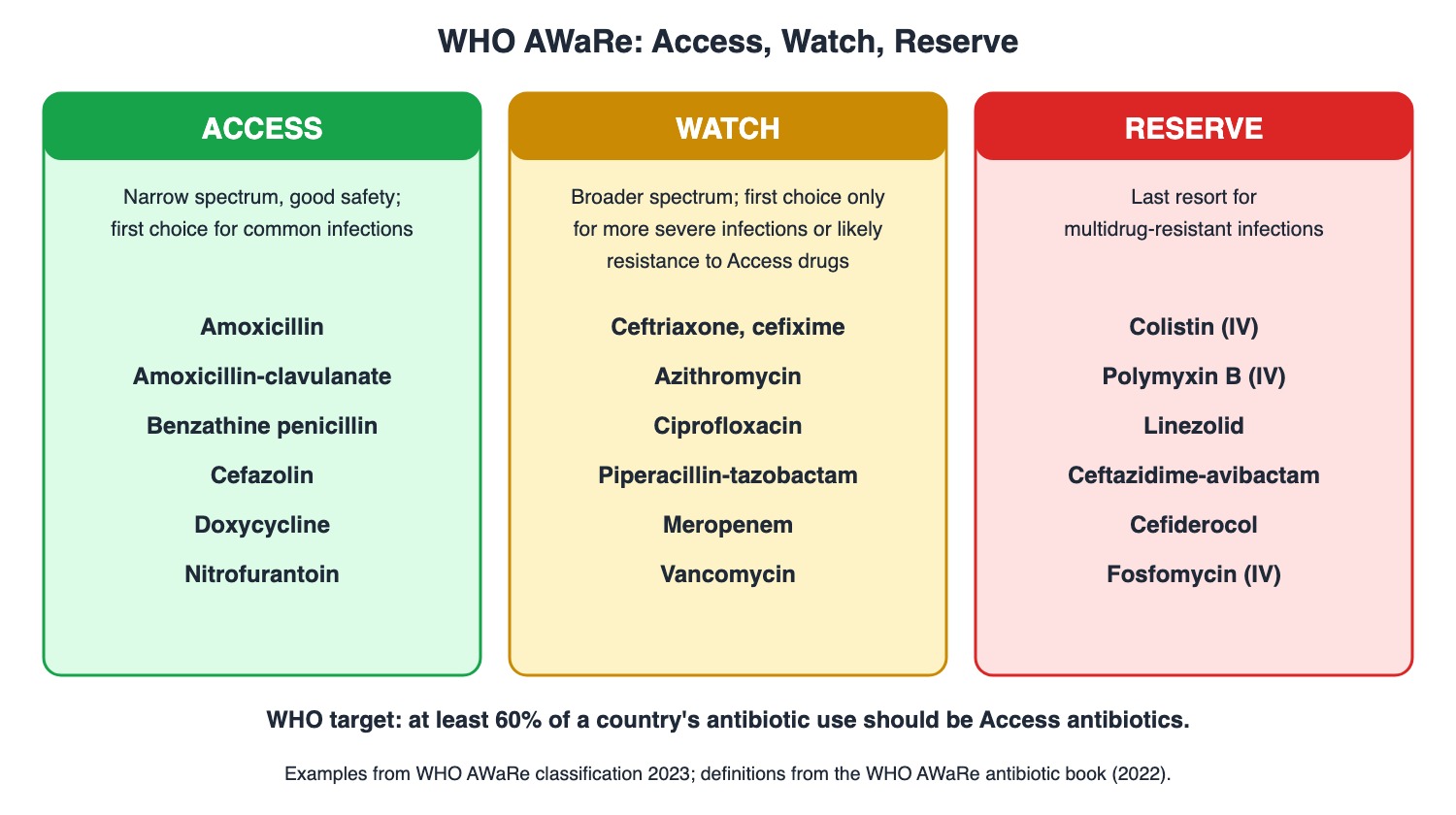
WHO AWaRe groups with examples from the 2023 classification. Drawn by TrackNation.
Access: narrow spectrum, good safety. Watch: broader spectrum; first choice only in more severe infections or where resistance to Access drugs is likely. Reserve: last choice for multidrug-resistant infections.
WHO target: at least 60% of national antibiotic use should be Access antibiotics.
Stewardship (ICMR): coordinated measures to improve choice, dose, duration and route; review empirical therapy and de-escalate once cultures return.
ICMR Choices for Common Syndromes
Typhoid: quinolone resistance up to 69% (S. Typhi) and 23% (S. Paratyphi A); resistance is low to co-trimoxazole, chloramphenicol and third-generation cephalosporins. Preferred: oral cefixime or azithromycin, or IV ceftriaxone; alternatives (co-trimoxazole, chloramphenicol, ciprofloxacin) by susceptibility; 10–14 days.
Acute cystitis: nitrofurantoin is the drug of choice.
Surgical prophylaxis: first dose within 1 hour before incision — e.g. a single IV cefazolin 2 g within 60 minutes before caesarean incision.
Beta-Lactams and Other Key Drugs
Drug (AWaRe group) | Exam point (label / ICMR) |
Amoxicillin (Access) | Rash in most patients with infectious mononucleosis; contraindicated after serious reaction to any beta-lactam |
Amoxicillin-clavulanate (Access) | Contraindicated after Augmentin-associated cholestatic jaundice; pointless if the organism makes no beta-lactamase |
Benzathine penicillin (Access) | Deep IM only — never IV; syphilis, yaws; prevents rheumatic fever recurrence |
Cefazolin (Access) | Surgical prophylaxis: single 2 g IV dose within 60 minutes before incision (ICMR) |
Ceftriaxone (Watch) | Not with calcium-containing IV fluids; contraindicated in premature and hyperbilirubinaemic neonates |
Piperacillin-tazobactam (Watch) | Anti-pseudomonal beta-lactam/beta-lactamase inhibitor |
Meropenem (Watch) | Lowers valproate levels → breakthrough seizures |
Vancomycin (Watch) | Infuse over ≥ 60 minutes (flushing, hypotension if fast); kidney injury; ototoxicity |
Linezolid (Reserve) | Weekly blood counts (myelosuppression); serotonin syndrome; tyramine pressor response |
Colistin (Reserve) | Perioral numbness and paraesthesia; apnoea/neuromuscular block, worse in renal failure |
Traps the Examiner Sets
Typhoid in India: not ciprofloxacin first (high resistance) — ceftriaxone, cefixime or azithromycin.
Prophylactic antibiotic goes in within 60 minutes before the incision, not after.
Benzathine penicillin given IV can be fatal.
Meropenem in an epileptic on valproate → seizures.
Linezolid and colistin are Reserve; vancomycin and carbapenems are Watch.
Memory Hooks & Shortcuts
Shortcuts to lock in this article's numbers and lists. Each one only re-packages facts proven above.
🧠 Traffic light: Green Access, Amber Watch, Red Reserve — AWaRe colour logic
🧠 Sixty goes Green — ≥ 60% Access target
🧠 Typhoid: Cipro Can't (69% resistant) — use ceftriaxone, cefixime or azithromycin
🧠 Cut within the hour — prophylactic antibiotic ≤ 60 minutes before incision
🧠 Bicillin in a Bottom, never a Bag — deep IM only, never IV
🧠 Mero Muffles valproate — seizures from lower valproate levels
🧠 Vanco Very slow (60 min) — infusion reaction if fast
Rapid-Revision Cards
AWaRe Access
Narrow spectrum, safe: amoxicillin, co-amoxiclav, benzathine penicillin, cefazolin, doxycycline, nitrofurantoin.
AWaRe Watch
Ceftriaxone, cefixime, azithromycin, ciprofloxacin, pip-tazo, meropenem, vancomycin.
AWaRe Reserve
Colistin, polymyxin B, linezolid, ceftazidime-avibactam, cefiderocol, IV fosfomycin.
WHO Access target
≥ 60% of national use.
Stewardship (ICMR)
Right drug, dose, duration, route; de-escalate.
Typhoid resistance (ICMR)
Quinolones up to 69% (Typhi).
Typhoid choice (ICMR)
Cefixime/azithromycin oral, ceftriaxone IV; 10–14 d.
Acute cystitis (ICMR)
Nitrofurantoin.
Surgical prophylaxis
Cefazolin 2 g IV ≤ 60 min before incision.
Amoxicillin + EBV
Rash.
Beta-lactam allergy
Serious reaction to any β-lactam → avoid amoxicillin.
Augmentin
Avoid after its cholestatic jaundice.
Benzathine penicillin
Deep IM only; syphilis, yaws, RF prophylaxis.
Ceftriaxone
No IV calcium; not in premature/jaundiced neonates.
Meropenem + valproate
Valproate ↓ → seizures.
Vancomycin
≥ 60 min infusion; AKI; ototoxicity.
Linezolid
Weekly CBC; serotonin syndrome; tyramine.
Colistin
Paraesthesia; apnoea in renal failure.
Sources
Facts in this article were checked against these documents.
Treatment Guidelines for Antimicrobial Use in Common Syndromes, 2nd edition — Indian Council of Medical Research, 2019 (link)
The WHO AWaRe (Access, Watch, Reserve) antibiotic book — World Health Organization, 2022 (link)
WHO AWaRe classification of antibiotics, 2023 (EML web annex C) — World Health Organization, 2023 (link)
Prescribing labels: amoxicillin, Augmentin, Bicillin L-A, ceftriaxone, Zosyn, meropenem, vancomycin, Coly-Mycin M, Zyvox — DailyMed, US National Library of Medicine, current labels, accessed November 2026 (link)
Competency Based Undergraduate Curriculum, Pharmacology (PH 8.1–8.3) — National Medical Commission, 2024
Test Yourself: Practice Questions
Twenty-four questions in NEET PG style, most of them clinical vignettes.
Practice Questions (NEET PG pattern)
Original questions written in the style of the exam: +4 for a correct answer, −1 for a wrong one. Every answer was checked against the sources listed above. NEET PG papers are not published by NBEMS, so these are not past-paper questions.
Q1. In the WHO AWaRe classification, amoxicillin belongs to the
(a) Watch group
(b) Access group
(c) Not-recommended group
(d) Reserve group
Show answer
Answer: (b) — Access: narrow spectrum, good safety.
Q2. Ceftriaxone and ciprofloxacin are both in which AWaRe group?
(a) Reserve
(b) Not recommended
(c) Watch
(d) Access
Show answer
Answer: (c) — Broader spectrum; first choice only in selected situations.
Q3. A tertiary hospital uses colistin for carbapenem-resistant Klebsiella. In AWaRe, colistin (IV) is
(a) Access
(b) not classified
(c) Reserve — last resort for multidrug-resistant infections
(d) Watch
Show answer
Answer: (c) — Also Reserve: polymyxin B, linezolid, ceftazidime-avibactam, cefiderocol.
Q4. WHO's national target for antibiotic consumption is that at least
(a) 60% should be Watch antibiotics
(b) 10% should be Reserve
(c) 60% should be Access antibiotics
(d) 90% should be Reserve
Show answer
Answer: (c) — WHO AWaRe book.
Q5. A 22-year-old in Delhi has blood-culture-proven typhoid. Given ICMR's resistance data, a preferred drug is
(a) ciprofloxacin empirically
(b) penicillin G
(c) ceftriaxone (or oral cefixime/azithromycin)
(d) nitrofurantoin
Show answer
Answer: (c) — Quinolone resistance up to 69% for S. Typhi; ICMR prefers cefixime or azithromycin orally, ceftriaxone IV; 10–14 days.
Q6. ICMR's recommended duration of antibiotic treatment for typhoid is
(a) 6 weeks
(b) single dose
(c) 3 days
(d) 10–14 days
Show answer
Answer: (d) — ICMR 2019 Table 2.1.
Q7. A non-pregnant woman has uncomplicated acute cystitis. ICMR's drug of choice is
(a) ceftriaxone
(b) nitrofurantoin
(c) meropenem
(d) colistin
Show answer
Answer: (b) — Nitrofurantoin is also an Access antibiotic.
Q8. For an elective caesarean section, ICMR's antibiotic prophylaxis is
(a) ceftriaxone for 7 days after surgery
(b) a single IV dose of cefazolin 2 g within 60 minutes before incision
(c) meropenem at skin closure
(d) no antibiotic
Show answer
Answer: (b) — First dose within one hour before incision.
Q9. Reviewing a patient on empirical meropenem whose culture grows a sensitive organism, the stewardship action is to
(a) continue meropenem for 6 weeks
(b) add colistin
(c) stop all antibiotics today regardless
(d) de-escalate to a narrower drug
Show answer
Answer: (d) — ICMR: evaluate whether empirical therapy can be justified or de-escalated.
Q10. A teenager with infectious mononucleosis is given amoxicillin and develops a widespread red rash. The explanation is
(a) scarlet fever
(b) true penicillin allergy for life
(c) Stevens-Johnson syndrome
(d) most patients with mononucleosis given amoxicillin develop a rash
Show answer
Answer: (d) — Amoxicillin label.
Q11. A patient had anaphylaxis to a cephalosporin. Amoxicillin is
(a) preferred
(b) safe if given IV
(c) safe
(d) contraindicated (serious reaction to another beta-lactam)
Show answer
Answer: (d) — Label contraindication.
Q12. A man developed cholestatic jaundice during a previous course of amoxicillin-clavulanate. Now
(a) give it IV
(b) only reduce the dose
(c) Augmentin is contraindicated
(d) it is safe to repeat
Show answer
Answer: (c) — Contraindication.
Q13. Benzathine penicillin for secondary prophylaxis of rheumatic fever must be given
(a) IV push
(b) orally
(c) by deep IM injection only — never IV
(d) subcutaneously
Show answer
Answer: (c) — Bicillin L-A boxed statement; also for syphilis and yaws.
Q14. A neonatal unit plans ceftriaxone with calcium-containing IV fluids in a jaundiced premature baby. The label says
(a) safe
(b) contraindicated: risk of ceftriaxone-calcium precipitation; avoid in premature/hyperbilirubinaemic neonates
(c) only reduce the dose
(d) give with extra calcium
Show answer
Answer: (b) — Ceftriaxone label.
Q15. An epileptic on valproate gets meropenem for sepsis and starts having seizures. The cause is
(a) valproate toxicity
(b) meropenem raising valproate levels
(c) meropenem lowering valproate levels
(d) hyponatraemia only
Show answer
Answer: (c) — Breakthrough seizures from reduced valproic acid concentrations.
Q16. During a rapid vancomycin infusion a patient becomes flushed, itchy and hypotensive. The fix is
(a) add calcium
(b) give it as a bolus
(c) infuse over at least 60 minutes
(d) switch to oral route for sepsis
Show answer
Answer: (c) — Infusion reaction; also watch kidney injury and ototoxicity.
Q17. A patient on vancomycin and an aminoglycoside develops rising creatinine. The label warns that vancomycin
(a) only causes rash
(b) causes hypoglycaemia
(c) protects the kidneys
(d) can cause acute kidney injury, more with other nephrotoxins
Show answer
Answer: (d) — Risk rises with exposure.
Q18. A man on linezolid for 3 weeks develops thrombocytopenia. The label advises
(a) doubling the dose
(b) adding an SSRI
(c) no monitoring
(d) weekly complete blood counts (myelosuppression)
Show answer
Answer: (d) — Also serotonin syndrome and a tyramine pressor response.
Q19. A patient on linezolid eats aged cheese and develops a severe headache with high BP. The mechanism is
(a) renal failure
(b) allergy
(c) hypoglycaemia
(d) linezolid's MAO-inhibiting pressor response with tyramine
Show answer
Answer: (d) — Label: significant pressor response with linezolid plus tyramine.
Q20. A patient with renal failure on colistin develops perioral numbness and then breathing difficulty. The concern is
(a) hepatitis
(b) neuromuscular blockade and apnoea, more likely in renal impairment
(c) hypercalcaemia
(d) anaphylaxis to penicillin
Show answer
Answer: (b) — Coly-Mycin M label.
Q21. Augmentin should not be used when culture shows
(a) the organism is amoxicillin-sensitive (no beta-lactamase)
(b) mixed infection
(c) beta-lactamase production
(d) H. influenzae resistance
Show answer
Answer: (a) — Clavulanate adds nothing without beta-lactamase.
Q22. Benzathine penicillin is labelled for the treatment of
(a) typhoid
(b) malaria
(c) tuberculosis
(d) syphilis and yaws
Show answer
Answer: (d) — Also prevents recurrence of rheumatic fever and chorea.
Q23. Which antibiotic is an AWaRe Access drug and the ICMR choice for surgical prophylaxis?
(a) Cefazolin
(b) Meropenem
(c) Linezolid
(d) Colistin
Show answer
Answer: (a) — First-generation cephalosporin.
Q24. ICMR defines antimicrobial stewardship as
(a) banning all antibiotics
(b) coordinated interventions to measure and improve appropriate antibiotic use
(c) giving antibiotics for all fevers
(d) using only Reserve antibiotics
Show answer
Answer: (b) — Optimal choice, dose, duration and route.
Active Recall
From memory: define the three WHO AWaRe groups with examples and the Access target; explain stewardship and de-escalation; give ICMR's choices for typhoid, acute cystitis and surgical prophylaxis; and give the key warning for amoxicillin, co-amoxiclav, benzathine penicillin, ceftriaxone, meropenem, vancomycin, linezolid and colistin.