Genetic Disorders for NEET PG Paediatrics: Down, Edwards, Patau, Turner, Klinefelter, Fragile X, PKU, Galactosaemia, Marfan and RBSK
Start Here
🎯 Exam priority: High. Expect: Down syndrome mechanisms and percentages, maternal-age risk, cardiac and GI associations, trisomy 18 vs 13 clues, Turner karyotype and heart lesions, Klinefelter features, fragile X repeat numbers, PKU enzyme and cofactor, galactosaemia signs, Marfan gene, and RBSK 4Ds.
Fact-checked against the MSD Manual and MoHFW's RBSK 2.0 operational guidelines (2026).
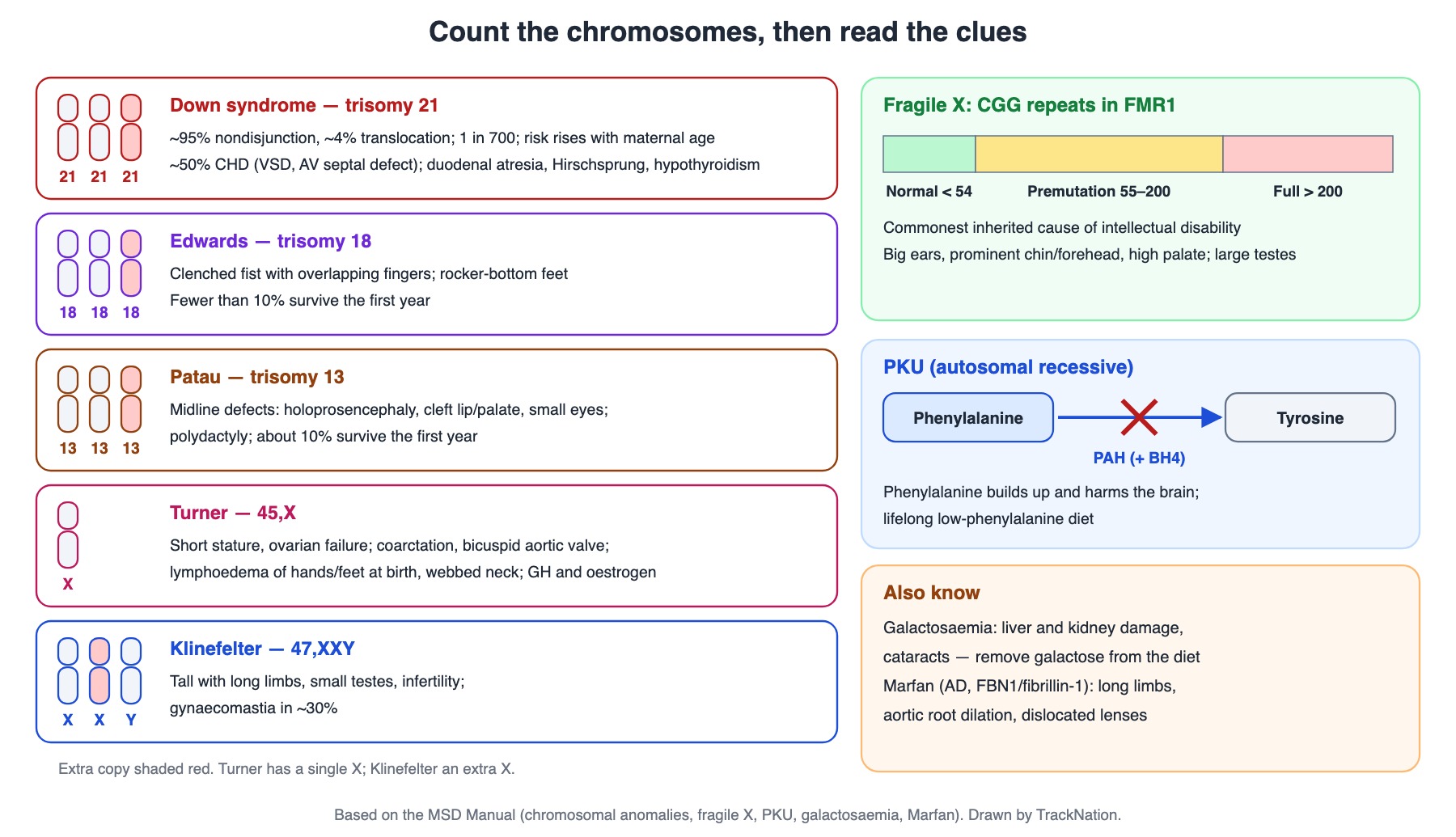
Chromosome counts and key clues for five syndromes, fragile X repeats and the PKU block. Drawn by TrackNation.
Down Syndrome (Trisomy 21)
Mechanism: ~95% nondisjunction (usually maternal), ~4% translocation (check parents for a balanced 21q;21q translocation), the rest mosaicism (milder, variable).
Incidence ~1 in 700; risk rises with maternal age — about 1/1476 at 20, 1/352 at 35, 1/85 at 40.
Associations: hypotonia, intellectual disability; congenital heart disease in ~50% (VSD, AV septal defect); GI anomalies ~6% (duodenal atresia), Hirschsprung and coeliac disease; hypothyroidism; atlantoaxial instability.
Trisomy 18 and 13
Edwards (18): maternal age; clenched fist with index finger overlapping the 3rd and 4th; rocker-bottom feet, clubfeet; fewer than 10% survive the first year.
Patau (13): midline defects — holoprosencephaly, cleft lip/palate, microphthalmia, coloboma; single palmar crease, polydactyly; about 10% survive the first year.
Sex Chromosomes: Turner and Klinefelter
Turner: ~45% are 45,X (80% lose the paternal X), most others mosaic; 99% of 45,X conceptions miscarry. Short stature, ovarian dysgenesis (high gonadotropins, infertility); coarctation, bicuspid aortic valve; newborn lymphoedema of hands and feet, webbed neck. Treat with growth hormone and oestrogen.
Klinefelter (47,XXY): tall with long limbs, small testes, hypergonadotropic hypogonadism, infertility, gynaecomastia in ~30%.
Single-Gene and Metabolic
Fragile X: commonest inherited cause of intellectual disability (and of autism); FMR1 CGG repeats — normal < 54, premutation 55–200, full mutation > 200. Big protruding ears, prominent chin and forehead, high palate, macroorchidism after puberty.
PKU: autosomal recessive deficiency of phenylalanine hydroxylase (cofactor BH4) — phenylalanine cannot become tyrosine and damages the brain; lifelong low-phenylalanine diet.
Galactosaemia: liver and kidney dysfunction, cataracts, cognitive problems, ovarian failure; remove galactose from the diet.
Marfan: autosomal dominant FBN1 (fibrillin-1); long limbs, aortic root dilation (dissection risk), dislocated lenses.
India: RBSK and the 4Ds
Rashtriya Bal Swasthya Karyakram screens children for the 4Ds — Defects at birth, Deficiencies, Diseases, Developmental delays — at delivery points and through mobile teams, with referral to District Early Intervention Centres (DEICs).
Defects at birth on the list include neural tube defects, Down syndrome, cleft lip/palate, club foot, developmental dysplasia of the hip, congenital cataract, congenital deafness, congenital heart disease, retinopathy of prematurity and CAKUT.
Traps the Examiner Sets
Translocation Down syndrome (~4%) is the type where parents need karyotyping.
AV septal (endocardial cushion) defect is the classic Down heart lesion.
Overlapping fingers + rocker-bottom feet = 18; holoprosencephaly + polydactyly + cleft = 13.
Turner: coarctation and bicuspid valve; Klinefelter: tall, small testes.
Fragile X premutation is 55–200 repeats; full mutation > 200.
Memory Hooks & Shortcuts
Shortcuts to lock in this article's numbers and lists. Each one only re-packages facts proven above.
🧠 Down risk '1476-352-85' at 20-35-40 — maternal age
🧠 Edwards = 'Overlapping fingers, Rocker feet'; Patau = 'Puny eyes, Polydactyly, Palate cleft' — trisomies
🧠 Turner 'Short girl, Swollen feet, Squeezed aorta' — Turner
🧠 Fragile X '54-200': under 54 safe, 55–200 pre, over 200 full — fragile X
🧠 RBSK '4D vision': Defects, Deficiencies, Diseases, Delays — RBSK
Rapid-Revision Cards
Down mechanisms
95% nondisjunction; 4% translocation; mosaic.
Down & age
1/1476 at 20 · 1/352 at 35 · 1/85 at 40.
Down heart
~50% CHD: VSD, AV septal.
Down GI
Duodenal atresia; Hirschsprung; coeliac.
Down others
Hypotonia, hypothyroidism, atlantoaxial instability.
Edwards (18)
Overlapping fingers; rocker-bottom feet; < 10% live 1 y.
Patau (13)
Holoprosencephaly, cleft, polydactyly; ~10% live 1 y.
Turner karyotype
45,X ~45% (paternal X lost); rest mosaic.
Turner signs
Short, ovarian dysgenesis, lymphoedema, webbed neck.
Turner heart
Coarctation; bicuspid valve.
Turner Rx
GH + oestrogen.
Klinefelter
47,XXY; tall; small testes; infertile.
Fragile X
FMR1 CGG; commonest inherited ID.
CGG ranges
< 54 / 55–200 / > 200.
Fragile X signs
Big ears, prominent chin, macroorchidism.
PKU
AR; PAH; BH4 cofactor.
PKU Rx
Lifelong low-phe diet.
Galactosaemia
Liver, kidney, cataract; no galactose.
Marfan
AD FBN1; aortic root; ectopia lentis.
RBSK 4Ds
Defects, Deficiencies, Diseases, Delays.
DEIC
District Early Intervention Centre.
Sources
Facts in this article were checked against these documents.
MSD Manual Professional: Down Syndrome; Trisomy 18; Trisomy 13; Turner Syndrome; Klinefelter Syndrome; Fragile X Syndrome; Phenylketonuria; Galactosemia; Marfan Syndrome — Merck & Co., 2025–2026 (link)
Rashtriya Bal Swasthya Karyakram (RBSK 2.0): Operational Guidelines — Ministry of Health and Family Welfare, Government of India, 2026
Test Yourself: Practice Questions
Thirty questions in NEET PG style, many of them newborn-exam scenarios.
Practice Questions (NEET PG pattern)
Original questions written in the style of the exam: +4 for a correct answer, −1 for a wrong one. Every answer was checked against the sources listed above. NEET PG papers are not published by NBEMS, so these are not past-paper questions.
Q1. The commonest mechanism of Down syndrome is
(a) translocation (~95%)
(b) mosaicism (~50%)
(c) maternal nondisjunction (~95%)
(d) paternal deletion
Show answer
Answer: (c) — MSD.
Q2. Translocation accounts for about what share of Down syndrome?
(a) 40%
(b) 95%
(c) 4%
(d) 0.1%
Show answer
Answer: (c) — Karyotype the parents.
Q3. The risk of a Down syndrome birth at maternal age 40 is about
(a) 1 in 1476
(b) 1 in 352
(c) 1 in 10
(d) 1 in 85
Show answer
Answer: (d) — 1/352 at 35.
Q4. About how many babies with Down syndrome have congenital heart disease?
(a) 50%
(b) 90%
(c) 20%
(d) 5%
Show answer
Answer: (a) — VSD and AV septal defect.
Q5. The classic heart lesion of Down syndrome is
(a) TGA
(b) bicuspid valve
(c) atrioventricular septal (endocardial cushion) defect
(d) coarctation
Show answer
Answer: (c) — Also VSD.
Q6. A GI anomaly associated with Down syndrome is
(a) duodenal atresia
(b) biliary atresia
(c) Meckel diverticulum
(d) pyloric stenosis
Show answer
Answer: (a) — Also Hirschsprung.
Q7. The commonest endocrine problem in Down syndrome is
(a) acromegaly
(b) hypothyroidism
(c) hyperparathyroidism
(d) Cushing syndrome
Show answer
Answer: (b) — MSD.
Q8. A newborn has clenched fists with overlapping index fingers and rocker-bottom feet. The karyotype is likely
(a) trisomy 18
(b) 45,X
(c) trisomy 21
(d) trisomy 13
Show answer
Answer: (a) — Edwards.
Q9. Holoprosencephaly, cleft lip and polydactyly suggest
(a) trisomy 21
(b) trisomy 18
(c) trisomy 13
(d) Klinefelter
Show answer
Answer: (c) — Patau.
Q10. Survival beyond 1 year in trisomy 18 is
(a) 100%
(b) about 90%
(c) fewer than 10%
(d) about 50%
Show answer
Answer: (c) — MSD.
Q11. In Turner syndrome, the commonest single karyotype is
(a) 47,XXX
(b) 45,X (~45%)
(c) 47,XXY
(d) 46,XY
Show answer
Answer: (b) — Most others mosaic.
Q12. In 45,X Turner syndrome, the lost X is usually
(a) random
(b) duplicated
(c) paternal
(d) maternal
Show answer
Answer: (c) — 80%.
Q13. A newborn girl with swollen hands and feet and loose neck skin suggests
(a) Klinefelter syndrome
(b) trisomy 18
(c) Down syndrome
(d) Turner syndrome
Show answer
Answer: (d) — Lymphoedema.
Q14. Cardiac lesions typical of Turner syndrome are
(a) TOF
(b) coarctation and bicuspid aortic valve
(c) AV septal defect
(d) PDA
Show answer
Answer: (b) — MSD.
Q15. Turner syndrome is treated with
(a) testosterone
(b) nothing
(c) growth hormone and oestrogen
(d) thyroxine only
Show answer
Answer: (c) — MSD.
Q16. Klinefelter syndrome karyotype is
(a) 45,X
(b) 47,XYY
(c) 46,XX
(d) 47,XXY
Show answer
Answer: (d) — MSD.
Q17. A tall boy with small testes and infertility most likely has
(a) Klinefelter syndrome
(b) fragile X
(c) Marfan syndrome
(d) Turner syndrome
Show answer
Answer: (a) — Gynaecomastia ~30%.
Q18. The commonest inherited cause of intellectual disability is
(a) Down syndrome
(b) PKU
(c) Turner syndrome
(d) fragile X syndrome
Show answer
Answer: (d) — MSD.
Q19. Fragile X full mutation is defined by CGG repeats above
(a) 100
(b) 200
(c) 30
(d) 54
Show answer
Answer: (b) — Premutation 55–200.
Q20. A premutation for fragile X has
(a) 55–200 CGG repeats
(b) no repeats
(c) < 54 repeats
(d) > 200 repeats
Show answer
Answer: (a) — MSD.
Q21. A postpubertal male with intellectual disability, big ears and macroorchidism most likely has
(a) Marfan
(b) Down
(c) fragile X
(d) Klinefelter
Show answer
Answer: (c) — FMR1.
Q22. PKU is due to deficiency of
(a) phenylalanine hydroxylase
(b) tyrosinase
(c) galactose-1-phosphate uridyltransferase
(d) homogentisate oxidase
Show answer
Answer: (a) — MSD.
Q23. The cofactor needed by phenylalanine hydroxylase is
(a) thiamine
(b) tetrahydrobiopterin (BH4)
(c) pyridoxine
(d) biotin
Show answer
Answer: (b) — MSD.
Q24. PKU is treated with
(a) enzyme replacement only
(b) nothing after 5 years
(c) galactose-free diet
(d) lifelong phenylalanine restriction
Show answer
Answer: (d) — MSD.
Q25. A newborn with liver dysfunction and cataracts after milk feeds suggests
(a) PKU
(b) galactosaemia
(c) Down syndrome
(d) Marfan
Show answer
Answer: (b) — Remove galactose.
Q26. Marfan syndrome is caused by
(a) autosomal dominant FBN1 (fibrillin-1) variants
(b) PAH deficiency
(c) trisomy
(d) X-linked dystrophin
Show answer
Answer: (a) — MSD.
Q27. The classic triad of Marfan recognition is
(a) cataract, liver failure, sepsis
(b) eczema, infections, low platelets
(c) long limbs, aortic root dilation, dislocated lenses
(d) short stature, webbed neck, coarctation
Show answer
Answer: (c) — MSD.
Q28. RBSK screens children for the 4Ds:
(a) Diabetes, Dwarfism, Dyslexia, Delirium
(b) Drugs, Diet, Disability, Death
(c) Diarrhoea, Dengue, Diphtheria, Deafness
(d) Defects at birth, Deficiencies, Diseases, Developmental delays
Show answer
Answer: (d) — MoHFW.
Q29. Children identified under RBSK are referred to
(a) only private hospitals
(b) AIIMS only
(c) no referral
(d) District Early Intervention Centres (DEICs)
Show answer
Answer: (d) — MoHFW.
Q30. Which is on the RBSK 'defects at birth' list?
(a) dental caries
(b) Down syndrome
(c) vitamin A deficiency
(d) scabies
Show answer
Answer: (b) — Others in other Ds.
Active Recall
From memory: give the mechanisms, maternal-age risk and associations of Down syndrome, the clues of trisomy 18 and 13, Turner and Klinefelter features, fragile X repeat ranges, PKU and galactosaemia basics, Marfan features, and the RBSK 4Ds.