Paediatric GI and Liver for NEET PG: Oesophageal Atresia, Pyloric Stenosis, Duodenal Atresia, Volvulus, Intussusception, Hirschsprung, Meckel and Biliary Atresia
Start Here
🎯 Exam priority: High. Expect: age and acid–base of pyloric stenosis, double bubble and Down syndrome, bilious vomiting = volvulus until proved otherwise, intussusception age and stool, Hirschsprung biopsy, Meckel scan, omphalocele vs gastroschisis, physiological reflux, the cholestasis threshold and Kasai timing.
CBME mapping: PE26. Fact-checked against the MSD Manual (paediatric gastrointestinal and congenital anomaly chapters).
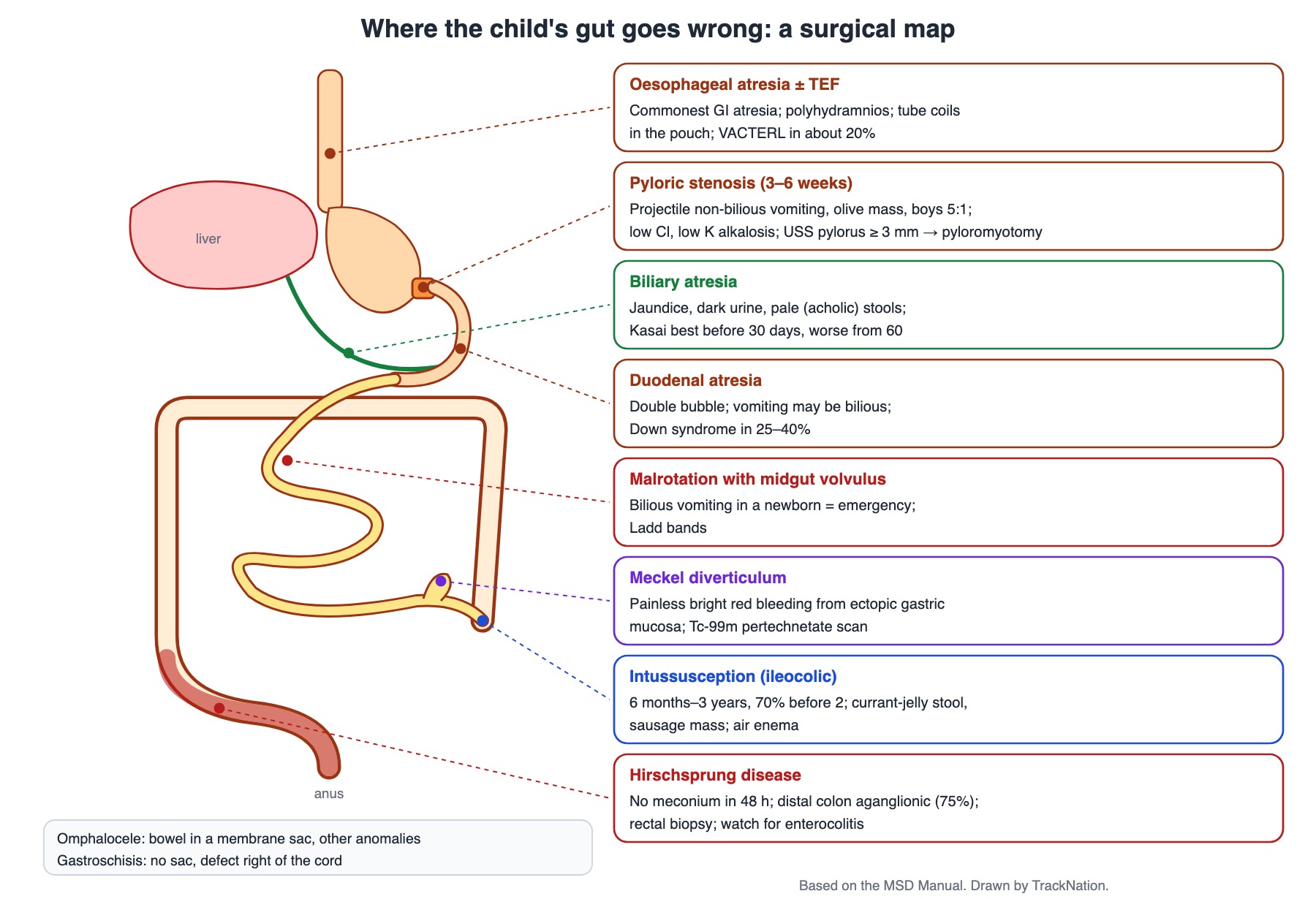
Where each surgical GI condition sits along a child's gut. Drawn by TrackNation.
Top of the Gut: Oesophagus, Pylorus, Duodenum
Oesophageal atresia (often with tracheo-oesophageal fistula): the commonest GI atresia. Suspected from polyhydramnios or aspiration; confirmed when a nasogastric tube will not pass and coils in the pouch on X-ray. About 20% have VACTERL association.
Hypertrophic pyloric stenosis: 3–6 weeks, rarely after 12; boys 5:1, especially firstborn. Projectile non-bilious vomiting after feeds in a hungry baby; olive mass; hypochloraemic hypokalaemic metabolic alkalosis. Ultrasound pylorus ≥ 3 mm thick; pyloromyotomy.
Duodenal atresia: second commonest atresia; double bubble; vomiting may be bilious; Down syndrome in 25–40%.
Mid and Lower Gut
Malrotation with midgut volvulus: twisting around the mesenteric stalk cuts the blood supply — bilious vomiting in a newborn is a surgical emergency; Ladd bands can obstruct the duodenum.
Intussusception: 6 months–3 years (70% before 2), mostly ileocolic. Colicky pain, then lethargy, currant-jelly stool, sausage-shaped mass. Reduce with an air enema; surgery if needed.
Hirschsprung disease: no ganglion cells (Meissner and Auerbach plexuses) — neural-crest cells failed to migrate. Most fail to pass meconium in 48 hours (normal babies pass it within 24); usually the distal colon (75%). Barium enema suggests it; rectal biopsy confirms. Danger: enterocolitis. Linked with Down syndrome.
Meckel diverticulum: persistent vitelline duct on the antimesenteric ileum, commoner in boys; ectopic gastric mucosa (up to 71%) causes painless bright red bleeding; Tc-99m pertechnetate scan.
Omphalocele: viscera in a membrane sac, look for other anomalies. Gastroschisis: full-thickness defect, no sac, usually right of the cord.
Reflux and the Yellow Baby Beyond 2 Weeks
Physiological reflux (spitting, wet burps) happens in almost all infants, rises at 2–6 months and falls after 7 months — reassure. GERD = reflux with complications (irritability, bleeding, respiratory problems, poor growth): start with feeding changes and positioning.
Neonatal cholestasis: direct (conjugated) bilirubin > 1 mg/dL; dark urine, pale (acholic) stools, hepatomegaly. Any baby still jaundiced after 2 weeks (3 weeks if breastfed and well) needs total and direct bilirubin.
Biliary atresia: jaundice, dark urine, acholic stools, hepatosplenomegaly; cirrhosis can develop by 2 months. Kasai portojejunostomy does best before 30 days; results worsen from 60 days; otherwise liver transplant.
Traps the Examiner Sets
Pyloric stenosis vomit is non-bilious; the alkalosis is hypochloraemic and hypokalaemic.
Bilious vomiting in a neonate = malrotation/volvulus until proved otherwise.
Double bubble + Down syndrome = duodenal atresia.
Hirschsprung is diagnosed by rectal biopsy, not by enema alone.
Pale stools with prolonged jaundice = cholestasis — check direct bilirubin; biliary atresia needs Kasai early.
Memory Hooks & Shortcuts
Shortcuts to lock in this article's numbers and lists. Each one only re-packages facts proven above.
🧠 Pyloric stenosis: 'firstborn boy, 3–6 weeks, hungry, projectile, olive' — HPS
🧠 'Green vomit = go to theatre' — bilious vomiting in a newborn means volvulus until excluded — volvulus
🧠 Double bubble — Down's double trouble — duodenal atresia
🧠 Hirschsprung '48 hours, biopsy is boss' — Hirschsprung
🧠 Kasai 'thirty is thrifty, sixty is risky' — biliary atresia
Rapid-Revision Cards
Oesophageal atresia
Commonest GI atresia; NG tube coils; VACTERL ~20%.
Pyloric stenosis
3–6 wk; boys 5:1; projectile non-bilious.
HPS metabolic
Hypochloraemic hypokalaemic alkalosis.
HPS diagnosis/Rx
USS ≥ 3 mm; pyloromyotomy.
Duodenal atresia
Double bubble; Down 25–40%.
Bilious vomiting newborn
Malrotation/volvulus — emergency.
Ladd bands
Malrotation.
Intussusception
6 mo–3 y; ileocolic; currant jelly; sausage.
Intussusception Rx
Air enema.
Hirschsprung
No meconium by 48 h; distal colon 75%.
Hirschsprung test
Rectal biopsy (aganglionosis).
Hirschsprung danger
Enterocolitis.
Meckel
Vitelline duct; gastric mucosa; painless bleed.
Meckel scan
Tc-99m pertechnetate.
Omphalocele
Sac; associated anomalies.
Gastroschisis
No sac; right of cord.
Physiological reflux
Peaks 2–6 mo; falls after 7; reassure.
GERD
Reflux + complications; feeding changes first.
Cholestasis
Direct bilirubin > 1 mg/dL; pale stools.
Jaundice > 2 weeks
Check direct bilirubin.
Biliary atresia
Kasai < 30 d best; worse ≥ 60 d.
Sources
Facts in this article were checked against these documents.
MSD Manual Professional: Esophageal Atresia; Hypertrophic Pyloric Stenosis; Duodenal Obstruction; Malrotation; Intussusception; Hirschsprung Disease; Meckel Diverticulum; Omphalocele; Gastroschisis; GER in Infants; Neonatal Cholestasis; Biliary Atresia — Merck & Co., 2025–2026 (link)
Test Yourself: Practice Questions
Thirty questions in NEET PG style, many of them newborn and casualty scenarios.
Practice Questions (NEET PG pattern)
Original questions written in the style of the exam: +4 for a correct answer, −1 for a wrong one. Every answer was checked against the sources listed above. NEET PG papers are not published by NBEMS, so these are not past-paper questions.
Q1. The commonest gastrointestinal atresia is
(a) oesophageal atresia
(b) anal atresia
(c) jejunal atresia
(d) duodenal atresia
Show answer
Answer: (a) — Duodenal is second.
Q2. A newborn chokes on the first feed and the nasogastric tube will not pass. Diagnosis?
(a) duodenal atresia
(b) GERD
(c) pyloric stenosis
(d) oesophageal atresia
Show answer
Answer: (d) — Tube coils in the pouch.
Q3. About what share of infants with oesophageal atresia have VACTERL association?
(a) 20%
(b) 60%
(c) 2%
(d) 90%
Show answer
Answer: (a) — MSD.
Q4. Pyloric stenosis typically presents at
(a) 2 years
(b) birth
(c) 6 months
(d) 3–6 weeks of age
Show answer
Answer: (d) — Rare after 12 weeks.
Q5. The vomiting of pyloric stenosis is
(a) faeculent
(b) bilious
(c) bloody
(d) projectile and non-bilious
Show answer
Answer: (d) — Hungry baby.
Q6. The metabolic picture of pyloric stenosis is
(a) hyperkalaemia
(b) hypernatraemic acidosis
(c) metabolic acidosis
(d) hypochloraemic hypokalaemic metabolic alkalosis
Show answer
Answer: (d) — MSD.
Q7. Pyloric stenosis is confirmed by ultrasound showing pyloric thickness of at least
(a) 3 mm
(b) 10 mm
(c) 1 mm
(d) 15 mm
Show answer
Answer: (a) — Elongated pylorus.
Q8. Treatment of pyloric stenosis is
(a) endoscopic dilatation
(b) gastrojejunostomy
(c) pyloromyotomy
(d) antacids
Show answer
Answer: (c) — MSD.
Q9. The 'double bubble' sign points to
(a) intussusception
(b) pyloric stenosis
(c) duodenal atresia
(d) Hirschsprung disease
Show answer
Answer: (c) — MSD.
Q10. Duodenal atresia is strongly associated with
(a) cystic fibrosis
(b) Down syndrome
(c) Turner syndrome
(d) Marfan syndrome
Show answer
Answer: (b) — 25–40%.
Q11. Bilious vomiting in a 3-day-old who was well suggests first
(a) overfeeding
(b) pyloric stenosis
(c) GERD
(d) malrotation with midgut volvulus
Show answer
Answer: (d) — Surgical emergency.
Q12. Fibrous bands crossing the duodenum in malrotation are
(a) Meckel bands
(b) Treves bands
(c) Ladd bands
(d) adhesions
Show answer
Answer: (c) — MSD.
Q13. Intussusception most commonly occurs at
(a) 6 months to 3 years
(b) adolescence
(c) the first week
(d) 8–12 years
Show answer
Answer: (a) — 70% before 2.
Q14. The commonest type of intussusception is
(a) colocolic
(b) ileoileal
(c) ileocolic
(d) jejunojejunal
Show answer
Answer: (c) — MSD.
Q15. A 9-month-old with colicky pain every 15–20 minutes passes red jelly-like stool; a sausage-shaped mass is felt. Diagnosis?
(a) Meckel diverticulum
(b) dysentery
(c) intussusception
(d) volvulus
Show answer
Answer: (c) — Currant-jelly stool.
Q16. First-line treatment for uncomplicated ileocolic intussusception is
(a) observation
(b) air enema reduction
(c) antibiotics
(d) laparotomy for all
Show answer
Answer: (b) — MSD.
Q17. Hirschsprung disease results from
(a) vascular occlusion
(b) mucosal atrophy
(c) smooth muscle hypertrophy
(d) absent ganglion cells due to failed neural-crest migration
Show answer
Answer: (d) — Meissner and Auerbach plexuses.
Q18. Most babies with Hirschsprung disease fail to pass meconium within
(a) 48 hours
(b) 12 hours
(c) 7 days
(d) 1 month
Show answer
Answer: (a) — Normal babies within 24 h.
Q19. Definitive diagnosis of Hirschsprung disease is by
(a) rectal biopsy
(b) plain X-ray
(c) barium enema
(d) ultrasound
Show answer
Answer: (a) — Enema only suggests.
Q20. A feared complication of Hirschsprung disease is
(a) pyloric stenosis
(b) biliary atresia
(c) intussusception
(d) enterocolitis
Show answer
Answer: (d) — Can be fatal.
Q21. Meckel diverticulum is a remnant of the
(a) ductus arteriosus
(b) urachus
(c) thyroglossal duct
(d) vitelline (omphalomesenteric) duct
Show answer
Answer: (d) — Antimesenteric ileum.
Q22. A 2-year-old has painless bright red rectal bleeding. The best test for Meckel diverticulum is
(a) Tc-99m pertechnetate scan
(b) colonoscopy
(c) CT angiography only
(d) barium meal
Show answer
Answer: (a) — Detects ectopic gastric mucosa.
Q23. Bleeding from Meckel diverticulum comes from
(a) pancreatic enzymes
(b) polyps
(c) acid from ectopic gastric mucosa ulcerating the ileum
(d) angiodysplasia
Show answer
Answer: (c) — MSD.
Q24. An abdominal wall defect to the right of the cord with bowel and no sac is
(a) omphalocele
(b) umbilical hernia
(c) gastroschisis
(d) bladder exstrophy
Show answer
Answer: (c) — Omphalocele has a membrane.
Q25. Omphalocele differs from gastroschisis because it has
(a) a membrane covering and more associated anomalies
(b) only liver outside
(c) no covering
(d) always a better outcome
Show answer
Answer: (a) — Look for other anomalies.
Q26. A thriving 4-month-old spits up after feeds. Best management?
(a) fundoplication
(b) PPI
(c) barium meal
(d) reassurance
Show answer
Answer: (d) — Physiological reflux.
Q27. Physiological reflux in infants usually starts to decrease after
(a) 1 month
(b) 7 months
(c) 5 years
(d) 3 years
Show answer
Answer: (b) — Peaks 2–6 months.
Q28. Neonatal cholestasis is defined as direct bilirubin above
(a) 10 mg/dL
(b) 5 mg/dL
(c) 0.1 mg/dL
(d) 1 mg/dL
Show answer
Answer: (d) — MSD.
Q29. A formula-fed baby still yellow at 3 weeks with pale stools needs
(a) reassurance
(b) stop formula
(c) total and direct bilirubin to look for cholestasis
(d) phototherapy only
Show answer
Answer: (c) — Jaundice beyond 2 weeks.
Q30. The Kasai portoenterostomy for biliary atresia has the best outcome when done
(a) at 1 year
(b) before 30 days of life
(c) after transplant
(d) after 3 months
Show answer
Answer: (b) — Worse from 60 days.
Active Recall
From memory: place each surgical GI condition along the gut and give its age, key sign, test and treatment; contrast omphalocele and gastroschisis; explain physiological reflux vs GERD; define neonatal cholestasis and when to test; and give Kasai timing for biliary atresia.