Read This First: Indian Society for UPSC GS1 Mains, the Playlist Map, Every Society Question 2019-2026 and How to Answer
Start Here: What This Playlist Covers
🎯 Start here. Indian Society is a block of General Studies Paper 1 in the Mains. It is short on facts and long on argument, so the method matters as much as the content. This page maps the playlist, shows every society question UPSC set in the papers we hold, and sets out how to write these answers.
The syllabus names nine things: the salient features of Indian society and its diversity; the role of women and women's organisations; population and associated issues; poverty and developmental issues; urbanisation, its problems and remedies; the effects of globalisation on Indian society; social empowerment; and communalism, regionalism and secularism.
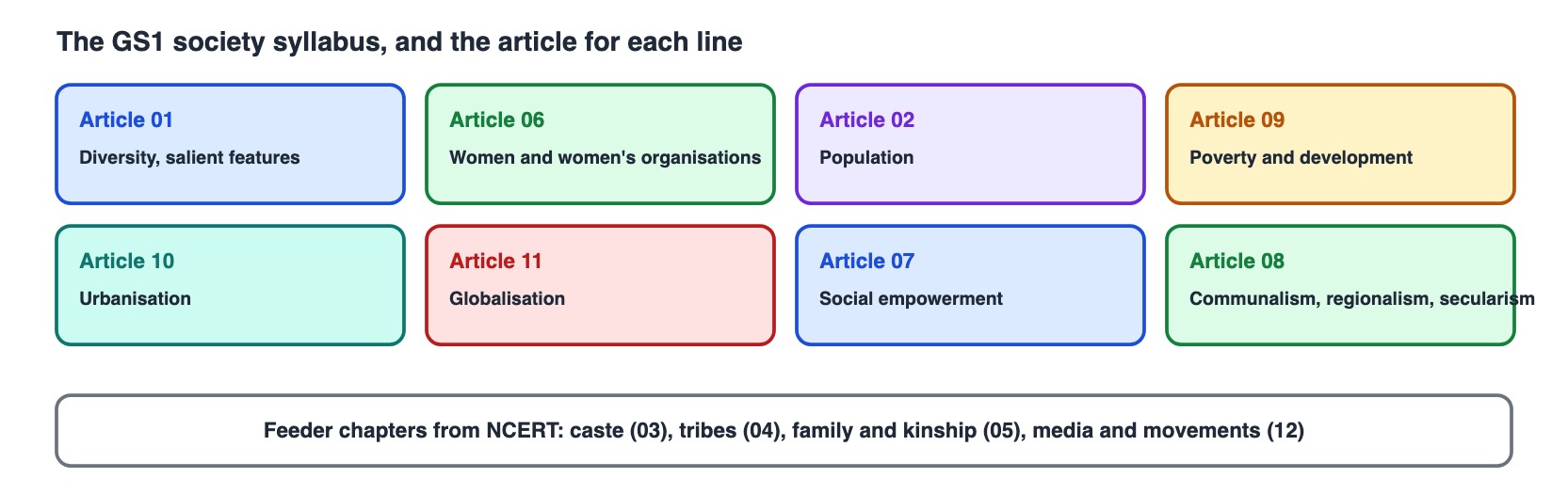
The society syllabus line by line, with the article that covers each.
Every article is built from the two NCERT Class 12 Sociology books (Indian Society and Social Change and Development in India) in chapter order, brought up to date with official data, and ends with the real questions it prepares you for.
What is in this playlist
# | Article | Main ideas |
1 | Salient features and unity in diversity | Continuity and change, unity in diversity, 'small India' pockets |
2 | Population and demographic transition | Demographic transition, dividend, ageing, sex ratio, 'demographic winter' |
3 | Caste: continuity and change | Caste as fluid and static, sect, caste in cities, affirmative action |
4 | Tribal communities | Who counts as tribal, knowledge systems, displacement and rehabilitation |
5 | Family, kinship and marriage | Forms of family, marriage as sacrament or contract, technology and the family |
6 | Women: role, issues and organisations | Equality, equity and empowerment; work, safety, migration; the women's movement |
7 | Social empowerment, disability and inclusion | Disability, affirmative action, working with NGOs |
8 | Communalism, regionalism and secularism | Indian secularism, regional disparity and diversity |
9 | Poverty and development | Poverty and inequality, growth versus the needs of the poor |
10 | Urbanisation and migration | Cities, migrants, Tier-2 growth, segregation of the poor |
11 | Globalisation and Indian society | Identity, consumer culture, youth, technology |
12 | Media, digital technology and social movements | Mobile phones and children, digital empowerment, movements |
Every Society Question, by Theme
UPSC asks about six society questions in every GS Paper 1. Here are all of them from the 2019 and 2021-2026 papers (UPSC's site does not list the 2016-2018 or 2020 papers).
Every society question, by theme
Theme (article) | Questions |
Diversity and continuity (1) | 2019: what makes Indian society unique in sustaining its culture; 'cultural pockets of small India'. 2021: continuity in traditional social values. 2024: cultural diversities and socio-economic marginalities. 2026: unity in diversity despite communalism and regionalism |
Population (2) | 2019: 'Empowering women is the key to control population growth'. 2021: population education. 2024: 'demographic winter'; why large cities attract more migrants. 2026: challenges of demographic transition |
Caste (3) | 2022: salience of 'sect' against caste, region and religion. 2023: why caste identity is both fluid and static. 2024: inter-caste and inter-religious marriages. 2026: is caste disappearing in urban India? |
Tribes (4) | 2021: tribal knowledge systems. 2022: when should diverse tribes be treated as a single category? 2025: displacement and rehabilitation |
Family (5) | 2022: work from home and family relationships. 2023: marriage as a sacrament; mobile phones and the socialisation of children |
Women (6) | 2019: continued challenges for women. 2021: the gig economy and women. 2023: suicide among young women. 2024: gender equality, equity and empowerment; urban migration of young unmarried women |
Empowerment (7) | 2024: affirmative action not reaching the underprivileged; government, NGO and private-sector collaboration. 2026: disability and an inclusive policy framework |
Communalism, regionalism, secularism (8) | 2019: cultural practices and secularism. 2022: tolerance, assimilation and pluralism in Indian secularism. 2023: post-liberal economy, ethnic identity and communalism. 2024: regional disparity versus diversity |
Poverty (9) | 2025: sustainable growth versus poor people's needs |
Urbanisation (10) | 2021: IT industries in big cities. 2022: Tier-2 cities and the new middle class. 2023: urbanisation and segregation of the poor. 2025: smart cities, urban poverty and distributive justice |
Globalisation (11) | 2019: local versus global identity. 2021: cryptocurrency and society. 2022: globalisation and new technology. 2025: consumer culture; fast food. 2026: globalisation and youth |
Media and technology (12) | 2023: mobile phones and children (with 5). 2026: does digital technology promote social empowerment? |
The pattern. Questions 1-10 carry 10 marks and 150 words; 11-20 carry 15 marks and 250 words. Society questions are rarely factual. They ask for a judgment ("Do you think...", "Is caste disappearing...", "Critically analyse...") about change in everyday life: marriage, family, caste in cities, women's work, young people, phones. Since 2022 almost every paper has tied society to technology or the economy.
How to Write a Society Answer
A method for writing these answers:
How to write a society answer
Define the concept first, the way sociology uses it: caste as a system of hereditary groups, secularism in its Indian sense, demographic transition as a sequence of stages. One precise sentence earns more than a paragraph of opinion.
Show both continuity and change. The NCERT books return to this again and again: institutions such as caste, family and religion change form without disappearing. "Both fluid and static" is the shape of most good answers.
Use one fact and one example per point: a Census, NFHS or survey figure, a law, a court judgment or a scheme. Each article gives you these, with the year.
Take a position and qualify it. "Is caste disappearing in urban India?" wants a reasoned answer (it is weakening in some spheres and persisting in others), not a list.
End with a constructive way forward tied to the Constitution's values: equality, dignity, fraternity.
Related playlists: Modern History (social reform movements), Polity (fundamental rights, reservations, the Fifth and Sixth Schedules), Government Schemes (women, tribal, disability and welfare schemes) and Geography (population and settlements).