Salient Features of Indian Society and Unity in Diversity for UPSC: Ascriptive Identity, the State-Nation, Linguistic States and Sanskritisation
What Makes Indian Society Diverse
🎯 Exam priority: High-yield (Mains). Diversity and continuity were asked in 2019 (twice), 2021, 2024 and 2026. Learn the concepts (ascriptive identity, nation-state and 'state-nation', assimilation and integration, Sanskritisation) and use them by name.
Sociology starts by asking you to unlearn common sense. What we "know" about society comes from the viewpoint of our own group, so it is partial in two senses: incomplete, and biased. The discipline trains self-reflexivity, the habit of looking at yourself from the outside, and, in C. Wright Mills's phrase, linking "personal troubles" to "social issues". Bring this lens to every society answer.
What makes Indian society diverse
Diversity stresses differences, not inequalities: many communities marked by language, religion, sect, race or caste living within one nation. It becomes a challenge when such identities compete, when cultural difference overlaps with economic inequality, and when scarce resources (river water, jobs, government funds) have to be shared.
Marker | The scale (Census 2011 and the Constitution) |
Population | About 1.21 billion in 2011 |
Language | 22 languages in the Eighth Schedule of the Constitution; Sindhi added in 1967, Konkani, Manipuri and Nepali in 1992, and Bodo, Dogri, Maithili and Santhali in 2003 |
Religion | About 80% Hindu (themselves regionally specific, plural in belief and divided by caste and language), 14.2% Muslim, 2.3% Christian, 1.7% Sikh, 0.7% Buddhist, 0.4% Jain |
Caste and tribe | Many caste groups (jatis) and tribal communities, each with its own customs (see articles 3 and 4) |
Small percentages are large numbers in India: the religious minorities together run into tens of crores of people.
Why community identity is so powerful
Ascriptive: community identity comes by birth and "belonging", not by achievement. Nobody chooses a family, mother tongue or religion at birth, yet the attachment is total and hard to shake off: others keep identifying us by it.
Universal: nearly everyone has a motherland, a mother tongue, a family and a faith, and is loyal to them. So conflicts between communities produce "mirror images": each side sees itself as right and the other as the enemy.
Overlapping circles: family, kinship, caste, ethnicity, language, region and religion give a person layered identities. That is why a threat to any one of them can provoke an emotional, even violent, response.
Unity in Diversity: Nation-State or State-Nation
The real question is how a state treats the many communities that make up its nation.
Unity in diversity: nation-state or 'state-nation'?
Nation and state: a nation is a "community of communities" that wants political unity; a state, in Max Weber's definition, is a body that successfully claims a monopoly of legitimate force in a territory. A nation is hard to define by any single trait (language, religion or ethnicity); the closest test is that it has a state of its own.
Two homogenising models (from the UNDP Human Development Report 2004): assimilation pushes everyone to adopt the dominant group's culture, often suppressing others; integration keeps a single national culture in public life and pushes other cultures into the private sphere. Both assume a single national identity, and both alienate minorities, which can intensify the identities they try to erase.
India's model fits neither. The Constitution declares a secular state but does not banish religion or language from public life; communities are explicitly recognised, and minority religions get very strong constitutional protection by international standards. The NCERT text calls India a good example of a "state-nation": many "nations" (ethnic, religious, linguistic, indigenous) coexisting in one polity with multiple, complementary identities. Its problems lie more in implementation than in principle.
Linguistic States as proof: leaders feared in the early 1950s that language-based States would split India further. After Potti Sriramulu died in October 1953, seven weeks into a fast for a Telugu State, Andhra Pradesh was created, and the States Reorganisation Commission's report took effect on 1 November 1956. The result was the reverse of the fear: it proved perfectly possible to be Kannadiga and Indian, Tamil and Indian. Federalism became the means of accommodating regional identity (article 8).
Model | What it does with diversity | Risk |
Assimilation | Everyone adopts the dominant culture | Suppression; alienation of minorities |
Integration | One public national culture; differences kept private | The dominant culture passes as 'national' |
State-nation (India) | Recognises communities in public life; multiple, complementary identities | Majoritarian pressure; gaps in implementation |
Continuity and Change
Indian society also holds on to old forms while changing them. That is the theme of the 2021 question.
Continuity and change: four processes
Process | Meaning | Note |
Sanskritisation | Coined by M.N. Srinivas: a 'low' caste, tribe or group adopts the customs, rituals, beliefs and lifestyle of a higher, especially 'twice-born' (dwija), caste | Pre-dates colonial rule; works differently region by region |
Westernisation | Srinivas: changes in Indian society and culture from over 150 years of British rule, in technology, institutions, ideology and values | Began with a small westernised minority, including many 19th-century reformers |
Modernisation | Improvement in technology and production; later, following the path of Western Europe and North America | Treated as desirable, but not a single path |
Secularisation | In the West, the decline of religion's influence | In India religious consciousness has not simply declined; it has taken new forms |
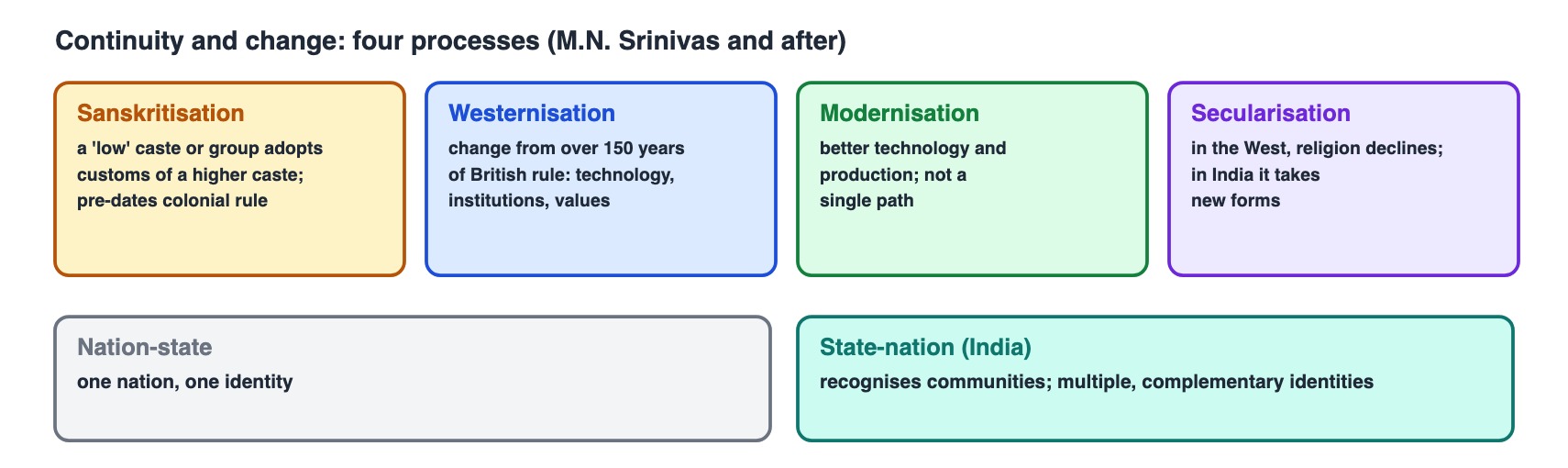
Four processes of continuity and change, and India's state-nation model.
Social reform in the 19th and early 20th centuries attacked sati, child marriage, the ban on widow remarriage and caste discrimination, building on older critiques in Buddhism and the Bhakti and Sufi movements.
How continuity works: institutions such as caste, family and religion adapt rather than vanish. Caste moves from ritual to politics, the joint family survives as a network across cities, and festivals and rituals take on new, often public and commercial, forms. Change and continuity happen together.
Writing the diversity answers
"What makes Indian society unique in sustaining its culture?" Plural traditions that absorbed newcomers, layered identities, the family as transmitter of values, a state that recognises communities, and festivals, pilgrimages and languages that tie regions together.
"Cultural pockets of small India": migrants carry language, food, worship and festivals to cities and industrial towns, creating "mini-Indias", which is the state-nation idea in everyday life.
Diversity and marginality (2024): diversity is about difference; marginality is about inequality. They overlap where a cultural group is also poor, which is why the NCERT text separates the two before linking them.
Unity in diversity and its challenges (2026): define the state-nation, give the linguistic-States evidence, then weigh communalism and regionalism (article 8), and end with constitutional fraternity.
Further Reading
PIB press releases, ministry websites and annual reports, the Gazette of India, MEA and UN documents and the official sources named in each note — the primary sources behind every fact above.
Test Yourself: Practice Questions & PYQs
12 practice questions, then the five GS Paper 1 questions on this theme.
Practice Questions
Q1. In sociology, 'diversity' emphasises
(a) differences between groups rather than inequalities
(b) inequalities of income
(c) the dominance of one culture
(d) conflict between States
Show answer
Answer: (a) — Diversity is about many kinds of communities; inequality is a separate question, though the two can overlap.
Q2. An identity that a person gets by birth rather than by achievement is called
(a) reflexive
(b) acquired
(c) ascriptive
(d) achieved
Show answer
Answer: (c) — Caste, religion, mother tongue and community are ascriptive identities.
Q3. The definition of the state as a body that successfully claims a monopoly of legitimate force in a territory is associated with
(a) M.N. Srinivas
(b) Emile Durkheim
(c) Max Weber
(d) Karl Marx
Show answer
Answer: (c) — The NCERT text quotes Weber's definition while contrasting nation and state.
Q4. Consider the following statements:
1. Assimilation policies try to make all citizens adopt the dominant group's culture.
2. Integration policies keep a single national culture in public life and push other cultures into the private sphere.
3. India follows the assimilationist model.
Which of the statements given above are correct?
(a) 1 and 2 only
(b) 2 and 3 only
(c) 1 and 3 only
(d) 1, 2 and 3
Show answer
Answer: (a) — 1 and 2 are correct. India fits neither model; the NCERT text calls it a 'state-nation'.
Q5. The idea of a 'state-nation', in which many ethnic, religious and linguistic identities coexist in one polity, is drawn in the NCERT text from
(a) the Constituent Assembly debates
(b) the UNDP Human Development Report 2004
(c) the Sachar Committee report
(d) the Census of 2011
Show answer
Answer: (b) — The report used India as an example of a cohesive multicultural democracy.
Q6. How many languages are in the Eighth Schedule of the Constitution?
(a) 14
(b) 18
(c) 22
(d) 24
Show answer
Answer: (c) — Bodo, Dogri, Maithili and Santhali were the last to be added, by the 92nd Amendment (2003).
Q7. Which languages were added to the Eighth Schedule by the 92nd Amendment, 2003?
(a) Sindhi only
(b) Odia and Urdu
(c) Bodo, Dogri, Maithili and Santhali
(d) Konkani, Manipuri and Nepali
Show answer
Answer: (c) — Konkani, Manipuri and Nepali came in 1992 (71st Amendment); Sindhi in 1967 (21st Amendment).
Q8. The recommendations of the States Reorganisation Commission took effect on
(a) 1 May 1960
(b) 26 January 1950
(c) 15 August 1953
(d) 1 November 1956
Show answer
Answer: (d) — Potti Sriramulu's death in October 1953 led first to Andhra Pradesh and then to the Commission.
Q9. The term 'Sanskritisation' was coined by
(a) Andre Beteille
(b) B.R. Ambedkar
(c) M.N. Srinivas
(d) G.S. Ghurye
Show answer
Answer: (c) — It means a lower caste, tribe or group adopting the customs and lifestyle of a higher, especially twice-born, caste.
Q10. According to the NCERT text, which of the four processes of cultural change pre-dates colonial rule?
(a) Secularisation
(b) Sanskritisation
(c) Modernisation
(d) Westernisation
Show answer
Answer: (b) — The other three are understood as responses to the changes colonialism brought.
Q11. Census 2011, as cited in the NCERT text, puts the share of Muslims in India's population at about
(a) 8.6%
(b) 18.4%
(c) 10.5%
(d) 14.2%
Show answer
Answer: (d) — Hindus about 80%, Christians 2.3%, Sikhs 1.7%, Buddhists 0.7%, Jains 0.4%.
Q12. C. Wright Mills's idea that sociology links 'personal troubles' to
(a) 'social issues'
(b) 'religious beliefs'
(c) 'state policy'
(d) 'economic laws'
Show answer
Answer: (a) — A personal trouble concerns one person; a social issue concerns large groups.
Mains Practice Questions
Use these to frame full-length answers. You don't have to answer one exactly — they show the angles UPSC tests, so let them guide which points you cover.
What makes Indian society unique in sustaining its culture? Use the idea of the 'state-nation'.
Unity in diversity remains the defining feature of Indian society despite communalism and regionalism. Comment.
How does Indian society maintain continuity in traditional social values while changing?
UPSC Mains — Previous Years’ Questions on this topic (last 10 years)
These are the actual GS Mains questions UPSC has asked on this theme — real proof of how, and when, it is tested. Try to write a full answer to each.
2019 (GS-I): What makes the Indian society unique in sustaining its culture? Discuss.
2019 (GS-I): Do we have cultural pockets of small India all over the nation? Elaborate with examples.
2021 (GS-I): How does Indian society maintain continuity in traditional social values? Enumerate the changes taking place in it.
2024 (GS-I): Critically analyse the proposition that there is a high correlation between India's cultural diversities and socio-economic marginalities.
2026 (GS-I): Unity in diversity remains the defining feature of Indian society despite the challenges from communalism and regionalism. Comment.