Poisoning for NEET PG Medicine: Organophosphates, Paracetamol, Methanol, Tricyclics, Iron, Lead, CO, Cyanide, Caustics
Start Here
🎯 Exam priority: High. Expect: OP features and atropine/pralidoxime, intermediate syndrome, paracetamol dose, NAPQI, 4-hour level and NAC timing, salicylate acid–base, methanol latency and fomepizole, TCA QRS widening and bicarbonate, iron and deferoxamine, charcoal limits, caustics, CO and pulse oximetry, cyanide and hydroxocobalamin, methylene blue, flumazenil caution.
CBME mapping: GM 22.1–22.13. Medicolegal aspects and many plant poisons are in Forensic Medicine; drug mechanisms in Pharmacology; snakebite in article 26.
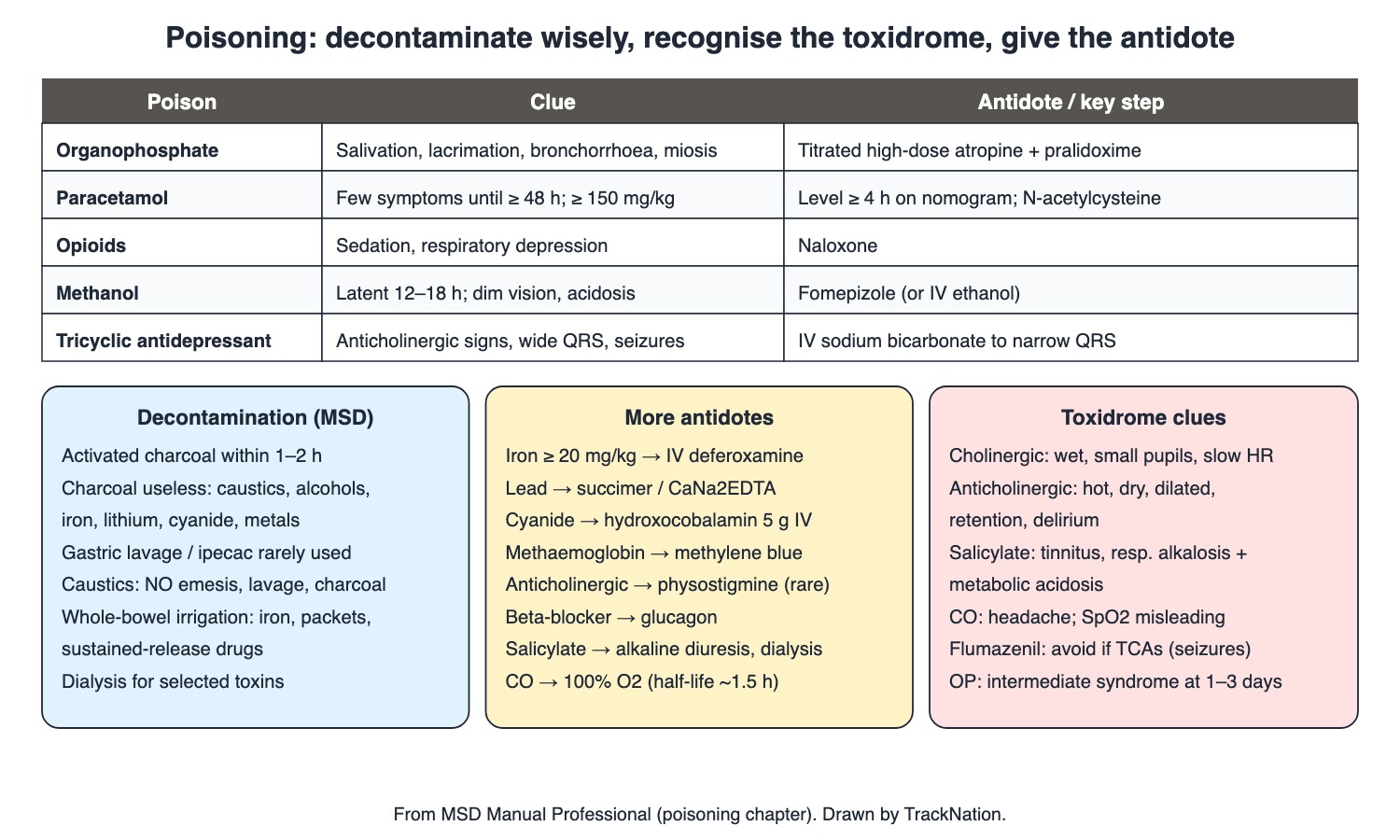
Common poisons and antidotes, decontamination and toxidromes. Drawn by TrackNation.
General Approach
Support first; then prevent absorption, enhance elimination, treat toxicity, and give specific antidotes. Six common toxidromes point to drug classes — e.g. cholinergic (wet, miosis, bradycardia) vs anticholinergic (tachycardia, hyperthermia, dilated pupils, warm dry skin, urinary retention, ileus, delirium).
Activated charcoal: most useful within 1–2 h; repeated doses for enterohepatic drugs (phenobarbital, theophylline). It does not bind caustics, alcohols, cyanide, iron, other metals or lithium.
Gastric lavage or ipecac: not proven, rarely used. Whole-bowel irrigation: sustained-release drugs, heavy metals (iron), drug packets. Haemodialysis or haemoperfusion for selected toxins (e.g. salicylates, lithium).
Caustics: no emesis, lavage or charcoal; endoscopy may be needed; alkalis cause liquefaction necrosis; strictures later.
Specific Poisons
Organophosphates/carbamates inhibit cholinesterase: salivation, lacrimation, urination, diarrhoea, emesis, bronchorrhoea, bronchospasm, bradycardia, miosis, plus fasciculations and weakness. Titrated high-dose atropine; IV pralidoxime. Carbamates clear in ~48 h; OPs bind irreversibly. Intermediate syndrome: proximal, cranial and respiratory weakness 1–3 days later.
Paracetamol: toxic dose ≥ 150 mg/kg; NAPQI depletes glutathione; symptoms minor for 48 h. Level ≥ 4 h on the Rumack–Matthew nomogram; N-acetylcysteine is most effective within 8 h, still given after 24 h.
Salicylates: tinnitus, vomiting, hyperthermia, respiratory alkalosis plus metabolic acidosis; charcoal, alkaline diuresis or dialysis.
Methanol: latent 12–18 h, then headache, dim vision, metabolic acidosis; fomepizole or ethanol.
TCAs: anticholinergic signs, seizures, QRS widening, arrhythmias — IV sodium bicarbonate. Avoid flumazenil if TCAs are involved (seizures).
Iron: ≥ 20 mg/kg; gastroenteritis → quiescent phase → shock and liver failure; radiopaque tablets; deferoxamine. Lead: basophilic stippling, neuropathy, cognitive deficits in children; no safe level; succimer or EDTA.
Carbon monoxide: headache, nausea, angina, coma; delayed neuropsychiatric effects; diagnose by carboxyhaemoglobin (pulse oximetry is misleading); 100% oxygen cuts the half-life from ~4.5 h to ~1.5 h.
Lithium: tremor, ataxia, seizures, diabetes insipidus, hypothyroidism; hydration, possibly dialysis.
Poison (MSD) | Antidote / specific treatment |
Organophosphate | Titrated high-dose atropine (secretions, bronchospasm); IV pralidoxime (neuromuscular) |
Paracetamol | N-acetylcysteine — best within 8 h; still give after 24 h |
Opioids | Naloxone |
Methanol / ethylene glycol | Fomepizole 15 mg/kg then 10 mg/kg 12-hourly (or IV ethanol) |
Tricyclic antidepressant | IV sodium bicarbonate 0.5–2 mEq/kg to narrow QRS; diazepam for seizures |
Iron (≥ 20 mg/kg) | Whole-bowel irrigation, IV deferoxamine (charcoal does not bind iron) |
Lead | Succimer or CaNa2EDTA ± dimercaprol |
Cyanide | Hydroxocobalamin 5 g IV (preferred) |
Methaemoglobinaemia | Methylene blue 1–2 mg/kg IV |
Beta-blocker | Glucagon 3–5 mg IV then infusion |
Traps the Examiner Sets
Charcoal does not bind iron, lithium, alcohols, cyanide or caustics.
OP poisoning: atropine for secretions; pralidoxime for weakness.
Paracetamol level before 4 h is uninterpretable.
Normal SpO2 does not exclude CO poisoning.
Never induce vomiting in caustic ingestion.
Memory Hooks & Shortcuts
Shortcuts to lock in this article's numbers and lists. Each one only re-packages facts proven above.
🧠 OP 'DUMBELS': Diarrhoea, Urination, Miosis, Bronchorrhoea/Bradycardia, Emesis, Lacrimation, Salivation — organophosphate
🧠 Atropine dries, Pralidoxime strengthens — OP antidotes
🧠 Paracetamol '150-4-8': 150 mg/kg, level at 4 h, NAC by 8 h — paracetamol
🧠 Charcoal can't bind 'CAIL-C': Caustics, Alcohols, Iron, Lithium, Cyanide — charcoal limits
🧠 TCA: 'wide QRS, give soda' (bicarbonate) — TCA
🧠 Anticholinergic: 'hot as a hare, dry as a bone, blind as a bat, mad as a hatter' — anticholinergic
Rapid-Revision Cards
OP features
Salivation, lacrimation, bronchorrhoea, bradycardia, miosis + fasciculations.
OP treatment
High-dose atropine; pralidoxime.
Intermediate syndrome
1–3 days; proximal, neck, respiratory weakness.
Carbamates
Reversible; clear ~48 h.
Paracetamol toxic dose
≥ 150 mg/kg.
Paracetamol metabolite
NAPQI; glutathione.
Paracetamol level
≥ 4 h, Rumack–Matthew.
NAC timing
Best ≤ 8 h; still after 24 h.
Salicylate
Tinnitus, resp alk + met acid; alkaline diuresis/dialysis.
Opioid
Naloxone.
Methanol
Latent 12–18 h; dim vision; fomepizole.
TCA
Wide QRS → IV bicarbonate.
Flumazenil
Avoid with TCAs.
Charcoal useless
Iron, lithium, alcohols, cyanide, caustics.
Charcoal timing
Within 1–2 h.
Gastric lavage
Rarely; unproven.
Iron
≥ 20 mg/kg; WBI + deferoxamine.
Lead
Basophilic stippling; succimer/EDTA.
CO
COHb; SpO2 misleading; 100% O2.
Caustic
No emesis, lavage, charcoal.
Cyanide
Hydroxocobalamin 5 g.
MetHb
Methylene blue 1–2 mg/kg.
Anticholinergic
Hot, dry, dilated, retention, delirium.
Beta-blocker OD
Glucagon.
Sources
Facts in this article were checked against these documents.
MSD Manual Professional: General Principles of Poisoning; Organophosphate and Carbamate Poisoning; Acetaminophen Poisoning; Salicylate Poisoning; Opioid Toxicity; Iron Poisoning; Lead Poisoning; Carbon Monoxide Poisoning; Caustic Ingestion; Symptoms and Treatment of Specific Poisons — Merck & Co. (MSD Manuals), reviewed 2025–26 (link)
Competency Based Undergraduate Curriculum, General Medicine (GM 22) — National Medical Commission, 2024
Test Yourself: Practice Questions
Thirty questions in NEET PG style, most of them clinical vignettes.
Practice Questions (NEET PG pattern)
Original questions written in the style of the exam: +4 for a correct answer, −1 for a wrong one. Every answer was checked against the sources listed above. NEET PG papers are not published by NBEMS, so these are not past-paper questions.
Q1. A man is brought after ingesting an insecticide; he has profuse salivation, lacrimation, bronchorrhoea, bradycardia, miosis and fasciculations. The mechanism is
(a) cholinesterase inhibition (organophosphate)
(b) dopamine excess
(c) sodium-channel blockade
(d) GABA agonism
Show answer
Answer: (a) — Muscarinic + nicotinic features.
Q2. In organophosphate poisoning, bronchorrhoea and bronchospasm are treated with
(a) pralidoxime alone
(b) naloxone
(c) titrated high-dose atropine
(d) adrenaline
Show answer
Answer: (c) — Pralidoxime for neuromuscular toxicity.
Q3. Pralidoxime in organophosphate poisoning is given mainly for
(a) neuromuscular toxicity (weakness)
(b) secretions
(c) seizures
(d) bradycardia only
Show answer
Answer: (a) — Reactivates cholinesterase.
Q4. Two days after apparent recovery from organophosphate poisoning, a patient develops neck flexor, proximal limb and respiratory weakness. This is
(a) atropine toxicity
(b) the intermediate syndrome
(c) delayed polyneuropathy at 6 months
(d) GBS
Show answer
Answer: (b) — 1–3 days after exposure.
Q5. Compared with organophosphates, carbamates
(a) are cleared spontaneously within ~48 hours (reversible)
(b) bind cholinesterase irreversibly
(c) need deferoxamine
(d) never cause symptoms
Show answer
Answer: (a) — OPs can bind irreversibly.
Q6. Acute paracetamol toxicity is likely after a total ingestion within 24 hours of at least
(a) 10 mg/kg
(b) 50 mg/kg
(c) 150 mg/kg
(d) 500 mg/kg
Show answer
Answer: (c) — About 7.5–10 g in adults.
Q7. The toxic metabolite of paracetamol is
(a) salicylate
(b) oxalic acid
(c) NAPQI, normally detoxified by glutathione
(d) formic acid
Show answer
Answer: (c) — Overdose depletes glutathione.
Q8. A woman took 40 paracetamol tablets 2 hours ago and feels well. The serum level should be measured
(a) immediately and acted on
(b) never
(c) at ≥ 4 hours after ingestion and plotted on the Rumack–Matthew nomogram
(d) after 24 hours only
Show answer
Answer: (c) — Symptoms are minor for the first 48 h.
Q9. N-acetylcysteine for paracetamol overdose is most effective if given
(a) within 30 minutes only
(b) never after 12 h
(c) within 8 hours of ingestion (still given after 24 h)
(d) only after liver failure
Show answer
Answer: (c) — Restores glutathione.
Q10. A patient with salicylate poisoning typically shows
(a) respiratory alkalosis with metabolic acidosis, tinnitus and hyperthermia
(b) isolated metabolic alkalosis
(c) miosis and bradycardia
(d) hypothermia
Show answer
Answer: (a) — Treat with charcoal, alkaline diuresis or dialysis.
Q11. A drowsy patient with slow shallow breathing is suspected of opioid overdose. The antidote is
(a) naloxone
(b) atropine
(c) flumazenil
(d) physostigmine
Show answer
Answer: (a) — Respiratory depression reverses.
Q12. After drinking a fluid later found to contain methanol, a man is well for half a day, then develops headache, blurred vision and severe metabolic acidosis. The antidote is
(a) deferoxamine
(b) fomepizole (or IV ethanol)
(c) N-acetylcysteine
(d) naloxone
Show answer
Answer: (b) — Methanol: latency 12–18 h.
Q13. A patient who overdosed on amitriptyline has a QRS of 140 ms and hypotension. The specific treatment is
(a) lidocaine only
(b) physostigmine routinely
(c) IV sodium bicarbonate 0.5–2 mEq/kg
(d) flumazenil
Show answer
Answer: (c) — Narrows QRS, prevents arrhythmias.
Q14. Flumazenil should be avoided in a mixed overdose involving
(a) tricyclic antidepressants (risk of seizures)
(b) opioids only
(c) iron
(d) paracetamol
Show answer
Answer: (a) — Use only for iatrogenic benzodiazepine sedation.
Q15. Activated charcoal is NOT effective for
(a) iron, lithium, alcohols, cyanide and caustics
(b) TCAs
(c) paracetamol
(d) phenobarbital
Show answer
Answer: (a) — Simple ions and alcohols.
Q16. Activated charcoal is most useful when given
(a) in caustic ingestion
(b) within 1–2 hours of a toxic ingestion
(c) only intravenously
(d) after 24 hours
Show answer
Answer: (b) — Repeat doses for enterohepatic drugs.
Q17. Regarding gastric lavage in poisoning, current guidance says it
(a) is best at 24 hours
(b) has not been shown to be effective and is rarely performed
(c) is mandatory in all
(d) is preferred for caustics
Show answer
Answer: (b) — Only for early, potentially lethal ingestions without other treatment.
Q18. A child swallowed many iron tablets (> 60 mg/kg elemental iron); abdominal X-ray shows radiopaque tablets. Treatment includes
(a) naloxone
(b) N-acetylcysteine
(c) whole-bowel irrigation and IV deferoxamine
(d) activated charcoal
Show answer
Answer: (c) — Toxicity from ≥ 20 mg/kg.
Q19. After iron overdose, gastroenteritis settles for a while before shock and liver failure. This middle period is the
(a) intermediate syndrome
(b) latent cyanosis
(c) recovery
(d) quiescent phase
Show answer
Answer: (d) — Do not be falsely reassured.
Q20. A child has anaemia with basophilic stippling, cognitive decline and a high blood lead level. Chelation therapy uses
(a) deferoxamine
(b) succimer or calcium disodium EDTA (± dimercaprol)
(c) methylene blue
(d) penicillin
Show answer
Answer: (b) — Lead poisoning; no safe level.
Q21. A family is found drowsy with headache; carbon monoxide exposure is suspected. Diagnosis is by
(a) carboxyhaemoglobin level (pulse oximetry is misleading)
(b) pulse oximetry alone
(c) chest X-ray
(d) serum lactate only
Show answer
Answer: (a) — Treat with 100% oxygen.
Q22. Breathing 100% oxygen shortens the half-life of carbon monoxide from about 4.5 hours to about
(a) 10 hours
(b) 1.5 hours
(c) 5 minutes
(d) 4 hours
Show answer
Answer: (b) — ~20 min with hyperbaric oxygen.
Q23. Delayed neuropsychiatric symptoms weeks after exposure are characteristic of
(a) iron poisoning
(b) carbon monoxide poisoning
(c) opioid overdose
(d) paracetamol overdose
Show answer
Answer: (b) — Also acute headache, angina, coma.
Q24. A child swallowed a drain cleaner (alkali). The correct statement is
(a) do not induce vomiting, lavage or give charcoal; endoscopy may be needed
(b) induce vomiting at once
(c) give charcoal
(d) neutralise with acid
Show answer
Answer: (a) — Alkalis cause liquefaction necrosis; strictures later.
Q25. The preferred antidote for cyanide poisoning is
(a) atropine
(b) hydroxocobalamin 5 g IV
(c) deferoxamine
(d) naloxone
Show answer
Answer: (b) — Nitrite–thiosulfate kit is an alternative.
Q26. A patient has severe cyanosis from drug-induced methaemoglobinaemia. Treatment is
(a) hydroxocobalamin
(b) naloxone
(c) vitamin K
(d) methylene blue 1–2 mg/kg IV
Show answer
Answer: (d) — For severe cyanosis.
Q27. Tachycardia, hyperthermia, dilated pupils, warm dry skin, urinary retention and delirium suggest
(a) anticholinergic toxicity
(b) opioid toxicity
(c) cholinergic toxicity
(d) sedative toxicity
Show answer
Answer: (a) — Physostigmine rarely, for refractory cases.
Q28. Severe beta-blocker overdose with bradycardia and hypotension may be treated with
(a) naloxone
(b) flumazenil
(c) glucagon 3–5 mg IV followed by infusion
(d) atropine is contraindicated
Show answer
Answer: (c) — Also vasopressors, insulin–glucose, pacing.
Q29. A patient on long-term lithium develops tremor, ataxia, polyuria and confusion. Lithium toxicity may also cause
(a) diabetes insipidus and hypothyroidism
(b) SIADH
(c) hyperthyroidism
(d) hypercalcaemia only
Show answer
Answer: (a) — Hydration; dialysis for severe cases.
Q30. Repeated doses of activated charcoal are useful for drugs that undergo enterohepatic recirculation such as
(a) iron
(b) phenobarbital and theophylline
(c) lithium
(d) ethanol
Show answer
Answer: (b) — And sustained-release preparations.
Active Recall
From memory: outline decontamination rules and charcoal limits, OP features and antidotes, the intermediate syndrome, paracetamol threshold, nomogram and NAC timing, salicylate acid–base, methanol and fomepizole, TCA and bicarbonate, iron, lead, CO, caustic, cyanide, methaemoglobin and beta-blocker management.