Social Justice Schemes for UPSC: PM-AJAY, NAMASTE, SMILE, AVYAY, RPwD Act 2016 (21 disabilities, 40%, 4%), Sugamya Bharat and the Transgender Persons Act 2019
SCs, OBCs and De-notified Tribes
🎯 Exam priority: Important. The 2026 paper tested the disability law, Sugamya Bharat and NDFDC in one statement question. Expect the same for transgender rights, sanitation workers and the elderly: which law, which year, which ministry, which number.
Within the Social Justice Ministry, the Department of Social Justice and Empowerment looks after Scheduled Castes, OBCs, de-notified tribes, sanitation workers, senior citizens, transgender persons, beggary and drug abuse, while the Department of Empowerment of Persons with Disabilities (DEPwD) handles disability. Tribal and minority schemes are covered in the next article.
Scheduled Castes, OBCs and de-notified tribes
Scheme | For | What it does |
PM-AJAY (2021-22) | SCs | Merged three schemes (PM Adarsh Gram Yojana, Special Central Assistance to SC Sub Plan, Babu Jagjivan Ram Chhatrawas Yojana): Adarsh Gram villages, district and State projects, hostels |
SHREYAS-SC | SC students | Umbrella for free coaching, top-class education, national overseas scholarship and national fellowship |
Venture Capital Fund for SCs | SC entrepreneurs | Concessional finance of Rs 10 lakh to Rs 15 crore at 4% a year |
PM YASASVI | OBC, EBC and DNT students | Umbrella for pre-matric and post-matric scholarships |
PM-DAKSH | OBCs (income under Rs 3 lakh), EBCs (under Rs 1 lakh), DNTs | Skill training in four formats, with a stipend for 80% attendance |
SEED (2022) | De-notified, nomadic and semi-nomadic tribes | Four parts: coaching, health insurance, community livelihoods, and housing through PMAY |
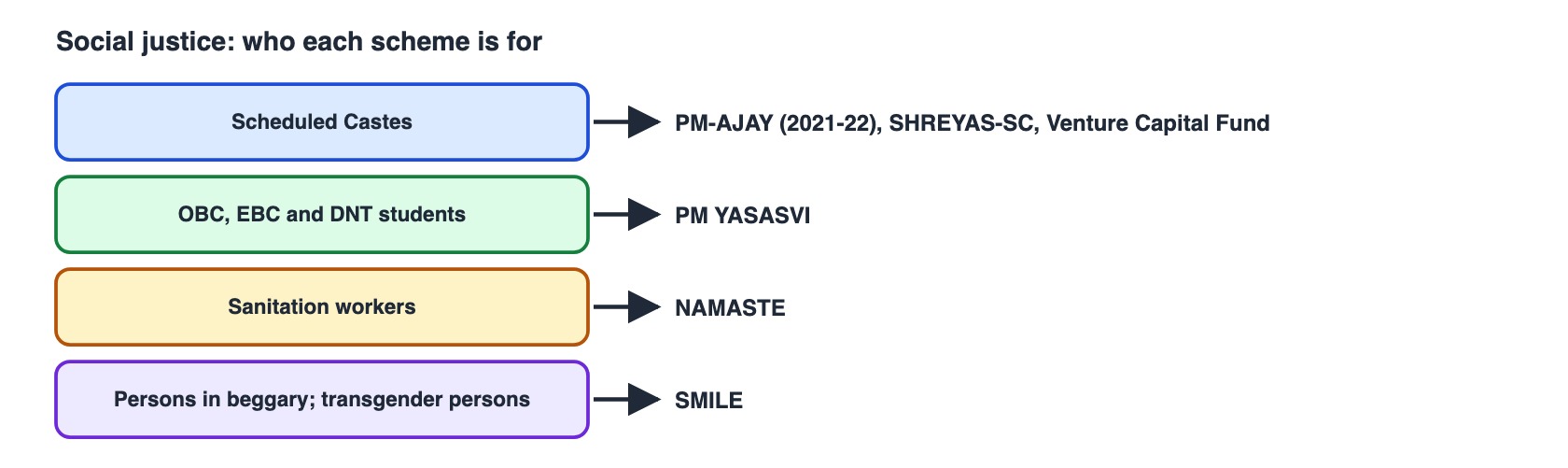
Which social justice scheme is for whom.
The National Commission for Scheduled Castes and the National Commission for Backward Classes are covered in the Polity playlist; in 2025 the NCBC advised dropping 35 castes from West Bengal's entries in the Central OBC list.
Sanitation Workers, Beggary, the Elderly and Drugs
Deaths in sewers and septic tanks keep sanitation workers in the news. The response is a scheme for safety and dignity, not just compensation.
Sanitation workers, beggary, the elderly and drug abuse
NAMASTE (National Action for Mechanised Sanitation Ecosystem), from 2023-24, is a Central Sector Scheme run jointly by Social Justice and Housing and Urban Affairs. It profiles sewer and septic-tank workers, gives them protective gear and training, and supports mechanised cleaning. It absorbed the old self-employment scheme for manual scavengers, and waste pickers were added from 2024-25. The National Commission for Safai Karamcharis presses for strict use of the Manual Scavengers Act, 2013 in sewer-death cases.
SMILE (Support for Marginalised Individuals for Livelihood and Enterprise) has two sub-schemes: rehabilitation of persons engaged in begging (goal: Bhiksha Vritti Mukt Bharat, a begging-free India) and welfare of transgender persons.
Senior citizens: Atal Vayo Abhyuday Yojana (AVYAY) is the umbrella for the five needs of the elderly: shelter, financial security, food, health care and social interaction. It includes old-age homes under the Integrated Programme for Senior Citizens, free assistive devices under Rashtriya Vayoshri Yojana (2017), and the Elderline 14567 helpline. Health cover for everyone aged 70+ comes from Ayushman Vay Vandana (see the health article).
Drugs: the National Action Plan for Drug Demand Reduction funds prevention, treatment and rehabilitation; Nasha Mukt Bharat Abhiyaan runs in all districts, with a toll-free de-addiction helpline, 14446.
Persons with Disabilities
Disability rights rest on a 2016 law that brought India in line with the UN convention.
Persons with disabilities
The Rights of Persons with Disabilities (RPwD) Act, 2016 replaced the PwD Act, 1995 (passed by Parliament in December 2016) and aligns Indian law with the UN Convention on the Rights of Persons with Disabilities. Census 2011 counted 2.68 crore persons with disabilities, 2.21% of the population.
Provision | RPwD Act, 2016 |
Types of disability | Raised from 7 to 21; the Centre can add more. New entries include speech and language disability, specific learning disability, acid attack victims, thalassemia, haemophilia, sickle cell disease and Parkinson's disease |
Benchmark disability | Not less than 40% of a specified disability, as certified |
Government jobs | Reservation raised from 3% to 4%: 1% each for (a) blindness and low vision, (b) deaf and hard of hearing, (c) locomotor disability including cerebral palsy, leprosy cured, dwarfism, acid attack and muscular dystrophy, (d) autism, intellectual and specific learning disability, mental illness and multiple disabilities |
Education | Free education for every child with benchmark disability aged 6 to 18 |
Institutions | Chief Commissioner for Persons with Disabilities with two Commissioners; Special Courts in each district; limited guardianship by District Courts with joint decision-making |
Sugamya Bharat Abhiyan (Accessible India Campaign), launched on 3 December 2015, works for universal accessibility in three domains: built infrastructure, transport and ICT. A revamped Sugamya Bharat App was launched at the International Purple Fest 2025.
NDFDC (National Divyangjan Finance and Development Corporation), set up in 1997 as a not-for-profit company, is a public sector body under DEPwD that funds self-employment of persons with disabilities.
UDID builds a national database and gives each person a Unique Disability Identity Card.
Since October 2026 the central disability pension uses the same 40% benchmark, with no minimum age (see the social security article).
Transgender Persons
Transgender rights moved from a court judgment to a statute in five years.
Transgender persons
NALSA v. Union of India (15 April 2014): the Supreme Court recognised transgender persons as a "third gender" and affirmed their right to self-identify their gender.
The Transgender Persons (Protection of Rights) Act, 2019 recognises the right to self-perceived identity; a person applies to the District Magistrate for a certificate of identity (a revised one after surgery). It bars discrimination in jobs, education, health care and services, and makes such offences punishable with up to 2 years' imprisonment and a fine.
A National Council for Transgender Persons was set up on 21 August 2020 to advise the Government and monitor the Act.
Delivery: the National Portal for Transgender Persons issues certificates online (30,441 so far); Garima Greh shelter homes under SMILE; Ayushman Bharat PM-JAY cover through a tie-up with the National Health Authority; and 20 States and UTs have Transgender Protection Cells.
How UPSC asks it
Year and content of a law (RPwD 2016 is often misdated as 2018; the 2019 Transgender Act), and which ministry runs a body (NDFDC is under DEPwD, not Corporate Affairs).
Numbers: 21 disabilities, 40% benchmark, 4% jobs, 6-18 free education, helpline numbers.
Mains: sewer deaths and the 2013 Manual Scavengers Act, accessibility, and the gap between legal recognition and social acceptance.
Further Reading
PIB press releases, ministry websites and annual reports, the Gazette of India, MEA and UN documents and the official sources named in each note — the primary sources behind every fact above.
Test Yourself: Practice Questions & PYQs
13 practice questions, then a real UPSC question on disability rights.
Practice Questions
Q1. PM-AJAY, a scheme for Scheduled Castes, was formed in 2021-22 by merging
(a) SHREYAS, PM YASASVI and PM-DAKSH
(b) PM Adarsh Gram Yojana, Special Central Assistance to SC Sub Plan and Babu Jagjivan Ram Chhatrawas Yojana
(c) NAMASTE and SMILE
(d) Stand-Up India and MUDRA
Show answer
Answer: (b) — PM-AJAY's three components are Adarsh Gram villages, grants for district and State projects, and hostels.
Q2. PM YASASVI is an umbrella scholarship scheme for
(a) Scheduled Caste students only
(b) minority students
(c) OBC, EBC and De-notified Tribe students
(d) students with disabilities
Show answer
Answer: (c) — PM YASASVI covers pre-matric and post-matric scholarships for OBC, EBC and DNT students.
Q3. Consider the following statements:
1. NAMASTE is jointly run by the Ministries of Social Justice and of Housing and Urban Affairs.
2. NAMASTE covers only manual scavengers in rural areas.
3. Waste pickers were added to NAMASTE from 2024-25.
Which of the statements given above are correct?
(a) 1 and 2 only
(b) 2 and 3 only
(c) 1 and 3 only
(d) 1, 2 and 3
Show answer
Answer: (c) — 1 and 3 are correct. NAMASTE targets urban sanitation workers, especially sewer and septic tank workers, and added waste pickers from 2024-25.
Q4. 'Bhiksha Vritti Mukt Bharat' is the goal of
(a) the SMILE scheme's sub-scheme for persons engaged in begging
(b) the Nasha Mukt Bharat Abhiyaan
(c) Stand-Up India
(d) the Swachh Bharat Mission
Show answer
Answer: (a) — SMILE has two sub-schemes: rehabilitation of persons engaged in begging and welfare of transgender persons.
Q5. Atal Vayo Abhyuday Yojana is an umbrella scheme for
(a) unorganised workers
(b) children in difficult circumstances
(c) senior citizens
(d) persons with disabilities
Show answer
Answer: (c) — AVYAY covers shelter, financial security, food, health care and social interaction for the elderly; Elderline 14567 is part of it.
Q6. Under the RPwD Act, 2016, the number of specified disabilities is
(a) 21
(b) 40
(c) 14
(d) 7
Show answer
Answer: (a) — The Act raised the list from 7 to 21 and lets the Centre add more.
Q7. A 'person with benchmark disability' under the RPwD Act, 2016 has
(a) a disability from birth only
(b) not less than 80% disability
(c) any disability certified by a doctor
(d) not less than 40% of a specified disability
Show answer
Answer: (d) — Benchmark disability means 40% or more, certified by the certifying authority. It decides eligibility for reservation and, since 2026, the disability pension.
Q8. Under the RPwD Act, 2016, reservation for persons with benchmark disabilities in government jobs is
(a) 5%
(b) 4%
(c) 3%
(d) 10%
Show answer
Answer: (b) — It was raised from 3% to 4%, split 1% each across four groups of disabilities.
Q9. Which of the following was added as a specified disability for the first time by the RPwD Act, 2016?
(a) Locomotor disability
(b) Blindness
(c) Acid attack victims
(d) Hearing impairment
Show answer
Answer: (c) — New additions include acid attack victims, specific learning disability, speech and language disability, thalassemia, haemophilia, sickle cell disease and Parkinson's disease.
Q10. NDFDC, which funds self-employment of persons with disabilities, works under the
(a) Ministry of Finance
(b) Ministry of Corporate Affairs
(c) NITI Aayog
(d) Department of Empowerment of Persons with Disabilities
Show answer
Answer: (d) — NDFDC was set up in 1997 as a not-for-profit company and is a public sector body under DEPwD.
Q11. In NALSA v. Union of India (2014), the Supreme Court
(a) recognised transgender persons as a third gender with the right to self-identify
(b) created the National Council for Transgender Persons
(c) upheld reservation in promotions
(d) struck down Section 377
Show answer
Answer: (a) — NALSA (15 April 2014) recognised the third gender; the Transgender Persons Act followed in 2019.
Q12. Under the Transgender Persons (Protection of Rights) Act, 2019, a certificate of identity is issued by the
(a) State Women's Commission
(b) National Council for Transgender Persons
(c) Chief Medical Officer
(d) District Magistrate
Show answer
Answer: (d) — Sections 4-7 let a person apply to the District Magistrate; certificates are now issued through the national portal.
Q13. Garima Greh refers to
(a) hostels for SC students
(b) homes for women rescued from trafficking
(c) old-age homes under AVYAY
(d) shelter homes for transgender persons under SMILE
Show answer
Answer: (d) — Garima Greh shelters are part of SMILE's transgender sub-scheme; Shakti Sadan is the women's shelter under Mission Shakti.
UPSC Previous Year Questions (PYQs)
Real UPSC Prelims question, checked against the official paper and answer key.
Q1. Which of the following statements with regard to the persons with disabilities in India is/are correct?
1. The Rights of Persons with Disabilities Act, an Act passed by the Parliament of India in 2018, mandates reservation in education and employment, places a legal duty on Governments to ensure accessibility and non-discrimination.
2. The Sugamya Bharat Abhiyan focuses on achieving universal accessibility for Persons with Disabilities across three key domains - built infrastructure, transport systems and information and communication technology.
3. The National Divyangjan Finance and Development Corporation (NDFDC) is a public sector organisation set up by the Ministry of Corporate Affairs as a not-for-profit company to promote entrepreneurship among Persons with Disabilities (PwDs).
Select the answer using the code given below: (UPSC CSE 2026)
(a) 1 and 2
(b) 2 only
(c) 1 and 3
(d) 1 only
Show answer
Answer: (b) — 2 only. The RPwD Act dates from 2016, not 2018. Sugamya Bharat (2015) covers built infrastructure, transport and ICT. NDFDC (1997) is under the Department of Empowerment of Persons with Disabilities, not the Ministry of Corporate Affairs.
Mains Practice Questions
Use these to frame full-length answers. You don't have to answer one exactly — they show the angles UPSC tests, so let them guide which points you cover.
Deaths in sewers continue despite the Manual Scavengers Act, 2013. Examine the role of NAMASTE and what else is needed.
Evaluate the Rights of Persons with Disabilities Act, 2016 in the light of the accessibility goals of Sugamya Bharat.
From NALSA (2014) to the Transgender Persons Act (2019): has legal recognition translated into social inclusion?