Rural and Urban Schemes for UPSC: VB-G RAM G Act vs MGNREGA, PMAY-G and PMAY-U, PMGSY, Jal Jeevan Mission and Swachh Bharat
From MGNREGA to the VB-G RAM G Act
🎯 Exam priority: Important. The rural job guarantee was rewritten in 2025: the VB-G RAM G Act replaced MGNREGA from 1 July 2026. Expect statement questions on 125 days, fund-sharing and the farm-season pause, plus scheme-to-ministry matching for housing, water and sanitation.
This article covers the schemes that build things in villages and towns: jobs on public works, houses, roads, piped water and toilets. Each is run with the States, which is why fund-sharing patterns are tested.
From MGNREGA to the VB-G RAM G Act
The Viksit Bharat - Guarantee for Rozgar and Ajeevika Mission (Gramin) Act, 2025 (VB-G RAM G) was introduced on 16 December 2025 and passed by both Houses on 18 December 2025. It came into force in all rural areas on 1 July 2026, and the MGNREGA, 2005 was repealed from the same date. Its motto is "Rozgar Bhi, Samman Bhi" (employment with dignity).
Feature | MGNREGA, 2005 | VB-G RAM G Act, 2025 |
Guaranteed work | 100 days a year per rural household | 125 days a year per rural household (adults volunteering for unskilled manual work) |
Funding | Centre paid all unskilled wages and up to three-fourths of material cost | Centrally Sponsored: 60:40, or 90:10 for North-Eastern and Himalayan States, for wages, material and administration |
Budget cap | No State-wise normative allocation | Centre fixes a normative allocation for each State; the State pays anything above it |
Farm season | No such pause | States announce up to 60 days a year with no works, during sowing and harvest |
Planning | Gram panchayats identify works | Gram panchayat plans in four domains: water security, rural infrastructure, livelihood infrastructure, extreme-weather mitigation; linked to PM Gati Shakti |
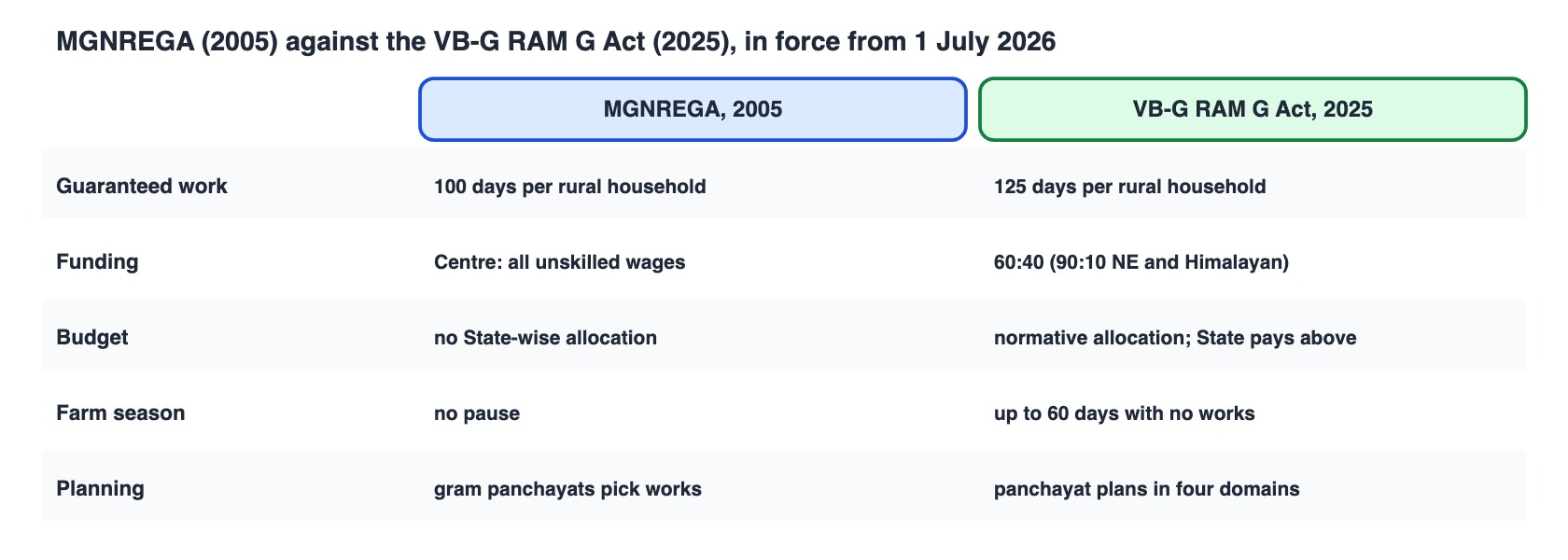
What changed when the VB-G RAM G Act replaced MGNREGA.
Kept from MGNREGA: an unemployment allowance if work is not given in time (at least one-fourth of the wage for the first 30 days, then at least one-half), paid by the State; wages by DBT within 15 days of closing the muster roll, with delay compensation of 0.05% of unpaid wages per day after the sixteenth day; and mandatory social audits.
Transition: e-KYC-verified job cards stay valid until new Gramin Rozgar Guarantee Cards are issued; attendance is by face authentication. A National Level Steering Committee oversees the scheme and recommends allocations. The Central share for 2026-27 is Rs 95,692.31 crore.
Housing and Roads
Housing and roads are the other two big rural schemes of the Rural Development Ministry.
Housing and roads
PM Awaas Yojana-Gramin (PMAY-G): pucca houses with basic amenities for houseless families and those in kutcha or dilapidated houses. The first target of 2.95 crore houses (by March 2024) was raised on 9 August 2024 by 2 crore more for 2024-25 to 2028-29, a total of 4.95 crore by 2029. By December 2025, 3.86 crore houses had been sanctioned and 2.92 crore completed.
PM Awas Yojana-Urban (PMAY-U 2.0): 1.22 crore urban houses sanctioned in all; the 2025 outreach drive was called Angikaar.
PM Gram Sadak Yojana (PMGSY), launched in December 2000, builds all-weather roads to rural habitations. Its verticals are PMGSY-I, II and III, the Road Connectivity Project for Left Wing Extremism Affected Areas (RCPLWEA), started in 2016 as a separate vertical for strategically important roads in 44 districts of 9 States, and roads under PM-JANMAN, the mission to bring basic facilities to Particularly Vulnerable Tribal Group (PVTG) families and habitations.
PM Employment Generation Programme (PMEGP), run by the MSME Ministry since 2008-09, is a credit-linked subsidy: it pays margin money on bank loans for new non-farm micro-enterprises, with projects up to Rs 50 lakh in manufacturing and Rs 20 lakh in services. It has helped over 10.71 lakh enterprises and an estimated 87 lakh jobs. Self-employment for SHG women runs through DAY-NRLM (see the SHG article).
DDU-GKY (25 September 2014) is the placement-linked skilling programme for rural poor youth under the National Rural Livelihood Mission.
Jal Jeevan Mission and Swachh Bharat
Water and sanitation are run by the Jal Shakti Ministry's Department of Drinking Water and Sanitation in villages, and by the Housing Ministry in cities.
Urban missions beyond housing
Mission | What it does | Progress (2025) |
AMRUT 2.0 | Water supply, sewerage and reuse of treated water in cities | Rs 33,287 crore of projects awarded in 2025; 33 lakh tap and 20 lakh sewer connections; 6,000 MLD of treated water reused; Water Resource Recovery Cells in 25 States/UTs (Jal Hi AMRIT) |
PM SVANidhi | Collateral-free working-capital loans and digital payments for street vendors | Over 70 lakh vendors, 1 crore+ loans worth Rs 15,000 crore+; restructured and extended to 31 March 2030 (Cabinet, 27 August 2025) |
Metro rail | Central support for urban mass transit | Operational network crossed 1,000 km (1,090 km) in 26 cities |
PM e-Bus Sewa | Electric buses for cities, with depots and power infrastructure | 3,622 buses sanctioned in 2025; eligibility widened in April 2025 to town clusters of 3-40 lakh people |
Swachh Bharat Mission-Urban 2.0 | Garbage-free cities; Dumpsite Remediation Accelerator Programme | Target 'Lakshya Zero Dumpsites' by September 2026; 1,428 sites under remediation, 80% of legacy waste in 214 sites |
Jal Jeevan Mission and Swachh Bharat
Mission | Goal | Where it stands (2025) |
Jal Jeevan Mission (Har Ghar Jal) | A functional household tap connection for every rural home | Over 15.7 crore rural households have taps; 81.47% have Har Ghar Jal status, so the focus has moved to regular, adequate, safe supply |
Swachh Bharat Mission-Grameen, Phase I | Open Defecation Free (ODF) India by 2 October 2019, Gandhi's 150th birth anniversary | Launched 2 October 2014; rural sanitation coverage rose from 39% (2014) to 100% (2019) |
SBM-G Phase II (from 2020) | Keep villages ODF and make them ODF Plus (Model), with solid and liquid waste management | Over 83% of villages ODF Plus (Model); over 970 community biogas plants under GOBARdhan |
AMRUT 2.0 (urban) | Water supply and sewerage in cities | 33 lakh tap and 20 lakh sewer connections provided in 2025 |
Water quality by the community: at least five women in every village are being trained to use Field Test Kits; District Collectors' Peyjal Samvad (from October 2025) brings district officials into water governance.
A Swachh Sujal Gaon is a village that is both ODF Plus (Model) and Har Ghar Jal certified.
Urban sanitation campaigns include Swachhata Hi Seva (17 September to 2 October 2025), the Swachh Shehar Jodi mentoring of cities, and the target of "Lakshya Zero Dumpsites by 2026".
How UPSC asks it
Which ministry runs a scheme, its launch year, and what changed in a new law (the VB-G RAM G Act is the 2026-27 favourite).
Definitions: ODF, ODF Plus, Har Ghar Jal, normative allocation.
Mains: the shift from demand-driven to capped employment guarantees, Centre-State cost-sharing, and asset quality versus income support.
Further Reading
PIB press releases, ministry websites and annual reports, the Gazette of India, MEA and UN documents and the official sources named in each note — the primary sources behind every fact above.
Test Yourself: Practice Questions
15 practice questions on the new job guarantee, housing, roads, water and sanitation.
Practice Questions
Q1. The VB-G RAM G Act, 2025 guarantees each rural household wage employment of
(a) 125 days in a financial year
(b) 150 days in a financial year
(c) 200 days in a financial year
(d) 100 days in a financial year
Show answer
Answer: (a) — It raised the guarantee from MGNREGA's 100 days to 125 days and came into force on 1 July 2026, repealing MGNREGA.
Q2. Consider the following statements:
1. Under the VB-G RAM G Act, the Centre and most States share costs 60:40.
2. North-Eastern and Himalayan States share costs 90:10.
3. Any expenditure above the State's normative allocation is borne by the Centre.
Which of the statements given above are correct?
(a) 1 and 2 only
(b) 2 and 3 only
(c) 1 and 3 only
(d) 1, 2 and 3
Show answer
Answer: (a) — 1 and 2 are correct. The State bears expenditure in excess of its normative allocation.
Q3. Under the VB-G RAM G Act, States may announce a period with no works of up to
(a) 60 days in a financial year, covering peak sowing and harvest
(b) 30 days during the monsoon only
(c) 90 days in summer
(d) no period; works must run all year
Show answer
Answer: (a) — The pause of up to 60 days is meant to avoid drawing labour away from farms in peak seasons.
Q4. Under the VB-G RAM G Act, who pays the unemployment allowance when work is not provided in time?
(a) The gram panchayat
(b) The Central Government
(c) The employer
(d) The State Government
Show answer
Answer: (d) — The State continues to pay the unemployment allowance and delay compensation, as under MGNREGA.
Q5. Which of the following is NOT one of the four thematic domains of works under the VB-G RAM G Act?
(a) Rural infrastructure
(b) Mitigation of extreme weather events
(c) Water security
(d) Urban housing
Show answer
Answer: (d) — The four domains are water security, rural infrastructure, livelihood-related infrastructure and mitigation of extreme weather events.
Q6. The revised target of PMAY-Gramin is to provide
(a) 10 crore houses by 2047
(b) 1.22 crore houses by 2030
(c) 4.95 crore pucca houses by 2029
(d) 2.95 crore houses by 2022
Show answer
Answer: (c) — The original 2.95 crore target was raised by 2 crore in August 2024, to 4.95 crore by 2029.
Q7. PM Gram Sadak Yojana was launched in
(a) August 2019
(b) October 2014
(c) April 2005
(d) December 2000
Show answer
Answer: (d) — PMGSY dates from December 2000; its verticals include RCPLWEA for Left Wing Extremism areas and PM-JANMAN roads.
Q8. A 'Swachh Sujal Gaon' is a village that is
(a) ODF Plus (Model) and Har Ghar Jal certified
(b) free of plastic waste
(c) connected by an all-weather road
(d) fully covered by PMAY-G houses
Show answer
Answer: (a) — It combines the sanitation and water goals of SBM-G and JJM.
Q9. Swachh Bharat Mission-Grameen Phase I aimed to make India Open Defecation Free by
(a) 15 August 2022
(b) 26 January 2020
(c) 2 October 2019
(d) 2 October 2024
Show answer
Answer: (c) — It was launched on 2 October 2014 with the target of Gandhi's 150th birth anniversary; rural sanitation coverage went from 39% to 100%.
Q10. Under Jal Jeevan Mission, women in each village are trained to
(a) collect water taxes
(b) test water quality using Field Test Kits
(c) drive water tankers
(d) repair hand pumps only
Show answer
Answer: (b) — At least five women per village are trained to use Field Test Kits for routine water-quality checks.
Q11. GOBARdhan, a component of SBM-G Phase II, is about
(a) community biogas plants using cattle dung and organic waste
(b) organic farming certification
(c) fodder banks for drought
(d) cow protection shelters
Show answer
Answer: (a) — Over 970 community biogas plants were working under GOBARdhan in 2025.
Q12. DDU-GKY, launched on 25 September 2014, is
(a) a pension scheme
(b) a housing loan scheme
(c) a rural road programme
(d) a placement-linked skilling programme for rural poor youth
Show answer
Answer: (d) — Deen Dayal Upadhyaya Grameen Kaushalya Yojana runs under the National Rural Livelihood Mission.
Q13. PMEGP, a credit-linked subsidy scheme for new non-farm micro-enterprises, allows a maximum project cost of
(a) Rs 10 lakh in all sectors
(b) Rs 20 lakh in manufacturing and Rs 10 lakh in services
(c) Rs 50 lakh in manufacturing and Rs 20 lakh in services
(d) Rs 1 crore in manufacturing and Rs 50 lakh in services
Show answer
Answer: (c) — PMEGP, run by the MSME Ministry since 2008-09, pays margin money on bank loans; over 10.71 lakh enterprises have been helped.
Q14. PM SVANidhi, extended in 2025 to 31 March 2030, gives
(a) electric buses to cities
(b) skill training to construction workers
(c) collateral-free working-capital loans to street vendors
(d) houses to urban poor
Show answer
Answer: (c) — Over 70 lakh vendors have received more than 1 crore loans.
Q15. 'Lakshya Zero Dumpsites' by September 2026 is the aim of
(a) Jal Jeevan Mission
(b) the Dumpsite Remediation Accelerator Programme under SBM-Urban
(c) the Smart Cities Mission
(d) AMRUT 2.0
Show answer
Answer: (b) — 1,428 dumpsites are under remediation.
Mains Practice Questions
Use these to frame full-length answers. You don't have to answer one exactly — they show the angles UPSC tests, so let them guide which points you cover.
The VB-G RAM G Act raises guaranteed days to 125 but introduces normative allocations and a 60:40 cost share. Does it strengthen or dilute the right to work?
Discuss the shift in Jal Jeevan Mission and Swachh Bharat from building infrastructure to sustaining services.
Evaluate rural housing under PMAY-G as a tool of poverty reduction and women's asset ownership.