Leprosy for NEET PG Dermatology: Cardinal Signs, NLEP 2025 PB/MB Classification and 3-Drug MDT, Spectrum, Reactions and ENL, SDR-PEP
Start Here
🎯 Exam priority: High (Dermatology and PSM). Expect: the three cardinal signs, PB vs MB under the 2025 Indian rules, the three-drug regimen now used for PB too, doses and durations, tuberculoid vs lepromatous features, ulnar claw hand and foot drop, type 1 vs type 2 reactions and their drugs, SDR-PEP for contacts, Grade 2 disability as an indicator, and NLEP milestones.
CBME mapping: DR 9.1–9.6. Programme details are also in PSM; M. leprae in Microbiology.
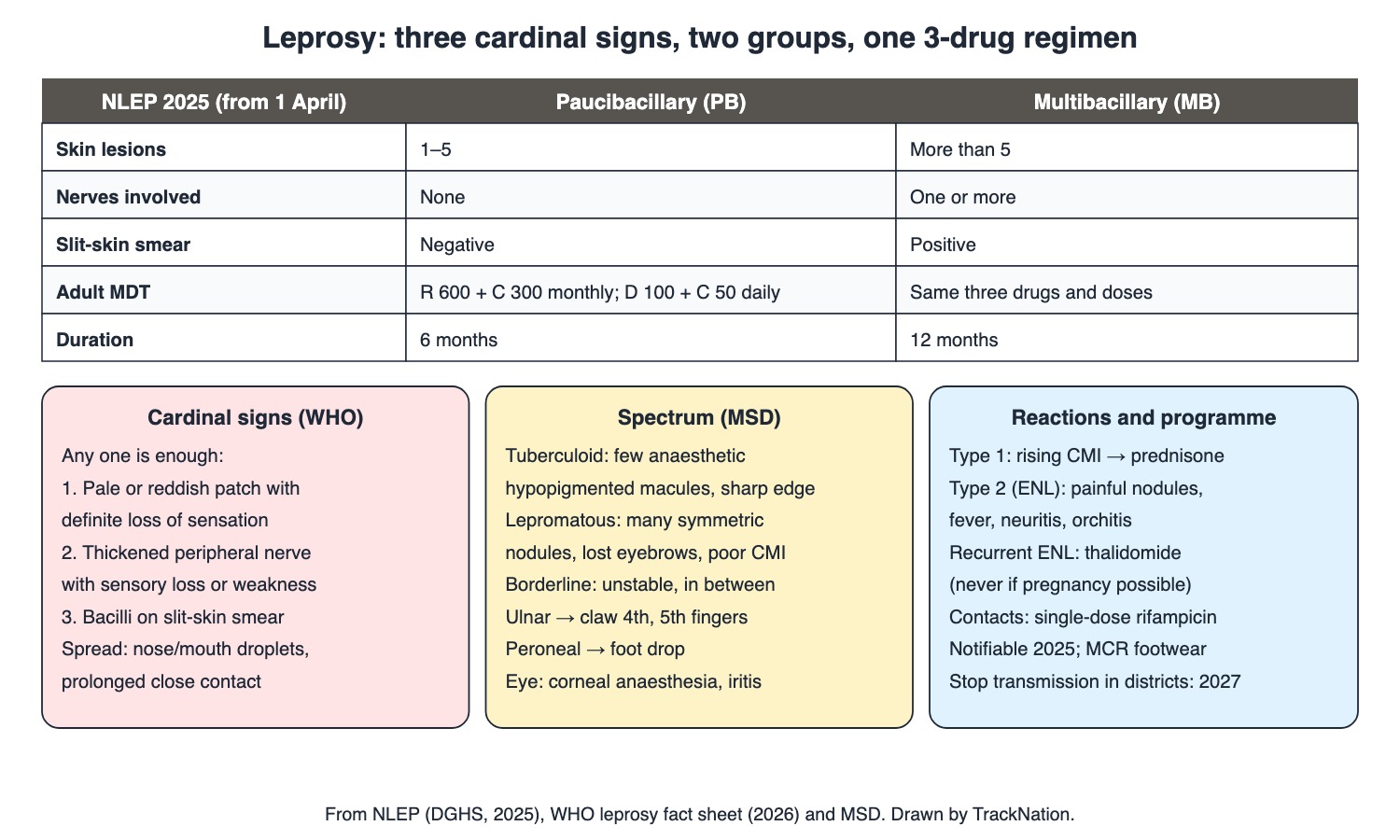
NLEP 2025 PB and MB classification and regimen; WHO cardinal signs; leprosy spectrum; reactions and programme. Drawn by TrackNation.
The Disease and Its Diagnosis
Chronic infection by the acid-fast Mycobacterium leprae (and M. lepromatosis) with a tropism for skin, peripheral nerves, upper respiratory mucosa and eyes. Spread by droplets from the nose and mouth of untreated patients during prolonged close contact — not by casual contact; only untreated lepromatous disease is meaningfully contagious. Incubation: a few months to 20 years. Armadillos are a zoonotic source in the Americas.
WHO cardinal signs (any one is diagnostic): (1) definite loss of sensation in a pale or reddish skin patch; (2) a thickened peripheral nerve with sensory loss or weakness of the muscles it supplies; (3) bacilli on a slit-skin smear.
Spectrum: tuberculoid — one or a few anaesthetic, hypopigmented macules with sharp raised borders and enlarged nerves (good cell-mediated immunity); lepromatous — widespread symmetric nodules and thickening, loss of eyebrows and eyelashes, gynaecomastia, nose, testis and kidney involvement (poor cell-mediated immunity); borderline — unstable, shifting towards either pole. Biopsy the advancing edge in tuberculoid and a nodule in lepromatous disease; PCR helps in early or atypical cases.
Nerve damage: ulnar → claw 4th and 5th fingers; common peroneal → foot drop; corneal insensitivity and iritis → scarring and blindness. Lepromatous disease may cause amyloidosis and infertility.
Classification and Treatment (NLEP 2025)
PB: 1–5 skin lesions, no nerve involvement, smear negative. MB: more than 5 lesions, or one or more nerves involved (including pure neuritis), or a positive smear.
From 1 April 2025 India uses the same 3-drug MDT (rifampicin, clofazimine, dapsone) for PB and MB, replacing the old 2-drug PB regimen: 6 months for PB, 12 months for MB. Patients already on treatment on 31 March 2025 finish their old regimen. Monthly doses are supervised; daily doses are self-administered. MDT is free in all public facilities.
NLEP regimen (from 1 April 2025) | Rifampicin | Clofazimine | Dapsone | Duration |
Adult PB | 600 mg monthly | 300 mg monthly + 50 mg daily | 100 mg daily | 6 months |
Adult MB | 600 mg monthly | 300 mg monthly + 50 mg daily | 100 mg daily | 12 months |
Child 10–14 y | 450 mg monthly | 150 mg monthly + 50 mg alternate days | 50 mg daily | PB 6 / MB 12 months |
Child (younger) | 10 mg/kg monthly | 100 mg monthly + 50 mg twice weekly | 2 mg/kg daily | PB 6 / MB 12 months |
Reactions, Disability and the Programme
Type 1 (reversal) reaction: a spontaneous rise in cell-mediated immunity — inflamed existing lesions and neuritis — treated with prednisone 40–60 mg/day tapered to a low maintenance dose over months; cyclosporine if steroids fail.
Type 2 reaction — erythema nodosum leprosum (ENL): immune-complex vasculitis/panniculitis with crops of painful red nodules, fever, neuritis, lymphadenitis, orchitis, arthritis and glomerulonephritis; less common since clofazimine joined MDT. Mild — aspirin; significant — a week of prednisone; recurrent or severe — thalidomide (never in women who may become pregnant).
Prevention: contact screening with single-dose rifampicin post-exposure prophylaxis (SDR-PEP) for eligible contacts. DPMR: self-care training, dressings, micro-cellular rubber (MCR) footwear, reconstructive surgery at district hospitals or medical colleges with a welfare allowance.
NLEP: began as NLCP in 1955 (dapsone monotherapy); MDT era from the 1980s; leprosy made notifiable in 2025; National Strategic Plan 2023–27 aims to interrupt transmission at district level by 2027 — zero transmission, disability and discrimination. Grade 2 disability in new cases is the key indicator of late diagnosis.
Traps the Examiner Sets
Since April 2025, PB patients in India also get clofazimine — three drugs for 6 months.
Any nerve involvement makes a case MB.
Type 1 = cell-mediated (reversal); type 2 = immune complex (ENL) → thalidomide if recurrent.
Grade 2 disability among new cases signals delayed detection.
Memory Hooks & Shortcuts
Shortcuts to lock in this article's numbers and lists. Each one only re-packages facts proven above.
🧠 Cardinal signs 'Patch, Nerve, Smear' — any one — diagnosis
🧠 'Five or fewer and nerve-free = PB' — classification
🧠 MDT 'R-C monthly, D-C daily; 6 for PB, 12 for MB' — regimen
🧠 Reactions: 'Type 1 = Turn-around immunity; Type 2 = Two (immune complexes), thalidomide' — reactions
🧠 'Ulnar claws, Peroneal drops' — nerve deformities
Rapid-Revision Cards
Organism
M. leprae (± M. lepromatosis); skin and nerves.
Spread
Nasal/oral droplets, prolonged contact.
Incubation
Months to 20 years.
Cardinal signs
Anaesthetic patch; thick nerve; smear +.
PB (2025)
1–5 lesions, no nerve, smear −.
MB (2025)
> 5 lesions or any nerve or smear +.
MDT 2025
R + C + D for both PB and MB.
Duration
PB 6 months; MB 12 months.
Monthly
R 600 + C 300 (supervised).
Daily
D 100 + C 50.
Child 10–14
R 450, C 150 monthly; D 50 daily.
Tuberculoid
Few, sharp, anaesthetic; good CMI.
Lepromatous
Many nodules, madarosis, gynaecomastia.
Ulnar
Claw 4th–5th fingers.
Peroneal
Foot drop.
Type 1
Rising CMI → prednisone.
Type 2 (ENL)
Painful nodules, orchitis → thalidomide.
SDR-PEP
Single-dose rifampicin for contacts.
Notifiable
2025.
NSP goal
District-level interruption by 2027.
G2D
Indicator of late diagnosis.
Sources
Facts in this article were checked against these documents.
National Leprosy Eradication Programme (NLEP) — Directorate General of Health Services, MoHFW, 2025 (link)
Revised treatment regimen for PB and MB cases in India (D.O. letter, 6 March 2025) — Directorate General of Health Services, MoHFW, 2025
Leprosy fact sheet — World Health Organization, January 2026 (link)
MSD Manual Professional: Leprosy (Hansen Disease) — Merck & Co. (MSD Manuals), reviewed 2026 (link)
Competency Based Undergraduate Curriculum, Dermatology (DR 9) — National Medical Commission, 2024
Test Yourself: Practice Questions
Thirty questions in NEET PG style, most of them clinical vignettes.
Practice Questions (NEET PG pattern)
Original questions written in the style of the exam: +4 for a correct answer, −1 for a wrong one. Every answer was checked against the sources listed above. NEET PG papers are not published by NBEMS, so these are not past-paper questions.
Q1. Leprosy is mainly transmitted by
(a) mosquitoes
(b) droplets from the nose and mouth of untreated patients during close contact
(c) shaking hands
(d) contaminated water
Show answer
Answer: (b) — Not by casual contact.
Q2. The incubation period of leprosy ranges from
(a) a few months to 20 years
(b) 1–3 days
(c) exactly 6 months
(d) 1–2 weeks
Show answer
Answer: (a) — Very long.
Q3. Which is a WHO cardinal sign of leprosy?
(a) silvery scales
(b) definite loss of sensation in a pale or reddish skin patch
(c) fever with rash
(d) itchy annular plaque
Show answer
Answer: (b) — Any one of three signs is enough.
Q4. The other two cardinal signs are
(a) anaemia and splenomegaly
(b) fever and weight loss
(c) a thickened nerve with sensory loss or weakness, and bacilli on slit-skin smear
(d) lymphadenopathy and cough
Show answer
Answer: (c) — WHO.
Q5. Under the 2025 Indian classification, a patient with 3 anaesthetic patches, no nerve involvement and a negative smear is
(a) multibacillary
(b) paucibacillary
(c) indeterminate, no treatment
(d) pure neuritic
Show answer
Answer: (b) — 1–5 lesions, no nerve, smear negative.
Q6. A patient with 2 skin patches and one thickened ulnar nerve is classified as
(a) tuberculoid, no treatment
(b) multibacillary
(c) paucibacillary
(d) pure neuritic PB
Show answer
Answer: (b) — Any nerve involvement → MB.
Q7. From 1 April 2025, paucibacillary leprosy in India is treated with
(a) rifampicin and dapsone for 6 months
(b) dapsone alone for 2 years
(c) rifampicin, clofazimine and dapsone for 6 months
(d) the same drugs for 12 months
Show answer
Answer: (c) — 3-drug regimen replaces the 2-drug PB regimen.
Q8. The duration of MDT for adult multibacillary leprosy is
(a) 3 months
(b) 24 months
(c) 12 months
(d) 6 months
Show answer
Answer: (c) — PB 6 months.
Q9. The supervised monthly doses in adult MDT are
(a) rifampicin 450 mg only
(b) isoniazid 300 mg
(c) rifampicin 600 mg and clofazimine 300 mg
(d) dapsone 100 mg and clofazimine 50 mg
Show answer
Answer: (c) — Daily: dapsone 100 + clofazimine 50.
Q10. The adult daily self-administered doses in MDT are
(a) rifampicin 600 mg daily
(b) clofazimine 300 mg daily
(c) dapsone 100 mg and clofazimine 50 mg
(d) dapsone 50 mg alternate days
Show answer
Answer: (c) — Per NLEP table.
Q11. A 12-year-old with MB leprosy receives monthly rifampicin of
(a) 150 mg
(b) 600 mg
(c) 450 mg
(d) 10 mg/kg weekly
Show answer
Answer: (c) — Child 10–14: rifampicin 450, clofazimine 150 monthly.
Q12. A patient has one hypopigmented, numb macule with a sharp raised border and an enlarged nerve nearby; immunity to M. leprae is strong. The pole of the spectrum is
(a) lepromatous
(b) borderline lepromatous
(c) histoid
(d) tuberculoid
Show answer
Answer: (d) — Few lesions, good CMI.
Q13. Widespread symmetric nodules, loss of eyebrows and gynaecomastia indicate
(a) type 1 reaction
(b) lepromatous leprosy with poor cell-mediated immunity
(c) indeterminate leprosy
(d) tuberculoid leprosy
Show answer
Answer: (b) — Lepromatous pole.
Q14. Clawing of the ring and little fingers in leprosy results from involvement of the
(a) ulnar nerve
(b) median nerve
(c) radial nerve
(d) common peroneal nerve
Show answer
Answer: (a) — Peroneal → foot drop.
Q15. Foot drop in leprosy is due to damage of the
(a) sciatic nerve trunk
(b) femoral nerve
(c) common peroneal nerve
(d) tibial nerve
Show answer
Answer: (c) — Lateral popliteal.
Q16. Blindness in leprosy can follow
(a) retinal detachment only
(b) cataract from MDT
(c) optic neuritis only
(d) corneal insensitivity with scarring, or iritis
Show answer
Answer: (d) — Eye care is part of DPMR.
Q17. For skin biopsy in tuberculoid leprosy, the sample is taken from the
(a) centre of the lesion
(b) advancing edge of the lesion
(c) earlobe only
(d) normal skin
Show answer
Answer: (b) — Nodules or plaques in lepromatous.
Q18. Existing leprosy patches suddenly become red and swollen with painful nerves during treatment. This type 1 reaction is due to
(a) secondary infection
(b) immune complex deposition
(c) a spontaneous rise in cell-mediated immunity
(d) drug allergy to dapsone
Show answer
Answer: (c) — Reversal reaction.
Q19. The treatment of a significant type 1 reaction is
(a) prednisone 40–60 mg/day, tapered to a low maintenance dose
(b) thalidomide
(c) antibiotics only
(d) stop MDT
Show answer
Answer: (a) — Cyclosporine second line.
Q20. A patient with lepromatous leprosy develops crops of painful red nodules with fever, neuritis and orchitis. The diagnosis is
(a) dapsone syndrome
(b) relapse
(c) type 1 reaction
(d) erythema nodosum leprosum (type 2 reaction)
Show answer
Answer: (d) — Immune-complex mediated.
Q21. The drug of choice for recurrent or severe ENL is
(a) isoniazid
(b) thalidomide
(c) dapsone
(d) rifampicin
Show answer
Answer: (b) — Not in women who may become pregnant.
Q22. ENL has become less common since the addition to MDT of
(a) dapsone
(b) rifampicin
(c) clofazimine
(d) ofloxacin
Show answer
Answer: (c) — Clofazimine is anti-inflammatory as well.
Q23. Household contacts of a new leprosy case are offered
(a) single-dose rifampicin post-exposure prophylaxis after screening
(b) dapsone for 2 years
(c) nothing
(d) BCG revaccination only
Show answer
Answer: (a) — SDR-PEP.
Q24. Under DPMR, patients with insensitive feet are given
(a) steroid injections
(b) only analgesics
(c) micro-cellular rubber (MCR) footwear and self-care training
(d) amputation
Show answer
Answer: (c) — Disability prevention.
Q25. Leprosy was declared a notifiable disease in India in
(a) 2016
(b) 2005
(c) 1955
(d) 2025
Show answer
Answer: (d) — NLEP timeline.
Q26. The National Strategic Plan for leprosy aims to interrupt transmission at district level by
(a) 2047
(b) 2035
(c) 2027
(d) 2030
Show answer
Answer: (c) — WHO Global Leprosy Strategy runs to 2030.
Q27. Which NLEP indicator best reflects delayed diagnosis?
(a) Grade 2 disability among new cases
(b) number of MDT blister packs
(c) child sex ratio
(d) prevalence rate
Show answer
Answer: (a) — Visible deformity at diagnosis.
Q28. India's leprosy control programme began in 1955 using
(a) rifampicin alone
(b) MDT
(c) BCG
(d) dapsone monotherapy
Show answer
Answer: (d) — MDT came in the 1980s.
Q29. A patient treated for leprosy needs reconstructive surgery for a claw hand. Under NLEP this is done at
(a) district hospitals, medical colleges or leprosy institutes, with a welfare allowance
(b) it is not offered
(c) private clinics only
(d) PHC only
Show answer
Answer: (a) — Rs 12,000 allowance.
Q30. Which form of leprosy is contagious?
(a) patients on MDT
(b) tuberculoid on treatment
(c) all forms, highly
(d) only untreated lepromatous (multibacillary) disease, and not easily
Show answer
Answer: (d) — Patients become non-infectious quickly on MDT.
Active Recall
From memory: give the cardinal signs, the 2025 PB/MB definitions and the adult MDT regimen with durations, contrast tuberculoid and lepromatous leprosy, describe the nerve deformities, explain type 1 and type 2 reactions with treatment, and list NLEP prevention measures and goals.