Attitude for UPSC GS4: Structure, Functions, Cognitive Dissonance, Moral and Political Attitudes, Persuasion and Social Influence
Attitude: Content, Structure, Function
🎯 Exam priority: Important (Mains GS4). Attitude was asked in 2021 ("how to build a suitable attitude for a public servant"), 2022 ("positive-minded officers interpret the rules in favour of the case"), 2023 (coercion vs undue influence) and 2025 (William James on altering attitudes). The syllabus words are content, structure, function, relation to thought and behaviour, moral and political attitudes, and social influence and persuasion: take them in that order.
What an attitude is: content and structure
An attitude is our evaluation of a person, an idea or an object: favourable or unfavourable. Its content is what it is about (an attitude towards the poor, towards rules, towards women officers). Its structure is the classic three-part, or ABC, model:
Component | What it is | Example: attitude towards tribal welfare |
Affective | Feelings | Empathy and concern for displaced families |
Behavioural | The effect on action | Visiting hamlets, hearing grievances personally |
Cognitive | Beliefs and knowledge | Knowing the Forest Rights Act and the community's history of dispossession |
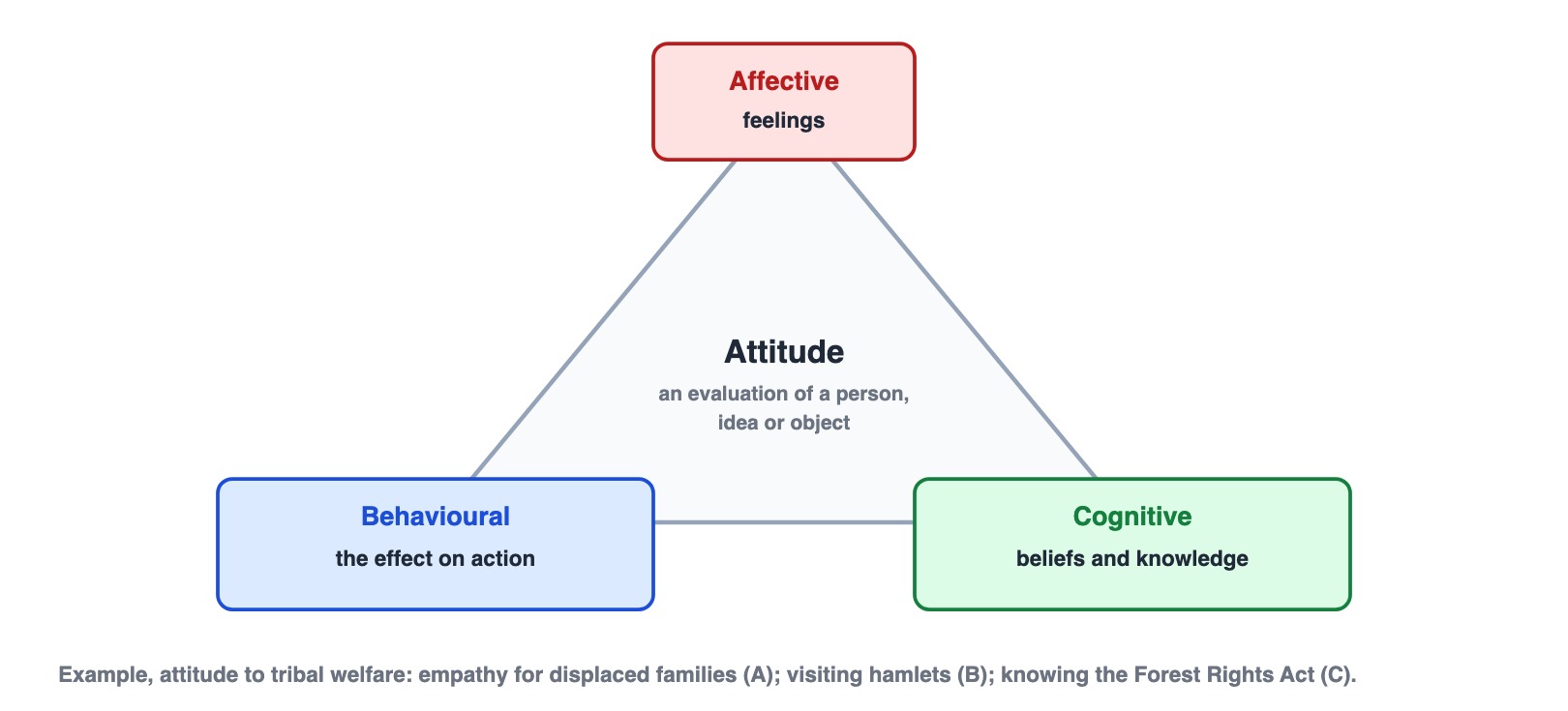
The ABC model of attitude, with the tribal-welfare example from the table.
Functions of attitudes
Quick evaluation: because an attitude is a ready-made evaluation, it lets us judge people and situations fast (useful, but also the root of stereotypes and prejudice).
Guiding behaviour: through its behavioural component, an attitude disposes us to act in a consistent way.
Protecting self-esteem: psychologists find that feeling good about ourselves is a powerful motive, so attitudes often bend to protect our self-image ("the poor are lazy" can shield one from guilt).
Expressing values and identity: an officer's visible commitment to fairness tells others, and himself, who he is.
Attitude, thought and behaviour
Attitudes shape thought and behaviour, but the link runs both ways. Leon Festinger's cognitive dissonance (1957) is psychological discomfort from holding two or more inconsistent attitudes, behaviours or thoughts. We reduce it by changing one of them. An officer who believes in honesty but accepts a "small gift" feels dissonance; either he refuses next time, or he rationalises ("everyone does it"), and the rationalisation slowly changes the attitude. That is how petty corruption corrodes values, and why the first compromise matters most.
Moral and Political Attitudes; the Right Attitude for Public Service
Moral and political attitudes
Moral attitudes | Political attitudes | |
About | Right and wrong: honesty, cruelty, fairness, dignity | Government, parties, ideologies, policies (role of the state, reservation, the market) |
Features | Felt as absolute; tied to identity and conscience; hard to change | Shaped by family, group, region and media; can shift with information and events |
Risk in public service | Imposing private moral views on citizens | Partisanship: loss of neutrality towards governments and citizens |
What the civil servant needs | Firm commitment to constitutional values | Political neutrality, while implementing the elected government's policy faithfully |
Building the right attitude for a public servant (2021, 2022)
Positive, problem-solving attitude: the 2022 question contrasted officers who read the same rules in favour of a genuine case with those who read them against it. The point is not bending rules but using lawful discretion with a citizen-friendly intent: seeking a way to say yes within the law.
How to build it: self-awareness and reflection (catch prejudices); exposure to the people one serves (field visits change the affective component); training and role models (Bandura's modelling, article 02); feedback and reward systems that recognise service; and small consistent commitments, since behaviour, once committed, pulls attitude along with it.
William James (2025): "a human being can alter his life by altering his attitudes". Use it to argue that attitude is the lever for both personal growth and institutional change.
Persuasion and Social Influence
Persuasion
Persuasion is the process of changing an attitude through communication. Public servants persuade all the time: to get villagers to use toilets, parents to vaccinate children, colleagues to adopt a reform.
Model | Key idea | Use in governance |
Yale attitude change approach (Carl Hovland) | Persuasion depends on the source (credibility, trustworthiness, attractiveness), the message and the audience | Use a trusted local doctor or ASHA worker, not a distant official, to promote vaccination |
Elaboration likelihood model (Petty and Cacioppo, 1986) | Central route: logic, data and facts, for an analytical, engaged audience. Peripheral route: cues such as celebrities and emotions, for a less engaged audience | Data for a district planning meeting; a film star and a jingle for a mass sanitation campaign |
Foot-in-the-door | Agreeing to a small request makes people likelier to agree to a larger one, from the wish to stay consistent | Ask a village first to stop open defecation near the school, then everywhere |
Social influence
Conformity (Solomon Asch, 1950s): in a line-judging task, 76% of participants conformed to an obviously wrong majority at least once. Conformity rose with group size up to about seven, and falls when answers are private, which is why elections use a secret ballot.
Two motives: normative social influence, conforming to fit in and be accepted; informational social influence, conforming because we believe the group knows better.
Compliance: going along with a request or demand even when you do not agree.
Obedience (Stanley Milgram, Yale, 1963): prompted by Adolf Eichmann's "I was following orders" defence. About two-thirds (65%) of participants kept giving what they believed were dangerous shocks when an authority told them to. The lesson for civil servants: obedience to a superior is not a moral defence for an unlawful order.
Groupthink (Irving Janis, 1972): members change their views to match what they think the group consensus is, and the group does what no individual would. Remedies: a designated devil's advocate, inviting outside views, the leader speaking last.
Coercion vs undue influence (2023)
Coercion | Undue influence | |
Means | Force or threat of harm (transfer, adverse report, violence) | Misuse of a position of power or trust to dominate another's will, without open threat |
Visibility | Usually open | Subtle; the victim may seem to agree |
Workplace example | A superior threatens a junior with transfer unless a file is cleared | A senior hints that a pending promotion depends on 'cooperation' over a contract |
Ethical problem | Destroys free consent | Corrupts consent while appearing voluntary |
Both violate the autonomy of the person influenced; legitimate persuasion, by contrast, works through reasons the other person can freely accept.
Further Reading
PIB press releases, ministry websites and annual reports, the Gazette of India, MEA and UN documents and the official sources named in each note — the primary sources behind every fact above.
Test Yourself: Practice Questions & PYQs
12 practice questions, then the GS4 questions on attitude.
Practice Questions
Q1. In the three-component (ABC) model, the components of an attitude are
(a) attention, belief and conduct
(b) affective, biological and cultural
(c) affective, behavioural and cognitive
(d) aptitude, behaviour and conscience
Show answer
Answer: (c) — Feelings, the effect on behaviour, and beliefs and knowledge.
Q2. Cognitive dissonance, defined by Leon Festinger, is
(a) agreement with a group
(b) obedience to authority
(c) discomfort from holding inconsistent attitudes, behaviours or beliefs
(d) a route of persuasion
Show answer
Answer: (c) — People reduce it by changing an attitude, a behaviour or a belief.
Q3. In the elaboration likelihood model, the central route to persuasion relies on
(a) celebrity endorsements
(b) fear alone
(c) music and colours
(d) logic, data and facts
Show answer
Answer: (d) — The peripheral route relies on cues such as attractive speakers.
Q4. The Yale attitude change approach is associated with
(a) Daniel Goleman
(b) Stanley Milgram
(c) Solomon Asch
(d) Carl Hovland
Show answer
Answer: (d) — It examined the source, the message and the audience.
Q5. Getting a person to agree to a small request before asking for a larger one is the
(a) groupthink effect
(b) door-in-the-face technique
(c) central route
(d) foot-in-the-door technique
Show answer
Answer: (d) — It works through the desire to remain consistent with past commitments.
Q6. In Asch's conformity experiments, the share of participants who conformed to the wrong majority at least once was about
(a) 25%
(b) 76%
(c) 95%
(d) 50%
Show answer
Answer: (b) — Conformity drops when responses are private, the reason for secret ballots.
Q7. Conforming because one believes the group has better information is
(a) obedience
(b) informational social influence
(c) normative social influence
(d) groupthink
Show answer
Answer: (b) — Normative influence is conforming to fit in and be accepted.
Q8. Milgram's obedience experiments were prompted by
(a) the Watergate scandal
(b) the Bobo doll study
(c) the trial of Adolf Eichmann
(d) the Vietnam War
Show answer
Answer: (c) — About 65% of participants obeyed to the end.
Q9. Going along with a request even when you privately disagree is
(a) persuasion
(b) attitude strength
(c) compliance
(d) internalisation
Show answer
Answer: (c) — Compliance can be a form of conformity.
Q10. Groupthink, a term from Irving Janis, refers to
(a) obedience to a leader's order
(b) a group making better decisions than individuals
(c) social loafing
(d) members aligning their opinions with the perceived group consensus
Show answer
Answer: (d) — A devil's advocate and outside views help prevent it.
Q11. Consider the following statements:
1. Coercion uses force or the threat of harm.
2. Undue influence exploits a position of power or trust.
3. Undue influence is always open and visible.
Which of the statements given above are correct?
(a) 1 and 2 only
(b) 2 and 3 only
(c) 1 and 3 only
(d) 1, 2 and 3
Show answer
Answer: (a) — 1 and 2 are correct. Undue influence is usually subtle, and the victim may appear to agree.
Q12. Asch found that conformity falls when responses are private. Which democratic practice reflects this?
(a) Open voting by show of hands
(b) The secret ballot
(c) Proportional representation
(d) Compulsory voting
Show answer
Answer: (b) — Voting in secret protects voters from being coerced by others.
Mains Practice Questions
Use these to frame full-length answers. You don't have to answer one exactly — they show the angles UPSC tests, so let them guide which points you cover.
How can a suitable attitude be built in a public servant?
Differentiate between coercion and undue influence in the work environment, with examples.
How can persuasion be used ethically to change public behaviour, for example on sanitation or vaccination?
UPSC Mains — Previous Years’ Questions on this topic (last 10 years)
These are the actual GS Mains questions UPSC has asked on this theme — real proof of how, and when, it is tested. Try to write a full answer to each.
2021 (GS-IV): Attitude is an important component that goes as input in the development of human being. How to build a suitable attitude needed for a public servant?
2022 (GS-IV): The Rules and Regulations provided to all the civil servants are same, yet there is difference in the performance. Positive minded officers are able to interpret the Rules and Regulations in favour of the case and achieve success, whereas negative minded officers are unable to achieve goals by interpreting the same Rules and Regulations against the case. Discuss with illustrations.
2023 (GS-IV): In the context of work environment, differentiate between 'coercion' and 'undue influence' with suitable examples.
2025 (GS-IV): "The greatest discovery of my generation is that a human being can alter his life by altering his attitudes." (William James) One of three quotations; what does it convey to you in the present context?