Ethics in Public Administration for UPSC GS4: Status and Problems, Ethical Dilemmas, Laws vs Conscience, Constitutional Morality and AI in Decisions
Status and Problems of Ethics in Administration
🎯 Exam priority: High-yield (Mains GS4). This syllabus line drew at least ten questions in 2021-2026: conscience vs laws (2023), form vs substance (2024), constitutional morality (2025), reason and critical thinking (2025), AI and digital technology in decision-making (2021, 2024), creativity in dilemmas (2021), core vs periphery (2022), a forest community facing displacement and remote schools that break the rules (2026).
Status and problems: why ethics in Indian administration is hard
The 2nd ARC names three aggravating factors, worth quoting as a set:
Colonial legacy of unchallenged authority and arbitrary use of power: "in a society which worships power, it is easy for public officials to deviate".
Asymmetry of power: nearly 90% of people work in the unorganised sector, while nearly 70% of organised, secure jobs are with the state; even junior officials are better off and more powerful than most citizens, which weakens social pressure to behave ethically.
Policy choices after Independence: over-regulation, state control, near-monopolies and an economy of scarcity put citizens at the state's mercy, turning "the public servant into patron and master" and citizens "into mendicants".
It adds over-centralisation: the more remotely power is exercised, the greater the distance between authority and accountability. Other familiar problems: red tape, rigid rule-following, politicisation, nepotism, delay, poor grievance redress and low public trust.
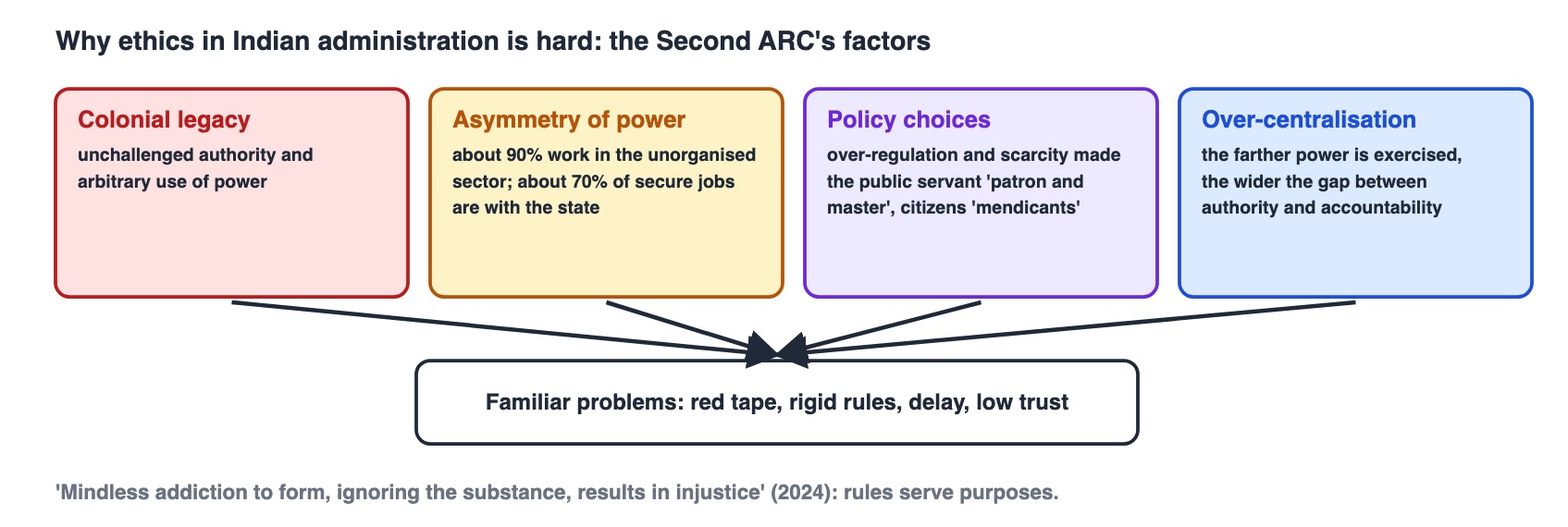
The Second ARC's factors that make ethics in Indian administration hard.
Form vs substance (2024)
"Mindless addiction to form, ignoring the substance, results in injustice." Rules exist to serve purposes; when an officer rejects a pension because a form was signed in the wrong ink, the form defeats the purpose. A perceptive civil servant reads the intent of a rule. The limit: substance cannot become an excuse for ignoring procedure that protects rights (notice, hearing, transparency). The 2022 question makes the same point: wisdom lies in knowing what to reckon with and what to overlook, so an officer lost in peripheral details neglects the core issue.
Ethical Dilemmas and How to Work Through Them
Ethical dilemmas in government and private institutions
A dilemma is a choice between two or more obligations that cannot all be met. Common types:
Dilemma | Example |
Rules vs compassion | Remote schools that miss norms but are the only schools (2026) |
Development vs rights and environment | A business project that would displace a forest community (2026) |
Loyalty to superiors vs public interest | An oral order to favour a contractor |
Transparency vs confidentiality | RTI request touching national security or privacy |
Efficiency vs equity | Fast-tracking projects vs consulting affected people |
Personal vs professional | A relative's application in your office |
Profit vs safety (private sector) | A company hiding a product defect; an employee deciding whether to blow the whistle |
Working through a dilemma
Facts and stakeholders: who is affected, and how badly?
Law and rules: what do the Constitution, statutes and rules require? Is there lawful discretion?
Values in conflict: name them (equity vs efficiency).
Options: look for a creative third option that honours more than one value (2021: innovativeness and creativity in resolving dilemmas).
Test the choice: would it survive publicity? Does it treat people as ends? Does it help the least advantaged?
The 2026 schools question: closing non-compliant schools would enforce the rules but deny children education. Better: a time-bound compliance plan with support (grants, teacher training, shared facilities); strict, non-negotiable enforcement only on safety; and help from the state to upgrade. The forest community question: the challenges are informed consent of the community, fair compensation and rehabilitation, protection of forest rights and culture, environmental harm, and pressure from the business house and politicians. The officer's duty is to the law and the affected people, not to the project's timeline.
Sources of Guidance: Law, Rules, Conscience, Constitutional Morality
Laws, rules, regulations and conscience as sources of guidance
Source | Strength | Limit |
Constitution and laws | Democratic legitimacy; binding on all; predictable | Cannot foresee every situation; may lag behind change |
Rules and regulations | Detailed, uniform, protect against arbitrariness | Rigid; can become form without substance |
Codes of conduct and ethics | Shared professional standards (article 13) | Often unenforced |
Conscience | Inner moral sense; works where rules are silent; resists unjust orders | Subjective; can be mistaken, biased or self-serving |
Is conscience more reliable than law (2023)? Neither alone. The ARC notes that no system of laws, however elaborate, can provide for all situations, so conscience is indispensable where discretion is wide. But conscience is personal and can be wrong, while law carries democratic consent. The AIS Conduct Rules capture the balance: an officer must act in his own best judgment to be true and correct, except under a superior's direction (which should be in writing). Best answer: law sets the boundary, conscience guides choices within it, and when conscience and law clash, a public servant should use legal channels (record dissent, seek written orders, refer upward) rather than private defiance.
Constitutional morality (2025)
Ambedkar, citing the historian Grote, told the Constituent Assembly on 4 November 1948: "Constitutional morality is not a natural sentiment. It has to be cultivated. We must realize that our people have yet to learn it." He warned that the Constitution could be perverted without changing its form, merely by changing the form of administration, and that democracy in India was "only a top-dressing on an Indian soil, which is essentially undemocratic".
For a public servant, constitutional morality means loyalty to the Constitution's values (liberty, equality, fraternity, dignity, the rule of law, the rights of minorities) above personal, party or majority preference; respect for institutions and due process; and restraint in the use of power. It promotes good governance by making decisions principled and predictable, and protects citizens' rights against both the powerful and the passions of the moment.
Reason, critical thinking and AI in decisions (2021, 2024, 2025)
Reason and critical thinking keep welfare schemes honest: checking evidence, questioning assumptions, testing who is left out (2025).
Digital technology and AI can speed decisions and cut discretion, but raise concerns: privacy, misuse of massive data, cyber-risk and job loss. Philosophers such as John Searle note that machines lack human intentionality, so they cannot carry moral responsibility. Ethical use: a human remains accountable, decisions are explainable and open to appeal, data is protected, and systems are checked for bias against the poor and marginalised.
Further Reading
PIB press releases, ministry websites and annual reports, the Gazette of India, MEA and UN documents and the official sources named in each note — the primary sources behind every fact above.
Test Yourself: Practice Questions & PYQs
12 practice questions, then the GS4 questions on ethics in public administration.
Practice Questions
Q1. Which is NOT one of the three aggravating factors for corruption named by the 2nd ARC?
(a) Excessive judicial activism
(b) A colonial legacy of unchallenged authority
(c) Asymmetry of power in society
(d) Post-Independence policies of over-regulation and state control
Show answer
Answer: (a) — It also names over-centralisation as a factor increasing corruption.
Q2. According to the 2nd ARC, nearly what share of Indians work in the unorganised sector?
(a) 50%
(b) 90%
(c) 30%
(d) 70%
Show answer
Answer: (b) — Nearly 70% of organised, secure jobs are with the state.
Q3. The ARC says over-centralisation increases corruption because
(a) it widens the distance between authority and accountability
(b) it reduces the number of rules
(c) it empowers local government
(d) it increases competition
Show answer
Answer: (a) — Power exercised remotely is hard for citizens to hold to account.
Q4. Which of these does the ARC list as instruments of accountability?
(a) Secret rules
(b) RTI, citizens' charters and social auditing
(c) Press censorship
(d) Lifetime tenure for all posts
Show answer
Answer: (b) — Along with public consultation and stakeholder involvement.
Q5. 'Constitutional morality is not a natural sentiment. It has to be cultivated' was said by
(a) Sardar Patel
(b) B.R. Ambedkar
(c) Mahatma Gandhi
(d) Jawaharlal Nehru
Show answer
Answer: (b) — In the Constituent Assembly on 4 November 1948, citing Grote.
Q6. Ambedkar warned that the Constitution could be perverted without changing its form by
(a) dissolving Parliament
(b) abolishing elections
(c) changing the form of administration
(d) amending the Preamble
Show answer
Answer: (c) — Hence administrative details were written into the Constitution.
Q7. Under the AIS Conduct Rules, an officer must act in his own best judgment except when
(a) the public objects
(b) acting under the direction of his official superior
(c) the matter is urgent
(d) a minister is present
Show answer
Answer: (b) — Such directions should ordinarily be in writing.
Q8. Consider the following statements:
1. Conscience works where rules are silent.
2. Conscience can be mistaken or biased.
3. Conscience overrides the law for public servants in every case.
Which of the statements given above are correct?
(a) 1 and 2 only
(b) 2 and 3 only
(c) 1 and 3 only
(d) 1, 2 and 3
Show answer
Answer: (a) — 1 and 2 are correct. A public servant should resolve conflicts through legal channels such as written orders and recorded dissent.
Q9. Rejecting a valid pension claim for a minor procedural flaw illustrates
(a) constitutional morality
(b) form over substance
(c) probity
(d) social audit
Show answer
Answer: (b) — A 2024 GS4 question asked about this.
Q10. Why can an AI system not carry moral responsibility for an administrative decision, according to philosophers such as John Searle?
(a) It is illegal
(b) It lacks human intentionality
(c) It is too slow
(d) It is always wrong
Show answer
Answer: (b) — A human must remain accountable.
Q11. Which concerns about AI were listed by industry leaders in the Pew survey cited by OpenStax?
(a) Only high cost
(b) Privacy, misuse of data, cyber-risk and job loss
(c) Only slowness
(d) Only lack of electricity
Show answer
Answer: (b) — Bostrom adds the risk of superintelligence not aligned with human values.
Q12. The best way to handle a clash between conscience and an order from a superior is to
(a) seek a written order, record dissent and use legal channels
(b) leak the file to the press
(c) ignore the order without telling anyone
(d) obey silently
Show answer
Answer: (a) — This preserves both integrity and the rule of law.
Mains Practice Questions
Use these to frame full-length answers. You don't have to answer one exactly — they show the angles UPSC tests, so let them guide which points you cover.
Is conscience a more reliable guide than laws, rules and regulations in ethical decision-making?
Examine the significance of constitutional morality for a public servant.
How should an administrator balance strict enforcement of rules with the rights of citizens? Illustrate.
UPSC Mains — Previous Years’ Questions on this topic (last 10 years)
These are the actual GS Mains questions UPSC has asked on this theme — real proof of how, and when, it is tested. Try to write a full answer to each.
2021 (GS-IV): Impact of digital technology as reliable source of input for rational decision making is a debatable issue. Critically evaluate with suitable example.
2021 (GS-IV): Besides domain knowledge, a public official needs innovativeness and creativity of a high order as well, while resolving ethical dilemmas. Discuss with suitable example.
2022 (GS-IV): Wisdom lies in knowing what to reckon with and what to overlook. An officer being engrossed with the periphery, ignoring the core issues before him, is not rare in the bureaucracy. Do you agree that such preoccupation of an administrator leads to travesty of justice to the cause of effective service delivery and good governance? Critically evaluate.
2023 (GS-IV): Is conscience a more reliable guide when compared to laws, rules and regulations in the context of ethical decision-making? Discuss.
2024 (GS-IV): The application of Artificial Intelligence as a dependable source of input for administrative rational decision-making is a debatable issue. Critically examine the statement from the ethical point of view.
2024 (GS-IV): "Mindless addiction to Form, ignoring the Substance of the matter, results in rendering of injustice. A perceptive civil servant is one who ignores such literalness and carries out true intent." Examine the above statement with suitable illustrations.
2025 (GS-IV): "Constitutional morality is not a natural sentiment but a product of civil education and adherence of the rule of law." Examine the significance of constitutional morality for public servants.
2025 (GS-IV): "For any kind of social re-engineering by successfully implementing welfare schemes, a civil servant must use reason and critical thinking in an ethical framework." Justify this statement with suitable examples.
2026 (GS-IV): A business house is working on a project that could displace a forest community from their habitat. As the administrative officer of that district, what ethical challenges are you likely to face?
2026 (GS-IV): Usually schools working in remote areas do not fully comply with government regulations. However, if the rules are enforced strictly, it would lead to most schools closing down. How should an administrator strike a balance between enforcement of rules and educational rights of children?