Western Moral Thinkers for UPSC GS4: Socrates, Plato, Aristotle, Utilitarianism, Kant, Rawls, Care Ethics and the Principles of Bioethics
The Greeks and the Three Families of Theory
🎯 Exam priority: High-yield (Mains GS4). "Contributions of moral thinkers and philosophers from India and world" is a syllabus line, and the theories behind them are the toolkit for every case study. Western thinkers appeared directly in 2024 (Kant's quotation; whether justice is contextual) and 2026 (Shakespeare on intent; paternalism and beneficence; testing an unproven remedy on a tribe; duty versus charity).
The Greeks: knowledge, the good life and virtue
Thinker | Key idea | Use in a GS4 answer |
Socrates | "The unexamined life is not worth living"; the Socratic method of questioning; being aware of what one does not know | Self-examination before judging others; humility in decision-making |
Plato | The Allegory of the Cave (Republic, Book VII): prisoners mistake shadows for reality; education turns the soul towards truth | Officials must look past appearances, rumours and file-notings to the real situation |
Aristotle | Virtue is the mean between excess and deficiency (courage lies between cowardice and rashness); virtue leads to flourishing (eudaimonia); we are 'made perfect by habit' | Ethics is practised, not just known; the right amount of firmness and compassion |
Three families of normative theory
Theory | Test of right action | Thinkers | Strength / weakness |
Consequentialism (utilitarianism) | The action that produces the greatest happiness for the greatest number | Jeremy Bentham; John Stuart Mill (and, in ancient China, Mozi) | Fits policy cost-benefit analysis / can sacrifice minorities for the majority |
Deontology | Duty and rules that bind every rational being, whatever the outcome | Immanuel Kant; W.D. Ross | Protects rights and dignity / rigid when duties clash |
Virtue ethics | What a person of good character would do; right action flows from right character | Aristotle; Confucius | Builds character / gives less precise guidance in a hard case |
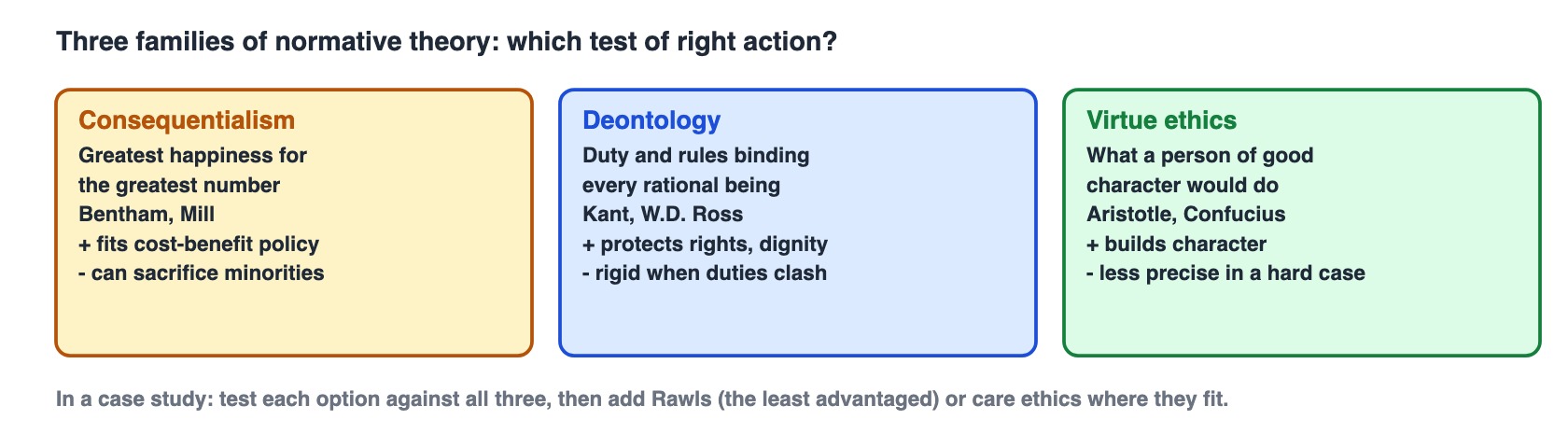
Three tests of right action. In a case study, run each option through all three.
Kant, Intent, Rawls and Care Ethics
Immanuel Kant
Categorical imperative, a rule binding on every rational being, unlike a hypothetical imperative ("if you want X, do Y"). Two formulations: universal law, act only on a rule you could will to become a universal law (a lie to get a discount fails, because if everyone lied, no one would be believed); and humanity, treat humanity, in yourself and others, always as an end and never merely as a means.
The 2024 quotation: "In law, a man is guilty when he violates the rights of others. In ethics, he is guilty if he only thinks of doing so." Kant locates morality in the will and intention, not just the act. An officer who plans to favour a relative but is stopped has acted lawfully but not ethically.
W.D. Ross's refinement: duties are not absolute but prima facie, binding "other things being equal". When duties clash (truthfulness and preventing harm), we must weigh them, which is exactly what a case study asks.
Intent and outcome (2026: Shakespeare)
"The arms are fair when the intent of bearing them is just" (Henry IV) puts the deontological emphasis on intent. Kant would agree that a just intention is necessary; a utilitarian would add that results also matter. In governance, use of force by the police is legitimate only when the intent is to protect, the means are proportionate and the law is followed. A good answer shows that intent is necessary but not sufficient.
John Rawls: justice as fairness
In A Theory of Justice, Rawls asks us to choose society's rules from an original position behind a veil of ignorance, not knowing our own gender, caste, class or talents. We would then choose two principles: the liberty principle (equal basic liberties for all) and the difference principle (inequalities are allowed only if attached to positions open to all under fair equality of opportunity, and only if they benefit the least advantaged most). This is the philosophical case for reservations, progressive taxes and targeted welfare, and the frame for the 2024 question on whether justice is contextual: principles stay fixed, but what helps the least advantaged changes with circumstances.
Care ethics
Built on Carol Gilligan's work, the ethics of care values relationships and the concrete needs of particular people over abstract rules; feminist critics say traditional theories ignored women and the vulnerable. It is a reminder that a "correct" decision delivered without care can still fail the citizen.
Bioethics, Paternalism and Duty vs Charity
Applied ethics: the four principles of bioethics
Principle | Meaning | Example |
Autonomy | The patient's right to decide about her own care; protected by informed consent (being given all relevant information to decide) | A woman chooses medication over surgery |
Beneficence | Act for the good of others | A doctor recommends the treatment with the best outcome |
Non-maleficence | Do not cause unnecessary harm | No untested drug when a safe one exists |
Justice | Fair, equitable distribution and treatment; similar cases treated alike | Rare drugs allotted by need, not influence |
Paternalism vs beneficence (2026)
Paternalism means overriding a person's choice for what someone else judges to be her own good. In the 2026 case, a doctor convinced a woman's family to push her into surgery when she preferred medication. The doctor acted from beneficence (he believed surgery was better), but he bypassed her autonomy: consent obtained through family pressure is not informed, free consent. Ethical practice is to give the patient full information and time, and then respect her decision.
The tribe and the untested supplement (2026)
A District Magistrate is told a mineral supplement might cure a tribe's severe skeletal deformity, but clinical trials have not been done. Apply the principles: non-maleficence (unknown side effects); autonomy (informed consent in the community's language, free of pressure, which is hard because vulnerable groups are especially exposed to coercion); justice (a marginalised tribe must not become a test population; the Tuskegee syphilis study of 1932-1972 is the classic warning); and beneficence (the suffering is real). The ethical course: do not administer it on the DM's own authority; press the health authorities and research bodies for a properly approved, fast-tracked trial with consent and monitoring, while giving the community all existing relief.
Duty or charity? (2026)
The claim that helping those who badly suffer, when it costs us little, is a duty and not mere charity rests on utilitarian impartiality: the suffering of a distant stranger counts as much as that of a neighbour, and if we can prevent great harm at small cost, failing to do so is wrong. Charity is optional and praised; duty is owed, and its neglect deserves blame. Kant's humanity formula supports the same conclusion from respect for persons. In public life it underlies redistributive taxation, disaster relief and foreign aid.
Further Reading
PIB press releases, ministry websites and annual reports, the Gazette of India, MEA and UN documents and the official sources named in each note — the primary sources behind every fact above.
Test Yourself: Practice Questions & PYQs
12 practice questions, then the GS4 questions on Western thinkers and theories.
Practice Questions
Q1. "The unexamined life is not worth living" is attributed to
(a) Kant
(b) Bentham
(c) Aristotle
(d) Socrates
Show answer
Answer: (d) — Plato records it in the Apology.
Q2. For Aristotle, courage is the mean between
(a) fear and anger
(b) justice and mercy
(c) pride and humility
(d) cowardice and rashness
Show answer
Answer: (d) — Virtue is the mean between deficiency and excess.
Q3. The 'greatest happiness for the greatest number' is the principle of
(a) deontology
(b) utilitarianism
(c) virtue ethics
(d) care ethics
Show answer
Answer: (b) — Developed by Bentham and modified by Mill.
Q4. Kant's rule 'act only on a maxim you could will to become a universal law' is a
(a) difference principle
(b) prima facie duty
(c) hypothetical imperative
(d) categorical imperative
Show answer
Answer: (d) — A hypothetical imperative is an action taken to achieve a specific goal.
Q5. Kant's humanity formulation says we must treat persons
(a) according to their usefulness
(b) always as ends, never merely as means
(c) according to their virtue
(d) as means to the greatest happiness
Show answer
Answer: (b) — It grounds respect for human dignity.
Q6. W.D. Ross held that moral duties are
(a) absolute in every case
(b) prima facie: binding other things being equal
(c) only legal obligations
(d) irrelevant to ethics
Show answer
Answer: (b) — Ross thought single-principle theories over-simplify moral life.
Q7. Rawls's 'veil of ignorance' asks us to choose principles of justice
(a) based on our talents
(b) as the state decides
(c) according to majority vote
(d) without knowing our own position in society
Show answer
Answer: (d) — From this original position he derives the liberty and difference principles.
Q8. Rawls's difference principle allows inequalities only if they
(a) are approved by the market
(b) are temporary
(c) reward the talented
(d) benefit the least advantaged most
Show answer
Answer: (d) — And are attached to positions open to all under fair equality of opportunity.
Q9. Consider the following statements:
1. Autonomy is one of the four principles of bioethics.
2. Non-maleficence means not causing unnecessary harm.
3. Paternalism always respects autonomy.
Which of the statements given above are correct?
(a) 1 and 2 only
(b) 2 and 3 only
(c) 1 and 3 only
(d) 1, 2 and 3
Show answer
Answer: (a) — 1 and 2 are correct. Paternalism overrides a person's choice for her supposed good.
Q10. Informed consent protects mainly the principle of
(a) beneficence
(b) justice
(c) utility
(d) autonomy
Show answer
Answer: (d) — It means giving all relevant information so the person can decide.
Q11. The ethics of care developed from the research of
(a) John Rawls
(b) Socrates
(c) Carol Gilligan
(d) Jeremy Bentham
Show answer
Answer: (c) — It values relationships and concrete needs over abstract rules.
Q12. Which study is the classic warning against exploiting marginalised people in medical research?
(a) The Tuskegee syphilis study
(b) The Asch experiment
(c) The Heinz dilemma
(d) The Bobo doll study
Show answer
Answer: (a) — It ran from 1932 to 1972.
Mains Practice Questions
Use these to frame full-length answers. You don't have to answer one exactly — they show the angles UPSC tests, so let them guide which points you cover.
Compare utilitarian and Kantian approaches to a decision on acquiring land for a public project.
Explain Rawls's theory of justice and its relevance to affirmative action in India.
Explain paternalism and beneficence with an example from public health.
UPSC Mains — Previous Years’ Questions on this topic (last 10 years)
These are the actual GS Mains questions UPSC has asked on this theme — real proof of how, and when, it is tested. Try to write a full answer to each.
2024 (GS-IV): "In law, a man is guilty when he violates the rights of others. In ethics, he is guilty if he only thinks of doing so." (Immanuel Kant) One of three quotations; what does it convey to you in the present context?
2024 (GS-IV): "The concept of Just and Unjust is contextual. What was just a year back, may turn out to be unjust in today's context. Changing context should be constantly under scrutiny to prevent miscarriage of justice." Examine the above statement with suitable examples.
2026 (GS-IV): An endangered tribe has developed a severe skeletal deformity. A university research has identified a mineral supplement as a possible remedy, though clinical trials are yet to be conducted. Should the District Magistrate (DM) use this research on the tribe? Discuss from the perspective of medical and administrative ethics.
2026 (GS-IV): Shakespeare in Henry IV says, "The arms are fair when the intent of bearing them is just". What ethical implications does this have in governance?
2026 (GS-IV): A doctor convinces the family of a female patient for surgery though her original choice was medication. Explain the concepts of paternalism and beneficence by analysing the doctor's action.
2026 (GS-IV): Some moral philosophers argue that spending some of your resources, without significantly affecting your financial stability, to help other people who badly suffer is our moral duty and not merely a matter of charity. Justify this claim by explaining the distinction between duty and charity.