Emotional Intelligence for UPSC GS4: Salovey and Mayer's Definition, Components, Uses in Administration, Crisis of Conscience and EQ vs IQ
What Emotional Intelligence Is
🎯 Exam priority: Important (Mains GS4). Asked in 2021 (does emotional intelligence help in a crisis of conscience without compromising one's moral stand?) and 2023 (is EQ more important than IQ for success, character and happiness?). It also runs through case studies: almost every Section B case has an angry crowd, a grieving family or a hostile boss.
What emotional intelligence is
The first formal framework for emotional intelligence was set out by Peter Salovey and John Mayer in 1990. Their definition, worth quoting in the exam: emotional intelligence is the subset of social intelligence that involves the ability to monitor one's own and others' feelings and emotions, to discriminate among them, and to use this information to guide one's thinking and actions. They placed it within Howard Gardner's personal intelligences (intrapersonal: understanding oneself; interpersonal: understanding others).
Daniel Goleman's 1995 book Emotional Intelligence: Why It Can Matter More than IQ popularised the idea, arguing that EI predicts success better than traditional intelligence. Psychologists still debate this: critics point to inconsistent definitions and the difficulty of measuring EI. A balanced answer mentions both.
The original framework: three branches
Branch (Salovey and Mayer) | What it covers | Administrative example |
Appraisal and expression of emotion | Recognising and expressing feelings accurately, in oneself and in others, including non-verbal cues | Reading fear behind a protester's anger |
Regulation of emotion | Managing one's own moods (keeping or repairing them) and influencing others' emotions | Staying calm under a minister's pressure; calming a crowd |
Utilisation of emotion | Using feelings for flexible planning, creative thinking, redirecting attention and motivation | Using concern for flood victims to drive a faster relief plan |
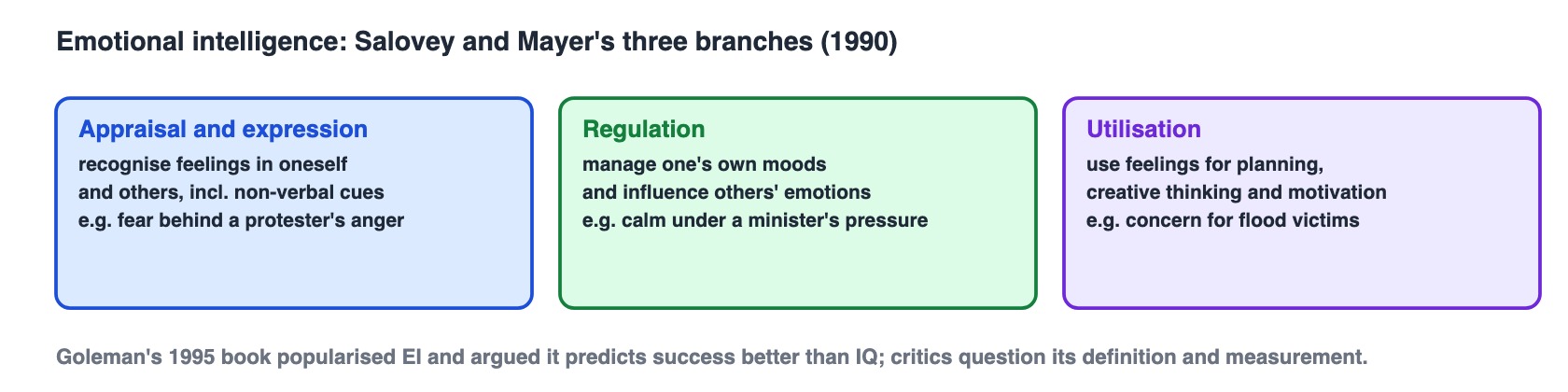
Salovey and Mayer's three branches of emotional intelligence, with an administrative example for each.
Five practical components
Psychology textbooks describe EI as the ability to understand one's own and others' emotions, show empathy, understand social relationships and cues, and regulate one's own emotions. For answers, arrange this as five components:
Self-awareness: knowing what you feel and why (noticing that irritation with a petitioner comes from fatigue, not from the case).
Self-regulation: controlling impulses and moods; not reacting in anger.
Motivation: using feelings to drive goals and persist through setbacks.
Empathy: sensing others' feelings and perspectives.
Social skills: handling relationships: communication, conflict resolution, teamwork. People with high EI typically have well-developed social skills.
Uses in Administration and a Crisis of Conscience
Utility in administration and governance
Area | How EI helps |
Crisis and disaster management | A calm leader prevents panic; empathy helps prioritise the most vulnerable; communication keeps rumours down |
Law and order | Reading a crowd's mood, negotiating with protesters, de-escalating before force is needed |
Public grievances and service delivery | Patient listening makes citizens feel respected; complaints are resolved rather than bounced |
Leading teams | Motivating demoralised staff, resolving internal conflicts, giving feedback without humiliation |
Political executive and stakeholders | Disagreeing with a minister respectfully and firmly; building coalitions for reform |
Personal well-being | Managing stress and avoiding burnout in long, high-pressure postings |
Ethical conduct | Recognising the emotions (greed, fear, loyalty) that pull towards a wrong decision |
EI and a crisis of conscience (2021)
A crisis of conscience arises when duty, loyalty or pressure pull one way and moral conviction the other: a superior orders an unfair transfer, or a colleague's family emergency tempts you to bend rules. EI helps in four steps:
Recognise the emotions in play (fear of the superior, sympathy for the colleague) so they do not decide the issue unnoticed.
Regulate them, creating space for reasoned judgment instead of a reflex.
Empathise with every stakeholder, which often reveals a third option: help the colleague through legitimate means, or put the superior's order on record and ask for it in writing.
Communicate the decision firmly and respectfully, preserving relationships without giving up the principle.
EI in the case studies
Section B cases test EI without naming it. In the 2023 case, a close colleague at a nationalised bank, widowed and from a lower-middle-class family, needs about Rs 10 lakh for her uninsured father's heart surgery. Weeks later she confides that the bank manager quietly released the money from someone's dormant account, and that she is repaying it. A low-EI answer either reports her coldly or keeps the secret out of sympathy. A high-EI answer acknowledges her distress and good faith, but recognises that a depositor's money was misused and the manager broke the rules. It encourages her to come forward herself, reports the manager's act through the proper channel, and backs her case for leniency and for legitimate help such as a staff loan. Examiners reward this combination of warmth and firmness.
The answer to "without compromising the moral stand" is yes, with a caution: EI is a skill, not a value. It can be used to manipulate (a skilled con artist has high EI). It helps a crisis of conscience only when it serves integrity; it does not replace it.
EQ vs IQ and Building EI
EQ vs IQ (2023)
IQ (cognitive intelligence) | EQ (emotional intelligence) | |
Measures | Reasoning, memory, verbal and numerical ability | Understanding and managing one's own and others' emotions |
Gets you | Through the examination and into the job | Through people, conflict and crisis on the job |
Risk if alone | Clever but tactless, rigid or arrogant | Likeable but without competence or values |
How to answer: agree that emotional skills matter greatly for character, relationships, leadership and happiness, and cite Goleman's argument. Then qualify: the evidence on EI is debated, IQ and domain knowledge remain essential for complex administrative work, and neither replaces values. Conclude that a civil servant needs all three: IQ to understand the problem, EQ to work with people, and integrity to choose the right end.
Developing EI in the civil service
Reflection and journalling; feedback from peers and subordinates (360-degree appraisal).
Training in communication, negotiation and stress management, now part of competency-based capacity building (article 09 covers Mission Karmayogi).
Field exposure that builds empathy; mentoring by emotionally mature seniors (Bandura's modelling again).
Mindfulness and well-being practices for officers in high-stress postings.
Further Reading
PIB press releases, ministry websites and annual reports, the Gazette of India, MEA and UN documents and the official sources named in each note — the primary sources behind every fact above.
Test Yourself: Practice Questions & PYQs
12 practice questions, then the GS4 questions on emotional intelligence.
Practice Questions
Q1. The first formal framework for emotional intelligence was set out in a 1990 article by
(a) Leon Festinger
(b) Peter Salovey and John Mayer
(c) Howard Gardner
(d) Daniel Goleman
Show answer
Answer: (b) — Goleman popularised it in his 1995 book.
Q2. Salovey and Mayer define emotional intelligence as a subset of
(a) logical-mathematical intelligence
(b) spatial intelligence
(c) social intelligence
(d) crystallised intelligence
Show answer
Answer: (c) — It involves monitoring and discriminating feelings and using them to guide thinking and action.
Q3. Goleman's 1995 book argued that emotional intelligence
(a) is identical to IQ
(b) cannot be measured at all
(c) is fixed at birth
(d) can matter more than IQ
Show answer
Answer: (d) — Its title: Emotional Intelligence: Why It Can Matter More than IQ.
Q4. Emotional intelligence is often described as combining Gardner's
(a) musical and spatial intelligences
(b) interpersonal and intrapersonal intelligences
(c) linguistic and logical intelligences
(d) naturalist and bodily intelligences
Show answer
Answer: (b) — Gardner called these the personal intelligences.
Q5. Consider the following statements:
1. Salovey and Mayer's framework includes the appraisal and expression of emotion.
2. It includes the regulation of emotion in self and others.
3. It excludes using emotions to plan and motivate.
Which of the statements given above are correct?
(a) 1 and 2 only
(b) 2 and 3 only
(c) 1 and 3 only
(d) 1, 2 and 3
Show answer
Answer: (a) — 1 and 2 are correct. The third branch is the utilisation of emotion, including flexible planning and motivation.
Q6. An officer who notices that her irritation with a petitioner comes from fatigue is showing
(a) self-awareness
(b) social skill
(c) groupthink
(d) obedience
Show answer
Answer: (a) — Recognising one's own emotions and their causes is the base of EI.
Q7. Calming an agitated crowd before force is needed mainly uses
(a) the foot-in-the-door technique
(b) regulation of others' emotions and social skills
(c) cognitive dissonance
(d) IQ alone
Show answer
Answer: (b) — Salovey and Mayer include regulating emotion in others.
Q8. Which is a valid criticism of emotional intelligence research?
(a) It ignores emotions
(b) It was invented by Kohlberg
(c) It applies only to children
(d) Inconsistent definitions and difficulty of measurement
Show answer
Answer: (d) — A balanced answer notes the debate.
Q9. Why is emotional intelligence 'a skill, not a value'?
(a) It is learned only in school
(b) It cannot be improved
(c) It can be used to manipulate as well as to help
(d) It is the same as integrity
Show answer
Answer: (c) — EI serves ethics only when guided by integrity.
Q10. In a crisis of conscience, the first step EI offers is to
(a) obey the superior immediately
(b) recognise the emotions pulling on the decision
(c) resign at once
(d) avoid all stakeholders
Show answer
Answer: (b) — Then regulate them, empathise with stakeholders and communicate firmly.
Q11. Who popularised the idea that emotional intelligence predicts success better than IQ?
(a) Stanley Milgram
(b) Daniel Goleman
(c) Carl Hovland
(d) John Rawls
Show answer
Answer: (b) — His 1995 book made EI widely known; researchers still debate the claim.
Q12. 'Mood repair' in Salovey and Mayer's framework belongs to
(a) appraisal of emotion
(b) IQ
(c) persuasion
(d) regulation of emotion
Show answer
Answer: (d) — Mood maintenance and mood repair are forms of self-regulation.
Mains Practice Questions
Use these to frame full-length answers. You don't have to answer one exactly — they show the angles UPSC tests, so let them guide which points you cover.
In a crisis of conscience, does emotional intelligence help without compromising one's ethical stand?
Is EQ more important than IQ for success and character? Argue both sides.
How can emotional intelligence improve crisis management and service delivery?
UPSC Mains — Previous Years’ Questions on this topic (last 10 years)
These are the actual GS Mains questions UPSC has asked on this theme — real proof of how, and when, it is tested. Try to write a full answer to each.
2021 (GS-IV): In case of crisis of conscience does emotional intelligence help to overcome the same without compromising the ethical or moral stand that you are likely to follow? Critically examine.
2023 (GS-IV): "What really matters for success, character, happiness and lifelong achievements is a definite set of emotional skills, your EQ, not just purely cognitive abilities that are measured by conventional IQ tests." Do you agree with this view? Give reasons in support of your answer.